
Daily Updates
Approximately 13 million metric tons of rare earth elements (REE) exist within known deposits in the United States, according to the first-ever nationwide estimate of these elements by the U.S. Geological Survey.
The report describes significant deposits of REE in 14 states, with the largest known REE deposits at Mountain Pass, Calif.; Bokan Mountain, Alaska; and the Bear Lodge Mountains, Wyo. The Mountain Pass mine produced REE until it closed in 2002. Additional states with known REE deposits include Colorado, Florida, Georgia, Idaho, Illinois, Missouri, Nebraska, New Mexico, New York, North Carolina, and South Carolina.
“This is the first detailed assessment of rare earth elements for the entire nation, describing deposits throughout the United States,” commented USGS Director Marcia McNutt, Ph.D. “It will be very important, both to policy-makers and industry, and it reinforces the value of our efforts to maintain accurate, independent information on our nation’s natural resources. Although many of these deposits have yet to be proven, at recent domestic consumption rates of about 10,000 metric tons annually, the US deposits have the potential to meet our needs for years to come.”
REE are a group of 16 metallic elements with similar properties and structures that are essential in the manufacture of a diverse and expanding array of high-technology applications. Despite their name, they are relatively common within the earth’s crust, but because of their geochemical properties, they are not often found in economically exploitable concentrations.
Hard-rock deposits yield the most economically exploitable concentrations of REE. USGS researchers also analyzed two other types of REE deposits: placer and phosphorite deposits. Placer deposits are alluvial formations of sandy sediments, which often contain concentrations of heavy, dense minerals, some containing REE. Phosphorite deposits, which mostly occur in the southeastern U.S., contain large amounts of phosphate-bearing minerals. These phosphates can yield yttrium and lanthanum, which are also REE.
Ninety-six percent of REE produced globally now comes from China. New REE mines are being developed in Australia, and projects exploring the feasibility of economically developing additional REE deposits are under way in the United States, Australia, and Canada; successful completion of these projects could help meet increasing demand for REE, the report said.
REE are important ingredients in high-strength magnets, metal alloys for batteries and light-weight structures, and phosphors. These are essential components for many current and emerging alternative energy technologies, such as electric vehicles, photo-voltaic cells, energy-efficient lighting, and wind power. REEs are also critical for a number of key defense applications.
This report is part of a larger, Department of Defense-funded study of how the United States, and the Department of Defense in particular, use REE, as well as the status and security of domestic and global supply chains. In addition, the USGS National Minerals Information Center maintains statistics on global mineral production, trade, and resources that include rare earth elements.
The new USGS report, which provides an overview of domestic REE resources and possibilities for utilizing those resources, is available online. To learn more about REE, please visit the National Minerals Information Center’s REE webpage.
Adapted from materials provided by U.S. Geological Survey
BIG PICTURE – Lets face it, governments always try to ‘kick the can down the road’. Rather than deal with economic issues in the here and now, they prefer to postpone the pain. Unfortunately, in their attempt to avoid painful economic recessions, the policymakers sacrifice the purchasing power of their currencies and they end up creating even bigger troubles for the future.
Look. The ‘Great Recession’ in the developed world was brought about by excessive debt and consumption. In the boom years, millions of Americans borrowed copious amounts of money to buy real-estate; they used their homes as a source of funding (home equity withdrawals) and spent way beyond their means. In those heady days, everyone was convinced that real-estate prices could not decline on a country wide basis. Unsurprisingly, the bankers gladly supported this misconception by providing cheap fuel to the raging speculative fire. The end result was that unworthy debtors were able to purchase several properties and real-estate prices appreciated considerably.
Unfortunately, when interest-rates went up and credit became scarce, the house of cards collapsed. When boom turned to bust, millions of American homeowners were left with negative equity (Figure 1) and the entire banking system came to its knees. When that happened, the American policymakers embarked on a fear-mongering campaign and they misled the public into believing that it was essential to save the banks. During the depth of the financial crisis, we were repeatedly told that the ‘too big to fail’ banks had to be saved, or else the consequences would be dire.
Figure 1: American homeowners in negative equity
….go HERE to read more and view charts.
Contrast that with the shoot-from-the-hip showmanship of Mr. Bet-a-Million, my colleague Jim Sinclair. Although his style and methods differ radically from my own, I have only respect for the man and for the way he has stuck to his guns on gold no matter what was happening in the markets. When an ounce was trading for around $1200 back in 2008, so certain was Sinclair that the price would rise to at least $1650 by this January that he baited doubters with a $1 million bet. Did he perhaps know something? Of course not. No one could possibly know for certain where gold would be trading three years from a given date. But he did know – and never tired of telling us — that the U.S. Government had embarked on the most reckless credit expansion in human history – a blowout so far beyond anything that had ever occurred that it all but guaranteed the continuation of gold’s steep upward trajectory.
List of Fed’s enemies grows longer as bond market carnage spreads
It’s always gratifying when the mainstream media picks up on a theme you’ve been banging away at for weeks. And boy is that happening now. Just get a load of the headlines we’ve seen in recent days:
“Fresh Attack on Fed Move; GOP Economists, Lawmakers Call for Abandoning $600 Billion Bond Purchase” — Wall Street Journal, November 15
“Under Attack, Fed Officials Defend Buying of Bonds” — New York Times, November 16
“Fed officials defend $600bn stimulus” — Financial Times, November 16
“Bond Market Defies Fed; Interest Rates Rise Despite Launch of Treasury Buying as Investors Take Profits” — Wall Street Journal, November 16
The gist of these articles? That the Fed is scrambling to defend its quantitative easing policy.
Key policymakers are giving rare, on-the-record interviews about QE2’s benefits, while simultaneously trying desperately to blunt the criticism coming from foreign central bankers, domestic lawmakers, prominent economists, and more.
Fed Fighting a Losing Battle
Defending the Undefendable!
My take? The Fed is right to worry. I say that because its QE2 program isn’t just not helping. It’s actually hurting the markets.
Take long-term Treasury yields …
As I’ve been pointing out recently, they’ve been rising rather than falling, and that move only gathered steam earlier this week. In fact, the yield on the 30-year Treasury bond hit 4.38 percent on Monday — the highest in six months! And ten-year yields hit a three-and-a-half-month high.
Then there’s the mortgage market …
Yields on mortgage-backed securities surged almost half a percentage point in just a handful of recent days, presaging a rise in retail mortgage rates. So much for the Fed’s policy helping homeowners.
And then there’s the municipal bond market …
It has completely imploded in the past several days. Take a look at this chart of the iShares S&P National AMT-Free Municipal Bond Fund (MUB). It’s one of the most actively traded benchmark ETFs for the municipal bond market, with more than 1,100 securities in its portfolio.
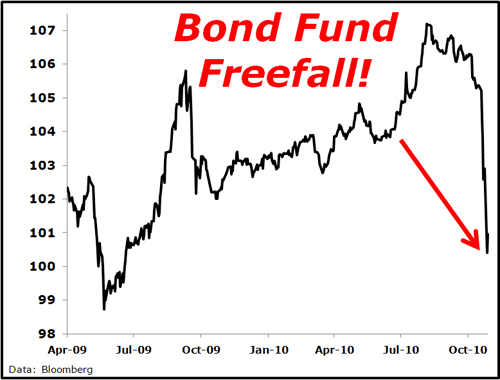
You can see it’s in freefall, with one of the sharpest declines since the credit crisis days of late 2008. MUB has now lost every penny of gains it’s made in the past 15 months … in just a few days! Long-term muni yields, which move in the opposite direction of prices, surged by the most in 18 months!
The move doesn’t stem entirely from concern about the long-term inflationary impact of Fed money-printing, or the back up in Treasury yields …
Muni investors are worried that federal support for state and local governments could wane now that the political winds are shifting in Washington. They’re also concerned that we could see a fresh upswing in issuance given deteriorating municipal finances.
But clearly, the cost of borrowing is now not only going up for Uncle Sam. It’s also rising for governments all over the country, and mortgage borrowers. And it’s starting to inch higher for corporate debtholders.
Opposition Rising in Washington —
and Everywhere Else
Is it any wonder then that a large group of prominent economists just published an open letter to Ben Bernanke, begging him to stop the madness before it’s too late?
The group, which includes Michael Boskin, a former chairman of the President’s Council of Economic Advisors … Douglas Holtz-Eakin, a former director of the Congressional Budget Office … and Kevin Hassett, a former senior economist at the Fed itself, said:
“We subscribe to your statement in The Washington Post on November 4 that ‘the Federal Reserve cannot solve all the economy’s problems on its own.’ In this case, we think improvements in tax, spending and regulatory policies must take precedence in a national growth program, not further monetary stimulus.
“We disagree with the view that inflation needs to be pushed higher, and worry that another round of asset purchases, with interest rates still near zero over a year into the recovery, will distort financial markets and greatly complicate future Fed efforts to normalize monetary policy.
“The Fed’s purchase program has also met broad opposition from other central banks and we share their concerns that quantitative easing by the Fed is neither warranted nor helpful in addressing either U.S. or global economic problems.”
The rising opposition to the Fed is further evidence that the global money war I’ve been worried about is intensifying. It’s proof positive that my previous advice to stay away from both long-term Treasuries and long-term debt of any kind, including municipals, was on target.
We’ll likely see a bounce in bond prices soon, given the massive sell off. But I think this market action is a signal to take some profits off the table after the recent major run in risk assets.
Until next time,
Mike
P.S. This week on Money and Markets TV, we looked ahead to the holiday shopping season. And our panel of experts explained why it’s so important for the retail industry, the overall economy and how you can profit with ETFs.
If you missed last night’s episode of Money and Markets TV — or would like to see it again at your convenience — it is now available at www.weissmoneynetwork.com.
This investment news is brought to you by Money and Markets. Money and Markets is a free daily investment newsletter from Martin D. Weiss and Weiss Research analysts offering the latest investing news and financial insights for the stock market, including tips and advice on investing in gold, energy and oil. Dr. Weiss is a leader in the fields of investing, interest rates, financial safety and economic forecasting. To view archives or subscribe, visit http://www.moneyandmarkets.com.
Alluvial mining is an ancient technology. The early gold-panners were alluvial miners. Although somewhat archaic, small scale alluvial mining operations are still common, both as a hobby and as a source of income, in areas of Africa and South America. Alluvial mining has also morphed into a big business involving cutting edge technology and a great deal of capital investment.
Alluvium refers to sediment that is transported and deposited by water. Alluvium is found in rivers, lakes and along coastlines. In the case of alluvium transported by an ancient stream, alluvium can also be found in a terrestrial environment. The alluvial process can transport, and concentrate, valuable minerals. Over thousands of years, minerals are eroded from their source and transported by water to a new locale. Because sediments settle out of water according to their weight, heavier, valuable minerals such as diamonds, platinum group metals, and gold will often deposit at the same time, this characteristic can lead to a concentrated deposit of valuable minerals, prime for extraction.
….read more about the following topics HERE:
Techniques
Alluvial Mining for Diamonds
Alluvial Mining for Gold
Alluvial Mining for Platinum
-
I know Mike is a very solid investor and respect his opinions very much. So if he says pay attention to this or that - I will.
~ Dale G.
-
I've started managing my own investments so view Michael's site as a one-stop shop from which to get information and perspectives.
~ Dave E.
-
Michael offers easy reading, honest, common sense information that anyone can use in a practical manner.
~ der_al.
-
A sane voice in a scrambled investment world.
~ Ed R.
Inside Edge Pro Contributors

Greg Weldon

Josef Schachter

Tyler Bollhorn

Ryan Irvine

Paul Beattie

Martin Straith

Patrick Ceresna

Mark Leibovit

James Thorne

Victor Adair