
Daily Updates
Faber believes China has a property bubble, but the whole economy may not go into recession. Some sectors may still expand, says Faber. He thinks inflation is a dangerous situation worldwide. China and the US are on a collision course both economically and politically, Faber argues. He doesn’t think the US stock market will reach a new high in the near term.
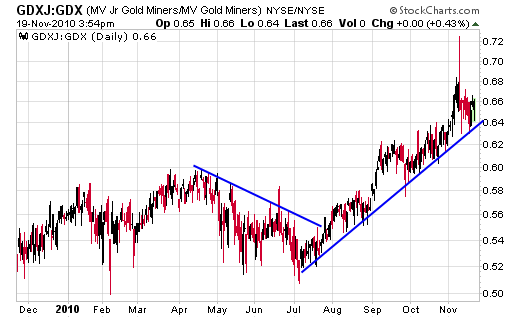
Is the gold picture becoming speculative? I think it might be. The chart below shows the ratio of GDX (the stocks of larger gold mining companies) divided by GDXJ (smaller more speculative junior gold mining stocks). You can see what’s happening, the junior stocks are now outperforming the biggies. This is a sign of growing speculation in gold and gold mining stocks. I think it has quite a ways to go before the gold bull market breathes its last. – Richard Russell has made his subscribers fortunes. One of the best values anywhere in the financial world at only a $300 subscription to get his DAILY report for a year. HERE to subscribe.
Widespread Silver Bar Shortages
As of today, there are no longer any regular wholesale supplies of the 1 ounce through 100 ounce silver rounds and bars available for immediate delivery. It may be possible to locate incidental quantities of some product, but most wholesalers are now promising two to four weeks delivery to allow time for the silver to be fabricated.
As a result of the shortages, premiums have started to rise. So far, the increases have been modest, on the order of 0.5-2%. However, if the shortage grows, expect to see further and larger premium increases in the coming weeks. We could see a repeat of the late 2008 gold and silver buying frenzy, where product availability got as slow as 1-4 months after payment.
….read more HERE
The Bottom Line
The anticipated short term correction in North American equity markets, sectors and commodities was completed last Wednesday. It has provided an opportunity to buy/own economically sensitive equity market and sector ETFs with favourable seasonality. Favoured sectors include China, Japan, Germany, technology, consumer discretionary, materials, Canadian financial services, lumber and metal & mining.
The most wonderful time of the year…for your portfolio
Next Thursday marks the unofficial start of the Christmas holiday season when America celebrates Thanksgiving. That day, Macy’s Santa Claus parade, football and, of course, turkey dinner take prominence over equity markets and economic woes. Equity markets in the U.S. are closed that day as investors take a much needed breather from Ben Bernanke’s game of chance. Canadian equity markets are left to trade on their own accord. Investors on this side of the border will not be sitting back in their rocking chair. Canadian investors will prepare to profit from possible strength in Canadian equity prices during the U.S. holiday.
Trading in TSX listed equities on U.S. Thanksgiving Day and the Friday after Thanksgiving has a high tendency of producing profits. Over the past twenty years, the TSX Composite index has recorded an average return of 0.82 percent per period. The trade has been profitable in 15 of the past 20 periods. Six of the twenty periods produced gains topping one percent, while only one resulted in a loss of the same magnitude.
Thackray’s 2011 Investors Guide highlights the period as days to “Give Thanks and Take Returns”. They are two of the best days in the year to own Canadian equities. Gains are a result of quiet markets surrounding the holiday. Institutional investors on both sides of the border depart early for the holiday leaving individual investors with greater influence over equity market trends. Also, individual investors tend to respond to optimistic projections about retail sales on the Friday after Thanksgiving Day. This day is better known as “Black Friday”, the busiest day of the year for U.S. retailers. Why is it called “Black Friday”? That’s the day that earnings by U.S. retailers historically have moved from red ink to black ink, marking profits for the year.
The effect is not limited to Canadian equity markets. U.S. equity markets have a history of moving higher on the day before the U.S. Thanksgiving holiday and on Black Friday. Returns by the S&P 500 Index on these two days have averaged 0.52 percent over the past 20 years. Positive results were the outcome in 14 periods.
The technical picture supports a bounce in the short-term. Equity markets reached severely overbought levels in the first week in November. Subsequently, they have weakened significantly and are quickly approaching oversold territory. Daily Stochastics for the S&P 500 Index already have declined from over 95 percent to near 20 percent during the past two weeks. Recent studies conclude that the probability of a short term recovery after daily Stochastics fall below 20 percent is approximately 60 percent. Daily Stochastics are just one of several simple technical indicators that are useful for measuring the probability of a successful trade when U.S. holidays occur near month end.
Preferred investment vehicles for this trade includes Horizon’s BetaPro S&P/ TSX 60 ETF trading on the Toronto Stock Exchange (Symbol: HXT) and S&P 500 SPDRs (Symbol: SPY)
….view the 45+ Charts and Analysis on Don’s site HERE
In the last week, gold and silver prices fell even as George Soros himself commented that conditions for gold looked perfect. Why? A look around at virtually all markets from Shanghai through Europe and back to the States fell. The media pointed to the potential for interest rates to rise, but that is an insufficient explanation when one considers that the declines were in the region of 5% across all the board. An event that touched the very structure of the global financial system occurred and is still happening right now was, we believe, the cause of the falls.
While the sovereign debt crisis in the Eurozone has been with us for some time now, it has developed into a more serious concern in the last week. The President of the Eurozone himself said that both the euro and the Eurozone were in danger of collapsing. Project this statement forward to an actual collapse, what would happen if it did collapse? What would happen if the Eurozone fragmented, or if Germany departed or if the southern nations of Greece, Portugal and Spain were booted out of the Eurozone? Chaos would reign in currency markets and amongst the banking system. The web-like nature of the global banking system would threaten a spread of the banking and sovereign debt crisis that would ravage investors in many markets.
So, what happened when gold and silver corrected nearly 20% a year and more ago In the last week, gold and silver prices fell even as George Soros himself commented that conditions for gold looked perfect. Why? A look around at virtually all markets from Shanghai through Europe and back to the States fell. The media pointed to the potential for interest rates to rise, but that is an insufficient explanation when one considers that the declines were in the region of 5% across all the board. An event that touched the very structure of the global financial system occurred and is still happening right now was, we believe, the cause of the falls.
While the sovereign debt crisis in the Eurozone has been with us for some time now, it has developed into a more serious concern in the last week. The President of the Eurozone himself said that both the euro and the Eurozone were in danger of collapsing. Project this statement forward to an actual collapse, what would happen if it did collapse? What would happen if the Eurozone fragmented, or if Germany departed or if the southern nations of Greece, Portugal and Spain were booted out of the Eurozone? Chaos would reign in currency markets and amongst the banking system. The web-like nature of the global banking system would threaten a spread of the banking and sovereign debt crisis that would ravage investors in many markets.
So, what happened when gold and silver corrected nearly 20% a year and more ago, could happen to a lesser extent again. The result then was that investors withdrew to the sidelines. But this time, we’ve seen a repeat of this but temporarily and only to allow around a 5% fall in precious metal prices. Knowing what happened following the last correction, investors were able to react faster than before.
Right now, the recent rescue of Greece may not be as convincing as many hoped for as their tax revenues have fallen well below budget as tax evasion in Greece [rife for decades], now taints the success of that rescue. Ireland, although small, is unhappy to let go of any sovereignty, (even financial sovereignty) is hoping the EU and IMF will bailout their banks, who have yet to fully assess their property losses. This refusal of support could endanger the Eurozone itself. Sadly the very nature of bailouts in Europe and even the resolution of global currency problems appear to be more difficult than most thought.
Why?
….read more HERE
“The nub of the crisis is this: “We have decided to socialize the private losses of the banking system. Now you have a huge increase in public debt—going from 7 percent to 100 percent of GDP. Soon it will be 120 percent.”
-
I know Mike is a very solid investor and respect his opinions very much. So if he says pay attention to this or that - I will.
~ Dale G.
-
I've started managing my own investments so view Michael's site as a one-stop shop from which to get information and perspectives.
~ Dave E.
-
Michael offers easy reading, honest, common sense information that anyone can use in a practical manner.
~ der_al.
-
A sane voice in a scrambled investment world.
~ Ed R.
Inside Edge Pro Contributors

Greg Weldon

Josef Schachter

Tyler Bollhorn

Ryan Irvine

Paul Beattie

Martin Straith

Patrick Ceresna

Mark Leibovit

James Thorne

Victor Adair