
Daily Updates
You now know, very clearly, what I’ve been warning you about since the great financial crisis began, with the busting of the real estate bubble.
Everything you are witnessing, from the wild gyrations in the markets, to the raging bull markets in gold, silver, oil and other commodities … to the rapidly eroding purchasing power of the dollar … and more …
Are all symptoms of a bankrupt nation!
The ratings agency Standard & Poor’s now knows this too. That’s why it downgraded its outlook on the U.S. Treasury market last week, signaling to the world that unless Washington gets serious about its spending and debts, the U.S. may lose its AAA credit rating.
To the extent the S&P warning gets Washington to %#@! or get off the pot and make some real changes, S&P’s warning is a good thing, no doubt.
But I’m afraid that whatever Washington does, it will be too little, too late. There is simply no way our country can make good on its approximately $136 trillion of IOUs.
And it’s time, if you haven’t already, to get very, very serious about protecting your wealth.
With all this in mind, I’m going to devote the rest of today’s column to the most recent questions I’ve received, and my replies.
Q: When S&P issued its outlook downgrade last week, the dollar actually rallied. Why? That seems insane.
A: The dollar does have some life to it. Not much, but it can show occasional strength, for two primary reasons in my opinion …
First, when investors are nervous in the very short term, they go into liquidation mode, taking risk off the table, selling off assets. The simple act of liquidating and going to cash can give the dollar a short-term boost.
Second, the euro is fraught with many of the same problems as the dollar, plus many other fatal problems that are unique to the euro. So savvy money at times may still prefer the dollar over the euro.
Nevertheless, the dollar remains in a very serious bear market. And mark my words, it will lose its world reserve currency status, officially, over the next few years.
There is simply no way the world can stay on a dollar standard when the country whose currency is playing the role of the world’s reserve currency is bankrupt.
Q: Larry, there’s a lot of talk these days about the Federal Reserve possibly reigning in the money printing, and perhaps even soon raising interest rates. What say you?
A: The Fed, at some point, is going to try to reverse course, stop or slow the money printing, and raise rates.
But neither action is likely to happen anytime soon. And even when the Fed does try to make some moves, it is going to quickly find out that it’s gotten itself into a real bind, a real Catch-22.
Slow the money printing, and asset prices fall. Raise rates, and the economy slumps, because it’s simply too vulnerable. End result: Go back to money printing and keep official short-term rates low.
But in the end, what the Fed does or doesn’t do is irrelevant. The markets are far more powerful than any central bank and any government.
And the markets already know what neither the Federal Reserve nor our leaders in Washington want to admit: That the U.S. is bankrupt … that the U.S. government has failed our nation … and that it’s time to rewrite all the rules and effectively reboot the monetary system and the government.
Q: Looks like you’ve been right as rain on inflation, it sure is heating up. Any updates for us?
A: Yes, expect a lot more inflation! In almost everything.
Keep in mind this cycle chart, which I’ve previously published. The cycles for inflation point higher for at least SIX more years, into the year 2016 — REGARDLESS OF WHAT THE FEDERAL RESERVE DOES.
Q: George Soros recently stated that for all intents and purposes, the dollar has already lost its reserve status. Do you agree?
A: Unofficially, it certainly has. Anyone who travels or does business in other parts of the world knows how serious the sentiment change is ― the dollar is no longer king of the hill, even in the streets.
It’s also why, as Mr. Soros noted, you’re witnessing the monetization of so many assets, which is simply another way of saying you’re seeing massive asset inflation.
Officially, the dollar will keep its reserve status for a few more years, until its lost so much value that there’s simply no alternative but for authorities to come together with a new Bretton Woods, so to speak, and rewrite the entire monetary system.
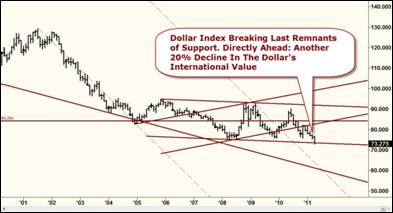
Q: How much more can the U.S. dollar drop?
A: Any fiat currency can theoretically drop to zero. History is cluttered with broken currencies that literally were not worth the paper they were printed on.
I think the dollar can lose at least another 50% of its value, if not more, before it loses its reserve status.
For reference purposes, we’re talking about the widely-watched U.S. Dollar Index plunging from its current value of about 75, to approximately the 37 level!
Q: There’s now a lot of talk about China finally allowing its currency to appreciate, something you forecast for this year. Do you think it will really happen?
A: Yes! First, despite four interest rate hikes and seven hikes in their banking reserve requirements over the last six months, Beijing has been unable to tame inflation.
Second, it won’t be able to contain inflation in its country as long as the Fed continues to print money, which it will.
Third, Beijing is running out of options to tame inflation, so now, it must start to let its currency appreciate. But that won’t be a problem for China, because, in essence, it will also give Washington what it wants, a lower dollar against the yuan.
No matter how I look at it, I see the dollar heading much lower long term, and the yuan, much higher.
Q: Gold and silver look very toppy at times, like they might end up pulling back sharply, just as you had previously forecast. At other times, they look like they’re going to go straight up. What should I do? I’m heavily invested in gold and silver, have made a lot of money on your core recommendations, but am very nervous about the markets!
A: There may still be the pullbacks I had warned about, especially in silver. However, per my recent columns, I do believe gold and silver are now past their most vulnerable cyclical periods. By vulnerable, I mean a period in which a sharp 20% to 30% pullback was likely.
So any pullbacks we see now should be shallow and short-lived. Most importantly for core gold and silver holdings in bullion, bullion ETFs, or mining shares — keep the long term in view: Precious metals and related investments are heading much, much higher over the next few years.
So as hard as it may be at times, for core precious metals holdings I recommend refraining from watching the markets on a daily basis and ignoring the daily moves. It helps keep you sane and objective!
Q: Many other editors I follow tell me that gold bullion ETFs could backfire someday and go belly up. You don’t seem to worry about that. Why?
A: No, I do not see that as a problem. Not now. It may become a problem once gold passes well north of the $2,300 level, its inflation-adjusted 1980 high. That’s when gold’s real bull market will begin to kick in.
But we’re not there yet, so I’m not worried about it, for either gold or silver ETFs. I will give plenty of advance warning when I do think it can become a risk.
Q: I’ve been tracking the recommendations you’ve made in your column since March 2009, when I subscribed. I acted on quite a few of them and have pretty large gains. Why don’t you give us more specific signals and recommendations to act on?
A: Yes, indeed, I’ve suggested quite a few recommendations in this column since its inception a couple of years ago, most notably for core long-term gold holding.
And yes, they are up substantially. However, keep in mind any recommendations I make in this column are of a general nature, meaning I do not give specific buy and sell prices. Those are reserved for subscribers to my Real Wealth Report and to my VIP trading services.
That being said, when I consider it extremely urgent, I will suggest specific ideas in this column, as I did recently when I recommended hedging positions.
So my best advice is …
A) Don’t miss a single one of my columns! Read them every week to make sure you’re fully up to date with my thinking. And, even better …
B) Take out a membership to my Real Wealth Report. It’s a mere $99 a year and you get every single recommendation I make, the instant I make it.
Best wishes,
Larry
We are approaching the end of this current 8.6 year wave come June 13th, 2011. What awaits us on the other side is a change in the overall trend.
e are approaching the end of this
current 8.6 year wave come June
13th, 2011. What awaits us on the
other side is a change in the overall trend. bankruptcies that followed, if anything, these
past 4.3 years have certainly not been but
boring. Many people lost their retirement
TOM HUDSON: Stocks and metal prices continue climbing, despite nervous investors and that`s a good sign according to tonight`s “Market Monitor.” Mark Leibovit back with us, chief market strategist at vrtrader.com, author of the new book entitled “The Trader`s Book of Volume.” He joins us tonight from Troy, Michigan. Mark, welcome back, great to see you again.
MARK LEIBOVIT, CHIEF MARKET STRATEGIST, VRTRADER.COM: Always a pleasure to be here, Tom, thank you.
HUDSON: So why do you think that some nervous investors is going to help push prices higher from here?
LEIBOVIT: Well, it`s called the wall of worry. Look, this past Monday where the S&P comes out threatening to downgrade U.S. debt. Dow was down 200 and then here we go yesterday, it`s a new closing, I believe today as well a new closing, (INAUDIBLE) market high. Just the function of bad news and the market choosing to ignore it, but generally when are you in an uptrend and get these shakes along the way, it just confirms the trend. And plus we have higher projections. Plus we have Ben Bernanke who is accommodative to the stock market who actually has said he is targeting a higher stock market. If you step back and look at any chart, weekly, monthly, daily, it is clearly an uptrend. So the trend is your friend. Stick with the trend.
HUDSON: So with that in mind here, volume though, some have been calling volume lighter than normal. You follow volume. What do you make of it?
LEIBOVIT: Volume is just fine. Basically it`s relative volume. You`re comparing one day to the next. Overall volume has still been relatively heavy. I don`t see anything in volume that has changed, at least the analysis that we do, more proprietary volume reversal and all the indicators that we follow in the traders` book of volume also confirm the trend as well.
HUDSON: Speaking of the trend, let`s take a look at your model for the Dow Jones Industrial Average through the middle of this year. This model here is anticipating a pretty nice rally from here through the end of June. What makes you bullish?
LEIBOVIT: Well, you know, the model is called a sharp sell-off. Remember this is published in January, called for a sharp sell-off right into mid-March which was a perfect call and basically it is trending up here into early summer. There is the expression sell in May, go away. In Canada they say buy when it snows, sell when it goes. Basically this is where we are at and maybe we will run into a little bit of a swoon in the summer, but beyond that, I still see a higher market but we are giving you a short-term picture here.
HUDSON: And how about for gold, we mentioned $1500, pierced that level today finally at the close. Looks for a slight climb through the summer before a bit of weakness into June. Is that weakness going to stick around?
LEIBOVIT: No, this is another cyclical swoon, so to speak, a pullback. Let`s see what kind of volume patterns come in and let`s see how high we are by June. If gold is $2,000 in the next two months, then we are probably due for one heck of a correction from some higher levels.
HUDSON: Are you going to call $2,000? Is your call $2,000 by the end of June?
LEIBOVIT: No, I would say we have a chance you could see $1650 the way it`s moving now. That`s a possibility. But we record interviews here (INAUDIBLE) for years that we`re looking for 3,000 plus. I have revised it up to about $3600 now. So that is a multiyear comment.
HUDSON: And it`s not just gold in the precious metals space. You also like silver. Here we`re going to look at the ETF, SLV, the ticker symbol, $45 an ounce. And you think this could hit triple digits?
LEIBOVIT: I think we`re looking at $100 in silver in the next couple to five years. And we`ve been looking, listen, look at it now. It is basically just catching up to where it was in 1980 which was $50 an ounce. Of course SLV trades at a discount to the actual spot metal so could see SLV very well near triple digits by the time this silver moves over and then gold by then like I say, could be $3600.
HUDSON: Last fall is when you were here in September 24th. We`re going to take a look at all four of your picks which have done very, very well. IAU, the gold, trust ETF up 16 percent. The central fund of Canada which is gold and silver up 50 percent. You also like Palladium, another metal, up almost 61 percent and the total stock market index up 18 percent. You still like these four?
LEIBOVIT: Absolutely. Stick with them. Trending the stock market is up, the BTI is a total stock market index. That`s like holding every stock in the stock market. Palladium is an industrial play just like platinum. Of course the silver and gold, I`m on record there and we might as well just hold what is working as the trend is up in all four.
HUDSON: Any ownership positions with these four, Mark?
LEIBOVIT: I own and trade every one of these. I love the metals.
HUDSON: It`s Mark Leibovit, the trend has been his friend, no doubt. He is with vrtrader.com
For more information and to register for this event Click Here
Commentary above from Mark Leibovit, TIMER DIGEST’s #1 Intermediate Market Timer for the 10-year period ending in 2007, the #2 Intermediate Market Timer for the 10-year period ending in 2009, AND the #3 Gold Timer for the Ten Year Period ending 12/31/10. Subscribe to the VRTrader Newsletter.
Metals Market Equations Are No Longer Simple
From the April 2011 Hard Rock Analyst Journal
David Coffin & Eric Coffin, HRA Advisories
World events continue to signal support for hard assets, but caution is still advised. News in the copper space is as much about consolidation of the players as the metal itself right now. The $7 bid by China Minmetals for Equinox Minerals (EQN-T, ASX) has offered some support for other mid tier copper assets. The Minmetals bid requires EQN to drop its own bid for Lundin Mining (LUN-T, LUNMF-Q) that had already squelched the planned merger of LUN with Inmet Mining (INM-T, IEMMF-Q). EQN had already merged with an Australian junior to acquire its Saudi copper mine development that is to begin out put late this year. To this has just been added a take-over bid by Capstone Mining (CS-T, CSFFF-Q) for Far West (FWM-T, FWMLF-Q) and its copper-iron project in Chile, with an assist from state owned Korea Resources Corp. Small and mid tier copper producers are focused on securing growth assets of the right scale as Asia gets more aggressive in ensuring supplies for its markets.
That’s enough to and fro for even the most ardent resource sector bears to give the sector another look. The interest in copper equities has contrasted with weakness for the metal’s fundamentals. The three-market (LME, SHFE, COMEX) inventory levels for the red metal are back up to levels similar to those at the copper price low in March ‘09. The biggest build up through that period has been in Shanghai where stocks actually went negative in early ‘09. (Of note is that the SHFE now breaks out “bonded” metal which has been delivered to a Chinese port but hasn’t had duties paid for entry.) This extra stockpile will work through the system in time, but it is large enough to have broadened the call for near term weakness in copper’s price. The looming structural deficient in copper supply still has producers looking for near term additions to their output. That should continue to support copper assets with well defined cash flow potential. Near term weakness for the red metal can still be viewed as an aid to picking up asset rich deals.
Base metals and globally priced commodities more generally also continue to see support from US dollar weakness. Dollar weakness and inflation are somewhat perversely linked. At the start of the year many expected strength in the Dollar based on higher growth forecasts for the US. The rise of the Arab Street and $110+ oil prices changed the picture. If a ceasefire in Libya calmed that region the oil price at least may be less of an issue. That’s still a big if. High oil prices definitely hurt in 2008 but much of the following recession was baked in the cake by the real estate bubble. Mayhem in the Arabic could generate a real time experiment on the breaking point from rising oil prices this go around.
News that tightening moves in China don’t seem to be biting yet has added to concern on the oil, but in balance we think China will continue this tightening until they do. However, near term Euro strength may ironically have the most influence Dollar pricing.
The ongoing debt crisis in Euroland is one reason many expected the Greenback to keep strengthening, but Portugal finally succumbing to its debt reality caused barely a ripple in the markets. The amounts involved are small enough that the larger Euro economies should not have much trouble absorbing those costs. That is not yet the end of the story. It’s widely assumed the next domino to fall could be Spain. The cost of a Spanish bailout would be an order of magnitude higher than Portugal, and the market would be much less sanguine about it. Spain continues to insist a bailout is unnecessary, as did Greece, Ireland and Portugal until right before they threw in the towel. Given this backdrop the strength in the Euro would be surprising except for one thing — the European Central Bank.
The ECB has credibility as an inflation fighter. It raised interest rates again this month by 25 basis points and made it clear it would continue to if it sees evidence inflation continues to accelerate. This sort of credibility is the reason the Euro has been strengthening. The US Dollar Index has now reached new 52 week lows, largely due to Euro strength.
Inflation is also rising in the US, but messages out of the Fed and Washington politicos are as mixed and contradictory as ever. While it seems unlikely there is the political will or necessity to institute “QE3”, it’s equally unlikely the US will follow Europe’s lead with interest rate increases anytime soon. The US Fed tracks GDP price deflators and core inflation numbers that are still steady since they exclude food and energy. The “QE3” issue revolves around the lack of demand for US Treasuries. The Fed has been the buyer of last resort in the treasury market for some time now. PIMCO, the world’s largest bond fund has sold what had been the biggest private holder of US treasury bonds, and gone short Treasuries.
The US Treasury yield did drop in March as the safety trade took hold, but that reversed fairly quickly as the markets started to normalize later in the month. During this period the Dollar itself barely benefited from the safety trade. There was some uptick as rates moved up but this soon dissipated and reversed. Despite worry about bonds selling off, Treasuries are still a parking spot for funds. That might change with another interest rate gain in Europe. If that happens PIMCO would have lots of company on the short side of US Treasuries.
Meanwhile, China still refuses to let its currency appreciate. And, recent economic stats increase the likelihood of more rate increases there. China’s Q1 trade statistics were headlined with a trade deficit, the first in years, but the numbers for March indicate strong gains for both imports and exports and a small trade surplus for the month. Numbers like these indicate China is still the world’s widget maker.
Like the ECB, Beijing is serious about tackling inflation so more interest and reserve ratio increases seem certain. The Yuan should be gaining while this tightening continues, but Beijing still seems to be more concerned about losing sales than allowing a stronger currency to knock down import costs and help cool inflation. With China trade so important these days, that eats into everyone else’s wiggle room.
Assumptions that the US Fed will avoid raising rates to fight inflation are none the less still quite rational. Moderate inflation debases US debt, and it’s simply not that easy to argue with the world’s biggest debtor. The US will try to maintain a negative real interest rate policy for at least the rest of this year. As long as the market is letting them get away with not spiking Treasury yields it makes no sense for the Fed to change tack — unless forced to.
More hawkish central banks trying to stay ahead of the inflation curve will continue to attract bond holders. This will maintain a benign environment for metals and other commodities, even if it does not push them to higher prices. However, as rates outside the US move higher it will become more difficult for Washington to roll over its debt without following suite. The S&P downgrade of US debt recognized that simple truth. We aren’t yet at that point of concern and may not be soon, but it has potential to be turning point when it takes place.
Gold and silver have continued barreling higher thanks to insurance buying, inflation expectations, and the currency picture. Given the underlying chaos in global affairs there is room for gold and silver to continue their gains, in US Dollar terms at least, as long as negative real rates persist in the US. Around that upward bias will be traders moving in and out of the safety trade and other short term sentiments. Expect volatility.
Gold’s advance has been fairly measured, with plenty of consolidation along the way. Pullbacks have been few lately in the silver market. Silver looks technically stronger, but it will be prone to sharp pull backs given the large one way move it has already had. Silver’s strength has shifted a number of companies we follow from being gold dominant to silver dominant just as they are reaching cash-flow waypoints. These are safer ways to play silver after its strong gain, so they have been getting some emphasis in our updates to subscribers. We are looking at a few exploration stories that may offer better silver leverage, but we do so cautiously. Market shifts can impact smaller metal markets swiftly, and unpredictably.
Ω
Sign up to receive HRA commentary, interviews and our latest free special report on Iron Ore & Potash, including a new HRA recommended company! www.hraadvisory.com
HRA initiated coverage on 22 companies since early 2009 – the average gain to March 2011 is 268%!
-
I know Mike is a very solid investor and respect his opinions very much. So if he says pay attention to this or that - I will.
~ Dale G.
-
I've started managing my own investments so view Michael's site as a one-stop shop from which to get information and perspectives.
~ Dave E.
-
Michael offers easy reading, honest, common sense information that anyone can use in a practical manner.
~ der_al.
-
A sane voice in a scrambled investment world.
~ Ed R.
Inside Edge Pro Contributors

Greg Weldon

Josef Schachter

Tyler Bollhorn

Ryan Irvine

Paul Beattie

Martin Straith

Patrick Ceresna

Mark Leibovit

James Thorne

Victor Adair