
Daily Updates
OPEC’s failure to increase output has raised speculation as to whether worldwide supply can meet future demand. Many believe OPEC won’t increase output because it can’t, and if that’s true, where will future supply come from?
There’s a Black gold rush on the US’s 95 Billion Barrels of Black Gold.
ExxonMobil (NYSE: XOM ) recently reported the largest discovery in the Gulf of Mexico in the last decade. The company estimates the wells hold approximately 700 million barrels of oil. That’s a 35-day oil supply based on current U.S. consumption rates.
Royal Dutch Shell is launching development on a sizable discovery in the Gulf. Last year, the company discovered an oil field capable of producing approximately 140 million barrels over its lifetime. Based on current consumption of roughly 20 million barrels a day, the Shell discovery is enough oil to meet U.S. demand for approximately seven days.
Surprisingly, ATP Oil & Gas (Nasdaq: ATPG ) is one of the most active drillers in the Gulf. The company ranks fourth in deepwater Gulf of Mexico wellbores and in total, holds 144 million barrels of oil reserves in the region.
All told, the Gulf of Mexico is estimated to hold 45 billion barrels in recoverable reserves. Drilling activity is picking up again after the temporary halt in production in the wake of the BP oil spill. But the hunt for oil doesn’t stop in the Gulf.
There are numerous onshore supply sources as well. The Eagle Ford shale in Texas is chief among these. EOG Resources is a big player in the fertile oil field. The company reportedly has 900 million barrels of oil in the region.
Marathon Oil (NYSE: MRO ) sees potential in the shale as well. The company recently shelled out $3.5 billion to double its land position in the region. Marathon now holds a top five acreage position in the promising oil field.
Chinese oil giant CNOOC is betting big on the Eagle Ford shale. Late last year, the company paid Chesapeake Energy (NYSE: CHK ) $1.1 billion for 30% of Chesapeake’s acreage in the oil field.
All told, some project the Eagle Ford shale holds about 25 billion barrels of oil, making it the most significant recent oil discovery in the United States.
Another significant discovery is the Bakken shale in North Dakota. The United States Geological Survey estimates the recoverable reserves at 24 billion barrels in the region.
Continental Resources (NYSE: CLR ) is the top producer in the Bakken and is expected to triple production in the region over the next three years. Continental has high hopes for the future. The company is setting a growth goal of 300% over the next five years.
Kodiak Oil and Gas (AMEX: KOG ) is another explorer targeting the Bakken. Kodiak recently acquired 25,000 acres in the Bakken, increasing its net acreage position to 95,000.
Then there’s the highly debated Arctic National Wildlife Refuge. It’s hard to predict how much oil the region contains, but the mean estimate of geologists places the figure at 10.4 billion barrels of recoverable reserves.
That’s a lot of oil, but the problem is many believe it would take several years and a significant financial commitment before we experience the benefit from exploring the wildlife refuge.
Last year, ConocoPhillips (NYSE: COP ) pulled out of Alaska claiming that investing in the region is not competitive with other exploration projects. However, expect ANWR exploration talks to heat up again with oil prices on the rise.
Below is a table summarizing the potential impact of some highly targeted oil fields based on current U.S. consumption rate of 25 million barrels a day.

The bottom line
All of these oil fields could partially pick up the slack for OPEC. But keeping up with U.S. as well as soaring worldwide demand will become increasingly difficult.
Investors should look to add some black gold to their portfolio, as the economics favors companies exploring for this valuable commodity. With situations like this in mind, The Motley Fool has created a new special oil report titled “3 Stocks for $100 Oil,” which you can download today, absolutely free. In this report, Fool analysts cover three outstanding oil companies, including the stock Fool analyst David Lee Smith calls the “energy king.” To get instant access to the names of the three oil stocks, click here — it’s free.
Worried stocks are headed for a major fall? Many investors are. That’s why for three weeks only, we’ve made it possible for you to get insider access to two of the most gifted investment minds at The Motley Fool… And discover the easiest, most effective ways to not only protect — but actually grow — your hard-earned money no matter where the market goes from here. Some pay $999 per year for this cutting-edge advice, but right now, you can get it absolutely free. Simply enter your e-mail address in the box below and click the button to learn more.
Michael: For six consecutive weeks the market has been going down. What advice you’d have for people how to play this kind of a market.
Ryan: If we look anecdotally over the first six months of this year we’ve released the least number of reports that were positive on a company than we have since around 2008. Now, that’s not to say that we believe the markets are as over valued as they turned out to be then, but and we look at the markets on a revenue basis, a cash flow basis , the S&P 500 ‘s PE in the range of 16 based on as reported earnings, and the markets are not really historically cheap here but not outrageously expensive on an earning basis either. But given the recovery that we’re seeing we believe that a lower earnings multiple may be warranted and we think we’re in that process right now. There is a level of a multiple that is we think should be lower right now in the market and we think that’s warranted. You really should do your shopping, and look for very undervalued companies right now.
Michael: What about Sell Signals?
Ryan: We had taken some profits heading into this year in a number of companies as we believed at the start of this year that the markets were a bit overvalued and needed a correction. Now we are going to position ourselves to be relatively aggressive over the summer and start buying some assets that are on sale after we’ve seen the markets correct somewhat. We see some assets that come on sale during the course of the summer when people are away at cottages, the brokers aren’t in the office as much, so in the lighter volumes we can pick up some bargains. When we buy we are looking long term, how it will react to its earnings over six months to three years.
Michael: Have you put a buy list together and what prices you want to accumulate them at?
Ryan: Right now if we find a stock that we like we suggest you use a strategy to layer into a position. If you find the stock that you like add half of your position right now at the current price, and I’ll give you an example of a company we talked about on this show a number of times. We like the company long term it’s called Glentel Inc the symbol is GLN on the TSX. It’s a wireless retailer operating in Canada and they’ve recently entered into the US. This stock it’s trading at around $19 right now, but we originally bought this stock at $2.93 about five years ago. Then we bought in again last fall at 9.70, and it trades at $19 so it may sound expensive relative to that. But it’s all relative to its earnings and as they increase over time we still think it still offers good value. In the near term with uncertain markets it’s probably fair value for the next three to six months, but we could layer in. Say we want to buy $10,000 worth of this company, we may buy our first $5,000 right now, and if the markets continue to correct and the stock itself corrects, we could buy more of our position at a later averaging down . Now if the company or the market continues to go up or the company itself continues to go up, the worst thing we have here is we are left with a good company and a solid position in that company.
Michael: What I like about the kind of approach you’ve just suggested is I put a foot in the water right now, take a third to half of my position and I wait to see what happens. If it goes up I’ve made some money , if it goes down I was hoping to get a better buy anyway.
Ryan: What it comes down to for us is really stock specific, and we don’t want to think that we can outsmart the market and completely buy at the bottom. It’s the company we are buying that’s the most important, we are layering the positions over time particularly when you have some uncertainties in the market.
Michael: Have you anything that’s caught your eye or we should put on our radar screen?
Ryan: Yes there’s about three or four companies we can look at. We’ve seen junior gold producers after a strong run at the start of this year have sold off and are becoming attractive are attractive right now. If we are looking at where the price of gold is right now and the price it costs these companies to take that gold out of the ground, the first company is Orvana minerals ORV on the TSX. This a company we originally bought into at about $0.53 in 2008 it’s traded as high as just under $4. We’ve sold half our position at around $3.50 and now it’s back down in the $2.45 range and we think that’s a great long term opportunity right now. The company is a gold producer in Spain primarily but it also has operations in Bolivia. We love the cash flow that this company is bringing online. In 2012 our earnings estimate for this company is beyond the $0.50 level, so if you’re looking at buying it right now in around $2.50 that’s about five times 2012 earnings if gold stays in the $1,400 or above. That’s growth at a reasonable price and it’s a mining friendly district so we like it.
Michael: With Orvana Minerals what their cost of extraction of Gold?
Ryan: It’s around $550 in that range. They are a relatively low cost producer.
Michael: So they have a lot of room in other words.
Ryan: The next company we are going to talk about is really a low cost producer. It’s on a smaller scale but we definitely like the low cost producers. Monument Mining Limited it’s MMY on the TSX venture is a profitable low cost junior gold producers operating two principle gold projects, one is currently producing in the mining friendly country Malaysia. With current production it has solid cash flow, limited to no debt, a good cash position, lowcost of production, production that is expanding and it has upside from some promising projects. I is on track this year from its primary mine to produce around 40,000 ounces of gold. Now its estimated cash cost on that production is around $317 which is very low. It’s an open pit, it has good recoveries and low labor rates. This is over an initial five year mine life and that generates very excellent cash flow for this company. In fact in this last third quarter it produced revenues of 15 million up from basically zero in the same period last year. The cash costs in that quarter were only $238 per ounce, so it’s net income was 10.4 million or $0.04 per share in the quarter alone and that’s fully diluted. This company trades at around $0.61 right now, so it’s got some good solid earnings and it’s trading at a relative low price relative to those earnings. We also see management planning to grow production to about 75,000 to 100,000 ounce of gold by the end of this calendar year and will be in full operation of those rates we believe by April 2012. The balance sheet looks good with 33 million in cash, working capital is 52 million, and its long term debt is only five million. So we like the metrics on that. we like the production expansion and we like the evaluations right now.
Michael: Monument Mining seems like a poster child for your approach for people not familiar with your services at Keystone Financial.
Ryan: We believe the more companies you add like that to your small account portfolio the better you will do over time Now not every one of those companies is going to be a success, but if you continue to add companies with that profile you’ll do well on a broad basis over time.
Michael: tell us about a company that you for their cash situation?
Ryan: The company’s name is Enghouse Systems Limited a communication software company, symbol is ESL on the TSX. They are what we call cash rich. Essentially they make software that helps clients interact with their clients through multiple channels which would include their website, their call center, fax, any contact point. They are very large in the call center software side of the business. But what we like about this company, as always, are the numbers. This company in terms of cash have around 75 million, and that’s after making a 20 million dollar acquisition in the last quarter. Now that 75 million equates to around $3 per share in cash while this company trades around $9.90 in the market, so it has an incredible war chest that it can use for strategic acquisitions and has been doing that over the course of the last couple of years, even in uncertain times, and we expect it to continue to purchase companies within its industry at relatively low valuations right now.
Now revenues for the second quarter this company came in at around 30 million up from 21 million, it’s earnings were up around 50% to $0.12 per share from $0.07 per share in the same period last year. This company isn’t, if you just look at the numbers at a glance, not as cheap as some of the companies we look at as it’s trading at about 19 times trailing earnings. But if you strip out that cash, we going on $3 per share, it’s around twelve and a half times earnings. We really value this company based on its cash flow, and we think this year the company will earn around a dollar per share in cash. So it’s about seven times cash flow when we take out that cash in the bank which is a relatively low valuation. We definitely have a long term outlook on this stock we believe over the next three years it will drive revenues to above the 200 million on an annual basis range.
So we believe you purchase at these levels and if it comes down we’d use the methodology we were speaking earlier to layer into a position at lower levels. Its dividend is around 2% which is good but we believe once it hits that 200 million range in revenues it really becomes a legitimate success story within Canada and you’ll see a lot more fund buying. Whether that happens in six months from now, a year or two years from now we’ll buy into this cash rich company with no debt, growing its earnings, making good acquisitions, trading at reasonable valuations and we’ll pocket a 2% dividend in the mean time.
Michael: Just very quickly Ryan do you look at the management of a company like that and past track record?
Ryan: It’s good you bring that up. The CEO of the company actually is part of the board of Open Text which is a large tech company in Canada, and he has basically helped in many of the major acquisitions. So he has a good degree of familiarity with the growth by acquisition strategy. This company was criticized with when it had about 100 million in cash in the bank back in 2006, 2007 for not making acquisitions at that time. But management found the companies it was looking at were just too expensive. Now in 2009, 2008 and into this year it has made more acquisitions over the past 18 months than it has in any time in its history because they are cheap now. So management was patient, and they are making acquisitions at opportune times. We like that and we like the track record of its success with these acquisitions, and the CEO success with Open Text as well.
Michael: As always Ryan we really appreciate you taking the time.
Ryan: Excellent thank you very much and there’s a special offer for Money Talks’ listeners in our website if you just go to www.keystocks.com and look at the media appearances page and you can see our appearance here and there’s offers for our service here and also our income stock services a special offer for that.
There is a dark shadow hovering over the US dollar and the ability (or, rather, inability) of the US federal government to pay its way in the future.
Below is a chart that shows the percentage of US government income that goes to pay interest on the national debt. It also shows the historical price of gold in real terms.
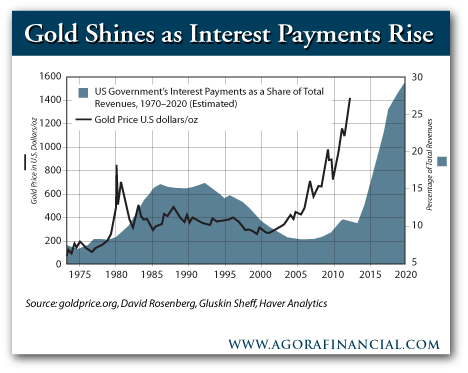
Before 2010, the chart uses historical data for both gold and the percentage of revenues going to pay interest. In the years ahead, the interest payments are an estimate based on known outstanding US debt and the anticipated rates. It’s just following the math.
As you can see, in the immediate future, interest on the debt will eat up more and more of the overall federal revenue stream. That’s because national debt and interest on that debt are growing far faster than taxable GDP.
What does chart this mean to you, as an investor? It means that within the investment horizon of every Outstanding Investments subscriber age 12-92, we’re staring at the potential for utter economic devastation. If you’ll grant me a bit of artistic license in all this…life as we know it in the US could come to a crashing halt.
From the standpoint of investing, the chart also gives us every reason to anticipate even higher prices for gold, and, by association, silver. So if you don’t have some gold and silver, get some.
Historically, the gold price rises when there’s an increasing percentage of federal revenues going to pay interest on the national debt. And historically, the gold price declines when US interest payments move down as a percentage of federal revenues.
So if you follow the correlations on the chart, the forecast for the price of gold is simply up, up and away. That is, by 2020, we may be living in a country where the government is chronically insolvent, due to interest payments, and gold is going stratospheric.
We’ll enter into an era when the government won’t pay its day-to-day bills on time, if it pays them at all. Eventually, we may see the US currency in free fall, if not collapse. That’s why your ONLY real long-term hope in all of this is to invest in “real” assets – things that will retain value over time. Energy and minerals come to mind, certainly to include physical gold and silver.
The mainstream media and old-line politicians pretty much ignore the looming debt crisis, or they talk around it. And compare this sense of economic non-urgency with how the media and bureaucrats deal with, say, the idea of “global warming” – a scientific possibility, but something subject to much debate.
It’s as if protecting future generations from the possibility of a few extra fractions of a degree of atmospheric temperature – over the next century – is a high mission. Yet there’s no need to wrestle with the absolute certainty that the country is immediately mortgaging its financial future. The US economy is loaded down with untold trillions of dollars’ worth of debt, and it’s only getting worse.
Why is that? Why the neglect? Why isn’t every church bell in the country ringing, sounding the alarm over the financial catastrophe that’s happening before our eyes? Perhaps it’s because addressing the idea of so-called “climate change” will increase the power and control of the political class. While dramatically cutting the federal budget and letting the private economy grow will reduce political power. Can’t have that, right?
During the last ten years, Outstanding Investments became the nation’s the No. 1 investment newsletter, according to Hulbert’s Financial Digest. We earned that spot by recognizing the frailties of the American economy and, by extension, the US dollar, long before most other investors. We continuously advocated investments in hard asset sectors like precious metals and energy. Fortunately, most of these investments performed very well.
The road ahead looks a lot like the road behind. Unless and until America’s leaders become serious about addressing our broken finances, Outstanding Investments will maintain course and speed – advocating investments in traditional hard assets like gold and silver, as well as investments in non-traditional assets like the “rare earth” elements.
Regards,
Byron King
for The Daily Reckoning
Byron King is the managing editor of Outstanding Investments and Energy & Scarcity Investor. He is a Harvard-trained geologist who has traveled to every U.S. state and territory and six of the seven continents. He has conducted site visits to mineral deposits in 26 countries and deep-water oil fields in five oceans. This provides him with a unique perspective on the myriad of investment opportunities in energy and mineral exploration. He has been interviewed by dozens of major print and broadcast media outlets including The Financial Times, The Guardian, The Washington Post, MSN Money, MarketWatch, Fox Business News, and PBS Newshour.
R
U.S. Macro in Three Charts: Credit Flows
The U.S. is suffering from insufficient aggregate demand the result of the bursting of the 2004-07 credit bubble. The consumer led economy financed by borrowing, much of it backed by home equity, has given way to massive private sector deleveraging as reflected in the charts below. To cushion the blow, the federal government stepped up deficit spending in an effort to replace the decline in demand. This is clearly illustrated in the charts below.
The latest data from the Federal Reserve’s Flow of Funds Accounts show that private domestic credit borrowing of the non-financial sector is still at very anemic levels (see middle chart) . Though total private non-financial credit growth was flat in Q1, corporate continued to strengthen and consumer credit was positive for the second straight quarter. This was offset, however, by continued deleveraging in the mortgage and non-corporate business sector. The negative borrowing is likely both supply and demand constrained.
The charts are revealing as they also illustrate the sharp Q1 drop in public sector borrowing with state and local government turning negative. Unless private credit significantly improves — net mortgage lending turning positive, for example – to help finance the expansion of domestic demand, the economy will likely remain sluggish as the crunch in public spending continues. After all, President Obama did say that “the flow of credit is the lifeblood of our economy.”
Corporate spending and the export sector will have to do the heavy lifting as the U.S. works its way through the credit mess. The President needs a positive Black Swan event, such as the explosion of the internet, which drove high levels of investment spending during the Clinton Administration, for example.
Policies to free up financing for small and non-corporate businesses and renewed efforts to clean up mortgage sector, which also allow housing prices to bottom, could help strengthen the recovery. Stay tuned, we’ll be back with more analysis of the Flow of Funds.
(click HERE if charts are not observable)


-
I know Mike is a very solid investor and respect his opinions very much. So if he says pay attention to this or that - I will.
~ Dale G.
-
I've started managing my own investments so view Michael's site as a one-stop shop from which to get information and perspectives.
~ Dave E.
-
Michael offers easy reading, honest, common sense information that anyone can use in a practical manner.
~ der_al.
-
A sane voice in a scrambled investment world.
~ Ed R.
Inside Edge Pro Contributors

Greg Weldon

Josef Schachter

Tyler Bollhorn

Ryan Irvine

Paul Beattie

Martin Straith

Patrick Ceresna

Mark Leibovit

James Thorne

Victor Adair