
Daily Updates
The next wave of the precious metals boom is about to come and its going to be big.
The Plunge-O-Meter tracks the dollar and percentage losses from the peak and projects when prices might find support
Ed Note: See also Bill Bonner’s excellent article: Sticking With the Golden Formula As Empires Crumble
The Greater Depression Is Upon Us
07/15/11 The phrase “Greater Depression” was coined by Doug Casey a decade or so back, as a way of describing the economic crisis he foresaw as inevitable, and which is now materializing.
Doug Casey now believes that the unfolding crisis is going to be even worse than he first imagined, and the longer the rest of us at Casey Research study the tea leaves, it is hard to disagree that the Greater Depression is still ahead.
Consider:
- The eurozone is growing increasingly desperate. Watching the heads of Europe dither and debate over further bailouts to the unhappy Greeks and other troubled PIIGS – before ultimately reaching back into the pockets of the equally unhappy citizens in Germany and the decreasing number of still-functioning economies in the eurozone – reminds me of a down-on-his-luck blackjack player. He’s mortgaged his home to play the game but is now down to his last chips. He doesn’t want to risk his remaining resources but has no choice, because to walk away now will mean taking up residence in a cardboard box. And so, reluctantly, he shoves across another pile. As the PIIGS start to default and either leave the eurozone entirely or are shunted off into some sort of sidecar organization, there will be great volatility in the euro and in the European markets.
- The U.S. debt situation is far worse than anyone in Washington is willing to admit. We keep hearing calls for more, not less debt creation. But if people would stop kidding themselves and tally up all the many demands the U.S. government has against it, the actual debt-to-GDP ratio rises to something on the order of 400% – and even that is likely understating things. The fundamental flaws in the U.S. monetary system – flaws that have given license to the bureaucrats to smash the limousine of state straight into a wall – have required a remaking every 20 to 30 years or so. The problem is that there is pretty much nothing else that can be done to save the status quo at this point, and so the monetary system is likely to collapse. That means big changes ahead, including – or perhaps starting with – a poisonous ratcheting up of interest rates.
- China’s miracle mirage. While having aspects of a free market, the hard truth is that China is run as a command economy by a cadre of communist holdovers. This is apparent in the cities that have been built for no purpose other than creating jobs and boosting GDP. It is also apparent in the growing inflation in China – the inevitable knock-on of the government’s decision to yank on the levers of money creation harder than any other nation at the onset of the Greater Depression. Meanwhile, signs of social unrest crop up here and there. Though so far they have been swiftly put down, there is no question that the ruling elite has to walk a very fine line. If the Chinese economy stumbles seriously, all bets are off. That we are talking about the world’s second-largest economy means this is not of small consequence.
- Japan is essentially offline. Reports from friends in Japan – including one who was initially skeptical about the scale of the problems at Fukushima – have now changed in tone by 180 degrees. You can almost feel the growing sense of desperation as the already massively indebted nation begins to slide toward an abyss. There is little standing in the way of the world’s third-largest economy’s slide.
- The Middle East is in flames. This, too, is far from settled. As usual, the U.S. government has been hopping here and there in an attempt to maintain its influence, but at this point pretty much everything is up for grabs. The odds of the U.S. retaining the same level of influence in the region that it has enjoyed over the last century are slim to none, especially now that even the Saudis are shipping more of their oil to China than to the U.S. Again, big changes are ahead.
- I’m convinced that nearly everything about today’s world is going to change over the coming decade… much of it for the worse.
But that doesn’t mean that people – you – can’t come through this in more or less good shape, just as our parents and grandparents made it intact through the last Great Depression. Pay attention and take action, and you’ll do far, far better than most.
Some investment ideas…
First and foremost, protect yourself against the collapse of the U.S. monetary system. It is not as simple as ducking into the nearest coin store and loading up, though that should certainly be one part of your strategy. Between now and the endgame that leads into what we can only hope will be a new money based on something tangible, there will periodically be opportunities to make big moves with your portfolio.
As Doug also likes to say, you should do whatever you want in this world, as long as you are willing to accept the consequences. If you are willing to risk going down with the ship, then do nothing.
Some other investible ideas…
- Everyday essentials. Energy is the classic essential. Sure, energy use and prices will ebb and flow with the economy, but ultimately everyone uses energy every day, and the people in emerging markets want to use a lot more of it. Carefully thought-out investments in energy, ideally bought on the dips, belong in everyone’s long-term portfolio.
- Breakthroughs to a brighter future. Throughout modern history, companies that make significant technological advances transcend bad economic times. Do you think that the company that finds a cure for a common variety of cancer will be weighed down, even by a stock market crash? Hardly. In cautious amounts, these sorts of potential breakthrough stocks belong in your portfolio.
- Investing in the inevitable. A ton of charts and data point to just how unusual and unsustainable today’s low, low U.S. interest rates are. When these sorts of baseline trends eventually change direction, they tend to move in the new direction for years, and even decades. No one can pick the bottom, but anyone who is paying even a little attention can and should be getting positioned to profit from a sea change in U.S. interest rates while they still can.
- One foot over the border. History has shown that having even one foot over the border can make the difference between losing everything and coming out just fine. Internationalizing your assets is not always easy or convenient, but that doesn’t make it any less urgent that you do so.
The bottom line is that while the scale of the crisis is beginning to become more widely apparent, and reading and thinking about it can become fatiguing for those of us who have been on this story from the beginning, the base case for a Greater Depression is fully intact. We need to gird our loins and continue to take active measures to prepare – with the caveat that even in this base case, there are prudent measures you can take to ensure that not all your eggs are in one basket.
Regards,
David Galland,
for The Daily Reckoning
David Galland is Managing Director of Casey Research. Over the course of his career he has worked on the Gold Newsletter, the Aden Analysis, Wealth Magazine and Outstanding Investments. He currently serves as Managing Editor for Doug Casey’s International Speculator, Casey Investment Alert, and What We Now Know and was a founding partner and Executive Vice President of EverBank.
Read more: The Greater Depression Is Upon Us http://dailyreckoning.com/the-greater-depression-is-upon-us/#ixzz1SQyXK2TV
Market Buzz – Why Invest in Dividend (Income) Stocks?
Dividends have a long history of providing returns to intelligent investors. Only in the last 60 years has investing for stock price appreciation surpassed dividends as a key source of returns in the eyes of the common investor. Recent market volatility however, has caused most players in the market to rethink their investing strategy and in many cases re-embrace the wealth-building power of dividend investing. For those who are not already aware of fundamental benefits of dividend investing, we have provided four important arguments below.
Dividend Stocks Have Outperformed Non-Dividend Stocks over the Long Term
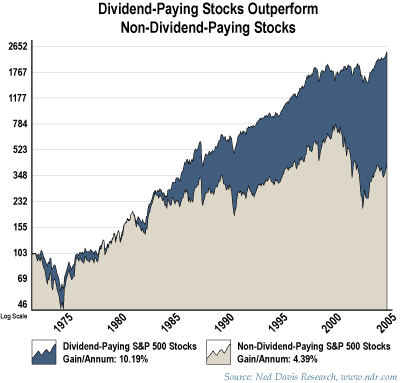
A very common misconception with the investing public is that dividend stocks provide a lower, albeit safer, return on investment. This has helped dividend stocks earn an ill-conceived reputation for being boring. However, the facts present a completely different picture – dividend stocks actually outperform non-dividend stocks by a significant margin over the long term.
The graph below (from Ned Davis Research) clearly illustrates that over a 30 year time horizon, dividend stocks on the S&P500 generated a total return of 10.19% per year compared to the 4.39% generated from non-dividend stocks (a nearly 6% difference). We can also see from the graph that this margin of superior performance has widened in the more recent years.
Dividend Stocks Can Pay Investor’s for Being Patient – You Get Paid As You Wait
Patience is a virtue when it comes to investing, but dividends give investors a reason to be patient, even when the market is not performing. You can wait years for a good company to complete their growth plans, become accepted by the market, or to rise out of a downturn. If they are not issuing a dividend however, you may not be making a return. But if you are being paid a dividend, you are being paid to be patient. If the company struggles with any kind of market head winds, you are continuing to earn a real return on your investment.
Dividends Can Help to Provide Price Support for a Stock during ‘Bear’ Markets
A regular and safe dividend can also provide price support for a company’s stock. During a market downturn, a good company can be punished even if the financials remain intact. If the market is bearish, investors can lose short-term reasons to own non-dividend stocks. In such circumstances, the stock price will typically fall. Why own a stock in the short term if the market is against you? But a company with a stable or growing dividend presents a very compelling reason for ownership – even in a bear market – the more compelling the reason, the more stable the company’s stock price.
Dividend Stocks Can Provide Investors with Growth as Well as Regular Cash Flow
Another common misconception about dividend stocks is that they are pure yield investments – meaning that while they provide a dividend, they also provide little or no potential for stock price appreciation. Once again, this notion is false. There are select opportunities in the market that not only pay a generous dividend, but also retain cash for re-investment into the operating business. This allows the company to grow their earnings and in turn increase the distribution on a regular basis – these are referred to as dividend growth stocks. Not only are you receiving a higher dividend (and yield) after every increase, but you will also likely see the value of your stock price increase as well.
In short, dividends should make up a core source of return in any investor’s portfolio. The companies that pay dividends truly come in all shapes and sizes. For those investors that are truly committed to growing their wealth over time while controlling risk, allocating a reasonable percentage of capital to dividend investing is not just prudent, it is fundamentally essential.
For investors interested in learning more about how KeyStone Financial can help add dividend growth stocks to a portfolio, go to our Income Stock Report website (www.incomestockreport.com) or email us at subscriptions@keystocks.com.
Looniversity – Debt Vs. Equity Analysts
In investing circles, there are two broad categories of analysts – debt and equity analysts. Debt analysts are known to take a fine-toothed comb to company financials, poring over balance sheets and profit-loss statements. Since they are paid to warn clients whether a company has adequate cash to make its debt payments, they are often ahead of the pack in predicting trouble.
Equity analysts, on the other hand, are more focused on a company’s growth outlook. What are the catalysts that will help earnings? Does the company boast product-line changes that will translate into revenue increases? Most important, will the market reward those trends by bidding up the stock’s price? While it is oversimplification, equities analysts tend to look at the upside, whereas debt analysts tend to look at the downside.
Now the question becomes – which group should investors heed? Experts say each can provide value, but together, they can give a much fuller picture of a company. However, each can have their biases in regards to the company they are assessing (corporate financing). So read each group’s comments, compare them, and take them with a solid grain of salt.
Put it to Us?
Q. Can a company pay or declare a dividend that exceeds its earnings per share?
– Ian Hunt; Calgary, Alberta
A. Indeed, they can. In fact, many of the world’s most well-known companies have paid dividends in years where they posted negative earnings per share! While this is not a practice that is viable long term, near term, when it comes to declaring and paying dividends, current earnings per share has nothing directly to do with whether a company is able to pay a dividend. Particularly in reference to companies that operate in cyclical industries, we see situations where a company has a string of more profitable (high EPS) years, in which it sets aside cash to pay future dividends, affording it the luxury to maintain its payments in down years or years where EPS is lower than its dividend. In the near term, what matters in reference to paying is that dividends are “retained earnings” and available cash. Having said this, we would pay particular attention to cash flow and free cash flow long term. A company cannot continue to pay out dividends that exceed cash flow over the long haul.
KeyStone’s Latest Reports Section
- Q1 2011 Revenues Surge for China-based Agricultural Manufacturer, Earnings Meet Expectations, 2011 Set-up for Breakthrough in Q2-Q4 (risk level remains higher) – Rating Maintained (Flash Update)
- Auto-Tech Manufacturer With Solid EPS Growth, Strong Balance Sheet Benefits From Strong Light Vehicle Production & Introduction of New or Refreshed Vehicles – Initiate Coverage (Focus BUY) (New Buy Report)
- Oil & Gas Service Company Posts Strong Q1, Risk Remains on Balance Sheet – Poised for Solid Second Half of 2011 (Flash Update)
- IP Company’s 2011 EPS Meets Expectations, Hold Strong Cash Position, & Yields 3.6% – Short-Term Cost Increase Leads to Long-Term Opportunity – Maintain Rating (Flash Update)
- China-based Fertilizer Stock Posts Q4 2011 Slightly Below Expected, Growth Expected into 2012, Fear Creates Buying Opportunity (Flash Update)
The Legendary Richard Russell (86yrs old) has made his subscribers fortunes. He made a fortune for his subscribers in Gold in the original run from the 30’s to $850, got his subribers into Gold at $300 & below and still bullish @ $1,500 today. One of the best values anywhere in the financial world at only a $300 subscription to get his DAILY report for a year. HERE to subscribe.
First, from Richard Russell, Clive Maund below:
Gold – From its July 1st low of 1482, gold has risen almost in a straight line to July 13th high of 1585, a spectacular rise of 103 points. Obviously, gold is in need of a rest or even a correction.
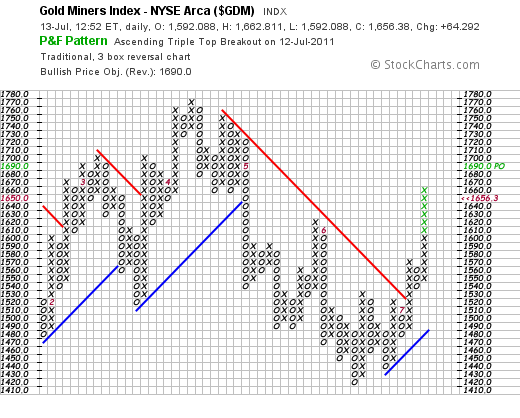
For long-suffering holders of gold mining stocks, however, “green shoots” (remember them?) are beginning to show. Below we see GDM, the gold miners index, shooting high into the 1600s and bettering by a wide margin its preceding peak. Score a big gold star for the gold miners.
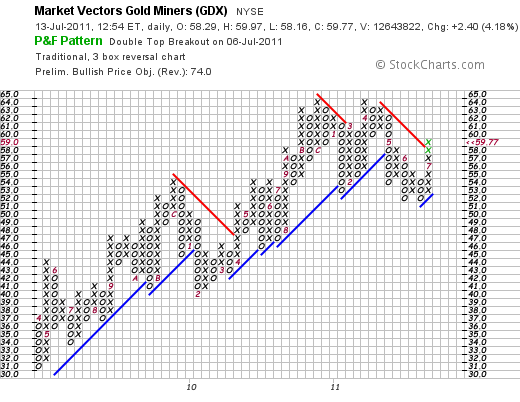
A second look at the gold mining stocks is provided by this P&F chart of GDX. Here we see an upside breakout with a P&F target of 74.
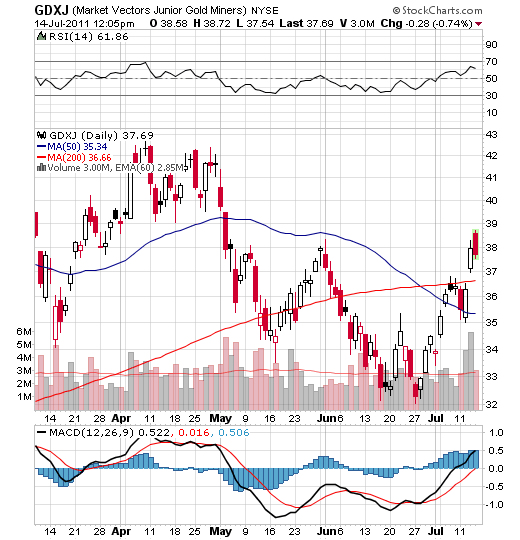
Finally, just to emphasize the situation, I have included a chart below of GDXJ, the “junior gold mining index. Here we see that GDXJ has bounded above both its 50 and its 200-day moving averages, always a bullish move.
More on gold — This morning (July 14th) August gold climbed as high as 1594.10. Then came a little intra-day correction, taking August gold slightly to the minus side. As I write gold is again on the plus side, up 1.80 to 1587.40. Either way, gold is fluctuating around an all-time record high. But gold is digesting its enormous gains since July 1. August gold has closed higher six of the last eight trading sessions. Time for a rest?
One of the best values anywhere in the financial world, Dow Theory Letters at only a $300 subscription to get his DAILY report for a year. HERE to subscribe.
Gold Market Update
by Clive Maund
On Wednesday gold broke out from a 10-week long box or rectangular consolidation pattern to commence its next major upleg. Fundamentally this coincided with noises emanating from the US to the effect that it is recognized that there is no alternative but to continue with QE. Denials later in the day caused the broad stockmarket to lose much of its gains, but the fact is that there is no alternative to QE, except a global systemic economic implosion, and thus, there is no alternative to QE, although attempts may be made to disguise the extent of it.
On our 6-month chart we can see gold’s breakout and how, after 7 days of gains, it is starting to become overbought. However, apart from brief pauses to partially unwind the overbought condition, it is expected to continue to advance strongly in coming weeks and months, overbought or not, and this positive outlook is reinforced by the strongly bullish picture for silver and Precious Metals stocks.
…click HERE to view all charts and comments
-
I know Mike is a very solid investor and respect his opinions very much. So if he says pay attention to this or that - I will.
~ Dale G.
-
I've started managing my own investments so view Michael's site as a one-stop shop from which to get information and perspectives.
~ Dave E.
-
Michael offers easy reading, honest, common sense information that anyone can use in a practical manner.
~ der_al.
-
A sane voice in a scrambled investment world.
~ Ed R.
Inside Edge Pro Contributors

Greg Weldon

Josef Schachter

Tyler Bollhorn

Ryan Irvine

Paul Beattie

Martin Straith

Patrick Ceresna

Mark Leibovit

James Thorne

Victor Adair