
Uncategorized
If you are new to investing in the gold market and do not know where to start, the opportunity might be just around the corner. Based on both fundamental and technical analysis, gold is predicted to hit $1,500 an ounce by the end of the year.
On its way to hit new records, however, there will be price corrections and pullbacks. These will be the times to hop onto the profit train with less risk. In this article we examine a strategy to enter into a long position of some gold mining stocks.
The buy price targets are based on strong support levels and trades have a lot of upside potential with minimum risk. In this gold bull market, these targets may not be triggered. But a strategy based on patience can be quite rewarding.
….for the 3 Gold Stocks, two Major’s and one Junior read on HERE
I am an affiliate of INO, a website which is geared to individual investors. I haven’t posted much from their site here but I thought their latest video on gold was interesting so I’ll say a few words about it. (disclosure: as an affiliate I receive a fee for referring customers).
Last month I wrote the following about gold:
I have been concerned about the medium-term risk/reward on both sides of this trade. Gold was hitting new highs every day for two weeks as of yesterday. And the ten-year bond, while well off its 2010 low yield of 2.48, still has an unfavourable risk/reward now. James Montier says it best:
http://www.kitco.com/ind/Schiff/oct182010.html
To read the full article from the beginning go HERE
Let me tell you why in 2000, I invested all my money in junior precious metals stocks (highly speculative according to the ‘Risk Tolerance’ criteria at my brokerage firm, and I suspect, at just about every other brokerage firm, as well) ) and in so doing I was extremely confident that I had minimized my exposure to risk. By the way, my investment account has averaged an annual rate of return of about 75% over the past ten years.
It boiled down to the fact that I was absolutely confident that I knew exactly where we were positioned in The Kondratieff Cycle. I knew that we were at the end of the great autumn bull market in stocks (1982-2000). This determination would herald the onset of winter. This is the deflationary/depression season of the cycle, when debt is virtually expunged from the economy. That process of debt elimination, I knew, would be very painful to debtors and creditors alike and would cause severe problems within the banking system. This, I also knew, would be very bullish for gold. Moreover, I knew that following the peak of the great autumn bull market in stocks, we would experience a vicious winter bear market in equities. So, in early 2000 the risk criteria should have been changed to reflect a gold bull market and a stock bear market. Hence, investing in any gold shares should now have been evaluated as ‘low risk’ and investing in ‘blue chip’ stocks should have been considered very high risk. As it turned out, these evaluations would have been appropriate. Because of my understanding of the Kondratieff Cycle, that is how I saw the markets unfolding and that is why I invested accordingly. This considered ‘High Risk’ strategy was actually, for me, very low risk. It has afforded me significant capital gains since 2000, despite the 2008 stock market debacle.
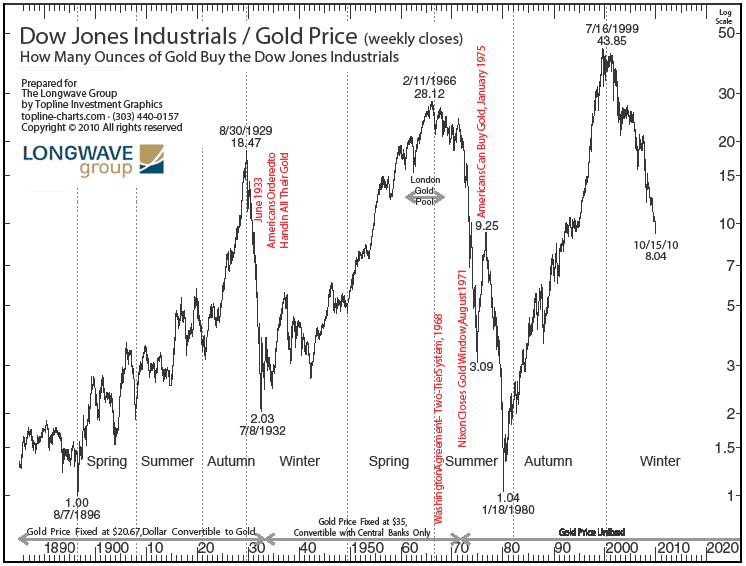
Reinforcing my conviction, there was another metric that I was watching, which signaled we were at the beginning of a huge bull market for gold and a devastating bear market for stocks; that was the Dow/Gold ratio. (The Dow Jones industrial Average divided by the price of an ounce of gold). This ratio has always reached an extreme high, when stocks performed well and gold performed poorly, such as in the Kondratieff spring and autumn. Correspondingly, this ratio has always reached an extreme low when the price of gold performs well, and stock prices perform poorly, as in winter and summer. This ratio reached a peak, much higher than any previous peak, as in 1929 and 1966, at 43.85 in July 1999. That peak also, was a signal that stock prices and the gold price were about to reverse direction; stocks to the downside and gold to the upside. (See Ian’s Insights Issue 1, Volume 1)
But why junior gold stocks? Wouldn’t the senior gold stocks perform just as well? Well, actually not. If you can buy the right juniors at the right time, their price will outperform their senior counterparts. (In an upcoming Winter Warning, available only to subscribers, I will outline how I manage my investment accounts and the criteria I use to select specific junior companies). As the gold bull market got underway you could buy junior gold mining companies with gold in the ground assets for ridiculously low prices. Share prices of companies such as Minefinders, Pelanagio, Nevsun and many others, all with gold in the ground, increased tenfold or more. There are still junior gold companies with significant gold in the ground assets which can be purchased very cheaply today.
What now? I am still almost 100% fully invested in junior gold mining shares. I have included a few short positions in the portfolio through inverse ETFs because the real monetary, economic and financial chaos brought about by the greatest debt bubble in history still lies in the future. When that chaos unfolds, the worldwide rush to own gold and gold mining shares will take prices far beyond where they are today. Owning these shares in such an environment is still, as I see it, a very low risk. Oh, and another thing, the Dow/Gold ratio is nowhere near its past lows, which has been 1. It is now about 8 having dropped from that 1999 high of 43.85 However, I think the extreme low on the index will be around a quarter to one; that is a quarter of an ounce of gold will buy the Dow Jones Industrial Average. Investing in anything (stocks, long-term bonds, real estate and commodities), other than gold bullion, gold mining shares and preferably, junior gold mining shares is, at this time, a very high risk investment strategy. Nonetheless, we doubt that equity analysts and investment advisors will agree with us.
###
Ian Gordon
website: www.longwavegroup.com
email: info@longwavegroup.com
Dec. gold dropped over 30 dollars on the opening this morning. Looking at the daily chart I note that GLD (a proxy for gold) is still holding above its rising bullish trendline. To violate that trendline, GLD would have to close below 128. That has not happened, at least not so far. Note RSI is in the heavily overbought position. And RSI has been there for a few months.
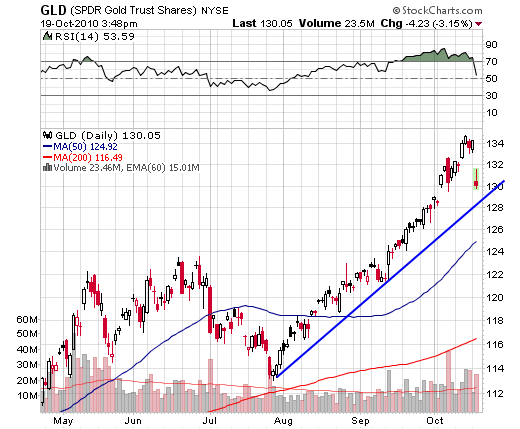
“No tree grows to the sky.” Gold has risen an astounding ten out of the last eleven weeks (see weekly chart below). Therefore, it’s only natural that traders are betting for a correction. For this reason, gold is down almost every night in the after-market as traders ready themselves for the long expected correction — the correction that never seemed to come. However, the fact is that gold is heavily overbought and the dollar is extremely oversold. I’m thinking that the resolution of this puzzle could be an extended period of consolidation in gold, in other words, a long sideways movement, preparatory to the next upward leg in gold. Consolidations often start with a sharp break, such as the one we witnessed today.
Closing comments:
Nasty day with almost everything down, down and down. My PTI was down 6 leaving it bullish by 28 (the high was bullish by 39). The Dow held above 10900, which was hopeful, but then we have Wednesday through Friday to think (worry) about. Today’s internals weren’t pretty. On the NYSE 570 issues closed higher, 2484 closed loser. There were 87 new highs and 7 new lows. Down volume was 90% of up + down volume. So it was a 90% panic type day. Normally, after a 90% down-day, there’ll be a two to seven day automatic rebound in stocks.
The oversold Dollar Index rose 1.28 to 78.21. Treasuries were a bit higher. Dec.gold plunged 36.10 to 1336, but still holding above 1300 (see charts above). Dec.silver was down 0.63 to 23.78. Jan. platinum was down 20.70 1677.60. Everything in the precious metals universe was down as the dollar rallied.
What does it all mean? Honestly, it’s too early to tell. But I will say this; today’s dreadful action is not going to help consumers’ sentiment. Think about that, Misters Obama and Bernanke. Anybody want to buy anything?
Comment — I take it that my subscribers are out of stocks, so all we have to worry about is gold and the world of precious metals. Gold has relative strength working for it — and what do you have, sir?
The biggest question of the day (Russell’s day, because it doesn’t seem as if anyone else is taking it seriously) is the dying dollar. While this is going on, here is an up-dated chart of the Dollar Index. Thus, you don’t have to take my word for it, you can just study the chart (ugh). Note that we are about to receive a “death cross” on the dollar as the 50-day MA drops below the 200-day MA. – Richard Russell One of the best values anywhere in the financial world at only a $300 a year, to get his DAILY Dow Theory Letters subscription HERE
-
I know Mike is a very solid investor and respect his opinions very much. So if he says pay attention to this or that - I will.
~ Dale G.
-
I've started managing my own investments so view Michael's site as a one-stop shop from which to get information and perspectives.
~ Dave E.
-
Michael offers easy reading, honest, common sense information that anyone can use in a practical manner.
~ der_al.
-
A sane voice in a scrambled investment world.
~ Ed R.
Inside Edge Pro Contributors

Greg Weldon

Josef Schachter

Tyler Bollhorn

Ryan Irvine

Paul Beattie

Martin Straith

Patrick Ceresna

Mark Leibovit

James Thorne

Victor Adair