
Uncategorized
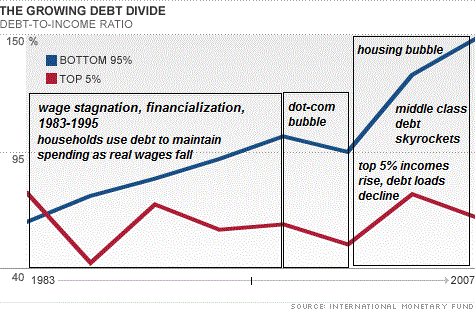
The essence of debt serfdom is debt rises to compensate for stagnant wages.
I often speak of debt serfdom; here it is, captured in a single chart. The basic dynamics are all here, if you read between the lines:
1. Financialization of the U.S. and global economies diverts income to capital and those benefitting from globalization/ “financial innovation;” income for the top 5% rises spectacularly in real terms even as wages stagnate or decline for the bottom 80%.
2. Previously middle class households (or those who perceive themselves as middle class) compensate for stagnating incomes and rising costs by borrowing money: credit cards, auto loans, student loans, etc. In effect, debt is substituted for income.
3. The dot-com/Internet boom boosted incomes across the board, enabling the bottom 95% to deleverage some of the debt.
4. When the investment/speculation bubble popped, incomes again declined, and households borrowed heavily against their primary asset, the home, via home equity lines of credit (HELOCs), second mortgages, etc.
5. The incomes of the top 5% rose enough that these households could actually reduce their debt (deleverage) even before the housing bubble popped.
To Read More CLICK HERE
It’s a multi-dimensional question.
The left says yes — income inequality has soared in recent years, and the way to address it (supposedly) is to tax the rich and capital gains at a higher rate. The right says no — that the rich already create more jobs and wealth, because they spend more money, and why (supposedly) should they pay more tax when they already pay far higher figures than lower-income workers?
Paul Krugman made the point yesterday that the tax rate on the top earners during the post-war boom was 91%, seeming to infer that a return to such rates would be good for the economy.
Yet if we want to raise more revenue, historically it doesn’t really seem to matter what the top tax rate is:
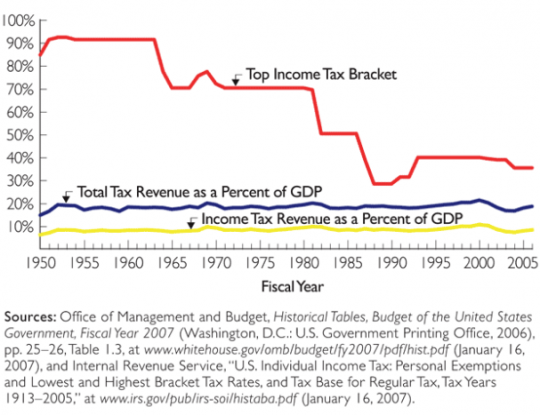
Federal revenues have hovered close to 20% of GDP whatever the tax rate on the richest few.
This seems to be because of what is known as the Laffer-Khaldun effect: the higher rates go, the more incentive for tax avoidance and tax evasion.
And while income inequality has risen in recent years, the top-earners share of tax revenue has risen in step:
To Read More CLICK HERE
You know of course its now Presidential Season down in the United States and one of the themes that’s carried through is the “Tax the Rich” scheme that was put forward by the Occupy Wall Street movement. My question is always “was always is there any room for research”? In this case I think it was again “no” which resulted in an embarrassing moment for President Obama last week.
Obama wants to impose an effective minimum tax rate of 30% on incomes for anyone who makes more than a million. I might add its already 26% I’ll leave that aside.
Obama said he was doing it to stabilize the debt and deficits over the next decade in the U.S.. Welllll…. unfortunately Obama’s own treasury department did the numbers and they determined that the rise in taxes would raise somewhere in the neighborhood of 5 billion dollars a year……or less than 1/2 of 1% of the projected 1.2 Trillion dollar deficit for this year. I mean its just not a big deal but here’s the killer. If they do that for 10 years Obama’s tax will raise 47 billion dollars but their deficit (not including unfunded liabilities!) will be 45 Trillion dollars! So for all the foo-far-aw and all of the political stuff and spin that you’re getting down there it literally hits their deficit by 1/10th of 1%. That’s all. And yet look at all of the talk that Obama’s move is going to be the thing, because the Key In Politics is to suggest that there are easy solutions and other people’s money will do it.
Well in this case Obama’s own Treasury Department really put the Kibosh on that one.
It was an embarrassing moment.
-
I know Mike is a very solid investor and respect his opinions very much. So if he says pay attention to this or that - I will.
~ Dale G.
-
I've started managing my own investments so view Michael's site as a one-stop shop from which to get information and perspectives.
~ Dave E.
-
Michael offers easy reading, honest, common sense information that anyone can use in a practical manner.
~ der_al.
-
A sane voice in a scrambled investment world.
~ Ed R.
Inside Edge Pro Contributors

Greg Weldon

Josef Schachter

Tyler Bollhorn

Ryan Irvine

Paul Beattie

Martin Straith

Patrick Ceresna

Mark Leibovit

James Thorne

Victor Adair