Uncategorized

Scant Evidence That Salt Raises Blood Pressure

Salt360x215The evidence for health benefits associated with salt reduction is controversial and the “concealment of scientific uncertainty” is a mistake, researchers suggested.

Controversy about what effect too much sodium intake has on the body goes back to the early part of the 20th century, according to Ronald Bayer, PhD, and colleagues from Columbia University Mailman School of Public Health in New York City.

But in the last few years, the discourse has reached a fever pitch, they wrote online inHealth Affairs.

In 2011, for example, the Journal of the American Medical Association published a study by Stolarz-Skrzypek et al. that found only a weak correlation between salt and blood pressure. An editorial in the Lancet lambasted the JAMA study as “disappointingly weak” and “likely to confuse public perceptions of the importance of salt as a risk factor for high blood pressure, heart disease, and stroke.”

Also in 2011……

…..read more HERE

Government securities are the default safe haven in times of heightened risk aversion. But what happens when Government finances are the cause of the tension? Where are the safe havens then? 
 
I wrote a few weeks ago that I feared a Great Disorder and that I remain bullish on ‘safe havens’. But what exactly are suitable safe havens for such a circumstance? 
 
What constitutes a ‘safe haven’ changes over time. It’s important to remember not only that government bonds aren’t always the market’s safe haven, but that that there will always be a safe haven somewhere. For all the headlines about the billions wiped off stock market values during market routs, that money had to go somewhere. It doesn’t just disappear. It will go into whatever the safe haven is, which in normal times will be bonds. But what happens when government bonds themselves fall victim to the primary ills of the day? In the 1970s, bonds were no place to seek refuge from the inflation and so the safe haven mantle passed to gold. This is one reason I remain a gold bull. 
 
The eurozone throws up other interesting examples. Before the crisis, Spanish investors, for example, would normally have considered their sovereign bonds a safe haven on ‘risk-off’ days. But that stopped working when their sovereigns became the source of risk rather than a shelter from it. German bonds undoubtedly caught some of that safe haven bid, but did the very high quality, zero debt, local-champion-made-good retailer Inditex catch a similar bid too? 
 
A similar picture emerges with the standard quality equity names in countries afflicted by the eurozone sovereign crisis. For example, Hellenic Bottling (Greece), Luxoticca (Italy) and Kerry Group (Ireland) all followed a similar pattern, outperforming their domestic equity indices and performing the safe haven role vacated by their government bonds. 
 
So besides gold, another candidate for safe haven status in the event government bonds become unreliable are equity securities in high quality and robust businesses. I therefore remain very bullish on these too. 
 
Expected returns should be consistent with the long-run average return for quality equities, which has been around 6-7%. That’s hardly a once in a lifetime return, but for now, and for a potential safe haven I find it quite attractive because it comes with an embedded robustness. Suppose I’m all wrong in my fears. Suppose that we go all Japanese and the next decades are low-growth environments.  A 6-7% return isn’t a bad prospect at all. 
 
Now suppose I am right, and government bonds cease acting as safe havens. Owning such equities implies owning the new safe havens (especially if the rest of the portfolio is made up of cash and gold). So we’re on high ground with this strategy, and have a degree of robustness to the reality that we just don’t know what the future holds. That doesn’t guarantee survival from the worst case scenario, but it gives a better chance.

Economic Madness & The Lack Of Global Warming

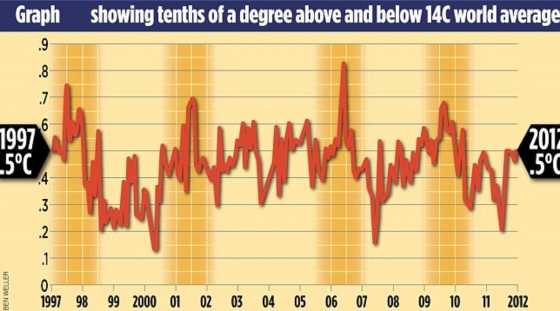
Climate change conferences come and go, with repeated attempts by the World Statists to set up International governance to manage a non-existent problem. As Lord Christopher Monckton of Brenchley reports from the latest Hot Air fest in Doha, Man-made Global Warming has been almost exclusively confined to the Intergovernmental Panel on Climate Change (IPeCaC) conferences, and there’s been precious little of it “in the wild”. Read his report.

Oops graph shows no warming 16 years-560x311-1

‘A complete economic transformation of the world’

Lord Christopher Monckton of Brenchley reports from Doha

At each event I asked the obvious question: ‘After 16 years without global warming, how confident are you that the official predictions of doom have not been overblown?’ — ‘A shrewish spokesman for the Gaia Foundation replied: “Why should we answer that? You’re a well-known climate denier.” Ma’am, 0 out of 10 for scientific rigor’

…..read more HERE

A carbon tax is climatically useless

by 

 Guest post by Chipp Knappenberger – reposted from Master Resource by request

“No matter how much you pay with a carbon levy, virtually nothing is received climatically…. No matter the level of domestic action that we take, it will pale in comparison to the rapid expansion of carbon dioxide emissions in other parts of the world.”

How much global warming will result from U.S. emissions over the course of this century, and how much of that could be prevented by a carbon tax? These two questions have the same simple answer—virtually none. One or two tenths of a degree a century out with–and without–a carbon tax makes the whole climate debate a peculiar exercise.

.…read more HERE


After the phony cliff, we face the terrifying one.

Last week, Fareed Zakaria and Charles Krauthammer appeared in Toronto (where I live much of the time), and while I did not go to their main debate, I went to a tasting of it at a luncheon. There was, I regret to write, as a longstanding friend of both of them, a surreal aspect to the exchange. After the usual compliments one exchanges (as I know from my time on that circuit), they embarked on a dialogue of the deaf, and a mutual flight, joined at the wingtip like Jurassic pterodactyls, soaring above the mighty chasm of American fiscal problems below. The otherworldly discussion of whether the Republican leaders in Congress will reach an agreement with the president about the automatic expiration of the Bush tax cuts of a decade ago vastly overshadowed the issue of reinserting spontaneous growth into the U.S. economy and grappling with the deficit at last.

…..read more HERE

Cheetahs are the fastest runners (60mph) on the planet. 

Using a Phantom camera filming at 1200 frames per second while zooming beside a sprinting cheetah, this team captured every nuance of the cat’s movement as it reached top speeds of 60+ miles per hour.

The extraordinary footage that follows is a compilation of multiple runs by five cheetahs during three days of filming.

Ed Notes: 

1. for a full screen image (very very highly recommended) click on the 4 arrows at the lower right hand side of the video (beside  HD) below.

2. An amazing slow motion shot of the Cheetah almost catching its prey claws extended at the 2:25 mark.

3. To see the Cheetah running at an astonishing 60mph and capturing its prey go to minute 6:10 forward. 

Update: Turns out multiple youtube presentations have caused National Geographic to take down the video I had posted here. You can go to the National Geographic site here – Cheetahs on the Edge–Director’s Cut from Gregory Wilson on Vimeo.

test-php-789