
Uncategorized
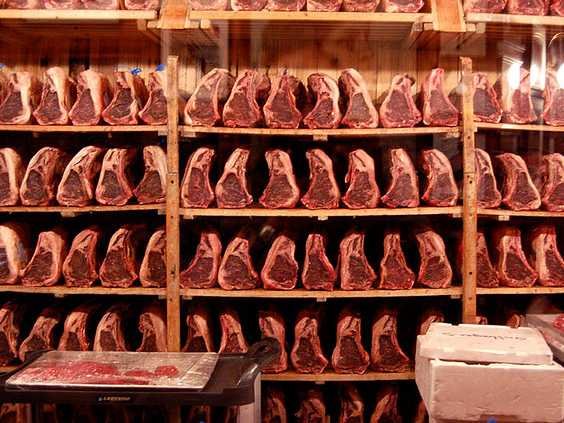
Hot Summer Nights & Great Steaks! This master chef tells you exactly how to impress your stomach & guests…..
A Master Chef Shares 11 Tips For Grilling The Perfect Steak At Home
There is nothing better than a steak done the right way.
Earlier this year we met Chef Michael Lomonaco of Porter House New York, a classic American-style steakhouse, who shared some of his key grilling tips.
He showed us how to select the right piece of meat, how long to cook it for, and how to take care of your grill.
Chef Lomonaco walked us through some of the important terms and concepts you need to understand to cook delicious steaks right at home.
The terms “prime meat” and “dry-aged” really do matter when it comes to quality.
…..read tips 2 thru 11 HERE
 Our friend and mentor Michael Campbell’s daughter Courtney is a finalist in SportsNet’s search for Canada’s Next Sportscaster and she needs your vote!
No, there is something even stranger…..
(Mike’s Goofy begins at the 34:51 mark)
{mp3}mtjune29goofytwo{/mp3}
 Research shows that more stuff does not make you happier, but regularly giving to people without does make you happier. Why? Because empathy is strong in humans and you feel better when you cultivate it and act upon it.
How Money Actually Buys Happiness
by Elizabeth Dunn and Michael Norton | 12:00 PM June 28, 2013
Warren Buffett’s advice about money has been scrutinized — and implemented — by savvy investors all over the world. But while most people know they can benefit from expert help to make money, they think they already know how to spend money to reap the most happiness. As a result, they follow their intuitions, using their money to buy things they think will make them happy, from televisions to cars to houses to second houses and beyond.
The problem with this approach is that a decade of research — conducted by us and our colleagues — demonstrates that our intuitions about how to turn money into happiness are misguided at best and dead-wrong at worst. Those televisions, cars, and houses? They have almost no impact on our happiness. The good news is that we now know what kind of spending does enhance our happiness — insight that’s valuable to consumers and companies alike.
Buffet recently penned an op-ed titled “My Philanthropic Pledge” — but rather than offer financial advice about giving, he suggested we give as a way to enhance our emotional wellbeing. Of his decision to donate 99% of his wealth to charity, Buffett said that he “couldn’t be happier.”
But do we need to give away billions like Buffet in order to experience that warm glow? Luckily for us ordinary folks, even more modest forms of generosity can make us happy. In a series of experiments, we’ve found that asking people to spend money on others — from giving to charity to buying gifts for friends and family — reliably makes them happier than spending that same money on themselves.
And our research shows that even in very poor countries like India and Uganda — where many people are struggling to meet their basic needs — individuals who reflected on giving to others were happier than those who reflected on spending on themselves. What’s more, spending even a few dollars on someone else can trigger a boost in happiness. In one study, we found that asking people to spend as little as $5 on someone else over the course of a day made them happier at the end of that day than people who spent the $5 on themselves.
Smart managers are using the power of investing in others to increase the happiness of their employees. Google, for example, offers a compelling “bonus” plan for employees. The company maintains a fund whereby any employee can nominate another employee to receive a $150 bonus. Given the average salaries at Google, a $150 bonus is small change. But the nature of the bonus — one employee giving a bonus to another rather than demanding that bonus for himself — can have a large emotional payoff.
Investing in others can also influence customers. Managers at an amusement park were unable to convince patrons to buy pictures of themselves on one of the park’s many rides. Less than one percent purchased the photo at the usual $12.95 price. But researchers tried a clever variation. Other customers were allowed to pay whatever they wanted (including $0) for a photo, but were told that half of what they paid would be sent to charity. Now, buying the picture allows the customer not only to take home a souvenir, but also invest in others. Given this option, nearly 4.5% of customers purchased the photo, and paid an average of more than $5. As a result, the firm’s profit-per-rider increased fourfold.
Warren Buffett, happiness guru. Just as we have taken his advice on making money, research suggests we should now take his advice on making happiness. By rethinking how we spend our money — even as little as $5 — we can reap more happiness for every dollar we spend. And Buffett’s happiness advice comes with a financial payoff as well. By maximizing the happiness that employees and customers get from every dollar they receive in bonuses or spend on products, companies can increase employee and customer satisfaction — and benefit the bottom line.
 It’s been a given that China will grow. Everyone knows that. It’s got to grow to maintain social stability. The catch is that any seasoned investor gets suspicious of things that “everybody knows.”
Chinese demand for commodities has been key to Canada avoiding the economic slump that has gripped much of Europe and the US. Rising commodity prices have had a massive impact on government revenues, employment and general prosperity in many parts of Canada. But what if China is about to go into a more severe correction?
I’ve written and broadcast for several months that China’s domestic credit problems scare the heck out of me. Below you’ll find the conclusions by Barclay’s Bank that China’s economic engine is about to slow down and with it brings the promise of social unrest.
We’ve already seen the impact of slowing demand for commodities on stocks and economic growth in Canada. At the least this is a warning shot across the bow for investors to make sure they are not over exposed in terms of risk. – MC
Demand for Commodities Down
On China – Barclay’s concludes, “In the short run, such rebalancing and deleveraging point to further downside risks for both economic growth and asset prices, including the exchange rate. Based on an increasingly likely downside scenario, we think Chinese growth could experience a temporary ‘hard landing’, which we would define as quarterly growth dropping to 3% or below, within the next three years.
There is a problem with this: as most know, the social stability GDP cut off floor is around 5.5 – 6.5%: anything below that, or the minimum growth rate required to preserve social cohesion and stability, and the riots begin. 3% growth means widespread looting, and millions of angry Chinese roaming the streets, an outcome that the Politburo will stop at all costs.
The Contrary View – JP Morgan and Goldman Sachs are Bullish
Both JP Morgan and Goldman Sachs think that commodity stocks have fallen far enough. I wouldn’t classify either as outright bullish but both feel the decline in the sector is overdone and now may have upside potential.
Of course time will tell which side is right. My own take is that once again it comes down to the central banks. If China’s bank becomes more aggressive in the face of growing social discord then it can push the problem down the road and juice commodities on the shorter term.
Investor must first decide what level of exposure is appropriate in terms of risk and then act accordingly. It’s a lot easier to put a toe in the water if you are under invested given two contrary views but if you are already positioned then you don’t have the leeway in terms of risk to add.
JPMorgan
JP Morgan has recommended an underweight position in commodities as an asset class since November, 2011, but now that view has changed. “We move to recommend a net long, overweight exposure for institutional investors (in commodities) for the first time in more than two years,” JP Morgan said.
“Like other global markets, commodity prices are buckling on rising concerns about China and the Federal Reserve. It is important to be specific about what these concerns are. The new fears are not that Chinese growth is slowing or that the US central bank will taper its QE3 asset purchases. Both are inevitable outcomes that have long been embedded in commodity forward curves.
The actual concerns are: (1) the large shadow banking sector in China might soon trigger an unexpected financial crisis, like the one that emerged in Asia in July of 1997, and (2) the FOMC might simultaneously be making a policy mistake in putting its own growth and inflation forecasts ahead of the markets’ fear about Chinese finance and the evidence that disinflation in the real economy is bulldozing inflation expectations in markets. These concerns are legitimate. A sturdily low-vol commodity regime has suddenly been asked to assign probabilities to these two scenarios. Neither is a zero probability. Nor is either likely a baseline outcome in 2013.”
“The last time we recommended moving to overweight was on September 30, 2010, or about a month ahead of the announcement of QE2 on November 3, 2010. In the nine months that followed (we turned neutral in June 2011), the S&P GSCI total return index produced a 16.5% total return against a 14.9% total return for global equities and a 2.5% total return for global bonds.”
“… metals prices have reached levels that are demonstrably forcing involuntary production cuts and fresh demand. Against one-sided sentiment and following 15 months of destocking, Chinese buyers are going to realize very soon this is the opportune moment to back up the truck and to restock supply channels where China is import dependent. A surge in Chinese buying of a metal at a lower price has already been observed in gold. We expect renewed vigor in imports of copper and oil. It is quite obvious what the Chinese should do here in physical markets, in pursuit of China’s long-run economic and social self-interest.”
-
I know Mike is a very solid investor and respect his opinions very much. So if he says pay attention to this or that - I will.
~ Dale G.
-
I've started managing my own investments so view Michael's site as a one-stop shop from which to get information and perspectives.
~ Dave E.
-
Michael offers easy reading, honest, common sense information that anyone can use in a practical manner.
~ der_al.
-
A sane voice in a scrambled investment world.
~ Ed R.
Inside Edge Pro Contributors

Greg Weldon

Josef Schachter

Tyler Bollhorn

Ryan Irvine

Paul Beattie

Martin Straith

Patrick Ceresna

Mark Leibovit

James Thorne

Victor Adair