
Timing & trends
 The popular belief that the U.S. economy has been steadily recovering has endured months of disappointing data without losing much of its appeal. A deep bench of excuses, ranging from the weather to the Chinese economy, has been called on to justify why the economy hasn’t built up any noticeable steam, and why the Fed has failed to move rates off zero, where they have been for seven years. But the downright dismal September jobs report that was released last Friday may prove to be the flashing red beacon that even the most skilled apologists can’t explain away. The report should make it abundantly clear that we are far closer to recession than recovery. But old notions die hard and, shockingly, most economists still believe that we have hit a temporary speed bump not a brick wall. But at some point healthy hope turns into dangerous delusion. We may have just turned that corner.
To order your copy of Peter Schiff’s latest book, The Real Crash (Fully Revised and Updated): America’s Coming Bankruptcy – How to Save Yourself and Your Country, click here.
For in-depth analysis of this and other investment topics, subscribe to Peter Schiff’s Global Investor newsletter. CLICK HERE for your free subscription.

 The three words in the title sufficiently describe the state of the globes financial markets. Although, directionless might be a little over optimistic given the S&P 500 is down nearly 6 per cent over the last 3 months and the yield on the US 10 year bond has moved from approximately 2.3 per cent to again below 2 per cent for the fifth time this year. The volatility in the markets this week was no doubt prompted by nonfarm payroll numbers out of the US Friday morning. The labour force participation rate is at a low last reached in 1977. And an economy that averaged 260 thousand jobs a month in 2014, a 3-month average from July of this year through September of 167 thousand certainly raises some concerns.
Of course, it relates back to what has the strongest influence on the markets, and that is the zero interest rate policy at the US Fed. Personally, I go back and forth on the debate of whether we overanalyze their policy statements and speeches too intently as it almost seems market participants have lost the ability to think for themselves. As the Fed is data dependent, investors are dependent on the guidance of policy makers. Part of the work of former Chair Ben Bernanke was to increase the transparency of the institution; investors almost have to question whether we demanded too much and bit off more than we could chew, while being inundated with a deluge of information.
The policy setting committee at the US Fed has marginally more certainty than the educated investor whether they’ll raise rates in December of this year, and that is because of the Fed’s data dependency. Moreover, to take the other side of the coin, the availability of Fed officials to deliver speeches and comment on their policy has reinforced the idea of a communications problem from the respective officials. This is especially true as of late when we are potentially on the cusp of a policy shift.
With the September meeting, the Fed cited global concerns impacting their decision to keep interest rates on hold. Following Friday’s jobs report, which is argued by many as the single most important monthly data release for Fed officials, investors have to question whether concerns over the domestic economy are as much an issue as what’s going on outside the US. It does relate back to a question raised when the European Central Bank and Bank of Japan began their monetary stimulus programs as the Fed was withdrawing support, and that is whether the US economy can go at it alone, and be immune to headwinds of global growth.
If anything is evident by the market reaction of the last three months, it’s that monetary policy in the US has failed to suppress financial markets instability. Fed officials have been challenged to lift off zero interest rates, and although in their view economic conditions may not warrant any action just yet, they are unable to put a lid on volatility that has been absent over the last six years.
This is partly due to what is being perceived as an inconsistent message. If the Fed can raise rates by the end of the year, it will be reinforced by a view of sufficient US economic fundamentals. Otherwise, if they don’t, it will question the impact headwinds from a slowing global economy have on the US and North America, which would seem appropriate.
Robert Levy
Border Gold Corp | www.bordergold.com
15234 North Bluff Road, White Rock, BC V4B 3E6
(Tel) 1-604-535-3287
(TF) 1-888-312-2288
(Fax) 1-604-535-3259

1. The Week Begins On A Scary Note
by John Rubino – DollarCollapse.com
The US markets awoke to news of several big, disturbing overseas events. Stock markets around the world were spooked by these and other stories….
2. Jim Rogers: Oil Ignoring Bad News Usually Means a Rebound Is Near
- Rogers sees decline in U.S. output helping stabilize prices
- Investor also sees opportunities in agricultural commodities
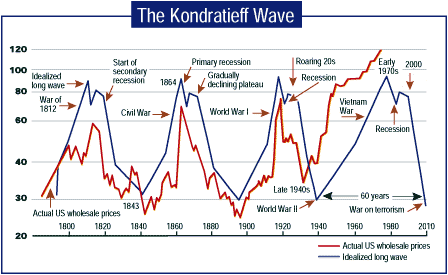 3. Marc Faber: The Kondratieff is a Price Cycle and Interest Rates follow The Kondratieff very closely
 If anyone could demonstrate expertise in “beating the market,” you would think it would be hedge fund managers. They get paid hefty fees (often 2 percent of assets under management plus 20 percent of profits) to generate “alpha.” Successful hedge fund managers make obscene amounts of money. The top hedge fund managers earned in excess of $1 billion in 2014…. CLICK HERE to read the complete article
This article was recommended by Paul Philip and the team and Financial Wealth Builders – www.fwbsecurities.com
 In Part 1 of this article I discussed the catalyst spark which ignited this Fourth Turning and the seemingly delayed regeneracy. In Part 2 I pondered possible Grey Champion prophet generation leaders who could arise during the regeneracy. In Part 3 I will focus on the economic channel of distress which is likely to be the primary driving force in the next phase of this Crisis.

-
I know Mike is a very solid investor and respect his opinions very much. So if he says pay attention to this or that - I will.
~ Dale G.
-
I've started managing my own investments so view Michael's site as a one-stop shop from which to get information and perspectives.
~ Dave E.
-
Michael offers easy reading, honest, common sense information that anyone can use in a practical manner.
~ der_al.
-
A sane voice in a scrambled investment world.
~ Ed R.
Inside Edge Pro Contributors

Greg Weldon

Josef Schachter

Tyler Bollhorn

Ryan Irvine

Paul Beattie

Martin Straith

Patrick Ceresna

Mark Leibovit

James Thorne

Victor Adair