
Stocks & Equities
Bearish rhetoric is once more reaching extremes FOLLOWING the tumbling of stocks to new recent lows, a decline that many market commentators have once more latched onto as a consequence of Fed Tapering of QE or more accurately money printing, this despite the fact that the stocks soared in response to the last December Taper decision which was a surprise for the markets whilst the January Taper move was expected.
Whilst at the present time I remain firmly immersed in the analysis of the housing markets as I attempt to get my latest ebook in the exponential inflation mega-trend series completed this month, as I have plowed most of my wealth into the UK housing market since early 2012.
However, I do still retain a sizeable 18% of assets invested in the stock market, so like most out there it would be useful to know whether the current sell off is a buying opportunity or not or whether it is an harbinger of the dreaded trend change that I have yet to acknowledge as a termination of the bull market trend that I have backed for the past 5 years duration of this stocks stealth bull market that began in March 2009 (Stealth Bull Market Follows Stocks Bear Market Bottom at Dow 6,470 ).
So first I refer to my last analysis of the stock market of mid November 2013 which laid out my expectations for the Dow over the following 4 months into early March 2014 as excerpted below –
11 Nov 2013 – Stock Market Forecast 2014 Crash or Rally? Drone Wars and the Nuclear Apocalypse
I expect the Stock market to break above the upper channel of Dow 15,770 and be trading above 16,000 by late December. Furthermore my analysis suggests that despite a volatile January that will likely bring forward many bankrupt doom merchants, the stock market will likely continue its rally into March 2014, when it is highly probable that the Dow will be trading above 17,000!

….continue reading HERE

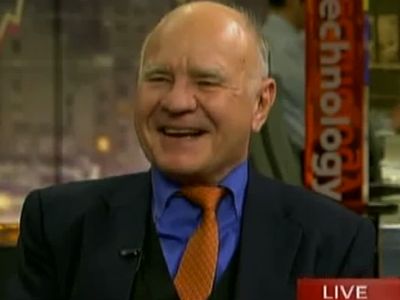 What I recommend to clients and what I do with my own portfolio aren’t always the same. That said, my first recommendation is to short the Russell 2000. You can use the iShares Russell 2000 exchange-traded fund [IWM]. Small stocks have outperformed large stocks significantly in the past few years.
Next, I would buy 10-year Treasury notes, because I don’t believe in this magnificent U.S. economic recovery. The U.S. is going to turn down, and bond yields are going to fall. Abby just gave me a good idea. She is long the iShares MSCI Mexico Capped ETF, so I will go short.- in 2014 Barron’s roundtable
also:
“I have no faith in paper money, period. Next, insider buying is also high in gold shares. Gold has massively underperformed relative to the S&P 500 and the Russell 2000. Maybe the price will go down some from here, but individual investors and my fellow panelists and Barron’s editors ought to own some gold.” – in fxstreet.com
They are going to bankrupt the world. Mr. Bernanke said the intention of QE3, which then turned into QE4, was to lower long-term bond yields.
As it happened, yields on Treasury notes and bonds bottomed on July 25, 2012, and have been rising since. The policy was a failure.
World Central Banks Are Going To Bankrupt The World!
About Marc Faber
Dr Marc Faber was born in Zurich, Switzerland. He went to school in Geneva and Zurich and finished high school with the Matura. He studied Economics at the University of Zurich and, at the age of 24, obtained a PhD in Economics magna cum laude. Between 1970 and 1978, Dr Faber worked for White Weld & Company Limited in New York, Zurich and Hong Kong. Since 1973, he has lived in Hong Kong. From 1978 to February 1990, he was the Managing Director of Drexel Burnham Lambert (HK) Ltd. In June 1990, he set up his own business, MARC FABER LIMITED which acts as an investment advisor and fund manager.
Dr Faber publishes a widely read monthly investment newsletter “The Gloom Boom & Doom Report” report which highlights unusual investment opportunities, and is the author of several books including “ TOMORROW’S GOLD – Asia’s Age of Discovery” which was first published in 2002 and highlights future investment opportunities around the world.
“TOMORROW’S GOLD” was for several weeks on Amazon’s best seller list and is being translated into Japanese, Chinese, Korean, Thai and German. Dr. Faber is also a regular contributor to several leading financial publications around the world. A book on Dr Faber, “RIDING THE MILLENNIAL STORM”, by Nury Vittachi, was published in 1998. A regular speaker at various investment seminars, Dr Faber is well known for his “contrarian” investment approach. He is also associated with a variety of funds and is a member of the Board of Directors of numerous companies. Website: please click HERE.
S&P500 key support at risk.
Despite the repeated signals that investor anxiety is at unsustainable levels and that this is a late stage “risk off” environment, given the blow off top conditions in several EM currencies, particularly $/TRY, and extreme readings in SPX volatility, with the VXV/VIX ratio recently breaking below 1, the S&P500 can’t maintain a bid. Key support is vulnerable.
….click HERE or on chart for more comment & 5 Charts( all that can be made larger)


Recent stock market weakness has stoked fears that we’ve hit a top in the S&P 500 and a “correction” is right around the corner. A “correction” is usually defined as a decline of at least 10% that was preceded by a rally of at least 10%. Since October 3rd, 2011 the S&P 500 has rallied 68.15% over 835 calendar days without a correction of at least 10%. The run up can be seen in the chart below.

A correction of some kind is eventually inevitable, but timing when that 10% drop comes is very difficult. There have been 4 rallies in the history of the S&P 500 that have had a longer streak than the current one, so this correction-free stretch is definitely not unprecedented. There have been two periods in the last quarter century that had a longer streak, including the period between October of 1990 and October of 1997. During that 7 year period, the streak without a correction got all the way to 2,553 days before finally losing steam. More recently we saw a streak of 1,673 days (twice as long as our current distance from a 10% drop) between March 2003 and October 2007. Over those periods, returns were 232% and 95% respectively; taking money off the table in mid-1993 or early-2005 would have been a serious drag on returns versus the market. It’s worth pointing out that the only other 21st Century run as long as the current one without a streak was also an entire bull market cycle. If we were to see a streak as long as the early 2000s bull market, we would be 5 months into the first term of President Obama’s successor. A run as long as the mid-90s bull streak would put us at October 14th, 2018…more than a decade removed from Lehman Brothers’ bankruptcy. If returns were to hold out in the same pattern as the 90s streak, the S&P will be at an impressive 2,558. Of course, that outcome is not particularly likely. In order to put the current streak in context, the below chart shows the length of streaks without a 10% correction dating back to 1928.

Looking for actionable market commentary? Sign up for a 5-day free trial to Bespoke Premium today!
World shares tumbled towards their worst month in almost two years on Friday as turbulence engulfed emerging markets.
European and U.S. markets were unable to fight the flow with Europe’s main stock indexes suffering another torrid day and Wall Street opening down 1 percent on course for a second successive week of falls.
U.S. Economic sentiment data was due later after a flurry of employment benefits and inflation figures, but it was the resumption of intense selling of vulnerable emerging markets that remained the focus.
….more HERE

-
I know Mike is a very solid investor and respect his opinions very much. So if he says pay attention to this or that - I will.
~ Dale G.
-
I've started managing my own investments so view Michael's site as a one-stop shop from which to get information and perspectives.
~ Dave E.
-
Michael offers easy reading, honest, common sense information that anyone can use in a practical manner.
~ der_al.
-
A sane voice in a scrambled investment world.
~ Ed R.
Inside Edge Pro Contributors

Greg Weldon

Josef Schachter

Tyler Bollhorn

Ryan Irvine

Paul Beattie

Martin Straith

Patrick Ceresna

Mark Leibovit

James Thorne

Victor Adair