
Stocks & Equities
 ETF.com: You’re famous for looking at and investing in places that other people aren’t talking about. Where is that right now? What part of the world are people ignoring?
Rogers: I would start with Russia, given that it’s one of the most hated markets in the world. Russia is very, very cheap, and it’s a very neglected stock market with enormous natural resources. I first went to Russia in 1966 and came away negative, and I stayed negative for the next 46 years, so it’s been a long-term bear for me. But in recent months I’ve started changing my views and have started buying shares in Russia.
Another one might be Japan. I don’t know if Japan is ignored or not, but it’s down 60-70 percent from its all-time highs, so it’s still neglected to some extent. Sure, it’s doubled in the last year, but its all-time high is 24 years ago!
Prime Minister Abe is spending and printing enormous amounts of money, which in my view will ruin Japan eventually. In 20 years, we’ll look back at Japan, and its death knell will be what Mr. Abe did in 2012-2014. But in the meantime, there are staggering amounts of money and spending, and printing has to go somewhere, and I suspect a lot of it’s going to find its way into the stock market.
ETF.com: Where will it show up?
Rogers: You look at things like NTT, which has done nothing for 13 years. It goes sideways. Mr. Abe, two weeks ago, changed the situation in Japan by giving people tax-free incentives to invest in the stock market. I’ve seen this in many countries over the past few decades, and if you tell people they can invest in something tax free, you know what? They do it!
People aren’t crazy. The combination of what he’s doing and this new tax incentive means, in my view, Japan is a place where you might make some money.
Look at some of the blue chips in particular. They’ve done nothing. Normally, when people start investing in these tax-free kinds of accounts, they invest in blue chips, because that’s what they know.
To receive the full sample issue of the ETF.com Alpha Think Tank Newsletter’s interview with Jim Rogers, including ETF.com’s top ETF picks to implement his recommendations, please email alpha@etf.com.

This year is already a sharp contrast to 2013, when the overall stock market rose an impressive 32%. Following the recent pullbacks, the market only needs to shed about 5% more to meet the widely accepted definition of a correction (a decline of at least 10%).
It has been a while since stock investors have had to endure such pain, so further sell-offs may prompt many to seek safer havens — especially if a full-on correction materializes soon. Since bonds don’t generally offer much in the way of returns right now, investors who want to dial back risk but still make money should consider top-flight large-cap stocks with attractive yields.
You might think they’d be hard to find after the market’s long run-up, but they’re available — right under our noses, really. To spot them, just scan the list of stocks in the Dow Jones Industrial Average. You’ll quickly see the index’s top five dividend payers all have generous yields in the 4% to 6% range. And you should be able to count on them for attractive payouts for years to come.

….the next 5 HERE
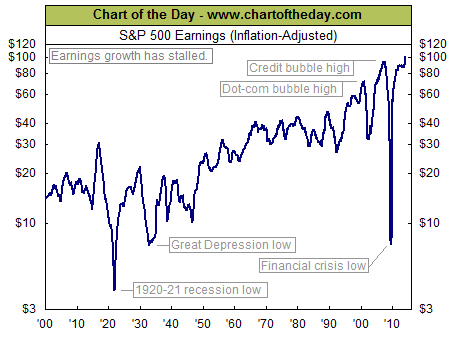
With first-quarter earnings largely in the books (over 66% of S&P 500 corporations have reported), today’s chart provides some long-term perspective to the current earnings environment by focusing on 12-month, as reported S&P 500 earnings. Today’s chart illustrates how earnings declined over 92% from its Q3 2007 peak to Q1 2009 low which brought inflation-adjusted earnings to near Great Depression lows. Since its Q1 2009 low, S&P 500 earnings have surged to all-time record highs. To further illustrate the significance of the current corporate earnings recovery, consider that the run-up in real earnings from Great Depression lows to credit bubble peak took over 74 years. The run-up from financial crisis lows to today has been similar in magnitude (actually slightly more) but was accomplished in a mere five years.
Notes:
Where should you invest? The answer may surprise you. Find out right now with the exclusive & Barron’s recommended charts of Chart of the Day Plus.
Quote of the Day
“It is a socialist idea that making profits is a vice. I consider that the real vice is making losses.” – Winston Churchill
Events of the Day
February 14, 2014 – Valentine’s Day
February 16, 2014 – NBA All-Star Game
February 17, 2014 – President’s Day – Washington’s Birthday (observed)
February 23, 2014 – Daytona 500
Stocks of the Day
— Find out which stocks investors are focused on with the most active stocks today.
— Which stocks are making big money? Find out with the biggest stock gainers today.
— What are the largest companies? Find out with the largest companies by market cap.
— Which stocks are the biggest dividend payers? Find out with the highest dividend paying stocks.
— You can also quickly review the performance, dividend yield and market capitalization for each of the Dow Jones Industrial Average Companies as well as for each of the S&P 500 Companies.
Click on this banner to subscribe:

Overnight markets were essentially a sea of green and the recent stock market rally continued here as well, with the testimony by Fed governor Janet Yellen merely reiterating the status quo, i.e., the Fed will continue to taper if the data support it, otherwise it will figure out what to do next. Through midday the indices had gained about 0.5%, with the Dow doing a bit better.
Also Known as a “Belief Rally”
Some folks may have scratched their head about why stocks have rallied, given that the Fed has continues to taper, but we can’t lose sight of two things: the market just had a pretty nasty setback, so it is bouncing, and a lot of folks believe that the Fed knows what it is doing, ergo, if it stays the course that is supposedly bullish. In any case, I hesitate to draw too many conclusions about how sanguine the equity market may be regarding Fed tapering until we see where this rally stalls.
But there was no stalling (yesterday), as the indices kept grinding higher all day, led by the Dow, which gained 1.5% (as of the last half hour, when I had to leave).

Away from stocks there was a bit more motion. Green paper was generally weaker against the major currencies, though emerging market currencies were subject to the same sort of pinball action we have seen, though that didn’t matter much today. Fixed income was weaker and the metals added 1%, plus or minus.
Down in Front!
It is interesting to note that lease rates have become more negative and backwardation has gone out to three months, even as the gold market has rallied. I don’t recall ever seeing lease rates tighten up like this during a rally. I’m not sure exactly what it means, but it is hard to believe it is bearish.


There are eerie parallels between the stock market’s recent behavior and how it behaved right before the 1929 crash.
That at least is the conclusion reached by a frightening chart that has been making the rounds on Wall Street. The chart superimposes the market’s recent performance on top of a plot of its gyrations in 1928 and 1929.
The picture isn’t pretty. And it’s not as easy as you might think to wriggle out from underneath the bearish significance of this chart.

….full article HERE

-
I know Mike is a very solid investor and respect his opinions very much. So if he says pay attention to this or that - I will.
~ Dale G.
-
I've started managing my own investments so view Michael's site as a one-stop shop from which to get information and perspectives.
~ Dave E.
-
Michael offers easy reading, honest, common sense information that anyone can use in a practical manner.
~ der_al.
-
A sane voice in a scrambled investment world.
~ Ed R.
Inside Edge Pro Contributors

Greg Weldon

Josef Schachter

Tyler Bollhorn

Ryan Irvine

Paul Beattie

Martin Straith

Patrick Ceresna

Mark Leibovit

James Thorne

Victor Adair