
Stocks & Equities
Uncertainty Following Yesterday’s Move Up
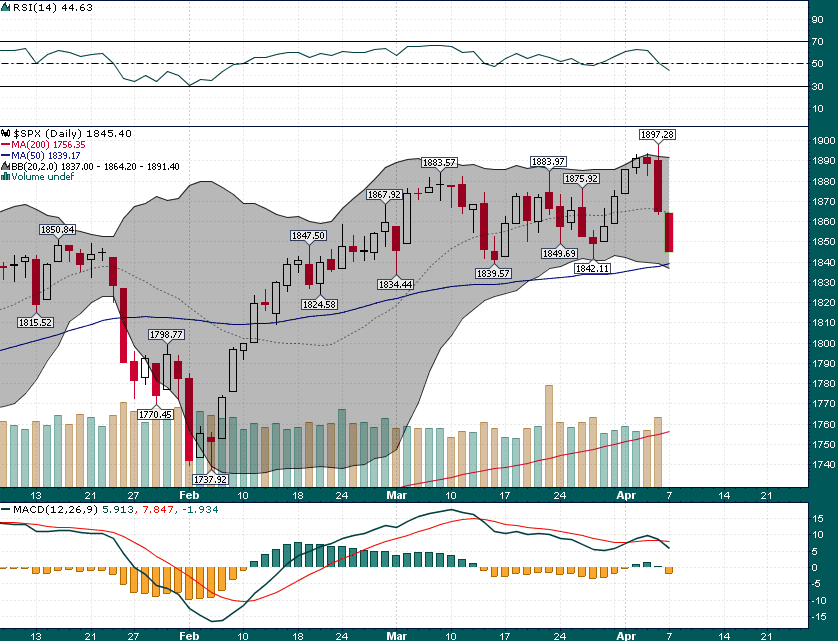
The U.S. stock market indexes gained between 1.1% and 1.8% on Wednesday, retracing some of their recent move down, as investors reacted to the FOMC Minutes release, hoping for prolonged easy monetary policy. The S&P 500 index trades higher within its March-April consolidation, after bouncing off the support at around 1,840-1,850. The bounce was not that much of a surprise, as we have stated in our yesterday’s forecast: “(…) a downtrend reversal cannot be ruled out – the market is at the support of 1,840-1,850, marked by March consolidation, among others”. The resistance remains at 1,880-1,900. There is no clear short-term trend, as we can see on the daily chart:

Expectations before the opening of today’s session are negative, with index futures currently down 0.2-0.3%. The European stock market indexes have been mixed so far. Investors will now wait for the Initial Claims data announcement at 8:30 a.m. The S&P 500 futures contract (CFD) has bounced off the support at 1,830-1,840. There is some intraday resistance at around 1,865. For now, it only looks like a correction within downtrend. The resistance remains at 1,875-1,890, as the 15-minute chart shows:

The technology Nasdaq 100 futures contract (CFD) has followed a similar path, bouncing off the support at 3,480-3,500. The nearest important resistance is at the psychological 3,600. The market remains in a month-long downtrend, as it keeps establishing lower lows and lower highs:

Briefly: In our opinion no speculative positions are justified.
Our intraday outlook remains neutral, as the market may retrace some of yesterday’s move up, extending its month-long fluctuations, and our short-term outlook is neutral:
Intraday (next 24 hours) outlook: neutral
Short-term (next 1-2 weeks) outlook: neutral
Medium-term (next 1-3 months) outlook: neutral
Long-term outlook (next year): bullish
Concluding, yesterday’s move up looks corrective and there have been no confirmed signals of a new short-term uptrend so far.
Thank you.



The Increase In Volatility Spells Trouble For The Market
Summary
- Severe correction looming.
- 4th quarter setting up to be strong.
- Nimble traders can profit short term.
This year is only 3 months old and we have already witnessed a dramatic increase in volatility and 2 short but painful corrections. I can honestly say that this has been the most difficult time in my 30 years in this industry. However, if experience has taught me anything, it’s that an increase in volatility coupled with frequent corrections usually means trouble for the market and investors.
On the economic front, we are also seeing a slight slowdown. Not a major slump indicating a recession, but on a year over year basis, we are seeing a downturn indicating that the economy will grow more slowly. This coincides perfectly with the demographic forces I discuss in my book, “Facing Goliath – How to Triumph in the Dangerous Market Ahead”, where the bulk of our population, the baby boomers, is well past their peak spending years. Unfortunately, the generation behind them, Gen-ex is not large enough to sustain their spending power, and the emergence of the next bull market generation, the echo-boomers, will require patience as they will not hit their spending stride for 5-7 more years.
Although we are overdue for a major correction, I don’t think that this is the “big one” – that cataclysmic crash that everyone is waiting for. In fact it is just that reason, that so many people are expecting a crash, that it will not happen… this time. Very simply, markets don’t crash when everyone expects them to.
The looming correction will however be agonizing enough to drive people out of the market, and then sit on the sidelines waiting to get back in but missing the advance as it rallies back. That is a classic correction and rebound.
There is one other indicator leading me to be cautious. Over the last few months, we have begun to see a major market rotation shift in leadership from growth to value and small cap to large cap. This is typically a defensive late bull market indicator.
Critical Market Strategy
It is time to err of the side of caution. Given the timing, this could be a “sell in May and walk away” situation. Although it’s important to remember that this phenomenon is never 100% accurate, and when you expect it to happen, it doesn’t. A sound strategy for this market will require investors to be very nimble, employing a tactical hands-on investment management approach.
A correction of even just 10-15% will be very painful and scare the bejeesus out of everyone, including the media. I intend to reduce risk slightly towards the end of the next earnings announcements in a few weeks. Earnings will be good and stocks will go higher. Although if they’re bad, run for the door. I will not be pulling out of the market completely because this will most likely be just a correction and not a crash.
Of course, if we get no correction and the market shoots higher, we will have sacrificed some of the upside returns. However, I am willing to take that chance. To me, this is in tune with buying life insurance. You only get paid if you die, but no one ever complains when they don’t die to get paid! If you disagree, please let me know and I will adjust your portfolio accordingly.
 Nimble traders can profit from strong Q1 earnings announcements in powerful growth names like Apple (AAPL), which will surprise on the upside; Microsoft (MSFT), which is the staple for every computer made; Google (GOOG), which is leading the technology war; Facebook (FB), which is the social media staple and is winning over the older crowd, the very people with money and who will not be upset by their ads. Or simply buy the market ETFs like QQQ and SPY. After earnings season, aggressive traders should be out of these names and or hedging with VIX.
Did the S&P 500 really make another all-time high Friday morning? It certainly doesn’t feel like it! The rapidly deteriorating market breadth and powerful downside reversal since Friday morning makes the all-time high at SPX 1897 seem like ages ago….
For larger images & the complete article Click HERE – Editor Money Talks
Briefly: In our opinion no speculative positions are justified.
Our intraday outlook is neutral, and our short-term outlook is now neutral, following Friday’s move down:
Intraday (next 24 hours) outlook: neutral
Short-term (next 1-2 weeks) outlook: neutral
Medium-term (next 1-3 months) outlook: neutral
Long-term outlook (next year): bullish
The U.S. stock market indexes lost between 1.0% and 2.7% on Friday, as investors reacted negatively to monthly jobs data release. However, the S&P 500 index has managed to reach yet another new intraday all-time high at 1,897.28, before going down to its daily low at 1,863.26. The nearest important resistance remains at 1,880-1,900, and the support is at 1,840-1,850, marked by March local lows, among others. For now, it looks like some sort of a medium-term topping pattern, however, further consolidation along the level of 1,850-1,900 cannot be ruled out:

Expectations before the opening of today’s session are negative, with index futures currently down 0.3-0.7%. The main European stock market indexes have lost 0.5-1.1% so far. The S&P 500 futures contract (CFD) trades in a relatively narrow intraday range, following Friday’s selloff. The nearest resistance is at around 1,860, with potential support at 1,840-1,850, marked by the late March local lows, as the 15-minute chart shows:

The technology Nasdaq 100 futures contract (CFD) is relatively weaker, as it trades below its March lows. The resistance is at around 3,550, and a potential support is at the psychological level of 3,500. There have been no positive signals so far, however, we can see some oversold:

So, was Friday’s selloff a new downtrend or just a short-term pullback? It’s a tough call right now – the signals are mixed and the outlook is unclear. The reason is that the S&P 500 index has invalidated its recent breakout into new all-time highs – extending March consolidation. The question is if it’s still a consolidation (bullish implications) or has the consolidation already ended and we should treat breakout’s invalidation on a stand-alone basis (bearish implications). Things should become much clearer in the coming days – stay tuned.
Thank you.

-
I know Mike is a very solid investor and respect his opinions very much. So if he says pay attention to this or that - I will.
~ Dale G.
-
I've started managing my own investments so view Michael's site as a one-stop shop from which to get information and perspectives.
~ Dave E.
-
Michael offers easy reading, honest, common sense information that anyone can use in a practical manner.
~ der_al.
-
A sane voice in a scrambled investment world.
~ Ed R.
Inside Edge Pro Contributors

Greg Weldon

Josef Schachter

Tyler Bollhorn

Ryan Irvine

Paul Beattie

Martin Straith

Patrick Ceresna

Mark Leibovit

James Thorne

Victor Adair