
Energy & Commodities

Below are factors that suggest that water will be the world’s most sought-after commodity in a handful of decades.
I couldn’t help but notice a new ad on Yahoo! Mail from Fidelity Investments that boldly asks, “Are you ready for water to become a globally traded commodity?”
This video accompanying the Fidelity Investments ad is as thought-provoking as it is ominous. The video discusses the respective costs in water to make items like a slice of bread, a cup of coffee, and a hamburger. From the video: “With global population expected to increase by 30 percent by 2050 and more developing nations transitioning to higher standards of living, regional water shortages and peak water issues will become more widespread.” The issue of water becomes more complicated in considering the accessibility and availability of drinking water in the years to come. From the video: “Global consumption of water is expected to increase by 40 percent over the next 20 years. And according to some estimates, more than half of the world’s population could be living under conditions of water stress by 2025.” Thus, the video suggests that water stress could intensify geopolitical affairs and “border disputes” related to the water supply.
…..read more and view Action Items (scroll to the bottom) HERE

Political risk in the Middle East has increased significantly with war between Iran and Israel almost inevitable, and precious metals and equities investments offer some safety, Swiss money manager and long-term bear Marc Faber said on Tuesday.
“Political risk was high six months ago and is higher now. I think sooner or later, the U.S. or Israel will strike Iran—it’s almost inevitable,” Faber, who publishes the widely read Gloom Boom and Doom Report, told Reuters on the sidelines of an investment conference.
Brent crude [LCOCV1 122.49  0.51 (+0.42%)
  ]traded near $123 per barrel in volatile trade on Tuesday on fears of a disruption in Iranian supplies. Israeli Prime Minister Benjamin Netanyahu showed no signs of backing away from possible military action against Iran following a Monday meeting with U.S. President Barack Obama.
“Say war breaks out in the Middle East or anywhere else, (U.S. Federal Reserve chairman![[cnbc explains]](http://media.cnbc.com/i/CNBC/Sections/News_And_Analysis/_News/_CNBC_EXPLAINS/_IMAGES/CNBC_explains_icon1.gif) ) Mr. Bernanke will just print even more money—they have no option… they haven’t got the money to finance a war,” said Faber.
) Mr. Bernanke will just print even more money—they have no option… they haven’t got the money to finance a war,” said Faber.
“You have to be in precious metals and equities… most wars and most social unrest haven’t destroyed corporations—they usually survive,” he said.
He said that Middle East markets had largely bottomed out, though regime changes from the Arab Spring revolutions were unlikely to be investor-friendly.
Faber said that in uncertain times, investors had to reconcile themselves to volatility.
“If you can’t live with volatility, stay in bed,” he said, pointing out that even cash.
The 66 year-old, who has earned the moniker “Dr Doom”, earlier told the conference that the likelihood of war in the Middle East was boosted by Western powers’ imperatives of keeping China in check, given its dependence on Middle Eastern oil.
“The Americans and the western powers know very well they cannot contain China economically… but one way to contain China is to switch on and switch off the oil tap from the Middle East,” he said.
“I happen to think the Middle East will go up in flames,” he said.
(POWERFUL Speech!) PM NETANYAHU’S SPEECH AT THE AIPAC 2012 – WASHINGTON DC Making the Case for Preventing Iran from acquiring Nuclear Weapons.
{youtube}4ufkFEU2kjw{/youtube}

Warren Buffett doesn’t like gold. Neither does Dennis Gartman. That settles it for us; gold must be a table-pounding buy.
In this year’s annual letter to Berkshire Hathaway shareholders, Warren Buffett scorned gold as an asset that is “forever unproductive.”
“[Gold] will never produce anything,” he wrote. “Gold has two significant shortcomings, being neither of much use nor procreative.”
Buffett’s statement is literally correct, but it has two significant shortcomings, being neither of much use nor insightful. No one holds gold hoping it will produce something. They hold gold because no one can produce it. Precisely for this reason, mankind has considered gold the ultimate money for several thousand years…and it has performed this role with meritorious distinction.
Gold’s appeal waxes and wanes, of course, depending upon the monetary environment in which it resides. But the less folks trust the cash in their pockets, the more they trust gold…and that’s exactly what’s been happening throughout the Western world for more than a decade.
Therefore, despite gold’s “significant shortcomings,” it has delivered a much higher return during the last 14 years than the “useful” and “procreative” Berkshire Hathaway. As the chart below shows, the “rolling 10-year return” of gold has been higher than that of Berkshire Hathaway since January 2008.
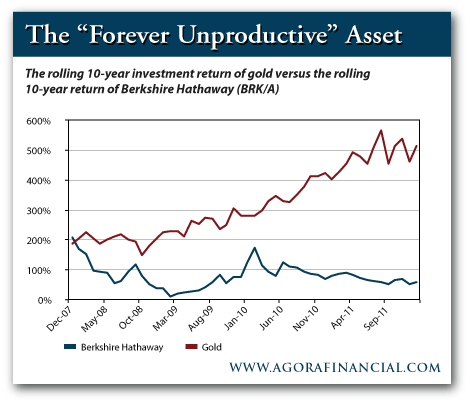
In other words, an investor who purchased gold at any time after January of 1998 would have received a higher investment return over the following 10 years than an investor who purchased Berkshire Hathaway. That seems like a fairly useful investment result.
But Buffett is the investment genius sans pareil. We aren’t. He knows gold is a losing bet. We don’t. But here’s the good news: You don’t need to be a genius to buy gold. You can be an idiot. In fact, according to Buffett, you are.
“This type of investment,” says the Oracle of Omaha, “requires an expanding pool of buyers who, in turn, are enticed because they believe the buying pool will expand still further. Owners are not inspired by what the asset itself can produce — it will remain lifeless forever — but rather by the belief that others will desire it even more avidly in the future.”
Like Buffett, Dennis Gartman has also scorned gold recently. Unlike Buffett, Gartman has recommended buying gold from time to time — and even buys it for himself on occasion. But he recently notified the world that gold was a “Sell” and the he would no longer be “long of gold,” as he says in his bizarre version of English.
On December 15, the editor of “The Gartman Letter” announced, “I sold all gold in my personal account… Since the early autumn here in the Northern Hemisphere gold has failed to make a new high. Each high has been progressively lower than the previous high, and now we’ve confirmation that the new interim low is lower than the previous low. We have the beginnings of a real bear market, and the death of a bull.”
A week later, Gartman kicked the “yellow dog” again. “I expect equities will outperform gold [in 2012] without any question,” Gartman told the CNBC viewers. Unfortunately for Dennis, his “Sell alert” on gold happened to coincide with a brand-new “Buy alert” from Ben Bernanke and a few of the Fed Chairman’s counterparts around the globe.
As you may recall, last November the Federal Reserve and the European Central Bank (ECB), along with the Bank of Canada, the Bank of England, the Bank of Japan and the Swiss National Bank announced “coordinated actions…to provide liquidity support to the global financial system.”
These banks have kept their promise. They have all ramped up their money supplies since November 30.
The day this announcement crossed the wires, we observed:
A new phase of monetary destruction is underway…All the largest central banks are committing to printing money in some way, shape or form.
Who knows what’s next? Probably, we can look forward to a new era of clandestine bailouts, backdoor lending facilities with inscrutable acronyms and global monetary game-playing that will look a lot like a massive money-laundering operation.
Perhaps someone should notify the authorities. The Fed is engaged in highly suspicious, un-American activities.
As it turns out, the Fed’s suspicious activities are merely part of a global crime syndicate — a worldwide counterfeiting ring. The following chart, courtesy of James Bianco at Bianco Research, tells the tale.
“Bianco’s chart,” observes Tim Price, Director of Investment at PFP Wealth Management, “shows the extent to which the eight largest central banks (China, the ECB, the US, Japan, Bank of England, Banque de France, Swiss National Bank, and Germany’s Bundesbank) have allowed their balance sheets to explode, in a desperate attempt to compensate for banking and private sector deleveraging since the debt crisis began. The Big 8 central banks now account for the equivalent of one third of world stock market capitalization.”
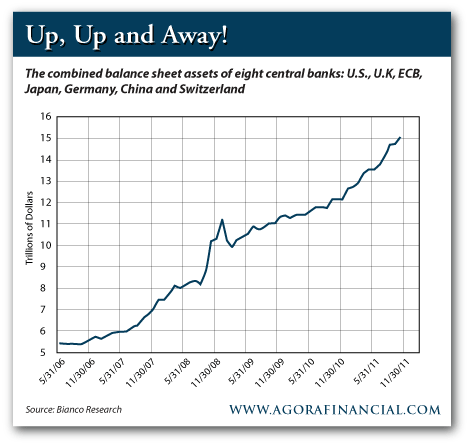
“If the basic definition of quantitative easing (QE) is a significant increase in a central bank’s balance sheet via increasing banking reserves,” Bianco remarks, “then all eight of these central banks are engaged in QE.”
True statement…which means that as long as the line on the chart above continues soaring higher, the precious metals are a “Buy”… no matter how frequently and self-assuredly Buffett and Gartman call it a “Sell.”
“The most bullish examples would see the pattern develop into a series of lows around $1690 or an A-B-C correction, as experienced in 2010, which holds around $1660 (50% retracement from the December lows). A close above $1775 would be the catalyst for a challenge of $1900 to $2155. At the other extreme, a failure to hold $1625 (62% retracement from $1523) would imply that the December lows will be taken out.”
….read and view all charts HERE

#1 Gold Timer of the Year 2011 Stephen Todd March 6th/2012: “GOLD: Gold got clobbered along with stocks. This finally puts us on a sell.”
#2 Gold Timer of the Year 2011 & #1 Gold Market timer for the 5 year period ending in 2010 Mark Leibovit March 6th/2012: GOLD – ACTION ALERT – BUY (And Take Delivery Of The Physical Metals)
Billionaire Sprott: What are the repercussions of all this money printing?
2012 is proving to be the ‘Year of the Central Bank’. It is an exciting celebration of all the wonderful maneuvers central banks can employ to keep the system from falling apart. Western central banks have gone into complete overdrive since last November, convening, colluding and printing their way out of the mess that is the Eurozone. The scale and frequency of their maneuvering seems to increase with every passing week, and speaks to the desperate fragility that continues to define much of the financial system today.
The first major maneuver took place on November 30, 2011, when the world’s G6 central banks (the Federal Reserve, the Bank of England, the Bank of Japan, the European Central Bank [ECB], the Swiss National Bank, and the Bank of Canada) announced “coordinated actions to enhance their capacity to provide liquidity support to the global financial system”. Long story short, in an effort to avert a total collapse in the European banking system, the US Fed agreed to offer unlimited US dollar swap agreements with the other central banks. These US dollar swaps allow the other central banks, most notably the ECB, to borrow US dollars from the Federal Reserve and lend them to their respective national banks to meet withdrawals and make debt payments. The best part about these swaps is that they are limitless in scope — meaning that until February 1, 2013, the Federal Reserve is, and will be, prepared to lend as many US dollars as it takes to keep the financial system from imploding. It sounds absolutely great, and the Europeans should be nothing but thankful, except for the tiny little fact that to supply these unlimited US dollars, the Federal Reserve will have to print them out of thin air.
Don’t worry, it gets better. Since unlimited US swap lines weren’t enough to solve the problem, roughly three weeks later, on December 21, 2011, the European Central Bank launched the first tranche of its lauded Long Term Refinancing Operation (LTRO). This is the program where the ECB flooded 523 separate European banks with 489 billion euros worth of 3-year loans to keep them going through Christmas. A second tranche of LTRO loans is planned to launch at the end of February, with expectations for size ranging from 300 billion to more than 1 trillion euros of uptake. The good news is that Italian, Portuguese and Spanish bond yields have dropped since the first LTRO went through, which suggests that at least some of the initial LTRO funds have been reinvested back into sovereign debt auctions. The bad news is that the Eurozone banks may now be hooked on what is clearly a back-door quantitative easing (QE) program, and as the warning goes for addictive drugs — once you start, it can be very hard to stop.
Britain is definitely hooked. On February 9, 2012, the Bank of England announced another QE extension for 50 billion pounds, raising their total QE print to £325 billion since March 2009. Japan’s hooked as well. On February 14, 2012, the Bank of Japan announced a ¥10 trillion ($129 billion) expansion to its own QE program, raising its total QE program to ¥65 trillion ($825 billion). Not to be outdone, in the most recent Fed news conference, US Fed Chairman Bernanke signaled that the Fed will keep interest rates near zero until late 2014, which is 18 months later than he had promised in Fed meetings last year. If Bernanke keeps his word, by the end of 2014 the US government will have enjoyed near zero interest rates for six years in a row. Granted, extended zero percent interest rates is not nearly as satisfying as a proper QE program, but who needs traditional QE when the Fed already buys 91 percent of all 20-30 year maturity US Treasury bonds? Perhaps they’re saving traditional QE for the upcoming election.
All of this pervasive intervention most likely explains more than 90 percent of the market’s positive performance this past January. Had the G6 NOT convened on swaps, had the ECB NOT launched the LTRO programs, and had Bernanke NOT expressed a continuation of zero interest rates, one wonders where the equity indices would trade today. One also wonders if the European banking system would have made it through December. Thank goodness for “coordinated action”. It does work in the short-term.
But what about the long-term? What are the unintended consequences of repeatedly juicing the system? What are the repercussions of all this money printing? We can think of a few.
First and foremost, without continued central bank support, interbank liquidity may cease to function entirely in the coming year. Consider the implications of the ECB’s LTRO program: when you create a loan program to save the EU banks and make its participation voluntary, every one of those 523 banks that participates is essentially admitting that they have a problem. How will they ever lend money to each other again? If you’re a bank that participated in the LTRO program because you were on the verge of bankruptcy, how can you possibly trust other banks that took advantage of the same program? The ECB’s LTRO program has the potential to be very dangerous, because if the EU banks start to rely on the loans too heavily, the ECB may find itself inadvertently attached to the broken EU banking system forever.
The second unintended consequence is the impact that interventions have had on the non-G6 countries’ perception of western solvency. If you’re a foreign lender to the United States, Britain, Europe or Japan today, how comfortable can you possibly be in lending them money? How do you lend to countries whose sole basis as a going concern rests in their ability to wrangle cash injections printed by their respective central banks? Going further, what happens when the rest of the world, the non-G6 world, starts to question the G6 Central Banks themselves? What entity exists to bailout the financial system if the market moves against the Fed or the ECB?
The fact remains that there are few rungs left in the financial confidence chain in 2012, and central banks may end up pushing their printing schemes too far. In 2008-2009, it was the banks that lost credibility and required massive bailouts by their respective sovereign states. In 2010-2011, it was the sovereigns, most notably those in Europe, that lost credibility and required massive bailouts by their respective central banks. But there is no lender of last resort for the central banks themselves. That the IMF is now trying to raise another $600 billion as a security buffer doesn’t go unnoticed, but do they honestly think that’s going to make any difference?
When reviewing today’s macro environment, we keep coming back to the same conclusion. The non-G6 world isn’t blind to the efforts of the Fed and the ECB. When the Fed openly targets a 2 percent inflation rate, foreign lenders know that means they will lose, at a minimum, at least 2 percent of purchasing power on their US loans in 2012. It therefore shouldn’t surprise anyone to see those lenders piling into alternative assets that have a better chance at protecting their wealth, long-term.
This is likely why China reduced its US Treasury exposure by $32 billion in the month of December (See Figure 1). This is also why China, which produced 360 tonnes of gold internally last year, also imported an additional 428 tonnes in 2011, up from 119 tonnes in 2010. This may also be why China’s copper imports hit a record high of 508,942 tonnes in December 2011, up 47.7 percent from the previous year, despite the fact that their GDP declined at year-end. Same goes for their crude oil imports, which hit a record high of 23.41 million metric tons this past January, up 7.4 percent year- over-year. The so-called experts have a habit of downplaying these numbers, but it seems pretty clear to us: China isn’t waiting around for next QE program. They are accelerating their move away from paper currencies and into hard assets.
2012 is proving to be the ‘Year of the Central Bank’. It is an exciting celebration of all the wonderful maneuvers central banks can employ to keep the system from falling apart. Western central banks have gone into complete overdrive since last November, convening, colluding and printing their way out of the mess that is the Eurozone. The scale and frequency of their maneuvering seems to increase with every passing week, and speaks to the desperate fragility that continues to define much of the financial system today.
The first major maneuver took place on November 30, 2011, when the world’s G6 central banks (the Federal Reserve, the Bank of England, the Bank of Japan, the European Central Bank [ECB], the Swiss National Bank, and the Bank of Canada) announced “coordinated actions to enhance their capacity to provide liquidity support to the global financial system”. Long story short, in an effort to avert a total collapse in the European banking system, the US Fed agreed to offer unlimited US dollar swap agreements with the other central banks. These US dollar swaps allow the other central banks, most notably the ECB, to borrow US dollars from the Federal Reserve and lend them to their respective national banks to meet withdrawals and make debt payments. The best part about these swaps is that they are limitless in scope — meaning that until February 1, 2013, the Federal Reserve is, and will be, prepared to lend as many US dollars as it takes to keep the financial system from imploding. It sounds absolutely great, and the Europeans should be nothing but thankful, except for the tiny little fact that to supply these unlimited US dollars, the Federal Reserve will have to print them out of thin air.
Don’t worry, it gets better. Since unlimited US swap lines weren’t enough to solve the problem, roughly three weeks later, on December 21, 2011, the European Central Bank launched the first tranche of its lauded Long Term Refinancing Operation (LTRO). This is the program where the ECB flooded 523 separate European banks with 489 billion euros worth of 3-year loans to keep them going through Christmas. A second tranche of LTRO loans is planned to launch at the end of February, with expectations for size ranging from 300 billion to more than 1 trillion euros of uptake. The good news is that Italian, Portuguese and Spanish bond yields have dropped since the first LTRO went through, which suggests that at least some of the initial LTRO funds have been reinvested back into sovereign debt auctions. The bad news is that the Eurozone banks may now be hooked on what is clearly a back-door quantitative easing (QE) program, and as the warning goes for addictive drugs — once you start, it can be very hard to stop.
Britain is definitely hooked. On February 9, 2012, the Bank of England announced another QE extension for 50 billion pounds, raising their total QE print to £325 billion since March 2009. Japan’s hooked as well. On February 14, 2012, the Bank of Japan announced a ¥10 trillion ($129 billion) expansion to its own QE program, raising its total QE program to ¥65 trillion ($825 billion). Not to be outdone, in the most recent Fed news conference, US Fed Chairman Bernanke signaled that the Fed will keep interest rates near zero until late 2014, which is 18 months later than he had promised in Fed meetings last year. If Bernanke keeps his word, by the end of 2014 the US government will have enjoyed near zero interest rates for six years in a row. Granted, extended zero percent interest rates is not nearly as satisfying as a proper QE program, but who needs traditional QE when the Fed already buys 91 percent of all 20-30 year maturity US Treasury bonds? Perhaps they’re saving traditional QE for the upcoming election.
All of this pervasive intervention most likely explains more than 90 percent of the market’s positive performance this past January. Had the G6 NOT convened on swaps, had the ECB NOT launched the LTRO programs, and had Bernanke NOT expressed a continuation of zero interest rates, one wonders where the equity indices would trade today. One also wonders if the European banking system would have made it through December. Thank goodness for “coordinated action”. It does work in the short-term.
But what about the long-term? What are the unintended consequences of repeatedly juicing the system? What are the repercussions of all this money printing? We can think of a few.
First and foremost, without continued central bank support, interbank liquidity may cease to function entirely in the coming year. Consider the implications of the ECB’s LTRO program: when you create a loan program to save the EU banks and make its participation voluntary, every one of those 523 banks that participates is essentially admitting that they have a problem. How will they ever lend money to each other again? If you’re a bank that participated in the LTRO program because you were on the verge of bankruptcy, how can you possibly trust other banks that took advantage of the same program? The ECB’s LTRO program has the potential to be very dangerous, because if the EU banks start to rely on the loans too heavily, the ECB may find itself inadvertently attached to the broken EU banking system forever.
The second unintended consequence is the impact that interventions have had on the non-G6 countries’ perception of western solvency. If you’re a foreign lender to the United States, Britain, Europe or Japan today, how comfortable can you possibly be in lending them money? How do you lend to countries whose sole basis as a going concern rests in their ability to wrangle cash injections printed by their respective central banks? Going further, what happens when the rest of the world, the non-G6 world, starts to question the G6 Central Banks themselves? What entity exists to bailout the financial system if the market moves against the Fed or the ECB?
The fact remains that there are few rungs left in the financial confidence chain in 2012, and central banks may end up pushing their printing schemes too far. In 2008-2009, it was the banks that lost credibility and required massive bailouts by their respective sovereign states. In 2010-2011, it was the sovereigns, most notably those in Europe, that lost credibility and required massive bailouts by their respective central banks. But there is no lender of last resort for the central banks themselves. That the IMF is now trying to raise another $600 billion as a security buffer doesn’t go unnoticed, but do they honestly think that’s going to make any difference?
When reviewing today’s macro environment, we keep coming back to the same conclusion. The non-G6 world isn’t blind to the efforts of the Fed and the ECB. When the Fed openly targets a 2 percent inflation rate, foreign lenders know that means they will lose, at a minimum, at least 2 percent of purchasing power on their US loans in 2012. It therefore shouldn’t surprise anyone to see those lenders piling into alternative assets that have a better chance at protecting their wealth, long-term.
This is likely why China reduced its US Treasury exposure by $32 billion in the month of December (See Figure 1). This is also why China, which produced 360 tonnes of gold internally last year, also imported an additional 428 tonnes in 2011, up from 119 tonnes in 2010. This may also be why China’s copper imports hit a record high of 508,942 tonnes in December 2011, up 47.7 percent from the previous year, despite the fact that their GDP declined at year-end. Same goes for their crude oil imports, which hit a record high of 23.41 million metric tons this past January, up 7.4 percent year- over-year. The so-called experts have a habit of downplaying these numbers, but it seems pretty clear to us: China isn’t waiting around for next QE program. They are accelerating their move away from paper currencies and into hard assets.
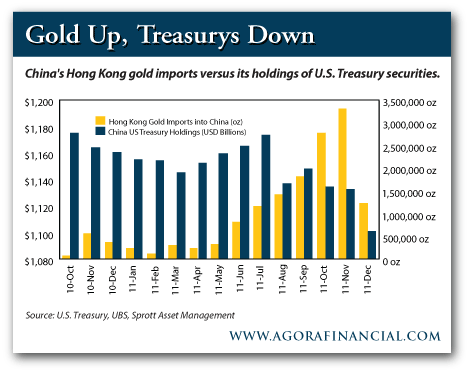
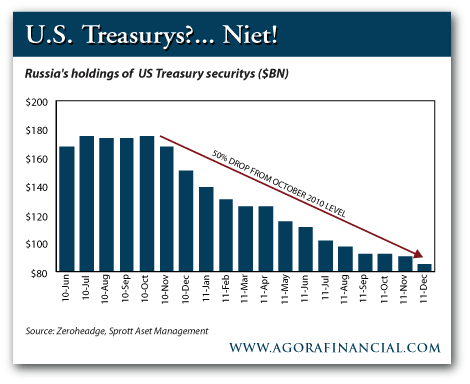
China is not alone in this trend either. Russia has reportedly cut its US Treasury exposure by half since October 2010. Not surprisingly, Russia was also a big buyer of gold in 2011, adding approximately 95 tonnes to its gold reserves, with 33 tonnes added in the fourth quarter alone. It’s not hard to envision higher gold prices if the rest of the non-G6 countries follow-suit.
The problem with central bank intervention is that it never works out as planned. The unintended consequences end up cancelling out the short-term benefits. Back in 2008, when the Fed introduced zero percent interest rates, everyone thought it was a great policy. Four years later, however, and we’re finally beginning to appreciate the complete destruction it has wreaked on savers. Just look at the horror show that is the pension industry today: According to Credit Suisse, of the 341 companies in the S&P 500 index with defined benefit pension plans, 97 percent are underfunded today. According to a recent pension study by Seattle-based Milliman Inc., the combined deficit of the 100 largest defined-benefit plans in the US increased by $236.4 billion in 2011 alone. The main culprit for the increase? Depressed interest rates on government bonds.
Let’s also not forget the public sector pension shortfalls, which are outright frightening. In Europe, unfunded state pension obligations are estimated to total $39 trillion dollars, which is approximately five times higher than Europe’s combined gross debt. In the United States, unfunded pension obligations increased by $2.9 trillion in 2011. If the US actually acknowledged these costs in their deficit calculations, their official 2011 fiscal deficit would have risen from the reported $1.3 trillion to $4.2 trillion. Written the long way, that’s a deficit of $4,200,000,000,000,… in one year.
There is unfortunately no economic textbook to guide us through these strange times, but common sense suggests we should be extremely wary of the continued maneuvering by central banks. The more central banks print to save the system, the more the system will rely on their printing to stay solvent — and you cannot solve a debt problem with more debt, and you cannot print money without serious repercussions. The central banks are fueling a growing distrust among the creditor nations that is forcing them to take pre-emptive actions with their currency reserves. Individual investors should take note and follow-suit, because it will be a lot easier to enjoy the “Year of the Central Bank” if you own things that can actually benefit from all their printing, as opposed to things that can only be destroyed by it.
Regards,
Eric Sprott and David Baker
for The Daily Reckoning

-
I know Mike is a very solid investor and respect his opinions very much. So if he says pay attention to this or that - I will.
~ Dale G.
-
I've started managing my own investments so view Michael's site as a one-stop shop from which to get information and perspectives.
~ Dave E.
-
Michael offers easy reading, honest, common sense information that anyone can use in a practical manner.
~ der_al.
-
A sane voice in a scrambled investment world.
~ Ed R.
Inside Edge Pro Contributors

Greg Weldon

Josef Schachter

Tyler Bollhorn

Ryan Irvine

Paul Beattie

Martin Straith

Patrick Ceresna

Mark Leibovit

James Thorne

Victor Adair