Currency

The Biggest Shocker: What the “Fiscal Cliff” Does to the Dollar

The Fiscal Cliff’s Biggest Surprise Could Be a Rising U.S. Dollar.

My grandmother Mimi had a saying that was as blunt as it was uncouth. “When the stuff hits the fan,” she used to say, “it will not be evenly distributed.”

shit-hitting-the-fan

This one came up often when she sensed that world events were about to take a turn for the worse. 

You’ve heard me mention Mimi before. She was widowed at a young age and went on to become a savvy global investor long before people thought to look beyond their own backyard.

Mimi never cared what Wall Street’s “Armani Army” had to say. 

Instead, she preferred to travel widely to see for herself what the real story was. Having grown up in the midst of the Great Depression, she believed that people were the ultimate indicator and that governments were the penultimate contrarian influence.

If she were still alive today, I think she’d encourage us to take a good hard look in the proverbial “mirror” especially with regard to the looming fiscal cliff making headlines the world over. 

And I don’t think she’d waste any time with the doom, gloom and boom crowd either. 

She was always on the hunt for opportunity when everyone else was running from chaos. Thanks to her, it’s a habit that remains firmly ingrained in me today. 

Not One but Three Fiscal Cliffs

And that brings me back to the “fiscal cliff.” 

In my mind, this is a misnomer. There isn’t really a singular fiscal cliff. As I explained earlier this summer to Sheryl Nance of Forbes there are actually three. 

  • The massive adjustments headed our way as tax and spending cuts expire and come into effect beginning in 2013. You may know it as taxmegeddon.
  • The debt debacle and the near complete lack of any sort of credible financial consolidation plan that will affect everything from interest rates to collateral requirements and the US credit rating – again.
  • And politicians who simply don’t understand that issues 1 and 2 are already dramatically impacting the economy long before the theoretical limits of spending come into play. Profits are declining and 61% of companies that have reported through Monday October 22nd have failed to meet expectations. Hiring is slowing and top line revenue is increasingly hard to come by.

Together, they constitute a massive threat to the U.S. economy that could push our beleaguered “recovery” to the breaking point. (And I use all the sarcasm I can muster with that because our recovery isn’t anything close to what’s needed.) 


Many believe this is a moot point because Congress will get down to business in November after the Presidential Election takes place. The hope is that some sort of budget agreement will be reached and that the US economy will then be positioned for stronger growth in 2013.

Yeah and I suppose the tooth fairy will show up, too. 

The IMF and CBO are both on record noting that the estimated $400 – $600 billion in impacts that will result from the combination of spending cuts and tax hikes could derail economic growth while causing a sharp contraction. 

Even Helicopter Ben himself has warned of dire consequences. More importantly, dozens of reformed economists, bankers, CEOs and small business owners agree. 

Any breakdown in the political infrastructure would represent a catastrophic political, social and economic failure that places literally every level of our economy at risk of further disaster. 

Under these conditons, everything from our credit rating to international trading relationships faces mortal risk. 

Europe could also come unglued if our banking system goes south. I know many European leaders like to believe they are independent but the reality of an internationally linked fractional banking system renders that notion pure folly in this instance. 

Is There a U.S. Dollar Rally Brewing? 

Conventional wisdom, under the circumstances, is that the U.S. dollar will become even more worthless than it is now. 

I don’t think so. In fact, I expect the U.S. dollar to strengthen significantly. Here’s why… 

When the shooting started in the Middle East, bankers came running. When the fiscal crisis began, the dollar ran some more. When the European crisis broke, people couldn’t get enough dollars.

And as China had slowed, the dollar has enjoyed newfound stability. Even during last year’s Congressional debt ceiling donnybrook for example, the dollar outperformed the Euro as investors sought refuge. 

History shows that bankers from Shanghai to Milan and all points in between run to the dollar when global instability raises its ugly head and the fiscal cliff or cliffs would certainly constitute instability.

And that reminds me of something else Mimi used to allude to all the time. 

“Keith,” she would say as we enjoyed some piping hot pastrami sandwiches and cold beer together (one of her favorites), “much of the world may hate our guts, but when the fur starts flying they love our money.”

These days they have to. For the moment, there’s literally no alternative capable of absorbing the needed liquidity. That alone is probably worth another 10%-15% of upside for the U.S. dollar. 

As for the alternatives, the euro itself is in question and at risk of fracture and the yuan isn’t deep enough yet. 

As the dollar goes higher, US-based stocks, bonds and preferreds should go along for the ride if not in terms of absolute gains, then in terms of stability. Investors factoring in dividends and bond payments, even at historically low interest rates could enjoy their own recovery.

So, too, could the Chinese who sit on an estimated $3.2 trillion in trade reserves and an estimated $1.169 trillion of which is held in U.S. dollar denominated debt.

Many people don’t want to hear that. But understanding how a stronger U.S. dollar would affect the markets may lead to some the most profitable decisions they’ve made since this crisis began. 

Best Regards, 

Keith Fitz-Gerald, Chief Investment Strategist 
Money Map Press

Further Reading…

Mimi’s sage advice has appeared in Keith’s columns before. In this article, she reasoned that when an investment or a trend began making the rounds over drinks, it was time to move on. In fact, she used to call it the “country club” test. Here, Keith talks about why she’d fire Microsoft CEO Steve Ballmer.

Mimi was also mentioned in Keith’s 2009 book entitled: Fiscal Hangover.


Adjust Your Investment View: While The West is in Turmoil – Asia’s Looking Good

Asia – Just a Different Beat

While turmoil abounds in Europe and Germany resists writing off Greek debt and previous holders of Greek debt squawk about taking a second haircut, Moodys actually upgraded the Philippines. The Indian market has a Double top and looks more like the early stages of Japan in the mid ’80s preparing for an explosive rally. As the West is melting down, Asia is starting to rise its head above the fray. Even in Singapore real estate has continued to boom where the government has demonstrated it is willing to think out of the box and adopt some of the most practical management tools of any country on the planet.

A special report will be provided to the conference attendees in Bangkok covering the currency and share markets for Australia, China (Shanghai & Shenzhen), Hong Kong, India, Indonesia, Japan, Korea, Malaysia, New Zealand, Philippines, Thailand, Taiwan, and Vietnam. This will be an important report for the brightest spot on the globe for the next several years.

Married to an Idea – The Dow & ElliotT Wave

In trading, the first primary rule is: Do not marry the trade! This is what destroyed Japan. Because of the accounting rules Japanese investors did not have to report a loss until they took it. That rule (not marked to market) led to the Japanese holding losing positions until they cried blood from their eye sockets. The failure to sell extended the correction into a 26 year depression. The Great Depression in the USA saw the 90% drop in just a 3 year period. This is why TIME is significantly different between USA and Japan and that will dictate the different outcome.

This is the type of email I typically get from people who are married to the idea that the Dow must fall 90% because that is what took place during the Great Depression.

“Hi Martin,

The Nikkei is well on its way to a 90% drop, so I can’t see any reason why the US indicies won’t do the same thing.  It looks just 1 more giant bubble based on out of control credit creation and leverage to me.”

dow-gold-ratioIt is nice to just presume the Financial Crisis we face must be resolved by a collapse in the share market. They then typically blend that with gold going to $30,000 dividing the debt by the official gold reserves as if this is some mandatory formulae. They also tout the Silver/Gold ratio as well as the Dow/Gold ratio. They pick extreme points and portray that is somehow the norm yet it has been at such levels briefly of arbitrarily because of some political fixing that ultimately failed. You might as well say the Nikkei should be 40,000 because it was there for one brief shining moment in December 1989.


Screen Shot 2012-10-31 at 6.25.00 AMJust how does this miracle of a 90% drop in the Dow with $30,000 gold unfold? This is just beyond me. I am a history buff. I correlate everything globally. I simply cannot find a single incident in history where such a scenario EVER played out. Those who always see the Dow at 1,000 and gold at $100 are creating unrealistic scenarios that are even more bizarre. They have said the same thing every time there has been any decline like a broken record. Just as the hyperinflationists who assume the Dow will drop by 90% and gold will soar to $30,000, the 1000/$100 crowd are also speaking gibberish. To create the first scenario is impossible for under hyperinflation ALL assets rise – including real estate. Under the second scenario, for the Dow to go to 1,000 and gold to $100, that is only possible if the dollar displaces ALL currency in the world. How does that happen in a Sovereign Debt Crisis?


djeliot

Apparently a number of people in the Elliot Wave camp have been using our chart that reconstructed the Dow back to 1789. There is a debate there where some say it will rise and others say it will crash by 90%. Here is our computer doing Elliot Wave from the 1932 low where the “count” and projection points to the final high do not show a 5th Wave Conclusion and projects that out into 2024. So sorry, even using the subjective Elliot Wave based pattern recognition still disagrees with any scenario of a 90% drop.

So NEVER get married to a trade. If you do – you will NEVER be a trader. A fool is quickly separated from his money. That ALWAYS happens when you are married to a trade. The best of the best remains fluid at all times buying or selling based upon the unbiased trend. You must always go with the flow. This is why I constantly tell people that the object of the computer models is to replace me. The danger in forecasting is always personal opinion. Computers do not get emotional. They do not only say buy. If you never say sell, then you are just like the Japanese – married to an idea and refuse to ever consider a change in trend.

I am not selling stock. I have no incentive to be on one side or the other. When I was first going to open an office in Europe I met with the head of a Swiss bank in Geneva and ran a few European names by him for his opinion. He asked me to name one European analyst. I couldn’t. I was embarrassed. He said to me don’t be. The reason everyone was using Princeton Economics was because I could care less if the dollar went up or down where European analysts would never say sell for it would have been like being a traitor.

The Reversal System is pure numbers. The numbers are the numbers. It does not depend upon my opinion. The same is true of the forecasting arrays. The object is not to be some guru claiming to be always right. Nobody can do that consistently. We have hot and cold streaks. The only way to look at the future is in an UNBIASED manner. It is what it is. It will never be some tool to seek retribution upon society. The object is to survive. If you are obsessed with evening the score and just want to see everyone suffer, sorry, you will reap what you sow. The future is bad enough. Look well after your own survival and let others suffer whatever fate that comes their way.


About Martin Armstrong

“In Armstrong’s view of the world where boom-bust cycles occur like clockwork every 8.6 years, what matters is his record as a forecaster. … He called Russia’s financial collapse in 1998, using a model that also pointed to a peak just before the Japanese stock market crashed in 1989. These days, as the European sovereign-debt crisis roils markets worldwide, he reminds readers of his October 1997 prediction that the creation of the euro “will merely transform currency speculation into bond speculation,” leading to the system’s eventual collapse.” – Ed Note: Much more HERE



No Way Has the Silver Market Peaked

Silver hit $806.00 500 Yrs ago, in the Year 1477 as seen on this 650 year Silver Chart (Ed Note: Click HERE or on the image for a larger view)
 
 
600yearsilver
 
 
There is plenty of data that the silver spike toward $50 last year was it for the silver market. Don’t be fooled, we heard the same thing in 2008 after silver had hit the $21+ level and during the depths of the financial crash silver sold near the $9 level. While many were throwing in the towel and admitting utter defeat we said…
 
BUY, BUY, and BUY some more – sometimes just the power of conviction is all that is needed. The conviction to stay the course and buy when FEAR was in the silver market!
 
When gold had dipped, silver was at the buy of a lifetime…it was silver investing that could make you rich!
 

Think about it, buying silver near $9 and selling near $48 would yield great returns. Those who jumped in near the bottom received almost five times their money without any leverage at all. . 

Silver-Price(Ed Note: Click HERE or on the image for a larger view)

What was so interesting is how much more money will be made in this sector but many that read this far will NOT invest. They will think the market is too far along in the bull progression and therefore they have missed the majority of the move.

It used to be one of my mantras – “If there is only one thing to teach you about the upcoming silver bull market it is this90% of the move comes in the last 10% of the time!”

Think about that statement—Would you be happy to capture 90% of any market move? What this means is you could just now be waking up the precious metals and build your wealth even starting at what appears as— this late date.

What if the entire precious metals bull market hits the average 17 year cycle. Since gold bottomed for this cycle in 2000 it would suggest that 2017 for the top. A full five years from today. If the last year or so of this market is the most explosive and gold explodes and you are along for the big gains in the blow-off phase how would you feel?

Now is the market really going to make the majority of the move in the last year, let alone 90%? Probably not, however think about the facts you already know, look at the housing bubble the most excitement and largest gains happened going into the top, the last few months of the move. Think about the technology stocks bubble, the Japan bubble, or any other market. This simply is market behavior!

However, this time is different—Why?

Because this time it will not be about being a smart real estate investor, or understanding that technology is leading the growth cycle, or the Japanese have a more efficient system. It will be about the one word I seldom use—FEAR…

Yes, you and many throughout the world will be concerned that you don’t have enough money for retirement…

Or concerned  that your pension will not be there? Or concerned your employer cannot meet his obligations? Concerned that the Dollar, Euro, Yen, or any government script will be worth tomorrow what it is today?

Worried that the system truly is cracking up and plans that you made based on solid evidence a decade ago are invalid and you need to take action into your own hands instead of relying on your financial planner, stock broker, defined benefit package or even the safety net provided by the governments at large.

When that shift takes place, that tipping point, when just enough people on a global basis collectively say, we are mad and we are not going to take it any more therefore we are moving into the precious metals. Once this happens look out the buying frenzy will be upon us, many have heard there is no fever like gold fever, this may be true, but bear in mind there is nothing close to a silver bull market! – Not a thing—nothing because silver shines the light of truth about the corrupt financial system better than gold because more people own it!

How high can silver go?

And as we brace ourselves for the final chapter of a U.S. dollar currency crisis…silver has a long way to go.

Let’s take a look at history. In 1980, as the nation was still reeling from the Carter-era inflation and investors were buying up precious metals…silver peaked at $52 an ounce. Adjusted for inflation, that’s about $143 today!

Those who get in now will be richly rewarded…and can get a lot more for their money.
 

by David Morgan

About The Morgan Report

Join The Morgan Report today 
and get 3 FREE Special Reports!

Screen Shot 2012-10-31 at 5.09.13 AM

Click HERE to start your membership now and claim your 3 FREE Special Reports.


Oil & Oil Stocks Seasonality & Year-End Outlook

Crude oil has had some large price swings this year and another one may be on its way. This report shows the seasonality of crude oil along with where oil is trading and what the oil service stocks are telling us is likely to happen going into year end.

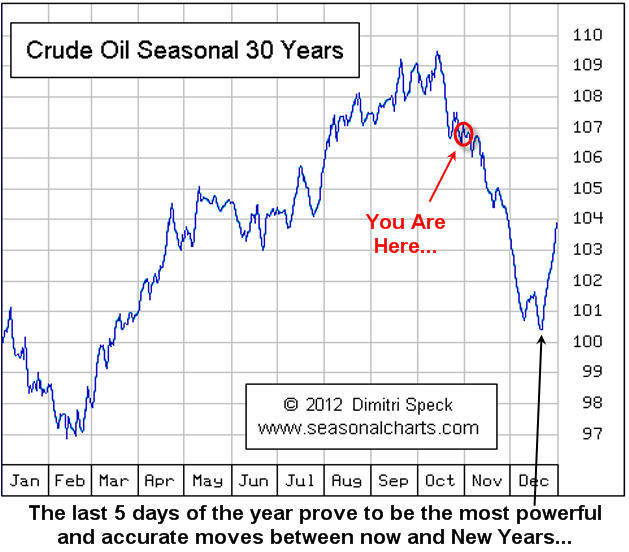
Since WTI Crude Oil topped out in September at the $100 resistance level (Century Number) many traders are looking for a bounce or bottom to form in the next week. Historical charts show that on average the price of oil falls during November and the first half of December.

The charts of oil and oil stocks shown below have formed patterns on both time frames (weekly & daily) that lower prices are to be expected. If you did not read my Gold Seasonality Report I just posted be sure to review it here: Gold Seasonal Report

CrudeSeasonality

WTI Crude Oil Weekly Chart:

Here you can see that price tends to fall going into Christmas and rallies during the last week of trading. This price action falls in line with Dimitri Specks seasonal chart providing us with insight as to what we should expect. Later this week I will finish my report on the Election Cycle Seasonality report which shows weakness in the market during Oct & Nov when a president is up for re-election.

CrudeOilPrice

Oil Services Stocks – Weekly Chart:

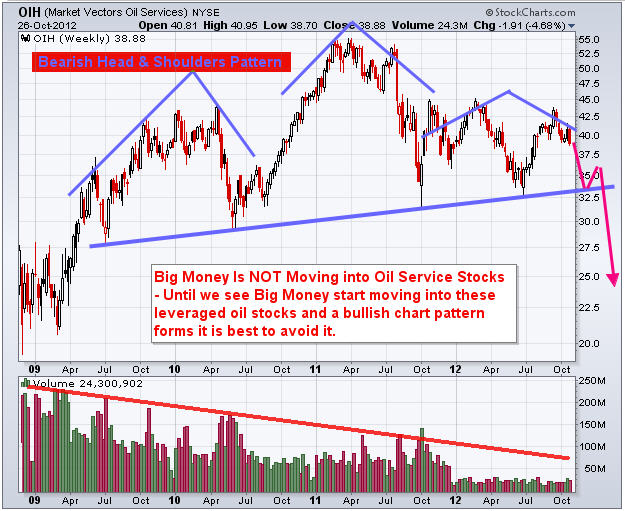
If you follow oil closely then you know likely know already that oil related stocks can lead the price of oil by a couple weeks. What this means is that if big money is flowing into oil stocks (bullish price patterns with strong volume), then you should expect the price of crude oil to rise in the coming days. That said, if money is flowing OUT of oils stocks then lower or sideways oil price should be expected.

The weekly chart oil stocks show a very large bearish head & shoulders pattern. While I do not think the neckline will be broken it is very possible.

One of the most important pieces of data on the chart is the VOLUME. Notice the lack of it… Volume tells us how much interest and power is behind chart patterns and declining volume clearly tells us these investments are out of favor currently and that big money is not moving into them.

OilStocksWeekly

Oil Services Stocks – DAILY Chart:

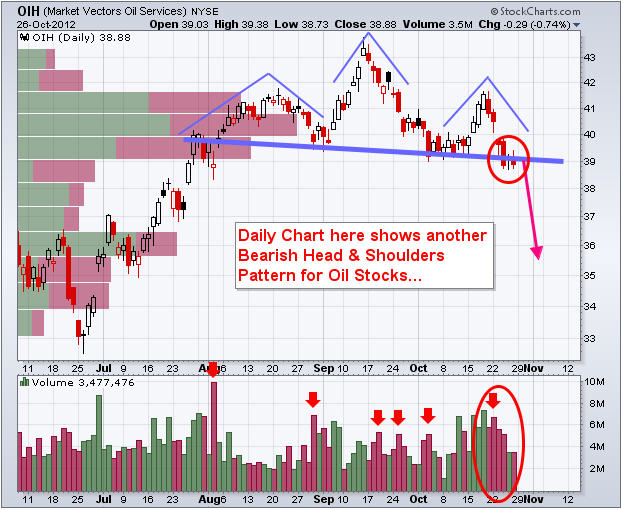
Zooming into the daily chart of the oil service stocks we can see there is yet another bearish pattern unfolding. Another head & shoulders pattern which looks as though it is just starting to breakdown as of this writing. Next support level is $35-36.

CrudeOilStocksDaily

WTI Crude Oil and Oil Service Stocks Trading Conclusion:

Looking forward 1-2 months (November – December) taking the seasonal price swings in oil, re-election cycle seasonality and price action of oil stocks I feel oil will trade sideways or down from here. With that being said, expect crude oil to rally during the last week of the year. I hope this provides some useful info for your trading!

Get my Daily Trading Analysis & Trade Setups at: www.TheGoldAndOilGuy.com

Chris Vermeulen is Founder of the popular trading analysis websitewww.TheGoldAndOilGuy.com. There he shares his highly successful, low-risk trade ideas. Since 2001 Chris has been a leader in teaching others to skillfully trade Currencies, Stock Indices, Bonds, Metals, Energies, Commodities, and Exchange Traded Funds. Reach Chris at: Chris[at]TheTechnicalTraders.com

We Have Been Warned!

Bernanke announced on September 13, 2012 a massive “money printing” program – QE3 – that will increase the money supply, help the large banks, create more commodity price inflation, and lower the standard of living of most of the middle class in the United States. Read what other authors had to say about QE3: We Have Been Warned! – Part 2

It is relatively easy to predict further commodity price inflation and that hard assets, not paper assets, will help protect purchasing power. But it is much more difficult to project where else this money printing leads and to what extent a crash is inevitable. What is the endgame? Will it be another financial crash such as in 2008? Or will it be a more destructive financial and economic crash that causes a severe but temporary disruption in the delivery of goods and services?

Jason Hamlin wrote regarding the United State national debt, as well as the sovereign debt of most other countries. His conclusions were:

  1.  “Raising taxes will not solve the problem. We could raise the tax rate to 100% and the government would   still not be able to get outof debt.
  2. Cutting spending (austerity) will not solve the problem. We could cut every non-essential government service and the government would still not be able to get out of debt.
  3. Inflating away the debt will not solve the problem in the long term. It will only kick the can down the road, exasperating the final crisis and making everyone pay for the poor decisions of a small group of lenders.

Solutions

So then, what is the solution to the debt crisis in Europe, the U.S. and around the globe?

The immediate default on all fiat debt.” (Worldwide Debt Default is the Only Solution)


….continue reading how the endgame will end by 7 more analysts including Michael Pento, Charles Hugh Smith, Egon von Greyerz, Chris Martenson, Vincent Cate, Nick Barisheff, John Rubino and the Conclusion HERE

warning-challenges


test-php-789