
Timing & trends
“Today should be the opportunity to get on board what is likely to be a significant rally over the next 3 weeks and probably a move to new highs over the next 2-3 months.
However I think the really big money will be made in mining stocks as gold should rally enough to make it’s first test of the all time highs at $1900. It’s not unreasonable to think miners will follow and test 640 during this time”.
“Typically the stock market will rally fairly aggressively out of one of these major intermediate bottoms, often gaining 6%-8% in the first 15-20 days. At that point the market will dip down into a half cycle low that will establish the trend line for this particular daily cycle”
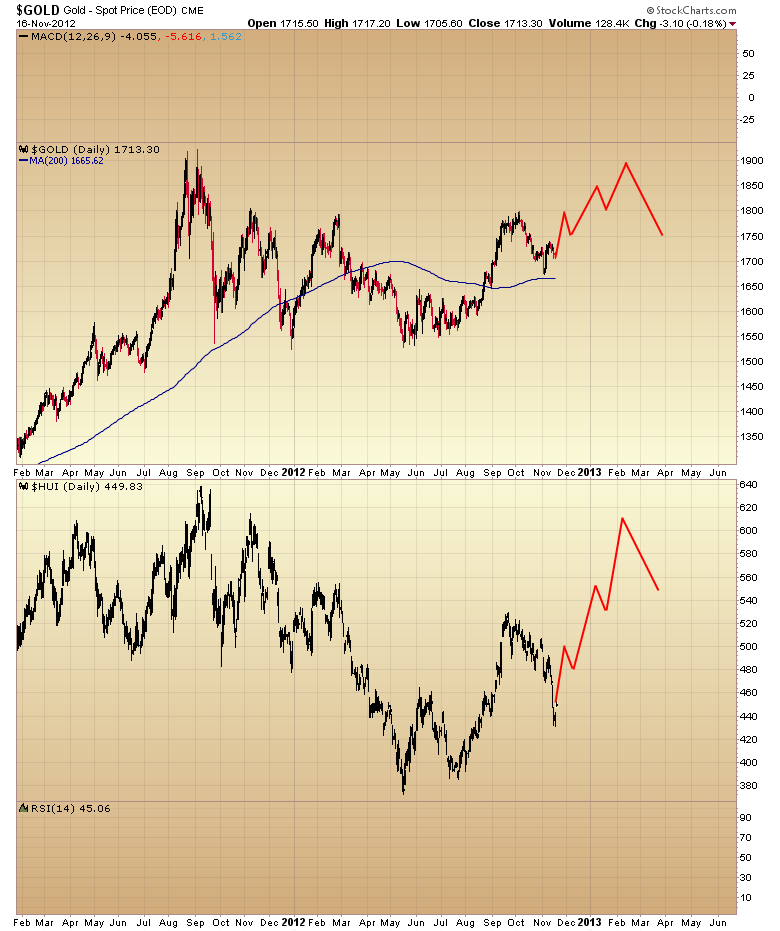

….4 more charts and commentary HERE

 In the past few weeks the equity markets have been in a tailspin in response to a variety of factors. The U.S. market, as measured by the broad S&P500 Index has declined approximately -8.4% from its early October high into Fridays low. In Canada the decline didn’t start until the beginning of November after moving sideways for most of October but finally succumbed to the global sell off with the TSX Composite dropping by -6.1%, slightly less than the U.S.

In this commentary we’ll survey the intermediate-term to longer-term market terrain and Gold Relative Strength. This is especially important since we’re about to enter a new year, which the Kress cycle outlook describes as potentially dangerous from a financial market and economic perspective.
Investors have had no shortage of worries in November, including uncertainty surrounding the presidential race earlier this month, the upcoming “fiscal cliff” on Dec. 31, troubles in the Middle East, and the ongoing euro zone debt crisis. On the European front, Spain has still not asked for the European Central Bank (ECB) to purchase its bonds, while the Euro area finance ministers will not likely to make a final decision to release the Euro 31.5 billion of aid to Greece until Nov. 26.
In a bull market investors tend to ignore worries and focus on the positive news, namely expanding corporate profits. Bull markets on average tend to run about 3-4 years before becoming exhausted. The bull market which began in March 2009 was accompanied by a major recovery in corporate profits, which was part of a feedback loop that propelled equity prices higher in the last 3+ years. Corporate profit momentum is in the process of revering now, which means investors have one less positive to consider when evaluating equities.
From an investor psychology perspective, what does it mean when fear and worry feeds on itself and creates downside momentum? It means we’re entering a bear market, which was fated to happen at some point after the 4-year cycle peaked in October. On an interim basis it was confirmed when the NYSE Composite Index (NYA) decisively broke below its 60-day moving average.

Another indication that conditions have turned bearish on an intermediate-term basis is seen in the series of internal momentum indicators known as HILMO (Hi-Lo Momentum). As the name implies, HILMO is based on the rate of change in the daily 52-week highs and lows on the NYSE. Whenever all the main components of HILMO (short-, intermediate-, and longer-term) are in synch to the downside it shows that conditions have turned decisively bearish.
Of course this negative internal condition can, and most likely will, be reversed on a short-term basis. We’re entering a favorable timeframe for equities seasonally (December-January) and a year-end rally isn’t out of the question. The investor sentiment poll released last Thursday by the American Association of Individual Investors (AAII) showed the percentage of their members who are bullish were only 29 percent, while 49 percent were bearish. This net bearish reading is one of the highest in two years and suggests, from a contrarian standpoint, a short-term market bottom.

But what separates a normal, healthy market from the environment we’re now entering on a longer term basis is that the rallies will likely not be sustainable beyond a few weeks. The main trend for 2013, in contrast to the past year, will likely be down. This is especially true with the final “hard down” phase of the 40-year and 60-year Kress cycles upon us in 2013 and 2014.
Gold ETF
Our preferred gold ETF, the iShares Gold Trust (IAU), hasn’t yet confirmed a buy signal according to the rules of our trading discipline, but it has begun to show significant relative strength. Consider the following graph which shows the meaningful spike in the gold ETF’s relative strength in just the last few days. In most cases, a spike in the relative strength lineprecedes an upside move in the IAU. Accordingly we should soon have a confirmed immediate-term buy signal for the gold ETF.

Market Analyst
About Cliff Droke
Clif Droke is the editor of the 3-times weekly Momentum Strategies Report which covers U.S. equities and forecasts individual stocks, short- and intermediate-term, using unique proprietary analytical methods and securities lending analysis.He is also the author of numerous books, including most recently “Turnaround Trading & Investing.” Home of the infamous Durban Roodepoort Deep (DROOY/RGLD/MDG/XAU/HUI) report. Published online every trading day. Aimed at serious day & short-term traders of Durban Deep & followers of the XAU & HUI index. Posted online each evening by 9pm EST. www.clifdroke.com
PO Box 3401 Topsail Beach NC 28445-9831 USA
clif @ clifdroke.com
http://www.clifdroke.com/

There are few mining sectors where chemistry, metallurgy and the supply chain meet in such a complex yet potentially profitable way as rare earths. Companies must keep an eye perpetually toward the future, making prescient judgments about end-user demands and constantly evolving technologies. In this interview with The Critical Metals Report, Gareth Hatch, founding principal of Technology Metals Research and president and director of Innovation Metals Corp., gives an update about which projects are closest to production and which have the right recipe to entice customers.
The Critical Metals Report: Gareth, many investors have abandoned rare earth element (REE) equities either because equity prices have fallen dramatically or the path to profits is moGare complicated than other equities in the mining space. Why should investors remain here?
Gareth Hatch: The answer to that question lies in understanding the cycle that we are in, with respect to the ongoing development of exploration plays and their transformation into nascent mining operations within the next two or three years. Clearly, the vast majority of companies in this sector are not going to follow that path, as is true in every mining sector. Some of their projects will go into production; the vast majority will not, at least not anytime soon; and investors need to do their due diligence.
This is no longer a sector where investors should be looking for a five- or tenbagger. Investors have already sunk a lot of money into these stocks. In the long term, investors should focus on the technical side and follow the companies that are doing the right things. If investors are here and want to stick around, they should look for the companies that are going to go into full-blown mining and processing, the companies that are going to actually make metals and oxides and sell such material through offtakes and the like.
TCMR: What about this sector still remains unclear to many investors?
GH: Few investors have a real appreciation of the complexity of developing processes that turn attractive geological deposits into actual commercial-grade materials that can be sold. It is interesting to me that four or five years after the interest in this sector underwent a major uptick, people are still not really aware of just what it takes and the questions that they should be asking to determine the probability that projects will go forward. There’s a lot of fuzziness and uncertainty.
TCMR: What are some of those questions that investors should be asking?
GH: First, do you understand exactly what type of minerals make up the deposit? That will tell an investor the approaches that the company will need to take to recover, process and develop the metallurgy, the chemical engineering required for those minerals.
Second, investors need to understand exactly where companies are at in their development. What is the status of a company’s resource development work, its mine design and its environmental permitting plans for building infrastructure? Investors need to dig into the reports – the preliminary economic assessment (PEA), the prefeasibility study (PFS) and any other information that is published to assess how a company is addressing each of these areas.
Another critical question concerns the handling of radioactive materials that can occur in REE deposits. Companies need to address the issues of handling radioactive substances, regardless of how low the levels may be, instead of, in some cases, just brushing this off. Sometimes that only starts to get focus and attention as a company moves into the prefeasibility stage.
TCMR: What are some companies that have done a good job of communicating the answers to these questions?
GH: I think it is less about the individual companies and more about where they are listed. Canada has guidelines that require companies to put out high-quality, independently developed information, for example, into the public domain. For such companies, there really are no excuses for investors to not review this information, if it exists. And if it doesn’t, depending on where particular companies are at in the development cycle, investors should be asking themselves whysuch companies have not yet put out such reports.
Investors can look at companies that are much further along in development and that have put out a PFS or who are working on one – Avalon Rare Metals Inc. (AVL:TSX; AVL:NYSE; AVARF:OTCQX), Quest Rare Minerals Ltd. (QRM:TSX; QRM:NYSE.MKT) or Frontier Rare Earths Ltd. (FRO:TSX), for example.
Companies like Matamec Explorations Inc. (MAT:TSX.V; MRHEF:OTCQX) and Tasman Metals Ltd. (TSM:TSX.V; TAS:NYSE.MKT; TASXF:OTCPK; T61:FSE) have done a good job of outlining the information at the PEA stage. They are not the only ones.
….to read page 2 click on the image below or HERE

 He manages one of the world’s largest mutual funds and he got to that position by making money. Investors should put their money into overseas stocks and closed end bond funds, said Bill Gross, founder of fund giant Pimco.
Slow growth and low yields in the United States make such venues attractive options.
“Both from the standpoint of stocks and bonds, an investor wants to go where the growth is. There are countries that should grow faster than Euroland countries, and countries that should grow faster than the United States. They would be the big obvious ones: China and Brazil, and even Mexico,” Gross told U.S News & World Report.
Looking at the broader economy, investors can get used to what Pimco describes as a “new normal,” a global economy focusing on paying down debts, which will slow growth for some time to come.
“[I]n 2008, the world was too highly levered and ever since it’s been in the process of de-levering, which means that consumers and businesses cannot take on the same amount of debt that they did in the past. Don’t think that anytime soon we’re going back to the ‘old normal’ because these cycles of de-levering are biblical in nature,” Gross said.
Inflation rates are due to creep higher as well, thanks to loose monetary policies carried out by central banks around the world, namely cuts to benchmark interest rates and liquidity injections into their respective economies.
“Slower growth and higher inflation — that’s not a positive, by any means. Individuals would want it to be just the reverse,” Gross said.
“The de-levering and the check-writing on the part of central banks, that’s really what produces the situation.”
Big banks are looking to emerging markets for growth these days, including Deutsche Bank, which wants to see pretax profits from foreign retail branches to approach 1 billion euros by 2015 to offset sluggish activity in more mature markets.
“A stagnating (European) population threatens growth opportunities in the long run. That is why retail business in emerging markets is of great significance,” Rainer Neske, head of private and business clients, told Reuters.
CANADIAN PERSPECTIVES
- To assess the potential impact of major macro drivers (such as extraordinary monetary policy in the U.S. and Europe) on Canadian inflation, PIMCO has designed proprietary Canadian inflation models.
- Inflation dynamics are highly complex, and our approach captures particular aspects of inflationary pressures in the economy to glean information about the future path of inflation.
- Our Canadian inflation modelling points to higher inflation over the coming year.
….read the whole article HERE

-
I know Mike is a very solid investor and respect his opinions very much. So if he says pay attention to this or that - I will.
~ Dale G.
-
I've started managing my own investments so view Michael's site as a one-stop shop from which to get information and perspectives.
~ Dave E.
-
Michael offers easy reading, honest, common sense information that anyone can use in a practical manner.
~ der_al.
-
A sane voice in a scrambled investment world.
~ Ed R.
Inside Edge Pro Contributors

Greg Weldon

Josef Schachter

Tyler Bollhorn

Ryan Irvine

Paul Beattie

Martin Straith

Patrick Ceresna

Mark Leibovit

James Thorne

Victor Adair