
Gold & Precious Metals

Gold Stocks Approaching a Crossroads

“An absolute treasure of analysis”.

Recently, the Erste Group published a 120 page report covering precious metals. The report contains an absolute treasure of analysis, figures and charts concerning gold and the gold stocks. I have selected a few of the charts which help us explain the current status of the gold stocks. Essentially, there is a huge divergence between financial performance and valuations. Ultimately, the performance of the shares over the coming months will answer the question as to the resolution of that divergence.

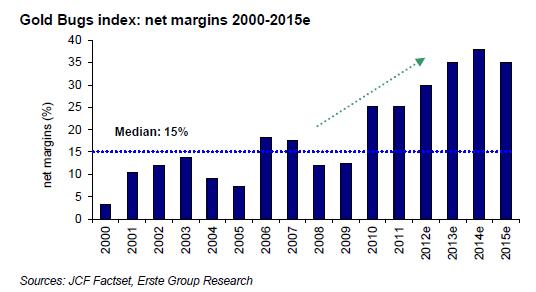
We often hear how difficult of a time some mining companies are having. Although that is true, the reality is present conditions for gold miners have never been better. Rising costs are a problem but margins for the large unhedged producers are at bull market highs (and likely all-time highs).

goldstocksmargins

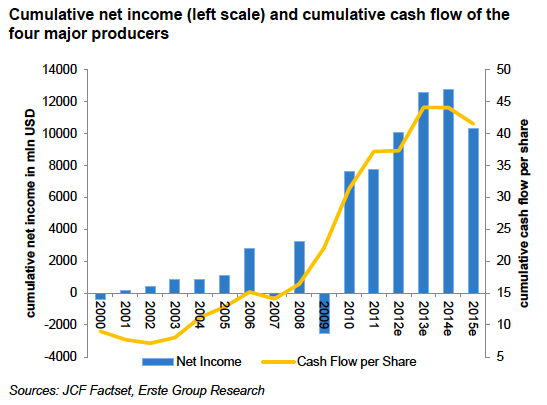
The rising margins explain the consistent increase in cash flow and net income (with a few bumps) as the chart below depicts. Cash flow and net income for 2012 will also reach a bull market high.

Nov28edCF

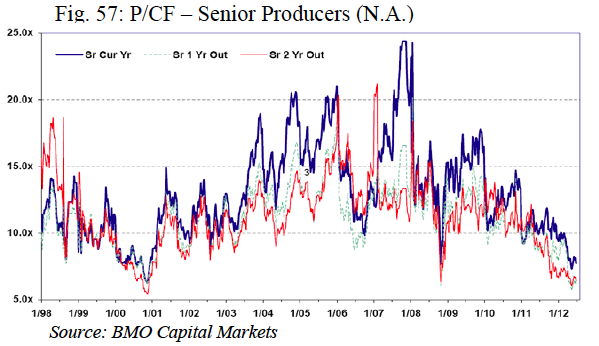
Given the high margins, cash flow growth and record earnings why are the stocks struggling and trading well off their highs? A major and often forgotten explanation is the current low valuations. Several months ago, the price to cash flow valuation of senior producers was equivalent to valuation lows seen in 2000 and 2008. No chart better illustrates valuations then this one from BMO Capital Markets.

nov28edgoldtocksvaluation

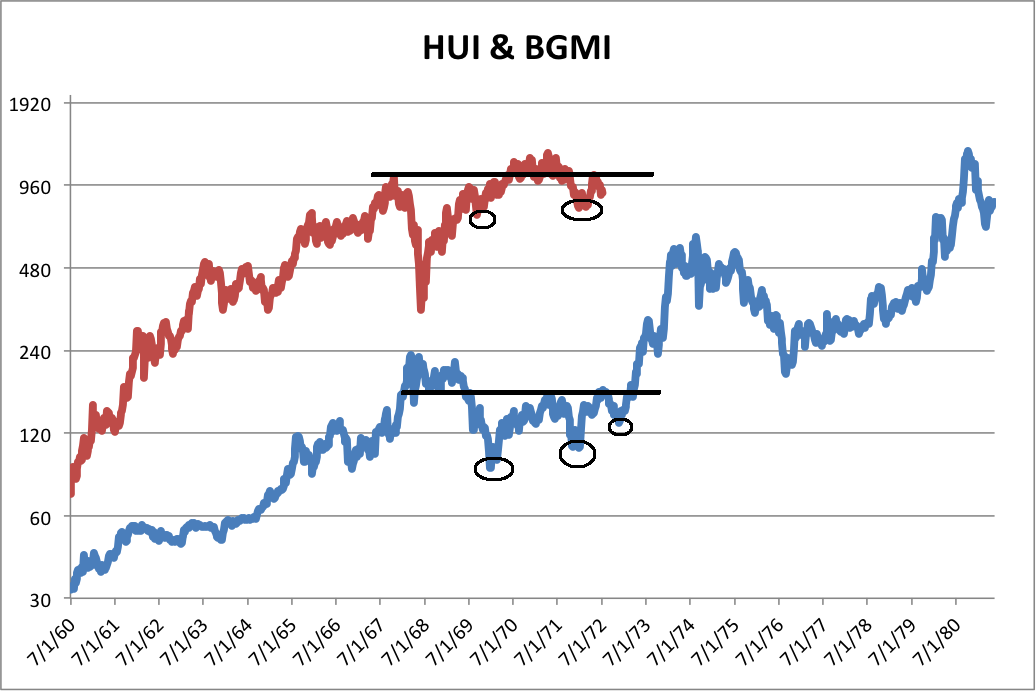
Now let’s examine the current technicals and draw a comparison between today’s bull market and the bull market from 1960 to 1980. Below we plot the current bull market in the HUI (red) and the Barron’s Gold Mining Index (BGMI). There are some differences but also some similarities. Note that the level 170 was key support and resistance for the BGMI for nearly five years. Once the Bgmi broke 170, it was headed much higher.

nov28edhistory

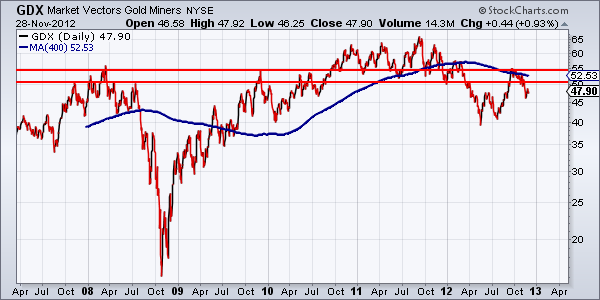
One can better view the current key pivot point from the chart below. The 52-55 range has been key support and resistance for GDX since late 2007. If and when GDX makes a weekly close above 55, you can bet that the prognosis will look quite bullish.

nov28edgdx

The market is at an interesting crossroads. Financial results have been strong but valuations are weak. The market believes earnings and cash flow will decline and has priced in that outcome to some degree. Ultimately, this will resolve itself in one of two ways. Producer margins can decline which would impact cash flows and profitability. That would eventually lead to lower share prices and GDX could threaten a break below 40. On the other hand, should margins increase then share prices will explode higher from a compounding effect. Rising margins will generate stronger cash flow and higher profits and the low valuations will rebound as sentiment would normalize. This is the fundamental case for the next major breakout in the gold shares.

Given the technical damage from the recent selloff (which went a bit further than expected) one should not anticipate this crossroads to be resolved anytime soon. Think months rather than days or weeks. Ultimately, the shares will break 55 to the upside in 2013 thanks to the combination of a breakout in Gold combined with stable costs in 2013. In the meantime the shares will consolidate providing you time to do your research and find the companies that will lead the next leg higher and outperform. If you’d be interested in professional guidance in uncovering the producers and explorers poised for big gains then we invite you to learn more about our service.

Good Luck!

Jordan Roy-Byrne, CMT
Jordan@TheDailyGold.com


Perspective

The Problem in any Post Bubble Contraction.

SIGNS OF THE TIMES

“Indian Industrial Production Unexpectedly Fell in September” – Bloomberg, November 12

“Economic output in the Eurozone fell 0.1 percent in the third quarter, following a 0.2 percent drop in the second quarter.”– Reuters, November 15

“China’s vehicle sales fell for the sixth straight month in October.” – Bloomberg, November 14

“Investment Falls Off a Cliff”– Wall Street Journal, November 18

This story included that U.S. companies were cutting spending plans because of “fiscal and economic uncertainty”.

Then there are two gems that really mark growing uncertainty:

“Krugman: Bring Back the 91% Tax Rate” – The New York Times, November 18

“Treasury Secretary Geithner: Lift Debt Limit to Infinity”– CNS News, November 19

*   *   *   *   *

PERSPECTIVE

Harvesting headlines is usually interesting and sometimes riveting. The first ones indicate a slowing global economy – despite unprecedented stimulation, corporate bailouts and “fixing” of any number of countries.

The problem in any post-bubble contraction is that in the mania debt was eagerly expanded to an amount that can’t be serviced even by a strong economy. The debt burden seems to be the main reason that post-bubble recessions are severe and recoveries are weak.

The last two headlines suggest that the establishment is discovering that massive intervention is not prompting a strong business expansion. The proposed remedies of higher tax rates and unconstrained issuance of treasury debt indicate that confiscation of wealth and earnings is changing from a hidden to an open agenda.

Intellectually pathetic and fiscally tragic.

COMMODITIES

The fall decline took base metal prices (GYX) from a nice high of 406 on September 14th to 359 on November 9th. Our November 8th piece was looking for a “natural” rebound. There is overhead resistance at the 380 level.

Agricultural prices (GKX) have been in a stair-step decline since all of the excitement peaked in July. The RSI reached the highest levels since the cyclical top at 570 in early 2011. Last week’s low at 463 extended the downtrend, but a rebound into January seems likely.

Crude oil slipped to a modest oversold condition and can trade in a narrow range into January.

*   *   *   *   *

AMPERSAND

Squirrels

Through the winter months it’s worthwhile to keep a bird feeder. One kind that is almost problem-free is one set up for husked peanuts, which only attracts the birds that like what the Southerners call “goober peas”. With a multi-grain feed, visitors scatter the seeds that they don’t like and that is messy.

My office has a lot of window and the feeder hangs from a cord attached to the house and to a tall post at the fence with the climbing hydrangea. The problem this season has been a new and persistent squirrel in the neighborhood. And the weather has yet to get cold.

A couple of plastic pie plates were drilled and the cord passed through such that they provide a barrier – that rotates. On the first few attempts the squirrel suffered a sudden instruction in the forces of gravity. Then with determination and practice was able to get to the feeder.

So, I switched the critical plate such that the rim faced the other way, but he was still able to get over it.

It needed something with a greater diameter, which the old camping equipment did not have.Fortunately, the record collection has some of the old twelve-inch 78s. This looked good as they already have the right-sized hole for the cord and now one is mounted. It is a recording of an indifferent Tchaikovsky, so it won’t be missed and it may be effective in its new role.

It will be interesting to see how it works.

Link to November 23rd ‘Bob and Phil Show’ on TalkDigitalNetwork.com:

http://talkdigitalnetwork.com/2012/11/us-markets-close-early-no-sign-of-santa/

INSTITUTIONAL ADVISORS

WEDNESDAY, NOVEMBER 28, 2012

BOB HOYE

PUBLISHED BY INSTITUTIONAL ADVISORS

The following is part of Pivotal Events that was

published for our subscribers November 22, 2012.

BOB HOYE,   INSTITUTIONAL ADVISORS

E-MAIL  bhoye.institutionaladvisors@telus.net

WEBSITE:   www.institutionaladvisors.com

Unknown

Why Gold is Overvalued

The Gold Report: Paul, your speech at the Hard Assets Conference in San Francisco was titled “Rational Expectations.” You spoke about monitoring the real rate of monetary inflation based on the total money supply.

You take into account everything in your indicator that acts as money, creating a money aggregate that links the value of gold and the dollar. You conclude that quantitative easing (QE) is not resulting in hyperinflation and is not acting as a driver for the continuing rise in the gold price. What then is pushing gold to $1,700/ounce (oz)?

Paul van Eeden: Expectations and fear. It’s very hard to know what gold is worth in dollars if you don’t also know what the dollar is doing. When we analyze the gold price in U.S. dollars, we’re analyzing two things simultaneously—gold and dollars. You cannot do one without the other. The problem with analyzing the dollar is that the market doesn’t have a good measure by which to recognize the effects of quantitative easing.

Since approximately the 1950s, economists have used monetary aggregates called M1, M2 and M3 (no longer being published) to describe the U.S. money supply. But M1, M2 and M3 are fatally flawed as monetary aggregates for very simple reasons. M1 only counts cash and demand deposits such as checking accounts. M1 assumes that any money that you have, say, in a savings account isn’t money. Well, that’s a bit absurd.

TGR: What comprises M2?

PvE: M2 does include deposit accounts, such as savings accounts, but only up to $100,000. That implies that if you had $1 million in a savings account, $900,000 of it doesn’t exist. That’s equally absurd.

Screen Shot 2012-11-28 at 3.28.53 PMM3 describes money as all of these—cash, plus demand deposits plus time deposits, but to an unlimited size. One may think then that M3 is the right monetary indicator. But the problem with both M2 and M3 is that they also include money market mutual funds, a fund consisting of short-term money market instruments.

That’s double-counting money because if I buy a money market mutual fund, the money I use to pay for that mutual fund is used by the mutual fund to buy a money market instrument from a corporation. The corporation takes the money it received from the sale of the instrument and deposits it into its bank account, where it is counted in the money supply. I cannot then count the money market mutual fund certificate as money, as it would be counting the same money twice.

TGR: So there is no accurate indicator.

PvE: M2 and M3 double-count money; M1 and M2 don’t count all the money. All are imperfect measurements. That is why I created a monetary aggregate called “The Actual Money Supply,” which is on my website at www.paulvaneeden.com.

TGR: How is your measurement more accurate?

PvE: It counts notes and coins, plus all bank deposit accounts, whether they’re time deposits or demand deposits. This is equal to all the money that circulates in the economy and can be used for commerce—nothing more and nothing less.

TGR: How does that separate out gold from the dollar in value terms?

PvE: I’m a goldbug. I believe gold is a store of wealth and gold is money. If gold is money, we should be able to look at gold and compare gold as one form of money against dollars, another form of money.

Changes in the relative value of gold and dollars will be dictated by their relative inflation rates. If I create more dollars, I decrease the value of all the dollars. If I create more gold, I decrease the value of all the gold.

TGR: The relationship is determined by both quantitative easing and mining?

PvE: Correct. Essentially most of the gold that has been mined is above ground in the form of bars and coins and jewelry. We can calculate how much that is. That’s the gold supply. That supply increases every year by an amount equal to mine production less an amount used up during industrial fabrication. That’s gold’s inflation rate.

We can also look at the money supply and see how it increases every year. That’s the dollar’s inflation rate. The value of gold vis-a-vis viaScreen Shot 2012-11-28 at 3.29.05 PM the dollar will be dictated by these relative inflation rates.

I have data on both gold and the U.S. dollar going back to 1900 and thus can compare the two. By doing that, I can calculate how the value of gold changes relative to the U.S. dollar and what gold is theoretically worth in terms of dollars.

Keep in mind that the market price is not the same as the value. In the market, price is seldom equal to value. Price often both exceeds and is below value. But it will always oscillate around value.

For example, in 1980, gold was trading much higher than value. By 1995, the gold price had sufficiently declined and U.S. dollar inflation had sufficiently increased to bring the gold price back to value, vis-a-vis the dollar. By 1999, gold was substantially undervalued. By 2007, it was again reasonably valued. But in 2012, it is again substantially overvalued.

vaneeden chart

TGR: The value of gold is not $1,700/oz?

PvE: No. The value of gold is about $900/oz. Expectations of monetary inflation are keeping gold prices high.

In 2008, after the financial crisis, the Federal Reserve Bank announced the first round of quantitative easing. The gold price started to rally because there was an expectation, with the Fed openly engaging in quantitative easing, that we would see massive U.S. dollar inflation. But that didn’t happen.

When the Fed engages in quantitative easing, it does so by buying assets in the open market, such as Treasury notes or bonds. When the Fed buys a government bond in the open market it creates the money to pay for it out of thin air. The payment is credited against a commercial bank’s account at the Federal Reserve Bank and is not available for commerce in the economy. It’s part of the monetary base, but not the money supply, as the money supply only counts money that can be used for commerce.

Thus, the money that the Fed creates is not in circulation. It’s not part of the money supply because it cannot be spent. The commercial bank in whose name it is credited cannot withdraw it. The only thing it can do is to create new loans against that reserve asset. But the bank can only create new loans equal to the demand for such new loans.

Right now, as a result of QE1 and QE2, there is an enormous amount of excess reserves on account at the Federal Reserve on behalf of these commercial banks. These excess reserves in theory could be used to create new loans. The reality is that new loan creation by commercial banks have proceeded at a very normal pace, and not at all at a rate that should cause fear of hyperinflation.

TGR: Is it that there isn’t a demand or that the banks don’t see creditworthy people to loan to?

PvE: It doesn’t matter; the result is the same. The point is that the marketplace is not creating those loans.

Money that is counted in the money supply is created when consumers and corporations borrow money from commercial banks. When a loan is created by a commercial bank, the banking system creates that money out of thin air just as the Federal Reserve created its money out of thin air.

When a loan is repaid, that money is destroyed. The natural increase of the money supply is the balance between loan creation and loan repayment from consumers and corporations to commercial banks. Their ability to create those loans is dependent, to some extent, on their reserve assets in the monetary base that they have on account at the Federal Reserve. Right now, those reserve assets are much, much larger than what is necessary to account for existing loans of banks. So banks have enormous capacity to create loans, but capacity to create is not the same as having created. We are not seeing runaway inflation in the market. The U.S. money supply is increasing at an annual rate of around 7%, which is high, but not high enough to cause the type of hysteria that the gold price is exhibiting.

TGR: The expectation that banks will eventually loan up to their lending capacity is what is causing the fears of hyperinflation and the gold price to go up.

PvE: That is correct.

TGR: When will banks start lending?

PvE: They are lending, which is why the U.S. money supply is increasing. But they are not lending at a torrid pace—the U.S. money supply is increasing only very slightly faster than the average annual rate since 1900, and slower than it was in the period from 2000 to 2009 before quantitative easing started. It is highly improbable that we will see the kind of monetary inflation the market is afraid of—the fear is misplaced.

The Federal Reserve alone controls the level of money in the monetary base. If the Federal Reserve starts to see an increase in price inflation or a rapid increase in loan creation—monetary inflation—it can sell assets back into the market. When those assets are sold back into the market the money that the Federal Reserve receives for the asset is destroyed. It evaporates.

Just as the Federal Reserve created money, it can destroy money. The Fed can absolutely prevent runaway inflation by selling assets back into the market, therefore constricting the ability of commercial banks to make loans.

TGR: If the Fed-created money isn’t loaned out, will the inflationary expectation in the market eventually disappear? Will the price of gold go to $800–900/oz?

PvE: That’s a possibility. The gold price rallied in response to QE1 and QE2 and when QE2 ended, the gold price started falling.

Prior to the announcement of QE3, the gold price rallied again in anticipation, but since QE3 has been announced, the gold price has been falling.

When the Federal Reserve announced QE1, there was a massive increase in the monetary base. When it announced QE2, there was another substantial increase in the monetary base, but much less than with QE1. But there hasn’t been an increase in the monetary base since the QE3 announcement. The Fed is “sterilizing” QE3 by offsetting sales of assets at the same time it is purchasing assets.

TGR: So the key is how the Fed implements quantitative easing?

PvE: Correct. The question is whether the gold market is rational in expecting hyperinflation or massive runaway inflation. That expectation is not being supported by the money supply, or by price inflation, or any other data. The only place the expectation is being manifest is in the prices of gold and silver.

TGR: If you look at the supply and demand expectations for gold versus the inflated valuation for gold, do you see more gold producers bringing gold out of the ground? If so, is that going to have an effect on the price?

PvE: If the gold price is high relative to production costs then yes, it does bring marginal mines into production, which increases the supply of gold. Incidentally, the increase in production from marginal mines then causes production costs to increase as well.

Does that have an impact on the price of gold? No. The reason is very simple. Approximately 1,000–2,000 tons of gold is traded each day. Annual production of gold is roughly 2,000 tons. If annual gold production increases by 5%, which is a lot, it’s 100 tons. We trade that in a couple of hours.

Whether annual mine production goes up or down, it makes no difference to the price of gold. The gold that’s trading globally is not just the gold that’s being mined; it’s all the gold that’s ever been mined, that’s sitting above ground in vaults and in storage. That’s where the price is set. Not on the margin of incremental production.

TGR: As you’re looking at the gold companies that are out there, are you seeing that we have some good prospects or are you seeing that the producers aren’t able to replace what they’re using and the juniors aren’t able to get the funding to find new sources?

PvE: I agree with your last statement. Producers are not able to replace their reserves. New exploration is not keeping up with reserve depletion and the juniors are not getting the funding to do the exploration.

The reason juniors aren’t getting funding is because the market has become quite risk averse. Junior exploration companies are among the most risky investments you can imagine. When risk aversion increases in the market, the ability of juniors to fund exploration evaporates.

It’s also true that the miners, particularly gold and copper, are having a tough time replacing reserves. Is that something that’s going to cause a calamity in the next 12 or 24 months? No. But, it is a reason why, over the long term, investing in mineral exploration is an interesting business. Without mineral exploration, there can be no mining industry and without a mining industry, our society does not function.

TGR: The last time we spoke to you, you said that you were very scared and that it was a healthy thing for investors to be scared because it keeps them from making mistakes. Are you still scared?

PvE: I’m definitely concerned that the market is going to look worse in 2013 than it looked in 2012. I think risk aversion is not yet ready to be replaced by risk appetite. The big concern I have for next year is further deterioration of the Chinese economy. In particular, a tipping point is being reached in China where its banking system can no longer sustain the bad loans it has created.

If economic growth in China takes a really big hit at the same time the financial problems in Europe have not yet been resolved, I see more risk aversion creeping into the market. That’s not good for junior exploration companies.

What makes me optimistic is that I think the worst is behind us in the United States. I think that slowly but surely the U.S. economy is going to get better and better. With time the improvement in the U.S. economy will bring risk appetite back into the market, but I don’t see that happening in 2013. We’ll have to see this time next year what the prognosis is for 2014.

TGR: In 2008, you told your investors to sell everything. Is that still your position?

PvE: The end of 2007 and the beginning of 2008 was the top of the market for most metals and certainly for mineral exploration stocks. That was the time to sell everything. Now we’re very close to the bottom of the market. It could be a long and drawn-out bottom but, nonetheless, I think that we’re close to a bottom.

This makes it a very good time to be accumulating mineral exploration assets or junior exploration companies. It assumes an investor has the patience and financial ability to wait for the next bull market and stay with the trades. Remember that junior exploration companies don’t generate revenue. If the bear market is protracted, these companies will need several rounds of financings in order to stay alive.

TGR: You also invest in silver, base metals and energy. Are some of these sectors doing better than others?

PvE: Copper, like gold, is very expensive. So is silver. The other base metals, such as aluminum, zinc, lead and nickel, are much more reasonably priced. Oil is also very reasonably priced at $85/barrel. I see less systemic risk in those sectors than I see in gold, silver or copper.

TGR: What specific companies do you like in those sectors?

PvE: I have recently acquired additional shares of both Miranda Gold Corp. (MAD:TSX.V) and Evrim Resources Corp. (EVM:TSX.V). I’m on the board of both of those companies and so I am not at all independent, or impartial.

I also recently acquired shares of a company called Millrock Resources Inc. (MRO:TSX.V). And I continue to scour the market for more opportunities. I intend to be a buyer of mineral exploration companies for the foreseeable future.

TGR: Why do you like those three?

PvE: All three of those companies share one element that is critically important. All have competent, experienced management and they have management that I trust: trust that they’re not going to squander the money that we give them and trust that they will use their best efforts to create shareholder value. It is my confidence in management teams that causes me to invest in mineral exploration. Mineral exploration is a business about ideas. It’s not about assets. And when you’re dealing with ideas, the asset that you’re de facto buying is people—it’s management.

TGR: You say that you’re doing this for the long term. How long do you think that you’ll have to wait?

PvE: Who knows? 5, 10 years? Maybe we get lucky sooner. Maybe we don’t.

TGR: Thanks for your insights.

Paul van Eeden is president of Cranberry Capital Inc., a private Canadian holding company. He began his career in the financial and resources sector in 1996 as a stockbroker with Rick Rule’s Global Resources Investments Ltd. He has actively financed mineral exploration companies and analyzed markets ever since. Van Eeden is well known for his work on the interrelationship between the gold price, inflation and the currency markets.

Want to read more Gold Report interviews like this? Sign up for our free e-newsletter, and you’ll learn when new articles have been published. To see a list of recent interviews with industry analysts and commentators, visit our Streetwise Interviews page.

DISCLOSURE:
1) JT Long of The Gold Report conducted this interview. She personally and/or her family own shares of the following companies mentioned in this interview: None.
2) The following companies mentioned in the interview are sponsors of The Gold Report: Millrock Resources Inc. Streetwise Reports does not accept stock in exchange for services. Interviews are edited for clarity.
3) Paul van Eeden: I personally own shares of the following companies mentioned in this interview: Miranda Gold Corp., Evrim Resources Corp. and Millrock Resources Inc. I am a director of the following companies mentioned in this interview and receive remuneration as a director from these companies: Miranda Gold Corp. and Evrim Resources Corp. I was not paid by Streetwise Reports for participating in this interview.

How Government ‘Works’….Part II

mask-of-king-tutIn the case of Egypt, people listened and obeyed – at least, as much as they did – because Pharaoh was, in theory, a god. In the case of Rome – with the exception of Caligula’s claims – and the Mongol empires, the theory was similarly simple, though different. Tamerlane made no claim to divinity.


He merely made it clear what he would do to you if you resisted him. Towns that submitted were generally governed passably, according to the standards of the day…and taxed, but not razed to the ground. Those that contested his authority were destroyed, often with all the inhabitants killed.

Everybody – or everyone who isn’t either feebleminded or a saint – wants wealth, power and status. And the easiest, fastest way to get it usually is to take it away from someone. That is government’s role.

In Rome and out on the steppes, those who controlled the ‘government‘ were in the favored position. They could reach out and impose their will on those who were not favored. Which is exactly what they did. As long as they were able, the insiders took from the outsiders. In both cases, the outsiders were literally outside the ruling group and its homeland.

This is perhaps a good place to point out that government is a phenomenon, not a system. It is best understood as a fight between the outsiders and the insiders. The insiders always control the government…and use it to conquer and control the outsiders. Why do they want to do so? The usual reasons. Wealth. Power. Status.

Everybody – or everyone who isn’t either feebleminded or a saint – wants wealth, power and status. And the easiest, fastest way to get it usually is to take it away from someone. That is government’s role. Only government can take something away from someone else lawfully. Why? Because governments make the laws.

We’ve already seen how a small group of Romans were able to reach beyond their home town, for nearly 1,000 years, taking wealth from people on the outside. One tribe fell under their control. Then another. Then, one town. And another. And always the power, prestige and wealth flowed back to Rome.

But not all Romans benefited in the same way. Rome itself was divided. During the Republican period, the insiders were the leading families who controlled the Senate. Then came the dictators, the emperors, and the scalawags who were able to get control of the government.

Often, they were military men, popular or cunning generals who rose through the ranks, murdered their rivals, and took the reins of power for themselves. Each brought in new insiders…and kicked out some of the old ones. Rome sizzled with intrigue…and sometimes erupted into open warfare, with one group of insiders battling it out with another.

After Rome fell, barbarian tribes swept over Europe. Local strongmen were able to set up their own governments. There was little theory or justification involved. They used brute force to take what they wanted.

Then they settled down to govern. One local lord provided protection from other local lords. All demanded payment, tribute, wealth and power. In the largely un-moneyed economies of the Dark Ages, taxes were in the form of a share of output…and/or days of labor. A serf typically worked one day in 10 for his lord and master.

In the fixed order of the world, each person had a job to do. One was a hewer of wood. Another was a drawer of water. A third was a king. Each man did his duty.

The local warlord and his entourage were the insiders. They took from the outsiders as much as they could get away with. Or as much as they thought it prudent to demand. Some even asserted a droit du seigneur, known in France by the more carnal expression ‘the right to the thigh.’

The local chief demanded the right to deflower the brides of his peasants. Even as recently as the beginning of the last century, Kurdish chieftains claimed the right to bed Armenian brides on their wedding night.

As the Dark Ages progressed, government became less locally peculiar. Across Europe, serfs, lords, and vassals knit themselves together into the feudal system. One governed a small area and was in turn governed by another, who governed a bigger one. At the top was the king, who owed his allegiance to God himself.

Justifying and explaining the phenomenon of government also evolved. How to make sense of it? Why was one man powerful and rich and another weak and poor? Europe was Christianized by then. All men were supposed to be equal in God’s eyes. How come they were so different in the eyes of each other?

Reaching back into antiquity, the doctrine of the ‘Divine Right of Kings’ was developed to explain it. Scholars did not maintain that kings were divine, because that would undermine the foundations of Judeo-Christian monotheism.

Instead, they claimed that kings had a special role to play, that they were appointed…and anointed, by God (through his ministers in the church of St. Peter)…to rule. Some people thought the kings were descended directly from the line of Jesus Christ. Others thought that God gave kings a ‘divine’ right to govern in His name.

In the fixed order of the world, each person had a job to do. One was a hewer of wood. Another was a drawer of water. A third was a king. Each man did his duty.

Scholars in the middle ages spent a lot of time on the issue. As a theory of government it seemed coherent and logical. But there were traps and dead ends in it. If the right to rule were given by God, man could not contradict Him. But men did. One divinely-appointed ruler met another divinely-appointed ruler on the field of battle. Only one could win. What kind of game was God playing?

And if God granted a man the right to rule other men, did that mean that every order he gave must be obeyed, just as though it had come from the mouth of God himself? And what if the king seemed not to be doing God’s work at all?

Adultery was clearly a no-no. God disapproved of it. But kings often made it a habit and a sport. Did not the king defile his body and betray his Lord? In an effort to explain away the problem, scholars put forth the idea that the king actually had two bodies. One sacred. One profane.

But which was which?

‘The Divine Right of Kings’ was a theory of government that held water. But you had to put the water in the right container. You had to believe in God. You had to believe that He gave out job assignments.

You also had to believe that He didn’t mind when His employees and agents made a mess of things…or even when they contradicted His own orders. Looking at the history of the monarchs who were thought to have been given this divine authority, you would have to conclude that God was either a very tolerant task-master, or a very negligent one. Adultery, murder, thieving, lying – there was hardly one of God’s commandments they obeyed.

As a theory of government, the ‘divine right of kings’ would have been okay had it not been for the kings themselves. Some were reasonable men. Others were tyrants. Many were incompetent, largely irrelevant and silly.

Taken all together, it was very difficult to believe that they had been selected by God, without also believing that God was just choosing His most important managers at random. Kings were not especially smart.

Not especially bold or especially timid. Not especially wise or stupid. For all intents and purposes, they were just like everyone else. Sometimes smart. Sometimes dumb. Sometimes good. Sometimes evil. And always subject to influence.

Towards the end of the 18th century, the ‘divine right of kings’ lost its following. The church, the monarch and the feudal system all seemed to lose market share. The Enlightenment had made people begin to wonder. Then, the beginning of the “Industrial Revolution” made them stir.

When the point of diminishing returns is passed, the payoff from further investment of resources in policing and wealth re-distribution declines. Then what happens?

In 1776, Adam Smith published his ‘Wealth of Nations’, arguing that commerce and production were the source of wealth. Government began to seem like an obstruction and a largely unnecessary cost. Its beneficial role was limited, said Smith, to enforcing contracts and protecting property.

The school of laissez-faire economics maintained that government was a ‘necessary evil’, to be restrained as much as possible. The ‘government that governs best,’ as Jefferson put it, ‘is the one that governs least.’

This is, of course, another way of saying that government – like every other natural phenomenon – is subject to the law of declining marginal utility. A little government is probably a good thing.

The energy put into a system of public order, dispute resolution, and certain minimal public services may give a positive return on investment. But the point of diminishing returns is reached quickly. For reference, here is the ‘take’ by modern governments today.

Government – according the Liberal philosophers of the 18th and 19th century was supposed to get out of the way so that the ‘invisible hand’ would guide men to productive, fruitful lives.

Smith thought the arm attached to the invisible hand was the arm of God. Others believed that not even God was necessary. Men, without central planning or God to guide them, would create a ‘spontaneous order,’ which would be a lot nicer than the one created by kings, dictators or popular assemblies.

This idea of government, such as it is, leads to what we know of today as ‘libertarianism’. Libertarians argue about how much authority the government should have. They scrap among themselves over what the government should do and how big it should be allowed to get. But all libertarians agree with Jefferson. And all agree that the governments in the world circa 2011 are much too big.

The libertarians are concerned about their loss of freedom. But what we’re concerned about is the downside. When the point of diminishing returns is passed, the payoff from further investment of resources in policing and wealth re-distribution declines.

Then what happens? We’ve already seen what happened to Germany in the ’30s and ’40s. Hitler was elected. But then, the Reichstag burned and he suspended democratic institutions. Perhaps more robust, modern democracies can adapt more readily and thereby avoid the downside?

We’ll see…in the next section.

Regards,

Bill Bonner
for The Daily Reckoning


About Bill Bonner

Since founding Agora Inc. in 1979, Bill Bonner has found success and garnered camaraderie in numerous communities and industries. A man of many talents, his entrepreneurial savvy, unique writings, philanthropic undertakings, and preservationist activities have all been recognized and awarded by some of America’s most respected authorities. Along with Addison Wiggin, his friend and colleague, Bill has written two New York Times best-selling books, Financial Reckoning Day and Empire of Debt. Both works have been critically acclaimed internationally. With political journalist Lila Rajiva, he wrote his third New York Times best-selling book, Mobs, Messiahs and Markets, which offers concrete advice on how to avoid the public spectacle of modern finance. Since 1999, Bill has been a daily contributor and the driving force behind The Daily ReckoningDice Have No Memory: Big Bets & Bad Economics from Paris to the Pampas, the newest book from Bill Bonner, is the definitive compendium of Bill’s daily reckonings from more than a decade: 1999-2010. 

NEW RELEASE: Addison Wiggin’s Latest Book… Inside you’ll find no less than 47 specific ways to protect your wealth — and your purchasing power — from the declining value of the U.S. Dollar. Discover how to claim a FREE copy of this new release here.

Read more: How Government “Works”, Part II http://dailyreckoning.com/how-government-works-part-ii/#ixzz2DY1Pu3db


Gold Dropping Like a Brick

Mark Leibovit warned he was going neutral in his “Gold & Silver Action Alert”  9 trading days ago. Further that if we approached a figure we are nearing now he would switch to a trading SELL. Click on that link above or HERE  to review that advice. 

If you are a short term trader, paying attention to a favorite of Mike’s and a  #1 Gold Timer like Leibovit makes sense on days like these:

Screen Shot 2012-11-28 at 7.46.25 AM

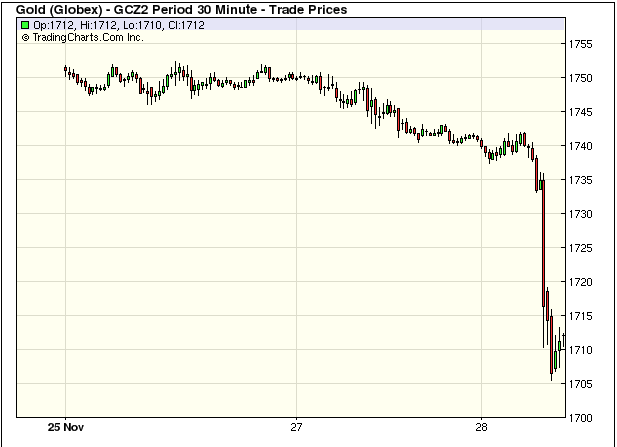
Ed Note: Gold closed at 1716.9 after hitting 1705.5 this morning.  Silver at 33.66 after hitting 32.9 this morning. 

Larry Edelson warned just 2 days ago when Gold closed at 1749.6 “I do expect gold to turn back down sharply and head toward the $1,600 level in the short term” in  Watch Out For Gold! – Stocks!  on this site. Now here’s Ben Traynor on why that pullback might be occuring:

Bullion at One-Week Low on Fiscal Cliff Concern

The dollar gold price fell to a one-week low below $1,735 per ounce Wednesday, as stocks and commodities also edged lower while the dollar and US Treasuries gained despite ongoing uncertainty over how the US will address its deficit problems. 

Silver fell to $33.73 an ounce, also a one-week low. 

“We are bullish silver, looking for a retracement back to the $35.35 [an ounce] high from early October,” says the latest technical analysis from bullion bank Scotia Mocatta. 

Bullion held to back shares in the world’s largest gold exchange traded fund SPDR Gold Shares (GLD) rose to a new all-time high yesterday at 1,345.8 tonnes. 

On the currency markets the US Dollar Index, which measures the dollar’s strength against a basket of other currencies, extended gains this morning despite ongoing uncertainty over the so-called fiscal cliff of tax rises and spending cuts due to kick in at the end of the year. 

“I haven’t seen any suggestions on what [the Democrats are] going to do on spending,” said Republican senator Orrin Hatch Tuesday. 

“There’s a certain cockiness that I’ve seen that is really astounding to me since we’re basically in the same position we were before.” 

“I think they feel somewhat emboldened by the election,” added Republican Congressman Tom Price. 

“How could you not when your president is re-elected after running four straight years of trillion Dollar-plus deficits?” 

Senate majority leader Harry Reid, a Democrat, said yesterday he hopes the Republicans can agree to proposed measures to raise additional tax revenue as a way of reducing the federal deficit. 

“And as the president’s said on a number of occasions, we’ll be happy to deal with entitlements,” Reid added, though he did not elaborate on where spending cuts might be made. 

“If the talks drag on,” says today’s commodities note from Commerzbank, “this could result in significant increases in the gold price.” 

The US Treasury meantime did not brand China a currency manipulator Tuesday, contrary to press reports predicting that it would. The Treasury Department did however say the renminbi “remains significantly undervalued”. 

Over in Europe, the European Court of Justice, Europe’s highest court, yesterday rejected a challenge to the legitimacy of the Eurozone’s permanent bailout fund the European Stability Mechanism.  

The ECJ rejected Irish politician Thomas Pringle’s argument that the ESM contravenes Article 125 of the European Union Treaty, which states that EU members states “shall not be liable for or assume the commitments…of another Member State, without prejudice to mutual financial guarantees for the joint execution of a specific project.” 

“The court has clarified that euro-zone creations such as the ESM and other bailout funds are not an EU fiscal system by the backdoor,” says Hugo Brady, analyst at think-tank the Centre for European Reform. 

Elsewhere in Europe, the number of unemployed in France rose to its highest level in 14 years last month, official figures published Wednesday show. 

French president Francois Hollande warned Tuesday that an ArcelorMittal steelworks in northern France could be nationalized. The company has given the French government a deadline of Dec. 1 to find a buyer for two blast furnaces or it will close the plant, which employs 629 people. 

“The president reaffirmed his determination to guarantee permanently the employment at the site,” a statement from the Elysée said. 

The central bank of South Korea meantime may buy more gold before the end of this year, according to local press reports. Korea added 16 tonnes to its gold reserves in June, on top of the 40 tonnes it bought last year, according to data published by the World Gold Council. 

BullionVault: the safest gold, the lowest price…

About Ben Traynor

Editor of Gold News, the analysis and investment research site from world-leading gold ownership service BullionVaultBen Traynor was formerly editor of the Fleet Street Letter, the UK’s longest-running investment letter. A Cambridge economics graduate, he is a professional writer and editor with a specialist interest in monetary economics.Ben Traynor

test-php-789





