
Personal Finance
 Today, every gas and electric meter in Baltimore is spinning. It’s a winter wonderland here. Which means, it’s damned cold.
Our thoughts turn to heat…and then to the expense of it…and then, we begin to wonder how ordinary families keep up with it all. Heat…food…cable. It adds up.
But we have advice. In a few words: don’t play that game. We’ll explain that later. First, let’s review. America’s middle class families. Everyone seems to be worried about them. President Obama thinks they’re getting a bad deal. Some think they are disappearing. How are they really doing?
Real, hourly wages have not gone up since 1964. Nearly half a century of flat earnings. We’ve been saying that for years now.
But wait. How come people seem richer? (continued below…)
 We are down to our last one week now!
We just wanted to remind you that the “Once-in-a-decade” offer we are currently running to celebrate StockSelect’s 10th anniversary will end PERMANENTLY in just 7 more days.
Yes! The exact ending time is 11:59 PM on 2nd February. And we will never, ever reopen it again after that.
Look, it’s pretty common for people to get busy with day-to-day ordeals, postpone signing up for later, and then completely forget about it. We don’t want that to happen with you.
So instead of putting this off for the very last moment, go ahead and sign up right now.
This offer comes with a 30-day, FULL moneyback guarantee. So if you don’t like StockSelect, we’ll gladly give you back your entire payment.
But once this offer closes, you won’t get a chance to sign up for StockSelect at more than 75% off again!
So don’t hesitate. Click here for full details…
Because they are richer. At least in a way. They have bigger houses, more marble countertops, more cars, wider screen TVs.
They’ve got a lot more stuff. Even better stuff.
That is the point of an article in yesterday’s Wall Street Journal. The authors argue that America’s middle class is actually much better off today than it was in 1964.
For one thing, they say, families have more members working (wives went to work in the’70s and ’80) so that family income is higher.
Okay…whether that is good or bad…we don’t know.
They also get the benefit of more health benefits. Hmm… We don’t know about that either. Families didn’t seem to need health care benefits back in the ’60s. Because health care was reasonably cheap and simple back then. Now, it’s very complicated and very expensive.
Yes, say the authors, but it’s also a lot better. Which would you rather have, they ask, 1960s health care at 1960s prices or 2013 health care at 2013 prices?
Hmmm… Again, we’re not sure. They say people live longer today. But that may have nothing to do with health care. They live longer in other countries too – places where people spend a fraction of what we spend on health care.
And many of those tests that are included in our health care plans – mammograms, PSI, colonoscopy – might be useless. That’s what the latest research shows.
Oh…and now we all have access to jet airplane travel, iPhones, and big TVs with options up the wazoo.
As to this last point, we offer a little personal anecdote. We didn’t have a TV for a long time. Not from about 1982 to 2012. We bought our first one this Christmas. A gift to the family. We watched a few movies over the holidays. Then, when the children left, we forgot about it. Until last night….
Elizabeth was away so we decided to turn it on for company. Trouble was, we couldn’t figure out how. There were 4 remote control devices. Which controlled what? It was far from obvious. We clicked every button we could find. Nothing. Then, we picked up the phone and clicked a few buttons on that too. Perhaps there was some sympathetic communication going on, some electronic voodoo.
In 1964, we turned one knob to turn the machine on. Another changed the channel. There was no doubt about it.
But come the miracle of electronics 2013 and it took us a good 15 minutes to figure out how to get the thing to work. Then, we spent another 15 minutes riffling through dozens of programs before we realized that there was not a single one that we wanted to watch.
Time lost: 30 minutes. Gain: negative.
So as to the wonders of modern gadgetry we are less than impressed.
But there is no doubt that the middle class is better equipped in stuff than its hourly wages suggest. This is partly because the price of the important stuff – food, shelter, clothing and utilities – has actually gone down as a percentage of household income, from 52% of disposable income in 1950 to only 32% today.
However, the authors don’t pay any attention to the other side of the ledger – debt. In 1964, total public and private debt in the US was 140% of GDP. Today, it is 375% of GDP. Hmmm….. That’s about 2 and a half times as much debt per family.
The figures show NET WORTH per household at about the same level it was 50 years ago…about 5 times disposable income. But those figures do not include government debt, which is a huge, largely uncharted iceberg.
With so much debt to reckon with, the typical family is much more exposed to interest rate increases and other setbacks.
Right now, the cost of carrying debt is low. Because interest rates are at their lowest point in more than half a century. But they were low in ’64 too. And if they go up from here – as they did then – we’ll have quite a hoopty do. How many families could afford a 10% mortgage interest rate?
And, of course, this calculation doesn’t include the trillions of ‘unfunded liabilities’ that the feds choose to ignore. Those liabilities barely existed in 1964. Today, they come to (according to Professor Lawrence Kotlikoff) more than $200 trillion…or about $150 trillion more than net assets. Now, how’s the middle class doing?
But families don’t yet feel the weight of those unfunded liabilities because they don’t have to pay them. In fact, they hope to be on the receiving end…to be collecting Social Security…disability…and health benefits, not paying for them.
Which just goes to show how corrupt and awkward the whole thing is. Middle class families work as hard as they can to keep up with expenses now…and everyone hopes to live at everyone else’s expense in the future.
It ain’t going to work.
A better approach…tomorrow…
About Bill Bonner
Bill Bonner is the President & Founder of Agora Inc, an international publisher of financial and special interest books and newsletters.
Disclaimer:
The views mentioned above are of the author only. Data and charts, if used, in the article have been sourced from available information and have not been authenticated by any statutory authority. The author and Equitymaster do not claim it to be accurate nor accept any responsibility for the same. The views constitute only the opinions and do not constitute any guidelines or recommendation on any course of action to be followed by the reader. Please read the detailed Terms of Use of the web site.

“Sometimes I’m so concerned about the world I want to jump out of the window.” said Faber at a seminar in Helsinki hosted at the Finnish National Opera by Evli Bank Oyj yesterday “In the worst case scenario, in the systemic failure that I expect, it would still have some value,” Faber told an audience in Finland yesterday. “in the worst case scenario, in the systemic failure that I expect, [gold] would still have some value,” “I’m prepared to make a bet,” said Faber responding to Robert Shiller “You keep your US Dollars and I’ll keep my gold. We’ll see which one goes to zero first.”
Marc Faber : In the Systemic Failure that I expect Gold would still have some value
Everyone should keep gold in their portfolios as the precious metal will be able to offer value to investors even in a worst-case scenario, said Marc Faber at an event hosted by Evli Bank Oyj in Helsinki Finland . “In the worst case scenario, in the systemic failure that I expect, it would still have some value,” When “the system goes down,” and only plastic credit cards are left, “maybe then people will realize and go back to some gold-based system or such,” he said.
Marc Faber :If you can’t take a 20 percent decline, don’t get out of your bed in the morning
Marc Faber : “I believe globally we are faced with slowing economies and disappointing corporate profits, and I will not be surprised to see the Dow Jones (Dow Jones Global Indexes: .DJI), the S&P (^GSPC), the major indices, down from the recent highs by say, 20 percent,” “That is not a big decline. If you can’t take a 20 percent decline, don’t get out of your bed in the morning,” – in Yahoo Finance
Marc Faber : In the Systemic Failure that I expect Gold would still have some value
Everyone should keep gold in their portfolios as the precious metal will be able to offer value to investors even in a worst-case scenario, said Marc Faber at an event hosted by Evli Bank Oyj in Helsinki Finland . “In the worst case scenario, in the systemic failure that I expect, it would still have some value,” When “the system goes down,” and only plastic credit cards are left, “maybe then people will realize and go back to some gold-based system or such,” he said
Marc Faber : When The System goes down , maybe then people will realize and go back to some Gold-based system or such
“In the worst case scenario, in the systemic failure that I expect, it (Gold) would still have some value,” Marc Faber, who is also the founder and managing director of Marc Faber Ltd., said at an event hosted by Evli Bank Oyj in Helsinki. When “the system goes down,” and only plastic credit cards are left, “maybe then people will realize and go back to some gold-based system or such,” he said. – in Bloomberg
MARC FABER”S GREAT DAILY BLOG HERE
Dr. Marc Faber author of the Gloom, Boom and Doom report is a world class Investor, Doctor Faber ‘s typically controversial and contrarian views have earned him the label of Dr. Doom. Doctor Doom also trades currencies and commodity futures like GoldNatural Gas and Crude Oil.Even his harshest critics must admit that he’s been unerringly correct in hismarket forecasts over the past three decades. Dr Marc Faber was born in Zurich, Switzerland. He went to school in Geneva and Zurich and finished high school with the Matura. He studied Economics at the University of Zurich and, at the age of 24, obtained a PhD in Economics magna cum laude. Between 1970 and 1978, Dr Faber worked for White Weld & Company Limited in New York, Zurich and Hong Kong. Since 1973, he has lived in Hong Kong. From 1978 to February 1990, he was the Managing Director of Drexel Burnham Lambert (HK) Ltd. In June 1990, he set up his own business, which acts as an investment advisor and fund manager.

“We are long term bullish for all major world markets, including those of the U.S., Britain, Canada, Germany, France and Japan”
DOW + 46 on 400 net advances
NASDAQ COMP – 23 on 300 net advances
SHORT TERM TREND Bullish
INTERMEDIATE TERM TREND Bullish
Another lower opening, but again buying came in immediately. However, this time the market didn’t just keep going up. It began to look a little tired. After all, the S&P 500 is up 10% since mid November. Favorable seasonality did it again.
I believe that we are close to some sort of pullback, but I’ve been thinking that for days and so far it hasn’t happened.
We’re still making a pattern of rising bottoms and rising tops on the important indices and until that changes, the path of least resistance is up.
Even the NASDAQ Composite, which has been weaker, relatively speaking, is still sporting this pattern (arrow).

TORONTO EXCHANGE: Toronto gained 30 for the day.
GOLD: Gold moved down $19. Some said it was concern the economy was getting better. I doubt that. More likely because Morgan Stanley lowered guidance for the year.
BONDS: Bonds were down slightly on Thursday.
THE REST: The dollar was up slightly. Gold, silver, copper and crude oil were all lower.
BOTTOM LINE:
Our intermediate term systems are on a buy signal.
System 2 traders are in cash. Stay there on Friday.
System 7 traders are in cash. Stay there on Friday.
Stock investors We long Intel from 21.61. We’re now down a bit. Stay with it.
NEWS AND FUNDAMENTALS:
Initial claims were 330,000, less than the expected 360,000. PMI manufacturing came in at 56.1, better than the consensus 54.0. On Friday we get new home sales.
————————————————————————————
We’re on a buy for bonds as of January 8.
We’re on a sell for the dollar and a buy for the euro as of November 19.
We’re moving to a sell for gold as of today January 24.
We’re moving to a sell for silver as of today January 24.
We’re on a buy for crude oil as of November 19.
We’re on a buy for copper as of January 22.
We’re on a buy for the Toronto Stock Exchange TSX as of November 21.

INDICATOR PARAMETERS
Monetary conditions (+2 means the Fed is actively dropping rates; +1 means a bias toward easing. 0 means neutral, -1 means a bias toward tightening, -2 means actively raising rates). RSI (30 or below is oversold, 80 or above is overbought). McClellan Oscillator ( minus 100 is oversold. Plus 100 is overbought). Composite Gauge (5 or below is negative, 13 or above is positive). Composite Gauge five day m.a. (8.0 or below is overbought. 13.0 or above is oversold). CBOE Put Call Ratio ( Below .80 is a negative. Above 1.00 is a positive). Volatility Index, VIX (low teens bearish, high twenties bullish), VIX % single day change. + 5 or greater bullish. -5 or less, bearish. VIX % change 5 day m.a. +3.0 or above bullish, -3.0 or below, bearish. Advances minus declines three day m.a.( +500 is bearish. – 500 is bullish). Supply Demand 5 day m.a. (.45 or below is a positive. .80 or above is a negative).
No guarantees are made. Traders can and do lose money. The publisher may take positions in recommended securities.
SERVICES:
We provide daily commentary via e-mail for the stock market, gold, oil, bonds, currencies and stock index futures. Available Mon- Friday after 6:00 P.M. Eastern, 3:00 Pacific. We also publish a monthly newsletter.
Our approach is mainly technical in nature. We pay attention to chart patterns, volume, overbought – oversold indicators and market sentiment. However, consideration is also given to fundamentals such as interest rates, Fed policy, earnings and the economy.
We have two main approaches. First we seek to provide specific entry and exit points for conservative investors who utilize mutual funds and ETFs. We also give precise instructions for short term traders who utilize ETFs, Options and stock index futures.
Managed Accounts
- In cooperation with Financial Growth Management, we offer a low risk bond income program. Your account would be managed through TD Ameritrade or Trust Company of America
- Your funds will be exchanged between high yield bond funds and money market funds based on a proprietary mathematical model. Our goal is to return 10-12% per year during a 3 to 5 year market cycle with very low risk.
-
If you would like more information, please contact Ray Hansen at 714 637 7784.
|
This email was sent by toddmarketforecast@charter.net
|
Todd Market Forcast | P.O. Box 4131 | Crestline, CA | CA | 92325
Gross: Bond investors take note: with current QE at 100 billion per month, any bonds worth < par are future road kill.
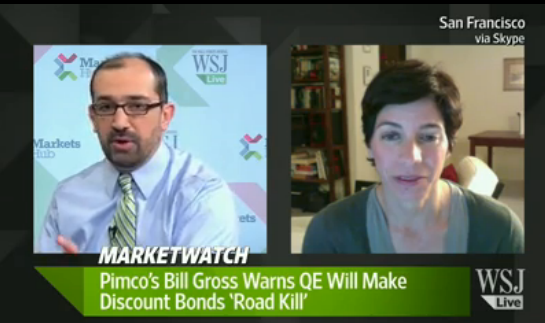
….click on the video or HERE to watch
Bonds generally are issued at par, or face value. But there’s a popular category of discount bonds called zero-coupon bonds, which are issued below face value and don’t make regular interest payments. They’ve had a turbulent 12 months as the Fed extended its quantitative easing program but gave a more precise sense of when it could end. Pimco’s own exchange-traded fund, the Pimco 25+ Year Zero Coupon U.S. Treasury Index ETF ZROZ -1.11%, returned 60% in 2011 but ended 2012 with a 1% return. Zero coupon bonds are more sensitive to interest rate changes than other bonds.
Gross, manager of the Total Return Fund PTTRX -0.09%, the world’s largest bond fund, in early January warned that the monetary easing actions of the Federal Reserve, European Central Bank and Bank of Japan were lining the lairs of “inflationary dragons” that will turn bond values to ash. Those worries got fresh fodder on Tuesday when the Bank of Japan said it will adopt an open-ended asset purchase program to stimulate the economy. Read more on the Bank of Japan.
Gross’ alarm over discount bonds may be an extension of that notion, that the massive amount of monetary stimulus dumped into the global financial system will lead to inflation and a bond selloff. It stands to reason that higher premium bonds will do better than discount, or sub-par, ones.
The Fed for its part is in the market on Tuesday buying bonds, in this case Treasury Inflation Protected Securities, as part of its QE efforts. See New York Fed’s Open Market schedule. There’s plenty of potential carnage for those who are looking.
– Laura Mandaro

Bundesbank announced last week that they’ll repatriate 674 metric tons of their total 3,391 metric tonne gold reserves from vaults in Paris and New York to restore public confidence in the safety of Germany’s gold reserves. The transfer from the Federal Reserve is set to take place slowly over a seven year period and will only be completed in 2020.

The Bundesbank, the central bank of Germany is to store half of its gold reserves in its own vaults in Frankfurt.
It is planning a phased relocation of 300 tonnes of gold to Frankfurt from New York and 374 tonnes to Frankfurt from Paris by 2020.
In doing so, the Bundesbank will have 50% of its gold reserves in Frankfurt, 37% in New York and 13% in London.
The Bundesbank said that it is focusing on the two primary functions in relocating its gold reserve, to build trust and confidence domestically, and the ability to exchange gold for foreign currencies at gold trading centers abroad within a short space of time.
Germany is the second largest gold holding country with 3,391.3 tonnes, behind the US with 8,133.5 tonnes.
Germany’s central bank will repatriate part of its $200 billion gold reserves stored in vaults in the Federal Reserve in New York and the Banque de France in Paris.
Before German reunification in 1990, 98% of Germany’s gold was stored abroad. The Bundesbank then started to bring its gold home and in 2000 transferred 931 tonnes from the Bank of England to Germany. It will continue to hold about 13% of its gold reserves in London, even after 2020.
With the introduction of the euro (12 years ago) the Bundesbank sees no need to hold any reserves at the Banque du France as it will no longer need them there for exchange for foreign currency, after all France uses the same currency now.
“This is above all a historical anomaly which is now being corrected,” said David Marsh, chairman of think tank OMFIF, which issued a report earlier this month in which it foresaw growing importance for gold due to uncertainty stemming from the rise of China’s Yuan as an alternative to the dollar.
Why?
- There have been widespread stories that the Fed does not have the gold to return as gold held for governments is usually, ‘unallocated’. This suggests that the German gold reserves were not ‘allocated’. Ordinarily, central bank monetary reserves should be held in an ‘allocated’ format to evidence to whom they belong. As it is, held in an ‘unallocated’ form, in simplistic terms, this means that should the Fed fail, foreign central banks holding their gold there would be that unsecured creditors. This concern has been voiced inside Germany. It has been noted that the gold of Germany has not been audited in the past and it should be, on a regular basis. The German Court of Auditors told legislators that the gold had “never been verified physically” and ordered the Bundesbank to secure access to the storage sites. It called for repatriation of 150 tons over the next three years to test the quality and weight of the gold bars. But Germany has decided to move more than in this recommendation. It is said that Frankfurt has no register of the numbered gold bars.
- We noted that it is going to take 7 years or 10 shipments a year to move it to Germany. This is odd because it can be done much faster. Are they allowing the banks from which it is being drawn to pull it back from those to whom it has been leased? If this is the case and they have to go out and buy the gold to supply Germany with, will we see the three central banks [the Fed, the Bank of England and the Banque de France] enter the open gold market as buyers of the gold they can’t access in that time or has seven years been decided on because this matches the maturation of the leases?
- The function of gold reserves is to ensure the flow of trade in such critical times that it is the last remaining asset a nation has that is acceptable to overseas creditors, when other national assets fail. As Greenspan put it, it is ‘money in extremis’. But is it necessary to keep all a nations gold outside the country for this purpose? The decision to repatriate half the gold only leaves gold available in the world’s financial centers for such purposes, while the gold held at home is available to be sent elsewhere. The problem of holding gold at home is that if it is needed for creditor payment it resides in the jurisdiction of the debtor, not a happy position.
- As we said above, it appears reasonable to think that as France is in the same currency, there seems little point in holding any of Germany’s gold in France. With the U.K. still using the pound sterling, keeping Germany’s gold there still makes sense. The same applies to the U.S. which remains the wealthiest nation in the world, at the moment.
- Are the nations where the gold is held the right places to store it? What if they face crises themselves? Is the move being made because of expectations of crises in those countries? What future monetary scene did Germany see that prompted the moves we see now? Nearly all the world’s nations are acknowledging that China is headed to the top of the wealthy nations pile and is going to take the Yuan to a major global reserve currency, but the prospect of holding German or any other developed nation’s gold in the People’s Bank of China takes a leap of faith and an admission that power and wealth has moved East into politically unknown waters that is just too much at this time.
As we said above, the move of this gold to Frankfurt will allow time to ensure the central banks where the gold is held, to get hold of the gold if they do not have it at the moment. The prospect of developed world central banks now competing with those of the emerging world in the gold market may well start the next leg of the gold bull market because this new, persistent, price-insensitive buying has the power to take gold to a whole new level! We watch to see. If this does happen, then the whole nature of gold in the money system will change even before the changes are ‘officially’ accepted. Gold will be in a ‘de facto’ pivotal position in the monetary system again. It will be a short time from that point before it is ‘officially’ accepted then. The way will have been paved for China to arrive on the scene and gold to have a vital function in the monetary system between two very different and unconnected, politically and economically, power blocs, the developed world and the emerging world with China as its hub.
The last time the world was divided on this basis was at the start of both world wars. The consequences to the monetary world then were so devastating and saw the destruction of national currencies on both sides, in Europe.
History teaches us another lesson. Ahead of the second war, when it became apparent that extremists had taken power in Germany and war became a probability again, gold came into the picture very forcefully. We are all aware of the 1933 confiscation of gold then, with the stated objective of expanding the money supply through the devaluation of the dollar in the U.S. but one side of that event has not been the subject of full public examination.
What happened to European Gold from 1935+?
Is the fear of future crises in those countries a motive for the move of Germany’s gold back home? It certainly was so in Venezuela’s case, fearful of the U.S.’s power over its gold and reserves. We don’t expect any further statement on the reasons from Germany because that’s the nature of central banks. But history tells us that there are other reasons which discount the future. These confirm the move of gold back to the monetary system and why confiscation of private gold has become a probability in the future too.
When the U.S. dollar was devalued in 1935, it was done so only in terms of gold. It was not devalued against foreign currencies. Exchange rates were then fixed against each other. Other governments did not devalue their currencies against gold. The result was that while gold was trading outside of the U.S. in the foreign currency equivalent of $20, there it was trading at $35 in the U.S.
With markets relatively unsophisticated in those days, alongside limited communication abilities the original “arbitrageurs” [dealers between two markets] found they could buy gold at the foreign currency equivalent of $20 and sell it into the U.S. for $35. Is it any wonder that they U.S. gold stocks roared up to 26,000+ tonnes?
Was this a financial error in an undeveloped world? We have no doubt it was not. It was the ideal quick way to shift the gold reserves of Europe away from the war zone to the relative safety of the U.S. The war arrived in Europe four years later.
But foreign governments weren’t stupid. European governments permitted this move, even though it was seen as a market event. Remember that gold was the basis of money then so such a shift had to happen with government approval. This had to happen within the monetary system in force at the time. The fact that it happened so smoothly implied total government cooperation.
We see it also as an example of how the banks work completely with monetary authorities to ensure complete control over the monetary system. The same is true today as we see the efforts of governments primarily directed at repairing the banking system and government finances with scant attention to the national economies below them.
With a war on the way Europe sent its gold to the U.S. without governments being seen to do it. The move came about as a result of ‘market forces’.
But you may rightly say that surely that wasn’t the end of the story? Of course not!
With a huge U.S. army based in Europe after the war, the flood of dollars from the U.S. to Europe happened from the forties right through to the sixties [Eurodollars] continued. European nations, including France, Italy, Switzerland and Germany led by President de Gaulle, kept selling their U.S. dollars for gold. Once Europe’s gold returned to it [as the war was out of the way and reconstruction just about complete], Europe had its gold back. Then the change in the monetary system changed and the dollar, the exclusive currency in which nations could buy their oil to run their economies with closed the gold window and excluded gold from the day-to-day system but remained in national vaults. It was then that the experiment, now 42 years old, in un-backed paper currencies began. European central banks were then rewarded by the extraordinary rise in the gold price in the seventies and eighties.
This two-way process of gold to and from the U.S. only became visible with hindsight.
Protect against the confiscation of your gold by contacting us throughwww.GoldForecaster.com or admin@Stockbridgemgmt.com for more information.
Get the Rest of the Article:
- The Big Picture of the Future
By Subscribing @

-
I know Mike is a very solid investor and respect his opinions very much. So if he says pay attention to this or that - I will.
~ Dale G.
-
I've started managing my own investments so view Michael's site as a one-stop shop from which to get information and perspectives.
~ Dave E.
-
Michael offers easy reading, honest, common sense information that anyone can use in a practical manner.
~ der_al.
-
A sane voice in a scrambled investment world.
~ Ed R.
Inside Edge Pro Contributors

Greg Weldon

Josef Schachter

Tyler Bollhorn

Ryan Irvine

Paul Beattie

Martin Straith

Patrick Ceresna

Mark Leibovit

James Thorne

Victor Adair