Timing & trends

Update: Stocks Gold Bonds & Dollar

U.S. Stock Market – It’s consolidating major move up and bears can’t keep it down for long. The “Don’t Worry, Be Happy” crowd have the deck stacked in their favor so barring something truly unforeseen, a new, marginal all-time high is a question of when, not if.

sc

Gold and Silver – While there are numerous positives I’ve posted about in last couple of days, the bears still hold serve. I continue to believe if one is a buyer of gold it’s best to continue standing on the sidelines until either the low $1,500s are tested or we have two consecutive closes above $1,700.

It’s mind-boggling how open interest remains so high despite the # of shorts in silver on the Crimenex (Comex). Either they will finally cave or the shorts may have bit off more than they can chew. Stay tuned.

sc-1

U.S. Dollar – The way overvalued Yen is finally descending and that has underpinned the U.S. Dollar for the time being. But when the rooster finally comes home to roost in the U.S., the dollar can make new lows IMHO. I have over 80% of my portfolio in Canadian financial institutions and in Canadian dollars – legally!

sc-2

U.S. Bonds – Bernanke may have kicked the can again, but it comes at a bigger and bigger price each time. Bonds are a total void in my book.

sc-3

Oil and Natural Gas – No change

sc-4

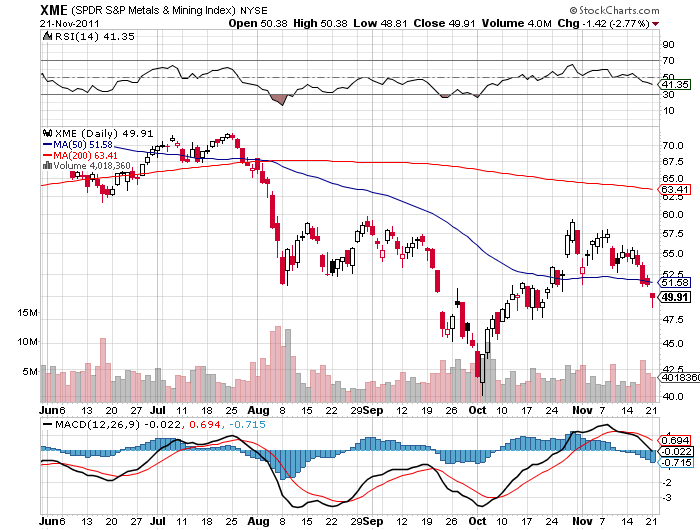
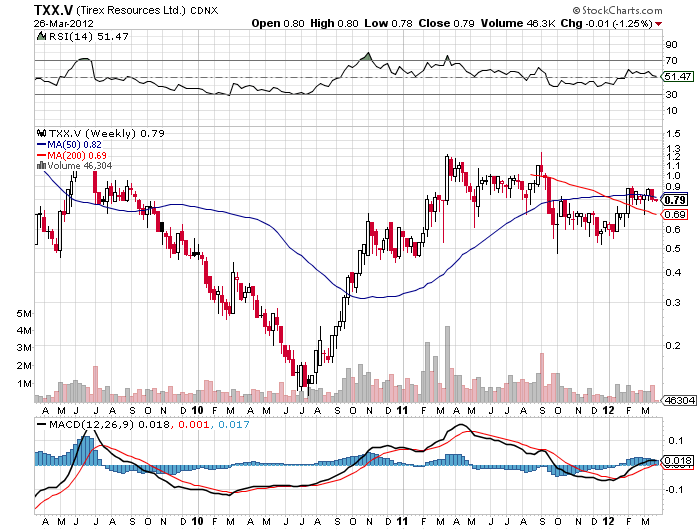
Mining and Exploration Shares – Each time it appears it can’t get any worse – it does! It shall take many months and a big reversal in the price of gold to have any meaningful and sustainable rally. Until then, stock up on ant-acids like I have.

sc-5

No Gold


It was two years ago when I penned this article. 

Many have heard me say that retirement is a myth (actually it’s a chapter in my book,Confessions of a Wall Street Whiz Kid). Another myth created by the financial industry to sell products is living for your “golden years”. I’m sorry to say but as my article stated, “there’s no gold in the golden years”.

And as I feared, seniors have fallen prey to the horrific habit America as a whole as taken on –more and more debt.

Now, more than ever, Canadians and Americans need to break away from the bad habits of their fellow citizens and the clutches of the flawed processes the financial industry has hooked them on in various degrees of traditional financial planning that in the end, failed to achieve the objectives for most.

It took me three years of searching but I found someone in Canada who was taught like I was on a process that increases wealth, with less risk and no change in lifestyle.

If you’re a resident of Canada or the U.S., I may be able to assist you in a process that’s best suited for household incomes of $150,000+ a year and (or) a net worth of $1M+

Email me at peter@grandich.com and note if you’re American or Canadian


About Peter Grandich

Though he never finished high school, Peter Grandich entered Wall Street in the mid-1980s with no formal education or training and within three years was appointed Vice President of Investment Strategy for a leading New York Stock Exchange member firm. He would go on to hold positions as a Market Strategist, portfolio manager for four hedgefunds and a mutual fund that bared his name.

His abilities has resulted in hundreds of media interviews including GMA, Neil Cavuto’s Your World on Fox News, The Kudlow Report on CNBC, Wall Street Journal, Barron’s, Financial Post, Globe and Mail, US News & World Report, New York Times, Business Week, MarketWatch, Business News Network and dozens more. He’s spoken at investment conferences around the globe, edited numerous investment newsletters, and is one of the more sought after commentators.

Grandich is the founder of Grandich.com and Grandich Publications, LLC, and is editor of The Grandich Letter which was first published in 1984. On his internationally-followed blog, he comments daily about the world’s economies and financial markets and posts his views on social and political topics.  He also blogs about a variety of timely subjects of general interest and interweaves his unique brand of humor and every-man “Grandichism” expressions with his experience gained from more than 30 years in and around Wall Street. The result is an insightful and intuitive look at business, finances and the world, set in a vernacular that just about anyone can understand. In his first year, Grandich’s wildly-popular blog had more than one million views. Grandich also provides a variety of services to publicly-held corporations on a compensation basis.

Grandich’s autobiography, Confessions of a Wall Street Whiz Kid, was publiched in fall 2011.

He is the also the founder of Trinity Financial Sports & Entertainment Management Co. [www.TrinityFSEM.com], a firm with a Christian perspective which he started in 2001 with former NY Giant and two-time Super Bowl champion Lee Rouson.  The firm offers services to celebrities, athletes and average folks.  Peter Grandich is a member of the National Association of Christian Financial Consultants, and a long-standing member of The New York Society of Security Analysts and The Society of Quantitative Analysts.

Grandich is also very active in Christian sports ministries including the Fellowship of Christian Athletes and Athletes in Action.

He resides in New Jersey with his wife Mary and daughter Tara.

Witches, Warlocks & Federal Reserve Chairmen

A few months ago, the insightful and engaging financial market observer, James Grant, drew a comparison between “witchcraft, on the one hand, and modern central banking, on the other.”

Grant presented this novel comparison in an address to the “Investment Decisions and Behavioral Finance” meeting at the Harvard Kennedy School.

“I won’t spend much time defining terms,” Grant began. “Witches, as you know, cast spells, make storms and fly on goats or broomsticks to diabolical nighttime rendezvouses called sabbats. Modern central bankers override the price mechanism, conjure money from thin air and undertake to boost economic growth by raising up stock prices.”

In other words, both activities rely greatly on a kind of mysticism – beginning with the notion that combining bizarre ingredients in a cauldron can work magic…and ending with the notion that mere mortals can wield supernatural powers.

UnknownBen Bernanke’s “eye of newt” is quantitative easing (QE). According to American folklore, Bernanke casts benevolent spells, simply by tossing just the right amount of QE into the economic cauldron at just the right time.

“One might almost call it witchcraft,” Grant concludes his address.

Between Grant’s opening remarks and his conclusion, he presents one very striking, and somewhat alarming, comparison between witchcraft and central banking. Both superstitions emerged and then flourished during a time of relative enlightenment. Educated and enlightened populations embraced both beliefs.

Quoting an essay entitled, “The European Witch Craze of the 16th and 17th Centuries,” by British historian, H.R. Trevor-Roper, Grant remarked, “The belief in witches was not, ‘Trevor-Roper writes, ‘a lingering ancient superstition, only waiting to dissolve. It was a new explosive force, constantly and fearfully expanding with the passage of time…

‘Creduality in high places increased, its engines of expression were made more terrible, more victims were sacrificed to it. The years 1550-1600 were worse than the years 1500-1550, and the years 1600-1650 were worse still…If those two centuries were an age of light, we have to admit that, in one respect at least, the Dark Age was more civilized.”

After contemplating Grant’s observations, a hard-money guy or gal, couldn’t help but think of the “Dark Ages” of the gold standard, in contrast to the Enlightened Age of central banking.

During the monetary Dark Ages, the gold-backed dollar fended for itself, without the benefit of central bank wizardry.

But the Age of Monetary Enlightenment changed all that. The Federal Reserve began casting its spells 100 years ago, and the U.S. dollar has been bewitched ever since. The greenback has lost 97% of its purchasing power since the Federal Reserve came into existence.

The Fed’s beguiling wizardry continues nonetheless. Ben Bernanke concocts his bubbling brews of QE #1 through QE-infinity, while other PhDs at the Fed publish illuminating manuscripts like the recently released, “Computing Dynamic Stochastic General Equilibrium Models with Recursive Preferences and Stochastic Volatility.” (Thanks, Jim Grant).

Given their impressive array of charms and potions, it should come as no surprise that the wizards at the Fed believe in their own magic; the surprise is that the investing public also believes in it…and remains spellbound by the Fed’s incantations.

Just yesterday, Chairman Bernanke repeated his familiar incantation, “More QE…More QE…Whatever may be…More QE.”

The Dow Jones Industrial Average promptly rallied more than 100 points. The masses were awed by his power.

“In the current economic environment, the benefits of asset purchases, and of policy accommodation more generally, are clear,” Bernanke told the Senate Housing and Urban Affairs Committee yesterday, referring to the $85 billion of Treasury and mortgage-backed securities the Fed buys under its current quantitative easing program.

“Monetary policy is providing important support to the recovery,” the Chairman-Wizard continues, “while keeping inflation close to the [Fed’s] 2% objective.”

Beguiling words, to be sure. But Bernanke’s spells may not be quite as potent as he would have us believe. The “important support to the economy” that QE provides is literally invisible.

The so-called recovery of the last four years has logged the slowest growth rate – by far – of any recovery since WWII, despite the fact that Bernanke has conducted more the $2 trillion of QE programs during that time frame.

Many are the data points that call into question the “success” of QE. For starters, U.S. GDP contracted in the final three months of 2012. Accordingly, unemployment remains stubbornly high and consumer spending stubbornly low.

Just last week, Wal-Mart’s VP of finance and logistics groaned in an internal email:

“In case you haven’t seen a sales report these days, February MTD (month-to-date) sales are a total disaster…The worst start to a month I have seen in my seven years with the company.”

The retail giant also reported that its sales are tracking very closely to what it calls the “paycheck cycle” – i.e., sales spike twice a month…on paydays.

“[This trend] speaks to a strapped consumer that lacks the confidence to spend unless they literally have cash in their pocket,” blogger, Jeff Macke, observes. “Living paycheck to paycheck isn’t something you typically see in the fourth year of an economic recovery.”

Nevertheless, very few investors exhibit any desire to consider the downside. Perhaps for good reason. Why fret over “Bubble, bubble, toil and trouble” when Chairman Bernanke provides continues helpings of “Bubble, Bubble?”

Despite Bernanke’s dubious power over the economy, the man sure knows how to conjure a stock market rally out of thin air. The Dow has soared about 250 points since he began addressing the Senate yesterday.

One might almost call it witchcraft.


About Eric Fry

Eric J. Fry, Agora Financial’s Editorial Director, has been a specialist in international equities for nearly two decades. He was a professional portfolio manager for more than 10 years, specializing in international investment strategies and short-selling.  Following his successes in professional money management, Mr. Fry joined the Wall Street-based publishing operations of James Grant, editor of the prestigious Grant’s Interest Rate Observer. Working alongside Grant, Mr. Fry produced Grant’s International and Apogee Research —  institutional research products dedicated to international investment opportunities and short selling. 

Mr. Fry subsequently joined Agora Inc., as Editorial Director. In this role, Mr. Fry  supervises the editorial and research processes of numerous investment letters and services. Mr. Fry also publishes investment insights and commentary under his own byline as Editor of The Daily Reckoning. Mr. Fry authored the first comprehensive guide to investing internationally with American Depository Receipts.  His views and investment insights have appeared in numerous publications including TimeBarron’sWall Street JournalInternational Herald TribuneBusiness WeekUSA TodayLos Angeles Times and Money.

Special Report: Is this America’s Last Gasp? A terrible question. But it must be asked – and answered. This urgent broadcast will do just that. Tune in now for urgent news on our banks, agencies, retirement accounts – and even our trash collection! Don’t wait, watch now…


There exist well-performing mining stocks

Rockstone Research published its first update six months after initiating coverage on Vendome Resources Corp., a silver exploration company, becoming highly active in Mexico.

The potential of Vendome’s exploration projects inspires us, especially when considering that virtually no drilling ever took place. This is about to change.

The large amount of high-grade chip, grab and channel samples that were found and presented to the shareholders appears to be unprecedented. The first NI43-101-compliant Technical Report that was published in mid-November 2012 confirmed our impression. The report anticipates the mineralized polymetallic vein deposit to be related to regional-scale (geologic) structures that penetrate to great depth, and, moreover, that it is probable that additional veins are present in proximity to other regional structures on and near the San Javier property.

Furthermore, based on ASTER satellite imagery, the apparent disposition of hydrothermal alteration and structure, the La Diana and San Miguel properties may host mineralization similar to that found at the San Javier property, and, with it, the possibility of multiple prospects and occurrences across those properties which have a combined size of 17,000 hectares.

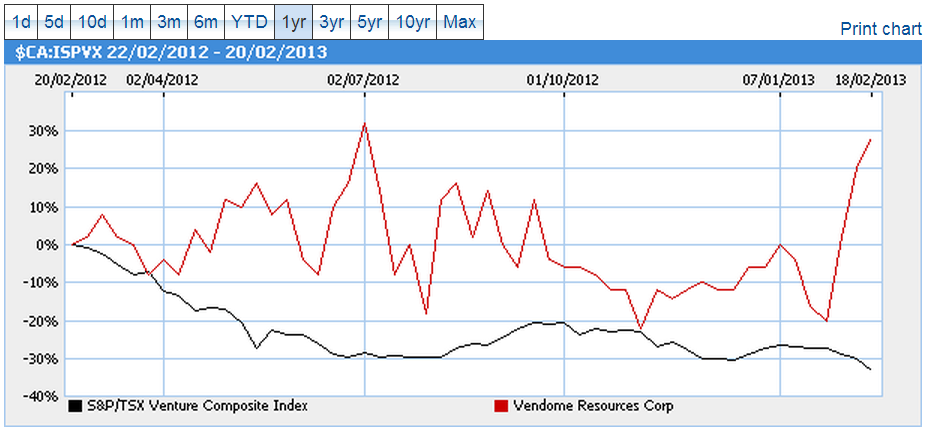
Although all mining indexes worldwide are reaching new year-long lows, the Vendome stock stems successfully against this trend:

B1

We value Vendome being a junior mining stock able to perform even if the general market continues to depreciate. Thanks to the announcement of a 3,000 m drilling campaign (first one ever), we feel constrained to increase our initial price target from 55 to 75 Canadian cents as we speculate on spectacular drill results during the next six months.

The full analysis can be read using the following link:

http://www.rockstone-research.de/research/RockstoneVDR2english.pdf

About the Author

Stephan Bogner (Dipl. Kfm. in Economics) is a mining and commodity analyst with Rockstone Research Ltd., an independent research house specialized in the analysis and valuation of capital markets and publicly listed companies. The focus is set on the exploration, development and production of resource deposits.

Recession Indicator Flips Positive!

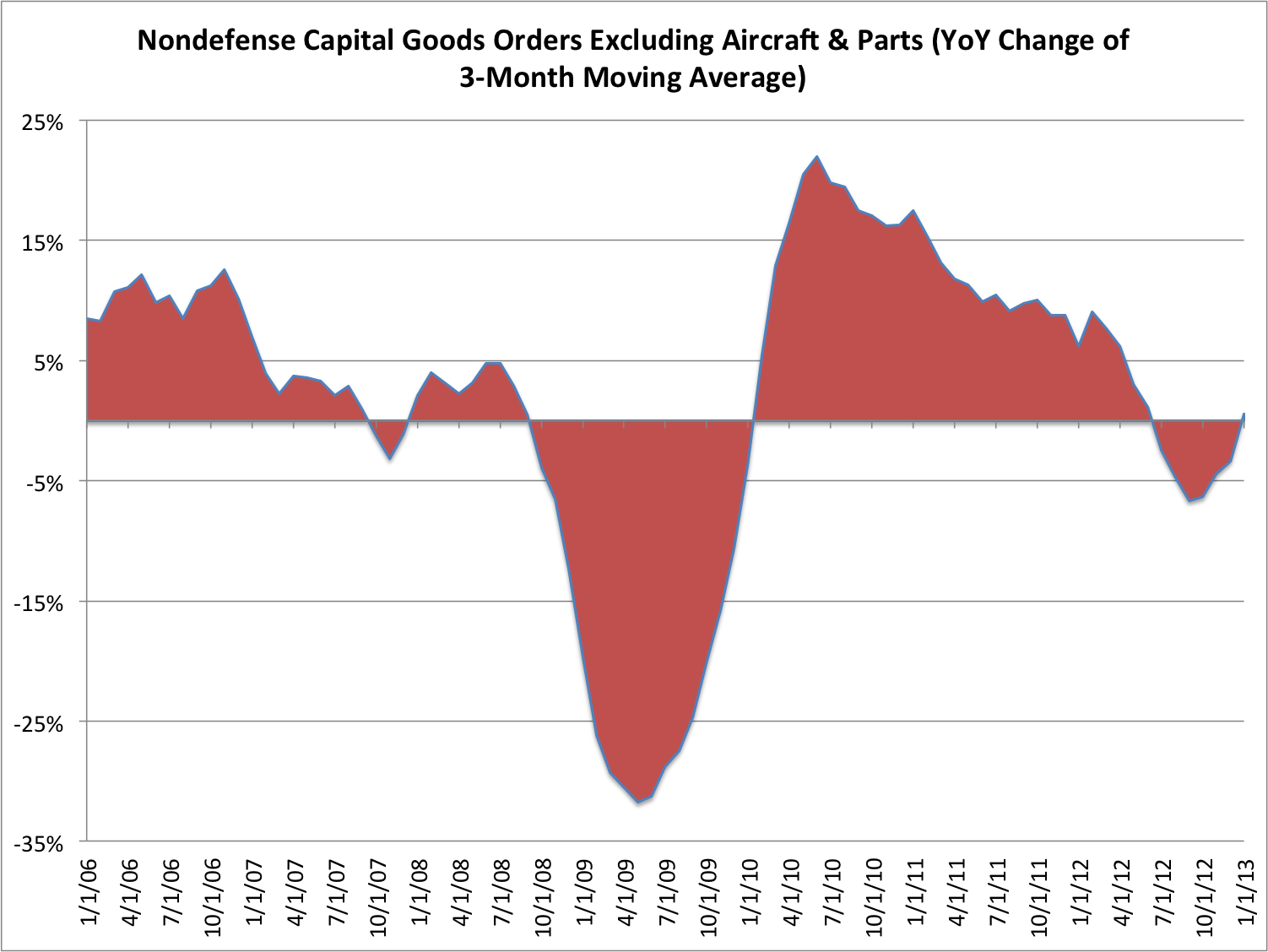
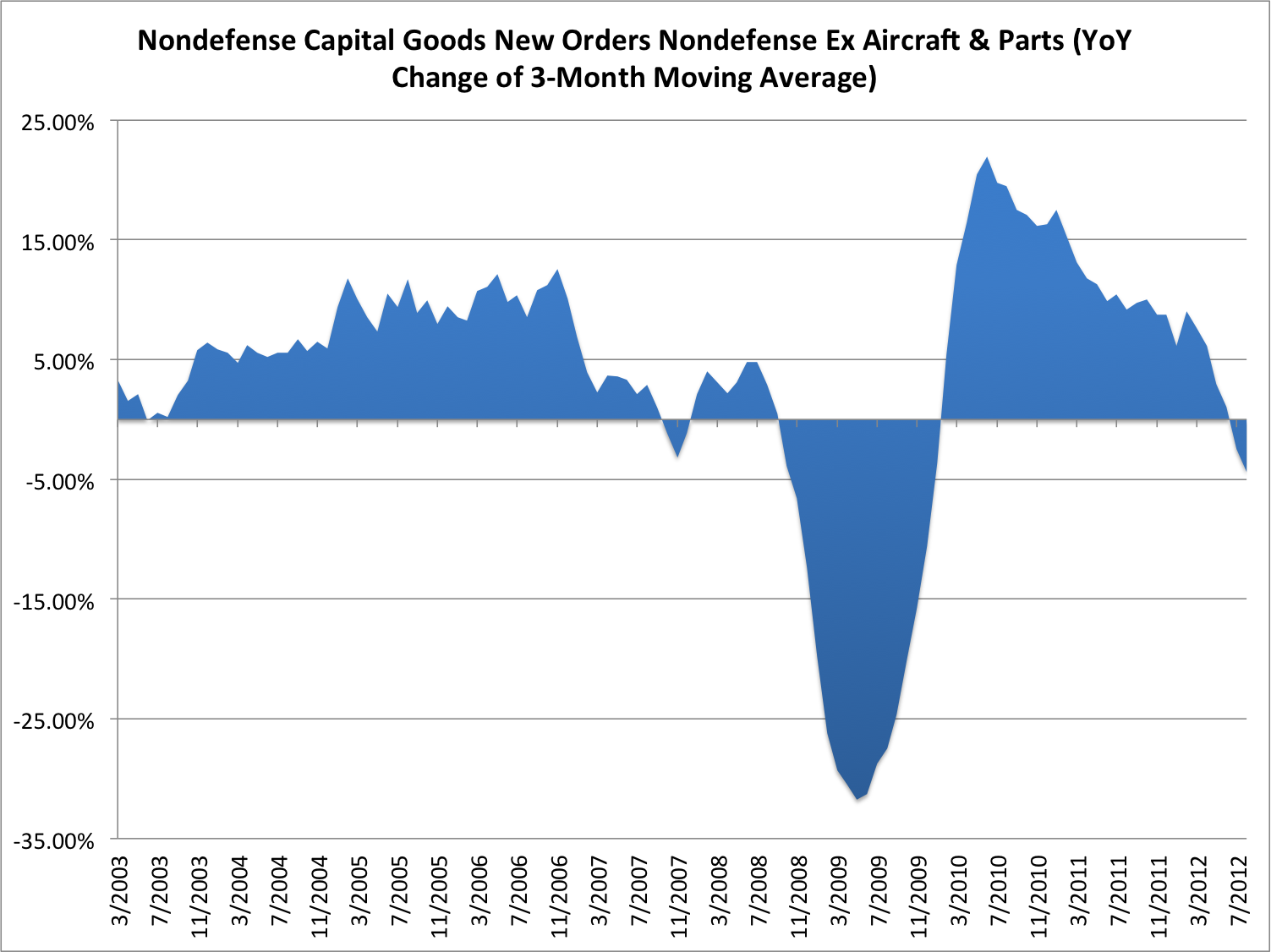
David Rosenberg’s has changed his mind! The economist with Gluskin Sheff’s recession indicator has gone positve and Rosenberg thinks that this Core Capex indicator (the three-month moving average of nondefense capital goods) surged and that is the best indicator that business is finally spending. 

core-capex-rosenberg-indicator

This change in the Core Capes differs significantly (trend is your friend/) from the one he posted back in October 2012 when he wrote the artice:  “Here’s Your Big Red Flag That We Could Be Heading For Recession”. Chart below is from that article & there is an article below the chart- Ed

core-capex-orders

With these changes afoot David has now written an article today:

Why cash is your least safe bet

“There’s an old saying that may be glib to some but is critical nonetheless, and it is that every bull market needs a wall of worry to climb.

So when we go back to where we were exactly a year ago, there were all sorts of risks on the worry list. Was Greece going to leave the euro area, or even Germany for that matter? Well, we know the answer to that.”

“This then brings me to my very last point, which is what I think was a critical inflection point when the Fed said in its December post-meeting press release that it will not budge from its 0% policy rate until the U.S. unemployment rate drops to 6.5%. It is currently around 8%.”

…..much more HERE

David Rosenberg is chief economist and strategist at Gluskin Sheff + Associates Inc. and one of FP Magazine’s 25 Most Influential People in Canada.


Oil and Gas Beats Mining Hands Down

Interest rates may be near zero, but financing big projects is still tough for most mining companies. That’s why James West has switched his focus to energy investments, where the payoff is often much faster. In this interview with The Energy Report, West explains why intermediate-term energy opportunities have become his sweet spot.

COMPANIES MENTIONED : ABAKAN INC. : AROWAY ENERGY INC. : CNOOC LTD. : EFLO ENERGY INC. : NEXEN INC. : NORTHLAND RESOURCES INC. : PETROBRAS : PROPHECY COAL CORP. : RIO ALTO MINING LTD. : TERRA NOVA ENER

The Energy Report: In the three months since your last interview, the sailing certainly hasn’t been clear. What’s your view of the global economic picture and the next focal point for investors?

James West: The competition for shrinking resources is indicative of an advanced civilization that has reached its zenith in terms of its ability to expand on the planet and is now in a state of decline. All of these macroeconomic situations that are engulfing the world—sovereign debt crises, currency debasement, resource nationalization and protectionism, declining employment opportunities, rising violence and rising competition for food resources—are part and parcel of that decline. From a macroeconomic focus, the possibility for growth is limited by these overriding factors. There are just too many people competing for increasingly scarce resources and opportunities. I don’t have a lot of hope for the economy, barring a massive decline in the global population.

TER: Last November, you talked about interest rates. Are they ever going to go up or can the U.S. economy and debt structure even stand the consequences of “normal” interest rates at this point?

JW: Interest rates can’t stay too low for too long and still have a positive economic impact. At this point, the purpose of low interest rates has been maximized. Despite the fact that interest rates are at all-time lows, lending is almost nonexistent and is mostly limited to the highest-quality corporate borrowers. The whole purpose of low interest rates is to spur economic activity and investment, but nobody is lending for startups. Nobody is lending for exploration. Nobody is lending even for resource development. They’re only lending when it’s safe. The only reason that we must maintain low interest rates now is so that the G7 sovereign group can continue to borrow at ridiculously low rates.

TER: In your last interview, you stated that you favor energy stocks over mining stocks because of the difficulty in getting financing. Has your opinion changed?

JW: It hasn’t changed. The mining market has become very company and management team specific rather than metal specific. In every deal, you have to look at management, where it is in its development and whether it can access capital. The best real-world example is what’s happening with Northland Resources Inc. (NAU:TSX; NPK:FSE). It has basically had to halt construction of its iron ore project in Sweden because it could not access the roughly $400 million ($400M) it needed in combined debt and equity. Shareholders are stranded in the deal, which is now frozen. Its management team cannot convince bankers to lend or invest in equities in the project because it doesn’t have the track record. There’s a large resistance out there to financing high-capex mining projects.

On the energy side, that’s not so much the case because the time from drilling a hole to bringing a well onstream is much shorter than the usual production timeline for mining projects. In a risk-averse universe, energy is far more attractive, especially conventional oil and gas.

TER: Where were you able to get your best returns last year?

Screen shot 2013-02-27 at 11.07.21 AMJW: My best performer in 2012 was Abakan Inc. (ABKI:OTCQB), which should soon be listed on the NASDAQ. Abakan has developed a technology that extends the life of metal assets used in oil and gas drilling between six and 20 times. Most of the world’s remaining oil and gas reserves are high in sulfur or other corrosive materials, so the lifetime of these metal assets used to explore, extract and transport can determine whether some projects are viable or not.

The Natuna Island project, which is owned by CNOOC Ltd. (CEO:NYSE), is one case in point. Here’s a $20 billion ($20B) gas deal that cannot viably move ahead using pipeline infrastructure that only has a life of five to seven years, which is what happens to pipes in a high-use environment. CNOOC has been waiting for this project to proceed, and Abakan has the solution through its MesoCoat product for cladding pipe and its Powdermet product for coating metals assets.

Abakan has agreements in place with Petrobras (PBR:NYSE; PETR3:BOVESPA) and other major oil companies that can’t be disclosed because they’re subject to confidentiality. That’s been my biggest win of 2012.

TER: Where did that go during the year?

JW: I bought it at $1.02 in September 2011. I sold a large portion of my position at $2.70 from September to mid-October. I essentially got a 160% return there. I’m negotiating to reload on that company because it will start producing commercial quantities of its pipe products in 2013, and majors will be ordering them. That’s when it changes from a speculative story to a growth story. I think it’s going to be a multibillion-dollar company. In Obama’s State of the Union address, he mentioned that he was recommending an immediate $50B program to replace corroded infrastructure in the U.S. Abakan happens to be sitting in the sweet spot to be the recipient of some of that.

TER: What’s your strategy for 2013 and 2014?

JW: I’m going to be looking for intermediate-term opportunities where there’s a profound shift in the company’s prospects that should drive value. I’m looking for 12- to 24-month plays. That’s my sweet spot. That timeframe makes conventional energy plays very attractive.

TER: Do you want to give an update on some of those companies you’ve discussed in the past or new ones that look interesting?

JW: I would like to mention, first and foremost, Aroway Energy Inc. (ARW:TSX.V; ARWJF:OTCQX). I love Aroway because it is developing oil and gas assets in central Alberta as well as in Saskatchewan. It has a program in place whereby in mid-2013, it plans to be producing over 2,000 barrels per day (bpd), and 90% is oil. It is building its production infrastructure more or less internally from cash flow, and it is in a position where it is going to be growing that domestic production in a safe jurisdiction, Canada. I think Aroway is probably one of the best-case examples of lower-risk exposure, with an experienced management team that can access the capital and that has a record of successful drilling.

It recently announced its year-end production. It exited 2012 with over a thousand barrels of oil equivalent per day (1 Mboe/d), of which 90% is oil. It also has another 100 boe/d behind pipe. That’s up from the 2011 exit of around 650–700 boe/d. It is also getting ready to drill a lot of wells in Saskatchewan on its West Hazel property, and is expecting to double its current production of about 300 bpd oil from there. It is well on track for reaching its target.

TER: What else do you like?

JW: Terra Nova Energy (TGC.V:TSXV; TNVMF:PINK; GLTN:FRA). We have that in our Midas Letter Opportunity Fund. Terra Nova is working on its petroleum exploration licenses with Hunt Energy & Mineral Co. Australia Pty Ltd. (private) in the Cooper basin of Australia. It expects to be drilling by March of this year. That’s one that I’m quite excited about because it has a strong management team. It has Jim Hutton, who has been a very successful investor in various energy projects and mining projects, as a director. It also has Henry Aldorf, who was a co-founder of Interoil Corp (IOC:NYSE), now the CEO. That really improves the company’s prospects, so I’m more excited about it than I was previously.

TER: You talked about Prophecy Coal Corp. (PCY:TSX; PRPCF:OTCQX; 1P2:FSE) and its situation in Mongolia. What’s going on there?

JW: Prophecy Coal is suffering from an unfortunate misconception. The mining world is now focused on Mongolia’s struggle with Rio Tinto Plc (RIO:NYSE; RIO:ASX; RIO:LSE; RTPPF:OTCPK), which has stopped development work at its Oyu Tolgoi project. The global perception is that Mongolia is rattling the resource nationalization saber a little bit too loudly for the comfort of foreign investors.

But the company that owns Prophecy Coal’s power plant and coal mine assets in Mongolia is actually a Mongolian company. People think it’s a foreign company operating in Mongolia, but it’s not; it’s a Mongolian company that’s listed on the Toronto Stock Exchange. That misconception, combined with the bad impression from observing the discord between Rio Tinto and the Mongolian government, is why Prophecy Coal is getting beaten up so badly in the market. But I think as it evolves with participation by the Mongolian government, people will start to understand the situation more clearly.

TER: What’s it going to take for people to understand it better, or to see the light? Or is it all pretty much up to what the Mongolian government decides to do?

JW: It’s very much a case now of “show me.” Investors want to see the company plan a power plant, raise the money for it, build it and bring it on-stream without the Mongolian government taking 90% of the revenue. It certainly has its power offtake agreement in place and at least soft financing commitments from various entities. Now it needs to firm those up and start building, and maybe we’ll see some upside come into the stock.

TER: What other companies are on your radar?

JW: One of the long-term plays that our fund has a big position in is EFL Overseas Inc. (EFLO:OTCQB). EFL has a great executive team with a record of founding major projects and taking them from start to finish, through the end zone into success. EFL is up in the Liard basin of southeastern Yukon, where it has doubled its land position, and it also has a largely unused gas processing facility there. This is a company that’s all about positioning itself now for the ultimate rise in natural gas prices, which will come about at some point. I think there will be a stampede into that stock because people will look around for the best contenders for large-scale natural gas production and EFL is certainly one. There are several projects under development for liquefied natural gas export facilities in British Columbia, and the company is a takeout target now that CNOOC has successfully taken outNexen Inc. (NXY:TSX; NXY:NYSE) for its natural gas asset.

TER: To sum things up, what’s your recommended investment strategy at this point?

JW: The strategy is looking for high-impact, low-risk, short-term plays where there’s a management team with a track record of success and the ability to raise capital as well as take projects from start to finish.

TER: We appreciate your time and the opportunity to talk to you again.

JW: My pleasure.

James West is publisher and editor of The Midas Letter, an independent capital markets entrepreneur and investor. He has spent more than 20 years working as a corporate finance advisor, corporate development officer, investor relations officer, media relations and business development officer for companies involved in mining, oil and gas, alternative fuels, healthcare, Internet technology, transportation, manufacturing and housing construction.

Want to read more Energy Report interviews like this? Sign up for our free e-newsletter, and you’ll learn when new articles have been published. To see a list of recent interviews with industry analysts and commentators, visit our Interviews page.

DISCLOSURE: 
1) Zig Lambo conducted this interview for The Energy Report and provides services to The Energy Report as an employee or as an independent contractor. He or his family own shares of the following companies mentioned in this interview: None.
2) The following companies mentioned in the interview are sponsors of The Energy Report: Aroway Energy Inc., EFLO Energy Inc. and Prophecy Coal Corp. Streetwise Reports does not accept stock in exchange for its services or as sponsorship payment.
3) James West: I or my family own shares of the following companies mentioned in this interview: None. I personally or my family am paid by the following companies mentioned in this interview: None. My company has a financial relationship with the following companies mentioned in this interview: Abakan Inc., Aroway Energy Inc., Terra Nova Energy, Prophecy Coal Corp. and EFLO Energy Inc. I was not paid by Streetwise Reports for participating in this interview. Comments and opinions expressed are my own comments and opinions. I had the opportunity to review the interview for accuracy as of the date of the interview and am responsible for the content of the interview. 
4) Interviews are edited for clarity. Streetwise Reports does not make editorial comments or change experts’ statements without their consent. 
5) The interview does not constitute investment advice. Each reader is encouraged to consult with his or her individual financial professional and any action a reader takes as a result of information presented here is his or her own responsibility. By opening this page, each reader accepts and agrees to Streetwise Reports’ terms of use and full legal disclaimer. 
6) From time to time, Streetwise Reports LLC and its directors, officers, employees or members of their families, as well as persons interviewed for articles and interviews on the site, may have a long or short position in securities mentioned and may make purchases and/or sales of those securities in the open market or otherwise.


test-php-789