Personal Finance

If it’s the “largest real estate bubble in human history”

….then it may not be too early to sell Chinese stocks.

Quotable

Screen shot 2013-03-04 at 10.55.44 AM“By three methods we may learn wisdom: First, by reflection, which is noblest; Second, by imitation, which is easiest; and third by experience, which is the bitterest.”Confucious

Commentary & Analysis

If it’s the “largest real estate bubble in human history” then it may not be too early to sell Chinese stocks.

“It [China] may have created the largest real estate bubble in human history,” was the introduction by Lesley Stahl of 60-minutes to a story about China’s real estate bubble. If you missed this story, I suggest you take time and watch it. You can find it here. After viewing this, and seeing the miles and miles and miles of empty skyscrapers, condos, and shopping centers, it is highly probable China has created the large real estate bubble in human history.

Lesley kept quoting from one of baseball’s classic movies, Field of Dreams(though JR and I prefer The Natural), “If we build it they will come,” as the rationale for all this space. But as you learn right away in the 60-minutes piece-they aren’t coming. There has been no mass migration from the rural areas to these new cities. And just maybe, as an analyst quoted in the piece said, it might be because most of the housing built in these gleaming new ghost cities is priced at about $50,000 US per unit and peasants make about $2 per day on average.

“It [China] may have created the largest real estate bubble in human history,” was the introduction by Lesley Stahl of 60-minutes to a story about China’s real estate bubble. If you missed this story, I suggest you take time and watch it. You can find it here. After viewing this, and seeing the miles and miles and miles of empty skyscrapers, condos, and shopping centers, it is highly probable China has created the large real estate bubble in human history.

Lesley kept quoting from one of baseball’s classic movies, Field of Dreams (though JR and I prefer The Natural), “If we build it they will come,” as the rationale for all this space. But as you learn right away in the 60-minutes piece—they aren’t coming. There has been no mass migration from the rural areas to these new cities. And just maybe, as an analyst quoted in the piece said, it might be because most of the housing built in these gleaming new ghost cities is priced at about $50,000 US per unit and peasants make about $2 per day on average.

Three takeaways here for me were: 1) When the migrant workers start to leave the building projects, “it is an early warning” that the debt crisis is about to begin, and the migrant workers are leaving, 2) A break in the bubble could wipe away “three generations of savings” by Chinese citizens, and 3) if the bubble pops it could spark an “Arab Spring” in China.

Yikes! Is it any wonder why Chinese leaders wish to keep the islands in the East China Sea and Japan on the front burner?

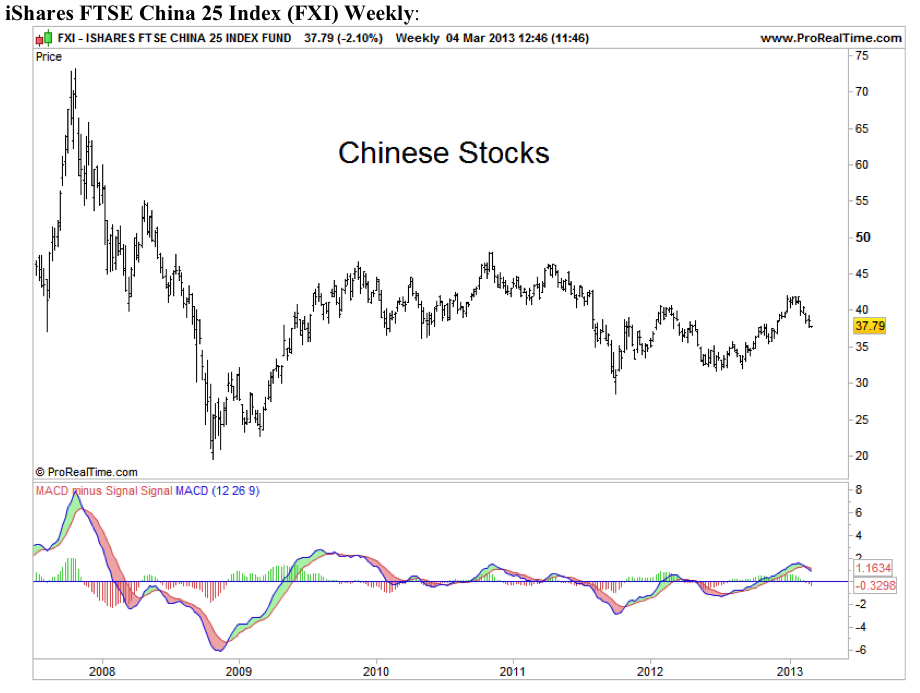
Though stock markets in most places have enjoyed heady gains the last few years—not China. This excerpt comes from an article by Edward Chancellor, “Consistency in a topsy turvy world,” appearing in today’s Financial Times:

“The mean reversion of stock market returns and returns on equity are one and the same.

“The performance of equities in less capitalistic economies seems to support this point.

“China is the most striking anomaly. Despite economic growth in double digits over the past two decades, Chinese equities have delivered an annual real return of -2.5 per cent in local currency since the early 1990s, according to the authors of the Credit Suisse Global Investment Returns Yearbook. The Chinese stock market is dominated by state-owned enterprises whose capital allocation is ultimately decided by government. Some studies suggest these businesses earn negative returns on capital once subsidies are taken into account.”

“The lesson of history is clear. Unless factories have been bombed or the country is being run by crooks or, even worse, by Communists, mean reversion is one of the few constants in an every changing investment world.”

In the eyes of Michael Pettis, a finance professor at Peking University, and a very brilliant macro strategist, China may indeed be entering the danger zone; this tends to dovetail on what Mr. Chancellor was saying [Mr. Pettis’ latest missive is a brilliant read if you have time]:

“In analyzing China’s growth in the past three decades we seem to forget that there have been many growth ‘miracles’ in the past two hundred years. Some have been sustainable and have led to developed country status but many, if not most, were ultimately unsustainable. Nearly all of the various versions have had some similar characteristics – most obviously infant industry protection, state-led investment in infrastructure, and a financial system that disproportionately favored producers at the expense of savers – but the way these characteristics played out were very different, in large part because the institutional structure of the economy and the financial sector created a very different set of incentives.”

Using the three key elements of the American System and historical development as a guide..  

  • infant industry tariffs
  • internal improvements,
  • and a sound system of national finance

…and contrasting this against China’s development, Mr. Pettis says:

“…the historical precedents should worry us. In most cases they suggest that China has a very difficult adjustment ahead of it and the closest parallels to its decades of miracle growth suggest unfavorable outcomes.”

Let’s count a break in the real estate bubble as being at the top of the list if it wasn’t already.


Screen shot 2013-03-04 at 11.18.22 AM


STOCK MARKET BOOM: Why This Bull Mkt Could Continue For Years

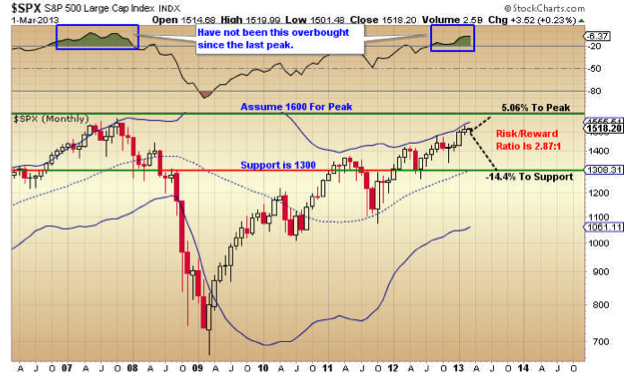
Screen shot 2013-03-04 at 7.14.03 AMStocks are just points away from their all-time highs.  And there are plenty of arguments why this could be a top for the markets.

But the bear case for stocks is mostly backwards-looking or based on short-term risks.

Yes, global growth is slow.

But the economy is still growing, and S&P 500 companies are actively increasing exposures to regions where growth is hot.

Yes, profit margins are near all-time highs.

But it’s a mistake to think things revert to the mean just for the sake of mean-reversion.  There are plenty of reasons why margins will stay high.

Some skeptics think that the stock market is being driven by easy monetary policy.  And they warn of a time when the Fed tightens.  But evidence shows that stocks can continue to rally amid a tightening Fed. And the Fed is expected to remain easy for a long time.

As you’ll see, the bull case for stocks is quite robust.

Read more: http://www.businessinsider.com/why-the-bull-market-can-continue-2013-3?op=1#ixzz2MaHtQrib

ARE WE THERE YET?

Are we there yet? Has gold bottomed? Is it about to begin its ascent to $5,000 plus?

After all, Fed Chief Ben Bernanke reiterated his money-printing policy last week, vowing to keep it in place until unemployment falls to at least 6.5 percent and inflation ticks higher.

On top of that, the Bank of Japan is printing money like never before. And the European Central Bank will undoubtedly join the melee soon as Italy falls into political gridlock, the sovereign debt crisis in Europe re-emerges, and the euro remains stubbornly strong, adding to the region’s deflationary forces.

But the simple truth of the matter is NO, we’re not there yet. Gold and other commodities are not yet ready to blast off again. In fact, quite the opposite is true …

More Declines Are Likely

I know that’s not what you want to hear. I myself am anxiously awaiting a bottom in the precious metals. More money than you can dream of will be made in their next leg up.


Screen shot 2013-03-04 at 6.31.57 AMBut right now, gold (and other commodities) have not fulfilled their shorter-term destiny. They have not yet worked off the prior bull leg up … they have not yet shaken out the weak buyers … and perhaps most importantly, the environment is not quite ready for them to blast off again.

Let me explain …

Despite all the money-printing going on around the world today, the overriding force right now is uncertainty.

Uncertainty about what Washington will do on spending cuts.

Uncertainty on taxes, because President Obama wants to raise them again.

Uncertainty in Europe because of Italy’s current political crisis. And uncertainty in Japan on whether the Bank of Japan’s new policies will actually turn around that country’s 23-year depression.

And uncertainty regarding whether China’s economy has bottomed and is turning up again.

In normal times, uncertainty is good for commodities and tangible assets.

But These Aren’t Normal Times

So instead, all the uncertainty that’s running rampant in the world today is having the opposite affect: It’s driving loads of savvy and not-so-savvy money to the sidelines. To cash.

That’s why the dollar is now soaring. You can see the sharp rally in the chart here.

Chart1

We may not like the dollar, but others do. That’s because — like it or not, right or wrong — the U.S. dollar is still the world’s reserve currency …

And when most of the world is experiencing as much uncertainty as there is today, going to cash means going largely to the dollar. Which is precisely why the dollar is so strong, rallying more than 3 percent during February.

That puts additional downside pressure on gold and other commodities.

Here’s a chart of gold. Quite a downtrend. So much so that now even George Soros has dumped as much as 55 percent of his gold holdings.

Chart2

Ditto for some other big gold investors, such as Moore Capital Management LP, which has sold its entire stake in the SPDR fund.

It’s why the total assets in the SPDR Gold Trust (GLD), the biggest exchange traded fund backed by the precious metal, dropped in the longest slump on record …

And why total global investments in all gold-backed exchange-traded products tracked by Bloomberg have tumbled 4.7 percent this year.

Thing is, unless gold can rally strongly and close above at least the $1,757 level soon — something I consider very unlikely — gold is headed much lower.

It will take out the most recent low at the $1,560 level and then flirt with the prior major low at the $1,527 level. If that gives way — and I expect it will — then great! We will finally get a washout in gold down to below $1,400 … all the weak longs will be shaken out … and a new bull market can then begin to form.

It’s much the same for silver. And many other commodities. And mining shares too.

No, I am not a long-term bear on the commodity sector. I am a long-term bull.

And if you’re one too, you should be hoping for a washout. Because, very simply put, a washout is what’s needed to clear the path for much higher prices to come in the future.

There are a few different ways to play what’s happening here.

To take a nice long position in the dollar as it rallies further, consider a stake in thePowerShares DB US Dollar Index Bullish ETF (UUP).

For a play on further downside in gold and silver, consider the inverse ETFs, theProShares UltraShort Gold (GLL) and the ProShares UltraShort Silver (ZSL).

Now, to Stocks …

Lastly, a note on U.S. equity markets. The strength in the equity markets is pretty amazing, isn’t it?

As I’ve long maintained, U.S. equity markets are entering a new bull market, one that could easily take the Dow substantially higher. Despite the potential for rising interest rates.

Why is the Dow so strong considering the problems in Europe and Washington, not to mention Tokyo?

This is where you need to put your thinking cap on. The U.S. equity markets are strong and forming a new long-term bull market precisely because of the problems in Washington, Europe, and Japan.

Europe and Japan’s sovereign debt crises are causing capital to leave those markets and invest in ours. Believe it or not, rightly or wrongly, the U.S. is seen now as the safest bet.

And as far as Washington goes, don’t fall into the trap that spending cuts will destroy the economy and the equity markets. It’s precisely the opposite: The best thing that can happen is for the cuts to go through … for government to downsize … and get the heck out of the private sector.

Yes, there will be sectors that will be hurt, such as defense spending. And yes, there will be loads of government employees laid off, forced to find new work in the private sector.

So there will certainly be some pain. Unemployment will most likely start to rise again.

But again, none of this means stocks are headed back to below 7,000. Or below 10,000. Or even below 11,000. While there is still a much-needed pullback probably coming in the stock market, getting government cut down to size is a long-term bullish factor for the equity markets.

Until next time, your ever-thinking out-of-the-box analyst,

Larry

P.S. A mere $89 a year will get you all, and I mean ALL, of my insights, analysis and recommendations, via my Real Wealth ReportTo join, simply click here now.

The Bottom Line: Shallow Correction Then Outperformance

More evidence of shallow correction! Economic data released this week generally will show a slowdown in economic growth in the month of February

Earnings reports this week are not expected to have a significant impact on equity prices

Political influences on equity markets are diminished this week. Congress is on holidays. The next critical date is March 27thwhen a continuing resolution needs approval by Congress.

Short and intermediate technical indicators continue to show that at least a short term peak has been reached by most equity markets and sectors.

Cash hoards remain high, but are declining as companies announce dividend increases and share buybacks instead of capital spending.


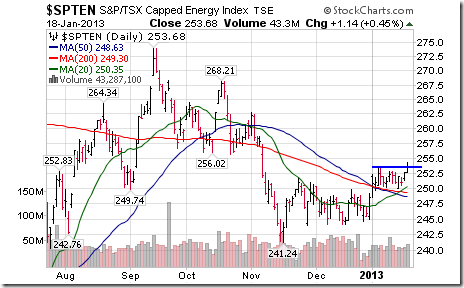
The Bottom Line: A shallow correction between now and the end of March will provide an opportunity to accumulate sectors on weakness that have a history of outperformance into spring. Sectors on the radar screen include energy, retail, steel and auto & auto parts?

With the exception of the Dow Jones Industrial Average and the Dow Jones Transportation Average which moved to new highs last week, most equity indices and sectors peaked between January 30th and February 20th. The peak coincides with average performance by the S&P 500 Index in a post-election year. History suggest that a shallow correction in equity markets has started that likely will last until the end of March/first week in April. (Special Free Services of charts below available through www.equityclock.com )

clip image046 thumb


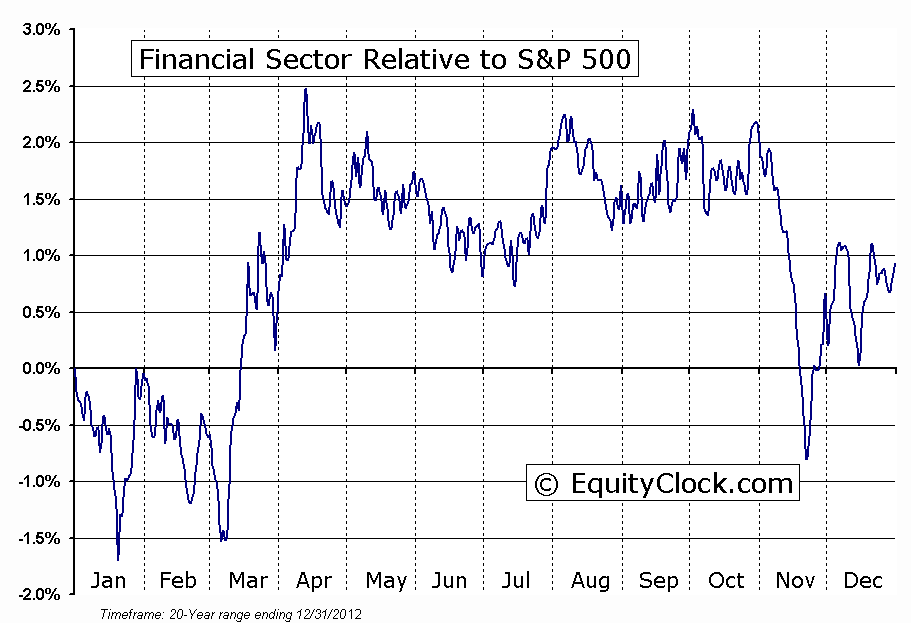
FINANCIAL RelativeToSPX


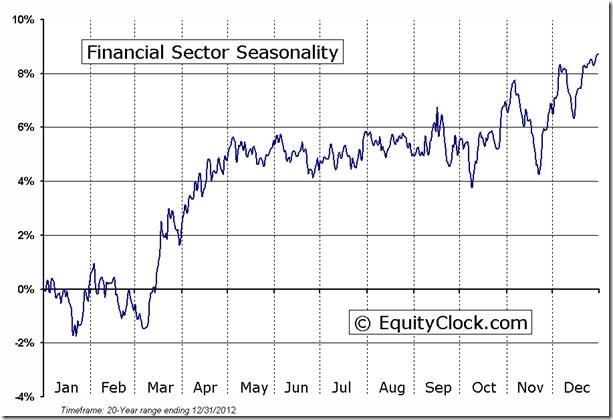
clip image048

Equity Trends

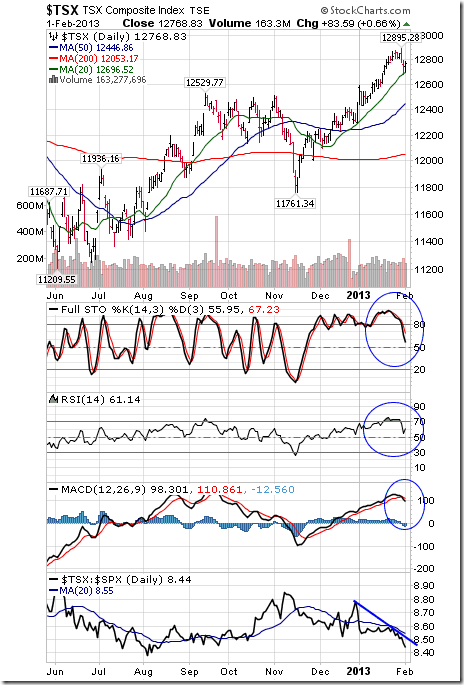
The TSX Composite Index gained 71.49 points (0.56%) last week. Intermediate trend remains down. Resistance is at 12,895.28. The Index remains above its 20, 50 and 200 day moving averages. Strength relative to the S&P 500 Index changed from negative to neutral. Short term momentum indicators have declined to neutral levels.

clip image008 thumb

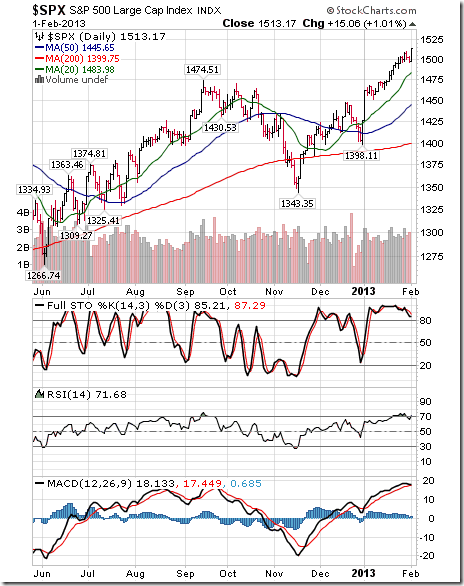
The S&P 500 Index added 2.60 points (0.17%) last week. Intermediate trend is up. Resistance is forming at 1,530.94. The Index remains above its 20, 50 and 200 day moving averages. Short term momentum indicators have declined to a neutral level.

clip image003 thumb


….. Read it all & view 45 Charts HERE


Volatile Markets & “The Bernanke Factor “

It was quite volatile in the markets last week with Monday’s sharp selloff leading to a large spike in the volatility index as investors went scrambling for the exits. With Obama on the television proclaiming that an “economic apocalypse” was upon us if the sequester wasn’t repealed – it is not surprising that investors were somewhat worried about the pending deadline. 

However, on Tuesday and Wednesday, Bernanke took to Capitol Hill and in a few deft words assuaged all investor fears with these simple words:

“In the current economic environment, the benefits of asset purchases and of policy accommodation more generally, are clear: Monetary policy is providing important support to the recovery while keeping inflation close to the FOMC’s 2 percent objective. Notably, keeping longer-term interest rates low has helped spark recovery in the housing market and led to increased sales and production of automobiles and other durable goods. By raising employment and household wealth–for example, through higher home prices–these developments have in turn supported consumer sentiment and spending.” 

In other words, Bernanke simply stated the “QE to Infinity” was here to stay for quite some time.  With those words of support investors quickly forgot about the looming sequester disaster and returned their focus back to piling into equity investments. By the end of the week, the sharp selloff was fully reversed as the previous spark of “fear” returned to outright “complacency.”

Screen shot 2013-03-03 at 11.28.40 PM

…..read More. Download This Weeks Issue HERE. which includes: 

  • What He Said Vs. Reality 
  • Excessive Confidence 
  • There Is No Asset Bubble 
  • QE Not Boosting Growth 
  • Risk Of Recession Rise
  • Great Charts

…..read it all HERE


test-php-789