Currency

Dollar-Crash Proofing a Portfolio

Financial writer and best-selling author Peter Sander sits down with portfolio manager Axel Merk for insights on investment considerations in light of the risks posed to the greenback.

Peter: A lot of talk about a “dollar crash” keeps coming up in the blogosphere. Is it a serious threat, and if so, what should an investor do about it?

1

Axel: A “dollar crash” is what we call a “tail risk” event. It’s something that may or may not happen, but would have a large impact if it did happen. “Black Swan” author Nassim Nicholas Taleb calls such events “so rare as to be beyond the normal expectations in the history of finance.” Not everyone thinks the threats to the dollar are so remote, but that’s ultimately up to each investor to assess for himself or herself. My view is that if an investor believes a risk is non-negligible, it may be prudent to take it into account in one’s portfolio allocation; investment professionals may even have a fiduciary duty to do so.

Peter: Let’s dig a little deeper. Why are investors concerned about a “dollar crash,” and are those concerns justified?

Axel: The “dollar crash” scenario starts with news we’re all familiar with about unsustainable deficits. The current deficit and Congressional gridlock is the short-term story; the real long-term story is entitlements and the future trajectory of the deficit. Without entitlement reform, we may go broke.

…..read more HERE


Four Possible Outcomes to Italy’s 5-Star Mess

UnknownRome will have a new pope before Italy gets a new government. Good job there’s no rush…

ROME has now been without a government since mid-December. Italy’s politicians will only start to talk later this week about doing something about last month’s failed elections. Barely a month after Benedict XVI resigned, the Catholic world will have a new pope before Italy gets a prime minister. It’s lucky there is no rush.

Italy’s debt was downgraded on Friday by the Fitch ratings agency. Interest rates have already risen further since then. Rome goes back to the bond market to raise new finance this Wednesday. Yesterday meantime brought a cut to the GDP figure reported for end-2012, now shown shrinking by 0.9% from three months earlier.

Can Italy shake itself out of this mess? Apparently at opposite ends of the political spectrum, both Beppe Grillo and Silvio Berlusconi have catalysed discontent with European politics, very often blaming the Euro as ultimate responsible for the crisis. But what would happen if the political programme of Grillo’s 5 Star Movement came to reality, and more specifically if Italy decided through a referendum to leave the Euro?

What if the Italian debt was restructured? And if these hypotheses don’t become reality, which scenarios are likely to take place instead?

#1. Italy chooses to leave the Euro

Returning to the Lira would mean that private savings would be redenominated in the old currency (well, a new currency with an old name), and be devalued. Savers would get poorer in real terms, losing purchasing power overnight. After all, going back to the Lira would be chosen exactly because it gave monetary sovereignty back to Italy. And what tradition could be more Italian than  devaluing the Lira?

But this leads to the next question: would the ‘old’ public debt be redenominated as well? It seems unlikely, as creditors would not accept such a loss in real terms. The consequences of having a public debt denominated in Euro while devaluing the Lira are easy to imagine.

#2. Restructuring the public debt

Restructuring debt is normally a consequence of a default. Letting Italy reach that stage would clearly present a hazard to all Eurozone states. But cutting interest rates on bond contracts that have already been agreed would also be a heavy blow for Italian banks, and for households too. Because 63% of the public debt is owned domestically. Consequently, Italy  would have a hard time trying to finance new debt after stinging its own citizens, most especially if it had just quit the Euro and lost the support of the European Central Bank.

#3. Italy muddles through

If Italy both stays in the Eurozone and avoids the extreme measure of debt restructuring, it seems unavoidable that the austerity of the past few months would continue. Italy could still finance its debt, with a little help from the ECB if needed. But only with some strict conditions, of austerity plus growth.

We’ll leave to the reader’s discretion whether austerity and growth can be used in the same sentence. But it is certain that the pain heaped on voters by “muddle through” would leave Italy repeatedly exposed to fresh debates over leaving the Euro or restructuring the public debt. Only, with the pain growing worse, the element of “choice” could be removed – making Euro exit and creditor losses an extreme but inevitable consequence of the failure to address or resolve Italy’s deep financial problems.

#4. Italy loses its independence

We’ll divide this scenario into two subcategories, one of which may sound familiar to Italian readers at least.

First, there’s a potential loss of sovereignty. Because extreme situations require extreme measures. The chance of compulsory administration by European authorities can’t be ruled out. In fact, and for good or for bad, the appointment of Mario Monti as prime minister to rescue Italy from the brink in autumn 2011 was a loss of national sovereignty.

This is a consequence of community life: many indignities will be permitted to avoid contagion. It seems fair to believe that the recent electoral result exposes Italy to this happening again, with Rome’s 16 Eurozone partners imposing their own victor.

Another possibility, and again with loss of sovereignty for Rome, would however be at the extreme opposite of the spectrum. Because it would see the expansion of European monetary and economic unity to include political and fiscal unity as well. This is probably very unlikely to happen in the short term. We know that the punctual German taxpayer is not particularly flattered by the idea. Yet the European Union’s own leaders believe it is a possible scenario, and the best. And they after all are in charge for the time being.

With so many politicians trying to take control, is there a way for a private citizen to protect his or her own financial independence and freedom? What we know for sure is that in the last few weeks the Italian phonelines here at BullionVault have started to ring more frequently.

“I’m sure I’m not the only Italian contacting you to buy gold in this situation,” says G.F. from Naples, explaining he has decided to invest in some gold to protect his savings in case the Euro collapses or Italy goes back to the Lira. And if the debt crisis worsens and turns unmanageable, who will pay in the end? Not the debtors, that’s for sure: they don’t have any money. Creditors always pay, and providing the funds they accepted that risk.

Owning physical gold would certainly be a great advantage if either of the first two scenarios above became real. Gold is an international asset, it does not represent a credit, and it is not bound to national or monetary policies. It can’t be reproduced or have its value debased at command, nor through a referendum either. Traditionally and in the worst crises, gold guarantees individual sovereignty and financial independence, an autonomy of choice, movement and action.

Yet this crisis insurance has been getting cheaper for Italian savers. Over the past few weeks the gold price in Euros dropped to the same level of November 2011. It is currently around €39,000 per kilo, when just six months ago it reached a fresh record peak of €44,300. Only uncertainty seems to be inevitable in Italy. But anyone interested in taking out insurance against a Euro exit or debt write-down might find it useful to remember that physical gold is not a credit. It can’t be restructured. It does not carry default risk.

Alessandra Pilloni

BullionVault

Published novelist and former language consultant Alessandra Pilloni is European operations executive for Italy at BullionVault, the world-leading gold and silver exchange for private individuals. Alessandra’s views and comment on precious metals investment are regularly sought by both Italy’s mainstream media and specialized blogosphere, among them Il Sole 24 Ore,La Stampa and Panorama.

(c) BullionVault 2013

Please Note: This article is to inform your thinking, not lead it. Only you can decide the best place for your money, and any decision you make will put your money at risk. Information or data included here may have already been overtaken by events – and must be verified elsewhere – should you choose to act on it.


Unscrew Your Kids, Part II

child-debt thumb2

Will Bonner here again…

Dad is still without power on the ranch. He’s working on restoring the solar panels. But he’s still out of reach.

So instead of his regular Diary entry, here is Part II of his essay to members of his family wealth preservation advisory Bonner & Partners Private Wealth. (To find out more, read this.)

Unscrew Your Kids, Part II

Thomas Jefferson was familiar with debt. He carried a substantial burden of it throughout his adult life.

At the time, there were no bankruptcy protection laws. If you did not pay your debts, your creditors hounded you… could take everything from you… and get you sent to jail.

Jefferson had such a reputation that his creditors were perhaps awed by it… or sympathetic. They did not push him too hard. Otherwise, he might have been ruined. Or even put in prison for non-payment of debt.

There he might have joined his fellow Declaration of Independence signatory James Wilson.

Wilson was put in prison for non-payment while serving as Associate Justice of the U.S. Supreme Court. There too, in the Walnut Street Debtors’ Prison, in Washington, D.C., he might have encountered his old friend Robert Morris, also a signatory of the Declaration of Independence. Morris was once one of the richest men in the colonies and was described as “the most powerful man in America.” From 1781 to 1784, he acted as the new nation’s secretary of the

Treasury — as its “Superintendent of Finance.” But he was bankrupted in the Panic of 1796 and sent to debtors’ prison.

The Great Danger

Another illustrious veteran of debtors’ prison was Henry “Light-Horse Harry” Lee, father of Robert E. Lee. He was a hero of the Revolutionary War, but nevertheless busted and sent to prison in 1808. He used his time there to write his Memoirs of the War.

Throughout history, excessive debt has been a great danger — with serious consequences for the unwary. There were heavy penalties for not satisfying your debts. In Ancient Greece, for example, the debtor could be taken into “debt bondage.” He was made a slave.

So many people became enslaved in this way that Athenian statesman Solon enacted a law in about 600 B.C. that banned the practice. Called the seisachtheia, it allowed the debt slaves to return to their farms as free men. But the debt was not erased. The debtor was still at risk of becoming his creditor’s slave if he failed to respect the new credit terms.

The penalty for failure to pay debts in Europe during the Middle Ages was prison. Conditions were appalling, as you might imagine. Typically, the debtor’s family had to continue providing food and clothing. If the prisoner had no family support he would starve. In prison, of course, he had little means to repay the debt, which commonly brought the story to a miserable conclusion.

Going broke was also an abominable disgrace. It was a blemish on a family escutcheon, telling the world that a member of the family — often the head of it — had let down his friends and associates. Read the novels of Thackeray and James; you will find young women of good society who can’t get married — ever — because their fathers defaulted on their financial obligations. Non-payment of debt sullied the family — for generations. To avoid this stain, uncles, cousins and other would come together to discharge the debtor’s obligation.

The penalties of excessive debt also figured heavily in commercial relations — especially in the banking industry. Until the creation of the Federal Reserve System in 1913… and the later Depression Era reforms that allowed banks to operate behind a corporate shield… bank owners were personally responsible for their bank’s losses. There was no federal deposit insurance and no private banking cartel that could come up with funny money when it was needed.

Money was real — expressed as a unit of gold. Losing it meant real losses. Failed banks went into receivership. The receiver would tally up the losses and send a bill to the owners. Each paid his share of the losses… or he would be judged insolvent too.

As you can imagine, bankers were a lot more prudent back then. So were borrowers. Both shared a keen interest in not overdoing it. Because both were directly exposed to penalties if anything went wrong! There was a direct connection between the debtor and his suffering — whether or not he operated behind the big brass door of a bank or the flimsy wooden door of a tenement apartment.

Today’s Debt Slaves

Times have changed…

The system today allows some people to make reckless bets and extravagant promises, while putting the penalties for failure onto someone else. Sooner or later their speculations go bad. Sooner or later they spend more than they can afford. Sooner or later they make wasteful and disastrous investments.

Who cares? Someone else pays the penalty… sooner or later!

Bankruptcy protection laws now permit debtors to continue to live normal lives, as their accounts are brought back into balance by court order. The modern debtor is usually allowed to keep the family home… provided it is not too extravagant… and enough of his earnings to allow him to carry on. Otherwise, his assets are seized and distributed among his creditors.

But public debt is another matter. Never before in history have we seen anything like it. A young man in the 19th century might inherit his father’s debts (along with his assets); he now inherits debts incurred by people completely unrelated to him.

An old man in Arizona gets free pills from the government in 2010; a young man in Maine will still be paying for them in 2030. A middle-aged banker pays himself a $10 million bonus in 2011 thanks to EZ money from the Fed; a plumber just starting out in 2025 wonders why his own money is worth so little. Washington goes $7 trillion further into debt in 2012; some hapless college grad 10 years from now finds he can’t get a job.

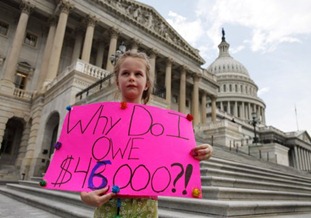
Calculated by Professor Lawrence Kotlikoff of Boston University, your grandson’s share of the total U.S. government debt burden is about $700,000. This is not a fiction. It is real. And as the baby boomer generation retires and grows old, this obligation will come due and payable.

It would cost your grandson about $20,000 a year, over a 40-year career, to discharge it. And that assumes that the government immediately stops adding to it. This young man will probably pay about 40% of his income just to keep the feds current on spending. On earnings of $50,000 a year, he would pay another 40% for the benefits his parents and grandparents consumed many years before.

We have yet to meet the young man or woman who would stand for this. None would. No government would dare impose it. And the markets would get the heebie-jeebies and collapse long before it came to pass.

Instead, what will really happen was outlined in last week’s Outlook. The feds will delay serious budgetary reforms as long as possible. They will raise taxes here and there. They will postpone spending cuts. The can will be kicked — and booted — so many times that it will be battered and bumped into an unrecognizable shape when it finally comes to rest against a brick wall. That will be the brick wall against which the feds will have their backs when all hell breaks loose.

Prices will begin to rise. Investors, fearing inflation, will sell U.S. Treasury debt. The feds will have only two choices: raise interest rates to stifle inflation (thereby protecting the dollar and the bond market) or print money to cover deficits (thereby protecting their jobs and benefit consumers). The first choice will mean recession, maybe depression, and possibly riots and looting. The second will mean hyperinflation.

This wall is out there. Where exactly this wall is, no one knows. I have been surprised by the example of Japan. The country has been racing toward its own brick wall for more than a decade. Shinzo Abe, the incoming prime minister, has promised to speed up! But so far investors and savers still consent to transferring more and more of their money to the government in return for IOUs (Japanese government bonds) that can’t possibly be paid off. They too must collapse… sooner or later.

A Lot of Ruin

The U.S. has “a lot of ruin in it” too, to borrow an expression from Keynes. How much? I don’t know. But it is certainly doing its best to find out. And it will be a costly lesson.

Succeeding generations (probably the next) will bear the costs of the debt. This will likely come in the form of a disastrous period of financial whammies… crashes… bear markets… and hyperinflation. They will also bear the cost of living and working in a debt-saturated zombie economy (one that is essentially moribund but that appears alive).

From a distance — or from the figures provided by the U.S. government — you might think the U.S. economy is “recovering” from a serious ailment. But if you hold a mirror up to its nose, you will not see much fog. Hold its wrist. The pulse will be hard to detect.

The false impression is primarily the result of faulty reporting. Real employment and inflation measures are distorted by changes to the system put in place at the Bureau of Labor Statistics. According to John Williams of ShadowStats.com, properly measured, the numbers would show the U.S. economy now in its seventh year of recession… with a 20% real unemployment rate. That is to say we are living through a depression, and young people are bearing most of the pain.

The young will also bear the brunt of the feds’ clumsy efforts to repair the system. Government is always reactionary — favoring existing capital interests over those of the (non-voting) future. But never before in a “free market” economy have governments so vigorously defended the past at the future’s expense.

In the U.S., Washington’s deficits and bailouts protect current jobs at the expense of future jobs. Its QE programs protect today’s bondholders at the expense of those of tomorrow. Its Social Security and Medicare programs protect present beneficiaries. Those who will come into the program 20 years from now can go fish.

In short, the young are today’s debt slaves. But unlike the debt bondage of ancient Athens, today’s young people never even got their hands on the money. Our job as parents is to help our children and grandchildren unscrew themselves by giving them a source of real capital and showing them how to use it.

Editor’s note: It is our mission at Bonner & Partners Private Wealth to ensure a secure future for our children. To make sure they can “unscrew” themselves. Independently, of course. We take this mission very seriously and have built a small group of members that do too. If you would like to know more, here’s the entire story.


About Bill Bonner:

Bill Bonner started Diary of a Rogue Economist to share his over 30 years of economics and market experience with as many interested readers as possible.

Diary of a Rogue Economist is always free, and it’s delivered to your email each business day. Sign Up HERE

Jim Rogers: We’re Wiping Out The Savings Class Globally – To Terrible Consequence

jim-rogers1

History shows this does not end well.

Jim Rogers decries the growing uncertainty and recklessness of global central planners as the world enters unchartered financial markets:

For the first time in recorded history, we have nearly every central bank printing money and trying to debase their currency. This has never happened before. How it’s going to work out, I don’t know. It just depends on which one goes down the most and first, and they take turns. When one says a currency is going down, the question is against what? because they are all trying to debase themselves. It’s a peculiar time in world history.

I own the dollar, not because I have any confidence in the dollar and not because it’s sound – it’s a terribly flawed currency – but I expect more currency turmoil, more financial turmoil. During periods like that, people, for whatever reason, flee to the U.S. dollar as a safe haven. It is not a safe haven, but it is perceived that way by some people. That’s why the dollar is going up. That’s why I own it. Will I own it in five years, ten years? I don’t know. 

It makes it extremely difficult for the investor looking for acceptable risk/reward or the saver looking to protect their purchasing power; as in Rogers’ view, all options have their problems:

I own gold and silver and precious metals. I own all commodities, which is a better way to play as they debase currencies. I own more agriculture than just about anything else in real assets because…

…..read more HERE

8 Hot Cheap Solid Gold Companies a Gold Agnostic Can Love

Eight Companies Swiss Money Manager Joachim Berlenbach Gives High Grades

In an environment of rising capital expenses, gold producers big and small are left with little or no free cash flow. Instead of investing in exploration to maintain production, too many companies are cutting costs and high-grading their current resources. Joachim Berlenbach, fund adviser with Switzerland’s Earth Resource Investment Group, believes this kind of short-term thinking will lead to decreased production and a higher gold price. In this Gold Report interview, Berlenbach shares his ideas on how to succeed in this stock-picker’s market.

The Gold Report: Goldman Sachs recently downgraded its 2013 gold forecast from an average of $1,800/ounces ($1,800/oz) to $1,610/oz due to interest rates rising in the U.S. Could this bearish sentiment actually be bullish for gold?

Joachim Berlenbach: I think the report was very one sided. Focusing solely on the U.S. interest rates does not provide a full picture. I would have liked to see a balanced look at where the real demand is coming from. If the report had said, for example, how much gold the Chinese central bank is actually buying compared to its reported purchases, it would have been a much more interesting discussion.

COMPANIES MENTIONED : ANGLOGOLD ASHANTI LTD. : AUREUS MINING INC. : CONTINENTAL GOLD LTD. : ELDORADO GOLD CORP. : GOLD FIELDS LTD. :PILOT GOLD INC. : RANDGOLD RESOURCES LTD. : TOREX GOLD RESOURCES INC. RELATED COMPANIES: COLOSSUS MINERALS INC. :GLOBAL MINERALS LTD. : GUYANA GOLDFIELDS INC. : LYDIAN INTERNATIONAL LTD.
 
TGR: You have a chart that suggests that by 2016 the all-in costs to produce an ounce of gold will reach $2,120/oz. How would that change the space?
 
Berlenbach chart rev 570
 

Click here to see enlarged chart.

JB: This graph includes all of the costs that make up a company’s free cash flow: operating cash costs, sustaining capital expense (capex), expansion capex, exploration and finance costs, plus a bit of general and administration expense (G&A).

Total costs are sitting at $1,600/oz for the 13 biggest companies, which has been our universe for the last 13 years. Over the last two to three years, we have seen total costs rise an average of 15–17%. At a gold price of $1,600/oz, the industry does not produce a single dollar of free cash flow. If we take a cost inflation of only 10%/year, we will need a gold price over $2,000/oz to maintain production.

The critical point is—and I believe it is poorly understood by the market and the investors—that the natural resources industry is different than any other industry. When a gold producer builds a new mine, it is not to increase production, it is to maintain production. And unfortunately, the new mine will likely have lower grades, because the high grades have been mined out.

Grades are drastically lower in the new deposits. That means companies have to build bigger mines outside the established mining areas like the Carlin Trend in North America or the Witwatersrand Basin in South Africa. Companies have to go into Indonesia, West Africa, the Democratic Republic of the Congo (DRC), Colombia or Guyana. New mines require higher capex.

Unlike other industries, capital spent for new production is not intended to increase shareholder value; it is done to maintain the company’s value.

In the coming months, we will see a huge effort by the industry to reduce costs. To become profitable again, the industry has to increase cash flow. To do this, a company could write off or stop capital projects already committed to. Instead of investing, it will try to preserve its free cash flow. And remember, the industry is under huge pressure from investors who want dividend yields.

The industry also could go back into high-grading the ore bodies. High-grading means picking out the high-grade parts of an ore deposit to reduce costs in the short term. I saw this happen when I worked in the South African gold industry at the end of the 1990s. The gold price was below the breakeven price. Companies stopped exploration and started high-grading.

In the short term, high-grading might result in more profitable mines and better cash flow. But in the longer term, it means that we cannot mine enough gold. Gold production has not increased over the last 10 years, despite the rising gold price; it remains at 2,600 tons, or 80 million ounces (80 Moz), per year. If companies do not invest in new mines, gold production will drop drastically.

TGR: Less supply means higher prices. Even with cost inflation, the margins should be thicker, right?

JB: That is why it is so important to be a stock picker today. All companies are not equal. We look at a spectrum of gold companies—mid cap, small cap and large cap—with very different costs and profit margins. You have to do your homework to pick the right stocks and make a profit.

Gold equities will come back, but there will be more diversity in performance among companies.

TGR: Many companies now report sustaining capex on the income statements in their quarterly statements. What does that change mean?

JB: Looking at the chart, the average cash operating costs in Q4/12 were $713/oz. But that figure does not include another $700/oz in capex: $150–200/oz sustaining capex—the capex needed to pay for tires on a mine’s trucks or advance a new crosscut to a mining area—and $400–500/oz in expansion capex to build new mines and replace the ounces the company has been digging out.

TGR: What is the difference between capex and finance costs?

JB: The financing cost is the interest a company pays on top of its debts. Exploration costs can vary. It is easy to switch exploration on and off. Sustaining capex is what a company spends on keeping its mines running; expansion capex is money used to build or buy new mines to keep up production in the mid- to long term.

Where the mining industry differs from some of the accounting standards, especially in North America, is in looking at the total breakeven price. That is the information most companies provide when they report the costs of producing the 2,600 tons or 80 Moz gold mined per year. Gold Fields Ltd. (GFI:NYSE), among some others, is a laudable exception; the company has emphasized the need to report notional cost expenditure (NCE), which includes capex, for some time already.

Looking at the chart, our Q4/12 free cash flow, breakeven price was $1,600/oz. Any less and the industry does not earn a single dollar of free cash flow. You need to add 20% on top of that to motivate the industry to build new mines. Without that incentive, why would companies take the risk? That means we need a gold price around $1,900/oz to maintain production of 2,600 tons or 80 Moz.

TGR: Does this mean there might be fewer takeovers?

JB: I think so. Today CEOs are under considerable pressure from investors to be careful with acquisitions. Several recent takeovers were not well received and have even impaired the industry, for instance, Barrick Gold Corp.’s (ABX:TSX; ABX:NYSE) takeover of Equinox Minerals Ltd. (EQN:TSX; EQN:ASX) in Zambia.

Many CEOs are focused on increasing cash margins, so a fall in production is likely over the next quarter, with higher cash margins. That could lift some equity prices. But it is not sustainable.

TGR: How can the average investor tell if a mining company is high-grading a deposit?

JB: My advice is to look at the annual reports over a five-year span or, better yet, look at the head grades of a mine on a quarterly basis and compare with the stated reserve grade; look at where the grades in a deposit in a certain mine are coming from. Is the company mining above or below the reserve grade?

Today, a lot of mines are mining above the reserve grade. If a mine is doing that, it can only mean that over the longer term the average grade on that mine is coming down, with resulting higher costs.

The biggest cost driver in the gold industry is falling grades. Grades have come down from 7–8 grams per ton (7–8 g/t) in the 1950s and 1960s to less than 1 g/t. Of course, technology developments, like heap leaching, have helped us mine lower grades.

At the same time, the new mines are being built in the middle of nowhere. I nearly fell over backward at the cost of one mine in Ghana. Diesel fuel accounted for 50% of its production costs because all of its power had to be provided by diesel generators—on a deposit mining just 2 g/t.

TGR: When you first put this chart together, the obvious strategy was to overweight the “better free-cash-flow generators.” Now that the gold price has fallen, where does that leave that strategy?

JB: With the gold price being so close to the free cash flow price, investors need to do their homework. You cannot put all gold companies into one basket. There are huge differences in geography, risk profile, geology. There are hydrothermal deposits, deposits with copper as byproduct, gold-silver deposits. You need to go through the technical side of the company if possible, visit the mine and speak to management, geologists and mining engineers. Do a detailed financial analysis.

TGR: Would it be fair to call you a gold bull?

JB: No, I am agnostic when it comes to the quasi-religious camps of gold bulls and bears. I would like to see a gold price that helps us maintain the industry. We do not have that today. So, to that extent, I am bullish on the gold price. It needs to be significantly higher in the mid to longer term.

TGR: Much of your group’s strategy involves what you call bottom-up analysis. Tell us more about that, as it pertains to being a stock picker.

JB: It is a very detailed analysis, including field visits. We all are geologists, mining engineers or geophysicists. We not only have degrees in these subjects, but field experience working for exploration companies or gold producers. At least three of us have been sell-side analysts, so we understand how to build very detailed financial models.

We do not invest in any companies without building a detailed financial model, generally using a discounted cash-flow analysis. The whole investment team analyzes and discusses every investment case. Once everybody is happy with the financial model, it goes into a ranking system where we compare a gold company with a copper company and an oil company and so on.

We also are very transparent with the geographic locations of our investments. We have an in-house risk system. Every country gets a mark (A, B, C or D); A is the lowest risk where we go fully invested. We do not invest in D countries. A company rated C would be a maximum of 2% of the portfolio; B companies a maximum of 5%.

TGR: There are about 3,500 publicly traded mining companies. How do you sift through all their financials, drill results and such?

JB: In many cases you can scan very quickly. For example, it does not take long to eliminate a company with an average ore body of 1.5–2 g/t on a project in the Congo and no cash.

We generally look for a buffer on the balance sheet to support the company for the next 18 to 24 months to allow for exploration. There must be good management with a solid track record.

TGR: Are some jurisdictions better understood and appreciated by the European investor than the North American investor?

JB: I think the North American investor is much better educated regarding natural resources than the European investor. I would like to speak more to North American investors, but we are a European fund, so we cannot market the fund in North America.

Having said that, North American investors generally are not well educated about Africa. They might not understand the differences among Ghana, Congo, South Africa and Zimbabwe; all of Africa gets thrown into the same basket. There is a huge risk aversion to Africa in North America. The European investor is more open to Africa.

However, North American investors are generally more open to and better educated about South America.

TGR: What did you take away from your recent trip to Africa?

JB: I noticed three trends. First, cost cutting is really coming into play in Ghana, Burkina Faso and South Africa. For example, to cut costs, companies are not putting a single dollar into exploration.

Second, in Burkina Faso projects are being downscaled. Prefeasibility studies that had already been presented are being scaled down 40–50% because the money is not there and capital markets are closed. This tells us we are looking at a reduction in production over the next few years. It also points to the importance of looking at the exploration and capital expenditures in Q1/13 quarterly results for the mid and large caps. Are they committed to their capital projects? What are they doing on the grade side?

Third, a new generation of CEOs is coming in. They will have four or five years at the helm and they want to leave that company with a big check in their pockets. The only way to get that check is to make a good return for the investors. Unfortunately, that means they will not focus on investing in exploration for future production, but on cost cutting. They will start high-grading.

TGR: You and others have identified a number of companies with high capex and sustaining capex costs per ounce. Are you willing to name names?

JB: Among the large caps, Goldcorp Inc. (G:TSX; GG:NYSE), IAMGOLD Corp. (IMG:TSX; IAG:NYSE) and Barrick Gold have all-in costs at $1,900/oz. They have no free cash flow.

Other companies in the mid-cap field, and even some large caps, look better. Gold Fields seems to be attractively valued on a free cash flow basis. It is producing at $1,400/oz all-in. AngloGold Ashanti Ltd. (AU:NYSE; ANG:JSE; AGG:ASX; AGD:LSE) is also attractive.

TGR: What midtier names offer value at current prices?

JB: We quite like Eldorado Gold Corp. (ELD:TSX; EGO:NYSE). The company is not the cheapest producer, but it has great exploration upside.

I also like Randgold Resources Ltd. (GOLD:NASDAQ; RRS:LSE). The company is not cheap, and you need to have a trading strategy in place if you buy. Like Eldorado Gold, it has a good track record for developing mines in difficult terrain and difficult jurisdictions.

TGR: If investors buy Randgold, when should they get out?

JB: Investors need to look at the share price, at where it fluctuates. Look at the quarterly reports, at money going in and coming out.

TGR: What positions do you have among the sub-$1 billion market-cap companies?

JB: I followed CEO Mark O’Dea, a structural geologist, from Fronteer Gold Inc. to Pilot Gold Inc. (PLG:TSX). We made a lot of money in the months before Fronteer Gold was taken out.

Pilot Gold has two big projects in Turkey, TV Tower and Halilaga, plus the Kinsley Mountain deposit in Nevada. Kinsley has a similar structural setting to Fronteer Gold’s Long Canyon, but Pilot Gold has more drilling to do.

TGR: Which of those projects excites you most?

JB: At this stage, the Turkish assets look more promising than Kinsley Mountain. I really like TV Tower. Pilot Gold might divest Halilaga for the right price.

TGR: Could it not develop both?

JB: I doubt it. It would have to raise capital. It has enough cash for exploration, but not enough to build two mines.

TGR: What do the drill results tell you about TV Tower, especially in the KCD zone?

JB: The results show some fairly high-grade cores, all located around the same bore hole. Producing core bulk of 4–5 g/t within 100 meters of the previous bore does not extend the deposit. The company needs to do some drilling that defines a bigger resource.

TGR: Is it meaningful to European investors that TV Tower is on Europe’s eastern edge, or do they just want the best?

JB: They want the best. European investors understand gold in Turkey as well as they understand gold in South Africa or in the Carlin Trend. They care about general risk, and Turkey is not perceived as a country with too high a risk. If this deposit were in Zimbabwe or Ecuador, they would have more questions.

TGR: Any other small-cap names you want to talk about?

JB: We like Torex Gold Resources Inc. (TXG:TSX) in Mexico. The company’s Morelos project is one of the few really high-grade deposits. It is a skarn deposit and recent drill results are shooting the lights out. There also are deposits south of the river. When we visited, it was obvious that the deposit is not confined to Morelos.

There are two issues here. The biggest is political risk. There are some drug bands and crime in the area. The Mexican army is there and Torex has hired security companies. The other issue is whether Torex can build the mines itself. So far management has done well. Torex is well capitalized and has already raised most of the money it needs.

TGR: Torex recently took out a $250 million ($250M) line of credit backed by five banks. Do you prefer to see that rather than an equity issue?

JB: At the current price, definitely. The company recently did another $380M bought-deal financing on top of that. At current equity prices, if a company can secure bank financing at attractive rates, I prefer a bank deal to an equity raising. Equity raising is very expensive.

TGR: How did Torex get the bank financing?

JB: As I recall, it was done by BMO Capital Markets. A bank typically will do its due diligence on such projects. There is still money available for high-quality projects. The taps are not as closed as they were in 2008.

For example, look at Aureus Mining Inc. (AUE:TSX; AUE:LSE) in West Africa. The banks are actually lining up to finance it with no hedging required. Generally, when a bank provides a loan to a gold miner, it wants hedging in place. Hedging and other obligations linked to a bank loan generally reduce the profitability of the project in the longer term.

TGR: Do you have a position in Aureus?

JB: Yes, we do. We have confidence in CEO Dave Reading, who had been the CEO of European Goldfields Ltd., which was taken over by Eldorado Gold.

In November 2012, Aureus closed an $18M offering and it can probably attract cash. Management has a good track record and the company has an interesting, doable project in West Africa. This is a bit of light at the end of the tunnel.

TGR: The project you are talking about is in Liberia, right? What about jurisdiction risk?

JB: Yes, it is in Liberia. The project is close to infrastructure. The new government is looking for investment. It wants mining to take place.

TGR: Do you have one more name in the small-cap space?

JB: I like Continental Gold Ltd. (CNL:TSX; CGOOF:OTCQX) in Colombia. It has a hydrothermal deposit, with strong exploration upside. The latest drill results support our view that it is open at strike and there seem to be a few parallel structures adjacent to it. Everything being equal, you want to be in the high-grade deposits. Continental Gold is one of those deposits.

The company is well financed and has cash on the balance sheet. Management is well respected; we know the team and adviser Greg Hall well.

TGR: Its resource in all categories is currently 5.9 Moz. How much higher might the next resource estimate go?

JB: Continental Gold has to do in-fill drilling and move the Inferred resource into Measured and Indicated. It is important for the company to issue a prefeasibility study and a feasibility plan and get into production.

TGR: Jamie Spratt at Clarus Securities models production of 225,000 oz (225 Koz) per year, generating cash flow in the neighborhood of $337M at $1,500/oz gold. What do you think of those numbers?

JB: We are playing around with 200–300 Koz production. Mining costs are the big question. In that part of Colombia, mining costs are probably at $70–80/ton. Given that it is hard ore, you need to add $40/ton for milling. Once you add G&A expenses, you have a mine that can produce cash flow relatively easily.

Deposits like Torex and Continental Gold—high-grade deposits, close to infrastructure—are scarce and that makes them potential takeover targets. I would be surprised if these companies have not signed confidentiality agreements with some of the bigger players.

TGR: Other exploration projects in Colombia have defined ounces in the ground, but none has advanced to production. Will Continental be the first?

JB: Definitely not. We were invested in Ventana Gold Corp. and Galway Resources Ltd. Both were taken out by Eike Batista and are private now. But they are further along than Continental. They are building mines, but are very secretive about it.

TGR: Will Continental be the first public company? The Colombian government has not been generous with mining licenses, has it?

JB: That is a problem. I was very impressed when I visited Colombia two years ago. I was expecting a drug dealer on every corner in Bogota. I was worried, but it was pleasant to speak with the mining geologists and CEOs. They all agreed that Colombia is a great country to operate in.

The government wants mining. Geologically, Colombia is a prosperous area. At one point, the northeast part of South America was hanging onto West Africa. Both regions are of the same age and have the same kind of deposit. The same is true of Guyana, where I saw the same rocks that I saw in West Africa.

Of course, there is risk. There is no guarantee of getting a mining license or of the taxes staying the same. But you have that everywhere. That is part of the game we play.

TGR: What one message do you want investors to take away from our interview today?

JB: Our industry needs to take risk. Companies are not investing to develop the new mines that will be needed to create and produce gold over the next 10 years.

We cannot sustain the industry if the current level of risk aversion continues, and mining companies are pressed to pay more dividends and cut costs. We need to maintain production and put risk capital into the market. We cannot have a short-term view on capital gains, dividend yields and so on.

TGR: How does a retail investor prosper today?

JB: There is only one way: Do your homework.

If you are not a real specialist on specific projects, stay with those management teams that have a good track record. Those are the teams that will go for the better-quality projects. If you are a North American investor, look to Africa and be open minded.

If everything is equal—jurisdiction, infrastructure, tax regimes—go for high grades. Those generally provide better cash flows than lower-grade deposits.

Finally, go for companies that are well capitalized. Exploration companies burning $1M or $2M a month, with no cash on the balance sheet, will not survive for long.

TGR: Joachim, thank you for your time and your insights.

RELATED ARTICLES


About Joachim Berlenbach:

Is an adviser to the Earth Exploration Fund UI and the Earth Gold Fund UI. He holds a Master of Science degree in economic geology from the University of Cologne, a Ph.D. in structural/mining geology from RAU (now University of Johannesburg/South Africa) and an MBA from UDW, South Africa. Berlenbach worked for 11 years in the South African gold and platinum mining industry. Following his operational occupation, he worked for five years as a sell-side analyst in the South African investment banking industry (Standard Bank, Citibank) where he was rated best South African gold analyst in 2001 and 2002. In 2003 he co-founded the boutique Craton Capital and in 2006 he founded the Earth Resource Investment Group, which advises the Earth Funds under the umbrella of Universal Investment in Frankfurt, Germany. He is a guest lecturer in economic geology at the mining school in Freiberg, Germany, and at the University of Münster, Germany, as well as a retained speaker on mining valuations in the international CFA program.

Want to read more Gold Report interviews like this? Sign up for our free e-newsletter, and you’ll learn when new articles have been published. To see a list of recent interviews with industry analysts and commentators, visit our Streetwise Interviews page.

DISCLOSURE: 
1) Brian Sylvester conducted this interview for The Gold Report and provides services to The Gold Reportas an employee or as an independent contractor. He or his family own shares of the following companies mentioned in this interview: None.
2) The following companies mentioned in the interview are sponsors of The Gold Report: Pilot Gold Inc. and Continental Gold Ltd. Streetwise Reports does not accept stock in exchange for its services or as sponsorship payment.
3) Joachim Berlenbach: I or my family own shares of the following companies mentioned in this interview: None (only invested in the Earth funds). I personally or my family am paid by the following companies mentioned in this interview: None. My company has a financial relationship with the following companies mentioned in this interview: Universal Investment (Frankfurt). I was not paid by Streetwise Reports for participating in this interview. Comments and opinions expressed are my own comments and opinions. I had the opportunity to review the interview for accuracy as of the date of the interview and am responsible for the content of the interview. 
4) Interviews are edited for clarity. Streetwise Reports does not make editorial comments or change experts’ statements without their consent. 
5) The interview does not constitute investment advice. Each reader is encouraged to consult with his or her individual financial professional and any action a reader takes as a result of information presented here is his or her own responsibility. By opening this page, each reader accepts and agrees to Streetwise Reports’ terms of use and full legal disclaimer. 
6) From time to time, Streetwise Reports LLC and its directors, officers, employees or members of their families, as well as persons interviewed for articles and interviews on the site, may have a long or short position in securities mentioned and may make purchases and/or sales of those securities in the open market or otherwise.


 

test-php-789