
Personal Finance
Don’t like a tax on Cypriot depositors? No problem – we’ll pretend to scrap it
by JR Crooks Monday March 25th 2013
 It got too much play. The proposal to levy an across-the-board tax on deposits in Cypriot banks, for good reason, was being called theft. (
So in order to quell the uprising and avoid setting a precedent everyone around the world could fear, Cyprus has agreed to a deal different only in semantics.
Here is Reuters:
Swiftly endorsed by euro zone finance ministers, the plan will spare the Mediterranean island a financial meltdown by winding down the largely state-owned Popular Bank of Cyprus, also known as Laiki, and shifting deposits below 100,000 euros to the Bank of Cyprus to create a “good bank”.
Deposits above 100,000 euros in both banks, which are not guaranteed under EU law, will be frozen and used to resolve Laiki’s debts and recapitalize Bank of Cyprus through a deposit/equity conversion.
The raid on uninsured Laiki depositors is expected to raise 4.2 billion euros, Eurogroup chairman Jeroen Dijssebloem said.
Laiki will effectively be shuttered, with thousands of job losses. Officials said senior bondholders in Laiki would be wiped out and those in Bank of Cyprus would have to make a contribution.
An EU spokesman said no across-the-board levy or tax would be imposed on deposits in Cypriot banks, although the hit on large account holders in the two biggest banks is likely to be far greater than initially planned.
We can all rest assured a tax will not be levied on depositors. Instead, a portion of uninsured deposits will simply be confiscated to pay off debts of a failed bank and raise enough money to satisfy bailout conditions.
Already there has been a limit of 100 euros put on ATM withdrawals. And come Tuesday, when banks are scheduled to reopen, additional capital controls will likely be needed. Parliament has given government the all-clear to apply capital controls if and when necessary.
All these last-minute antics are being categorized as a solution.
I suppose, considering the nature of the eurozone’s previous solutions, it is a solution. After all, they pulled the contagion card again. More precisely, they warned that if these drastic measures were not taken, the inevitable conclusion would be Cyprus withdrawing from the Eurozone.
Ahhh, say it ain’t so. Please no.
Officials are not hiding their motives anymore – they are acting in order to prevent financial market sell-offs. An exit by Cyprus, insignificant when measured by GDP, would open the door for other problem countries to escape the Eurozone, devalue and move towards a meaningful, albeit painful, recovery.
The thing is: any recovery in Cyprus will be painful no matter what. And this deal does very little to ensure depositors around the Eurozone their money won’t also be subject to confiscation. And potential capital controls would serve only to legitimize their concerns.
I suspect the kneejerk reaction of markets could be positive but very short-lived. I don’t see a meaningful difference between the recent deal and the proposals that have shaken markets to-date. I would suspect the Troika, namely the European Central Bank, will need to further maneuver so that Cypriot banks can be recapitalized, freed up to generate sufficient collateral and avoid the unintended consequences of capital controls.
Otherwise, this could all turn ugly very fast.
-JR Crooks

The Bottom Line
Upside potential by North American equity markets into April remains, but many seasonal trades also expire around mid-April. Retention of existing seasonal trades makes sense. However, new seasonal opportunities coming into April are relatively sparse (An exception is the Technology sector). In most cases with seasonal trades, the question is “When to take profits”?
U.S. economic news this week is expected to be slightly bearish (Consumer confidence, New home sales, Weekly initial claims, Chicago PMI).
First quarter earnings reports come into focus starting this week. Most companies are in their quiet time. Only companies with negative surprises are likely to comment. Consensus is a year-over-year gain by the 30 Dow Industrial companies of only 3.1%. Consensus for the TSX 60 companies is no change.
Short and intermediate technical indicators for North American equity indices and most sectors are overbought. Some already are showing signs of rolling over. Another test by the S&P 500 Index of its all-time high is likely, but is not expected to show significant follow through.
Currencies remain a focus, particular with the crisis in Cyprus and its potential impact on the Euro and the U.S. Dollar.
Political concerns are not a factor this week. Congress is getting ready to go on their Easter holiday.
Trading activity will diminish as the end of the week approaches. Look for quarter end “window dressing” to impact selected securities.
Cash hoards remain high.
Ed Note: To read the comments and view the 50 Monday Morning Charts just click HERE. Otherwise a chart from each category below:
Equity Trends
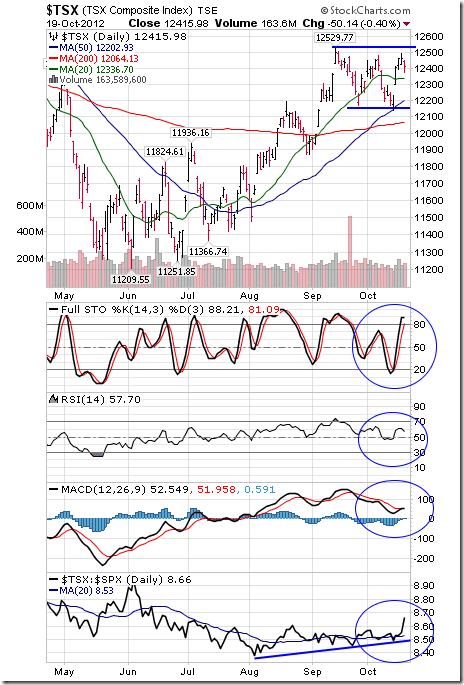
The TSX Composite Index slipped 72.67 points (0.57%) last week. Intermediate trend remains up. Resistance is forming at 12,904.71. The Index slipped below its 20 day moving average, but remains above its 50 and 200 day moving averages. Strength relative to the S&P 500 Index remains negative. Short term momentum indicators are trending down.
Currencies
The U.S. Dollar added 0.40 (0.49%) last week. Intermediate trend is up. The Dollar remains above its 20, 50 and 200 day moving averages. Short term momentum indicators are overbought and showing signs of rolling over.

Commodities
The CRB Index fell 1.74 points (0.59%) last week. Intermediate trend is down. The Index moved above its 20 day moving average. Strength relative to the S&P 500 Index remains negative, but showing early signs of change.

Interest Rates
The yield on 10 year U.S. Treasuries slipped 8.1 basis points (4.06%) last week. Yield fell below its 20 and 50 day moving averages. Short term momentum indicators have rolled over from overbought levels.

Other Issues
The VIX Index gained 2.27 (20.09%) last week.

Special Free Services available through www.equityclock.com
Equityclock.com is offering free access to a data base showing seasonal studies on individual stocks and sectors. The data base holds seasonality studies on over 1000 big and moderate cap securities and indices. Notice that most of the seasonality charts have been updated recently.
To login, simply go to http://www.equityclock.com/charts/
Following is an example, just click on the link:
Stock Market Outlook for March 25, 2013
 Following the Federal Reserve’s meeting on Wednesday there was a lot of speculation about how long the Fed will continue its Quantitative Easing (QE) program. Since the Fed’s statements are cryptic, I prefer to look at its economic projections. In this article, I discuss how the Fed’s current GDP and unemployment projections compare to the projections at previous meetings. At almost every meeting since 2011, the Fed has lowered its forecasts. Before a “Fed exit” is on the table, we probably need to see GDP projections increase from meeting to meeting. That may be far off and QE Infinity looks likely to be around for a while. Despite the Fed’s efforts, US Treasury bond yields are rising and prices falling (as measured by the iShares Barclays 20+ Yr Treasury Bond ETF (TLT)), but the big move in the bond market may happen when the Fed’s GDP projections begin to change directions.
The Fed’s Projections For GDP Growth & Unemployment
The following charts aggregate the projections for GDP growth and unemployment (as released after Fed meetings). The Fed releases its data in the form of a broad range of projections and a narrower “central tendency.” The figures below represent the midpoint of the central tendency for each period.
….read & view much more HERE

We have a very serious problem. In gold, everyone is loaded to the gills expecting hyperinflation that will never materialize and governments are getting outright nasty. We have THREE Monthly Bearish Reversals that have now lined up in gold at 15470, 15413, and 15323. We have a huge gap from there to 11589 and this is not real good. Gold closed 2012 higher than it did for 2011 on the 13th year up. That is by no means good at all. If these reversals are elected, look out below. We may have to clean house before gold can resume the uptrend.
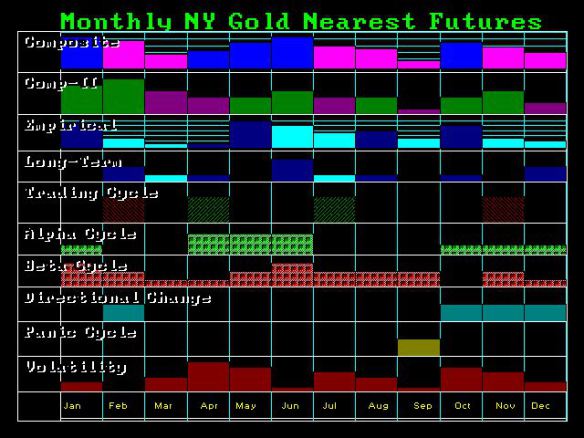
A snapshoot of the array for gold in 2013 came out as expected at the Berlin Conference. The Panic Cycle is September but look at the directional changes thereafter – every month. This is by no means going to be a walk in the park. The German elections are September 2013. Merkel is seen as the last hope for Europe even though she is really doing nothing of note but changing with the wind.
We will be preparing a new special metals report. It is obviously going to be needed right now. Will advise when it is ready.
Ed Note: The above as one in a series of 10 post Martin did for 2013. The rest are below here:
- Gold & 2013 (you just read that above – Ed)
- Dow Jones & 2013
- The Age of Materialism/Consumerism
- 2013 – The Roller-Coaster Ride of Your Life
- The Fate of Europe 2013
- Cycle of War & Political-Economy
- Beware the Taxman Cometh
- When I Was Wrong
- Can the World Really Abandon the Dollar As A Reserve Currency?
- Virginia Investigates Gold Back Currency as Alternative to the Dollar
- Cyprus – More than just a Debt Risk
- International Law & Territorial Jurisdiction
About Martin Armstrong
 Martin Armstrong was born in New Jersey the son of a lawyer and Lt. Col underGeneral Patton in World War II. Martin was encouraged by his father to get involved in computers during the mid-1960s. He completed engineering both in hardware and software but after being offered positions by a government contractor RCA in Thule Greenland, Guam, or Vietnam, he decided to go back to gold business that he had first began working while in High School to earn money for a family trip to Europe in 1964 for the summer. He continued to work on weekends through high school finding the real world exciting for this was the beginning of the collapse of the gold standard. Silver was removed from the coinage in 1965 and by 1968 gold began trading in bullion form in London. The gold standard collapse entirely in the summer of 1971 and gold became legal to trade in America during 1975 in bullion form. Previously, the market for gold had always been in coin form as long as they were dated prior to 1948.

….read and view much much more HERE

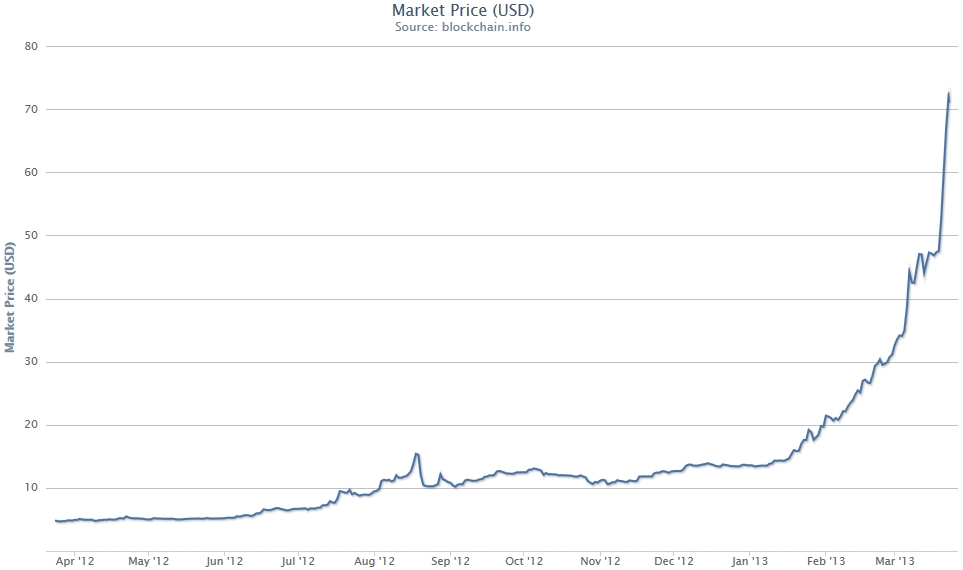
Bitcoin. Up 1,439,900% since inception and up 84% since the European Government attempting to steal investors savings in Cyprus!
Wow, you think. Better at least find out how it works.How hard it is to open an account (easy), whether its a good investment and how much would I have to risk (US$72 last thursday, up 84% from just two weeks ago on news of the Cyprus bailout ) and perhaps buy one just in case it is.
If you want to watch how Bitcoin works, click on the video below. Otherwise keep on reading underneath the video.
After it was noticed that Spaniards are opening accounts in a flurry after the European Union attempted to steal investors money in Cyprus, this video below was posted on Bloomberg’s “Market Makers” March 21. In it the guests explain what’s happening, what Bitcoin is, and how it is used:
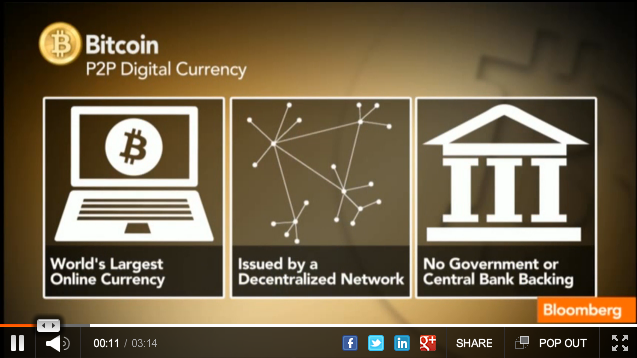
All around the world governments and central banks are expanding the current debt bubble. As a result, the global banking system failures and massive dilution to money are brining light to new forms of wealth protection. The following is an excerpt all about Bitcoin and Gold from Equedia’s full article The New Currency Movement. You will find more full articles of all different views from other authors also below this:
Bitcoin: The World’s Largest Online Currency
Bitcoin, an open-source software code founded in 2009, is a complex and anonymous type of electronic currency that can be swapped for local currencies like dollars, yen and euros.
Users create accounts and use their local cash to buy Bitcoins, at a rate that fluctuates with the supply and demand of the market — just like any other currency. The Bitcoins can be stored in an online wallet, used to make purchases and converted back into local currencies.
The beauty of Bitcoin is that — unlike most currencies that are controlled by central bankers — Bitcoin is highly decentralized with the number of Bitcoins in circulation expanding at a predictable and limited rate. Bitcoin also notes that its accounts cannot be seized by local authorities. ( that last bolding and underlining via Money Talks editor, all other bolding by Equedia)
If you think that Bitcoin is simply just a novel idea, think again.
The Strongest Currency: Up 1,439,900%
Nearly two years ago, Bruce Wagner, organizer of New York’s Bitcoin developer’s meet-up, told Forbes that, “Someday (Bitcoin) will probably have the Fed scrambling…They still don’t know what Twitter is. By the time they figure this out, it will have already taken hold.”
On Thursday, the value of one Bitcoin hit an all-time high of US$72, up 84% from just two weeks ago on news of the Cyprus bailout. That means there is over US$800 million worth of Bitcoin in circulation. It also means that since Bitcoin was introduced, the value of a Bitcoin has gone up 1,439,900%.
Bruce Wagner was right. Not only has the value of a Bitcoin increased exponentially, the Fed is beginning to scramble. Virtual currencies have garnered so much attention that even regulators are now taking notice as earlier this week the Treasury Department said it is applying money-laundering rules to so-called virtual currencies.
They say virtual currencies such as Bitcoins could become a haven for criminal activity. An FBI report last year revealed that at least one online service accepts Bitcoins in exchange for illegal drugs. I guess no one buys drugs with dollars anymore…
The recent media explosion of virtual currencies such as Bitcoin brings to light that people around the world are truly beginning to lose faith in central bank controlled paper money. When you have money that can be printed from thin air, stored in government controlled banking systems that can impose bailout taxes on your savings, it would be stupid not to look for alternative ways to protect your savings and wealth.
I am not writing about Bitcoin because I am promoting it. As a matter of fact, I don’t. I still don’t trust my wealth and security to open-source software codes or virtual currencies – even if they return me 1,439,900%. Perhaps if I had invested some dollars in Bitcoin years ago, I may be singing a different tune. However, Bitcoin already glitched earlier this month which caused the currency’s value to briefly plummet 23% before recovering.
Do you know what alternative currency doesn’t glitch and is being hoarded by central banks around the world?
Gold Hoarding Intensifies
With the recent media frenzy surrounding Cyprus, Bernanke’s announcement of continued QE, and Japan’s upcoming massive stimulus increases, gold’s value should only rise.
As I mentioned in “The Coming Shockwave,” countries around the world engaged in the race to devalue have been big purchasers of gold because they know they need to protect themselves from their own currency.
In January, I talked about Germany requesting their gold back from the U.S and France. Now it seems the Swiss want to do the same.
According to Swissinfo:
“A right-wing group has submitted more than 106,000 signatures to the federal authorities, seeking a vote on stopping the sale of gold reserves held by the Swiss National Bank (SNB). It also wants gold bars stored in the US to be returned.
The group, led by members of the Swiss People’s Party, the far-right Swiss Democrats and the Lega dei Ticinesi movement, is confident a nationwide vote will be called on the issue once the signatures are verified. A date still has to be set by the government.
People’s Party parliamentarian Luzi Stamm criticised the sale of gold reserves which started 13 years ago following a decision to abandon the gold standard.
“Gold reserves guarantee the stability of the Swiss franc. They ensure that that private savings, salaries, pension keep their value,” Stamm said. He warned gold must not be the object of speculation for the SNB or for politicians.
The initiative also seeks to enshrine in the constitution a clause obliging the central bank to keep a minimum of 20 per cent of its assets in gold, twice the current level. Promoters say higher gold reserves will boost the SNB’s credibility. In addition, they want to force the government to disclose where the gold reserves are stored.
An important part of the reserves are kept in the United States, according to People’s Party parliamentarian Lukas Reimann. He doubts whether the heavily indebted country can be trusted with the Swiss gold.
“It is only in safe hands if it is kept in Switzerland,” he told journalists.”
Back on June 2011, in my Letter, “The Greatest War in History,” I mentioned that many US states were beginning to introduce precious metals as legal tender.Now it appears that some states also want their gold back.
Texas Rep. Giovanni Capriglione now has a bill in play that would move the state’s gold from New York to a depository within the state of Texas itself. Via the Texas Tribune:
“Freshman Rep. Giovanni Capriglione, R-Southlake, is carrying a bill that would establish the Texas Bullion Depository, a secure state-based bank to house $1 billion worth of gold bars owned by the University of Texas Investment Management Company, or UTIMCO, and currently stored by the Federal Reserve.
“…We’re trying to figure out the right amount of gold to have here in Texas,” Capriglione said. “We don’t want just the certificates. We want our gold. And if you’re the state of Texas, you should be able to get your gold.”
Meanwhile, Argentines are buying more gold than ever to protect their savings from the fastest inflation in the Western Hemisphere.
According to Bloomberg, Banco de la Ciudad de Buenos Aires, Argentina’s only bank offering gold bullion coins and bars to investors and savers is negotiating with mining companies to purchase gold direct because there is so much demand.
It’s estimated that prices in Argentina are rising 26 percent a year and Argentines are using gold to protect their wealth because buying the buying of US dollar has been banned since last year.
One Argentine, as Bloomberg reported, bought gold a year ago and is already up nearly half as a result of a devaluing Argentine peso.
So while the world watches the paper market of gold being manipulated, the physical world continues to explode.
It’s catch up time.
End Notes
Ivan Lo
Equedia Weekly. Questions? Call Us Toll Free: 1-888-EQUEDIA (378-3342)
More Bitcoin Articles:
Canadian house first on sale for Bitcoin currency
Jittery Spaniards Seek Safety in Bitcoins – Businessweek
Sorry, Bitcoin Isn’t a ‘Currency’
Why Bitcoins Are Just Like Gold
….so much more at this google search HERE

-
I know Mike is a very solid investor and respect his opinions very much. So if he says pay attention to this or that - I will.
~ Dale G.
-
I've started managing my own investments so view Michael's site as a one-stop shop from which to get information and perspectives.
~ Dave E.
-
Michael offers easy reading, honest, common sense information that anyone can use in a practical manner.
~ der_al.
-
A sane voice in a scrambled investment world.
~ Ed R.
Inside Edge Pro Contributors

Greg Weldon

Josef Schachter

Tyler Bollhorn

Ryan Irvine

Paul Beattie

Martin Straith

Patrick Ceresna

Mark Leibovit

James Thorne

Victor Adair