Timing & trends

Investors unsure of which way to turn in this market need only watch the “smart money,” says Jeb Handwerger, the editor and publisher of GoldStockTrades.com.Billionaires like John Paulson and Carlos Slim are plucking up mining investments on the cheap. In this interview with The Gold Report, Handwerger shares his favorite discount buys.

COMPANIES MENTIONED : BARRICK GOLD CORP. :COMSTOCK MINING INC. : EDGEWATER EXPLORATION LTD. : INTERNATIONAL TOWER HILL MINES LTD. : LION ONE METALS LTD. : MAG SILVER CORP. : MIRANDA GOLD CORP. : NEVADA SUNRISE GOLD CORP. : NOVAGOLD : NULEGACY GOLD CORP. : PARAMOUNT GOLD AND SILVER CORP. :PILOT GOLD INC. : PLATINUM GROUP METALS LTD. :PROPHECY PLATINUM CORP.
 

The Gold Report: Gold recently witnessed some upside price support after the Cypriot parliament proposed taking money from private bank accounts to raise the €5.8 billion needed to qualify for an international bailout. What was your first reaction to that news?

Jeb Handwerger: Any confiscation of bank accounts would just highlight what I have been saying for a long time—savers are losing money in their banks. Bank deposits are supposed to be a safe haven. Investors are going to seek out alternative hedges against the deterioration of currency and financial repression worldwide. This isn’t just happening in Cyprus, but all over the world where there are citizens losing money in their banks and are experiencing negative real rates. Investors need to look for the assets that will protect and grow their wealth in case public policies continue to destroy wealth and savings.

TGR: How does this differ from what happened in Greece?

JH: This takes bailouts to a new level. The debt crisis still continues. The Swiss said they are devaluing the franc to keep pace with the euro. The Japanese are printing yen like crazy. Savings are already being stolen to bail out the banks. It has happened in the U.S. since 2008.

Precious metals are ripe to breakout. This is the environment where investors can get in ahead of the storms. We’re seeing little waves, but they’ll build up. It’s like a coiling spring. There could be a breakout, panic move into precious metals and the mining equities as investors rotate from the overbought equity market into the undervalued precious metals and the even cheaper gold and silver miners.

TGR: If that is the case, why didn’t we see a bigger run on gold when the news of Cyprus broke?

JH: In Cyprus there is panic because it tried to confiscate money outright, but the U.S. and Europe have been subtler about it.

What’s going on with precious metals is also hidden. Right now, precious metals are out of favor and mining equities are oversold. Investors believe dividend-paying stocks are a safe haven.

This also happened in the 1990s before precious metals and mining stocks broke out. They pushed the dividend stocks up to a premium, and dividends became smaller and smaller. Eventually, investors realized that dividends weren’t such a safe haven because they weren’t able to beat inflation.

From 2000 to 2007, there was a massive move into the mining equities and commodities that was set up in the 1990s when dividend stocks were a craze.

Capital will eventually seek out the traditional safe havens, which are precious metals and mining equities, as it has done in the past. Because this sector has been hit hard in 2011–2013, the subsequent rally should be quite impressive.

TGR: Can other citizens of the world expect treatment similar to Cyprus when their governments are short on cash?

JH: They should not only expect it—they’re experiencing it right now. Inflation is greater than what governments are saving. There’s disruption of capital and wealth as we speak in many countries, including the U.S., most of Europe, Japan and in the Swiss franc. It might not be front and center, but people better start wising up to it and preparing themselves. Once the public realizes this, once inflation starts rearing its ugly head, it will be too late to get in.

To paraphrase Gerald Loeb, who wrote “The Battle for Investment Survival,” the worst way to fight inflation is to buy assets at an inflated price. Mine equities are at historic discounted valuations compared to the overall equity markets. The long-term trend for inflation is that it will move higher. This is a significant discount for investors who want to prepare and be hedged against inflation with assets that are trading at deflated prices.

TRG: Is the euro doomed?

JH: What currency isn’t? What currency will still be in use in several hundred years? None. The only thing that lasts is gold, silver and precious metals.

TGR: The S&P/TSX Global Gold Index has lost about one-third of its value in the past two years. Things are far from rosy.

JH: Investors must realize that a poor performer last year might be the best performer this year. I believe gold is undervalued. It could definitely breakout this year and going into 2014.

TGR: In a recent commentary on GoldStockTrades.com you wrote, “Stick to the long term and don’t get shaken out of core positions as the smart money will turn around and buy these junior assets graciously from you.” I think everyone wants to believe that, but give us a reason why we should.

JH: Major billionaires are taking positions. Billionaire Carlos Slim recently bought AuRico Gold Inc.’s (AUQ:TSX; AUQ:NYSE) gold assets in Mexico; John Paulson has large gold holdings. The smart money has a long-term approach and understands how to protect wealth by buying undervalued assets that have the ability to provide leverage to a rising gold price and inflation. The smart money is positioning and protecting itself ahead of the storm.

TGR: The smart money is looking to undervalued junior miners that should survive this downturn?

JH: Investors don’t think that the junior mining companies are going to survive. But they can pick up assets and create value during these difficult economic times if they start paying attention to the companies that can actually grow. Investors have already thrown out some advanced assets, some that are already permitted—that’s worth a lot! Yet investors have this attitude that the junior miners are going to go bankrupt. Some of these companies are priced at liquidation levels, but are quality assets, with good management teams in friendly jurisdictions. With strong shareholder support, they are going to survive. They are going to retain value.

TGR: Juniors need cash to survive. What’s the minimum they need to survive the limited financing environment that exists right now?

JH: It depends on the company and the burn rate. Every asset is different. If a company doesn’t have cash, is its asset worth something? It could be a candidate for an acquisition. There’s very limited downside risk if there’s an asset or cash backing the company. The investor just has to hold on and wait until the markets turn.

TRG: Let’s talk about some of those companies. What companies fit those criteria?

JH: International Tower Hill Mines Ltd. (ITH:TSX; THM:NYSE.MKT) has a dream team of miners and executives. A vice president helped build the Fort Knox mine, which has been a huge moneymaker for Kinross Gold Corp. (KGC:NYSE) for years in Alaska. The company is progressing the Livengood gold deposit, a very large deposit of more than 20 million ounces (20 Moz) located in a mining-friendly area near Fairbanks, Alaska, to bankable feasibility this year.

These are the types of assets that can produce more than 500,000 ounces (500 Koz) gold and provide impressive leverage, profits and earnings for investors. That’s especially true if the gold price rises, which we think will happen later in 2013.

TGR: Other promising gold projects in Alaska have faced some opposition. Does this project have to overcome that hurdle?

JH: It’s in a mining-friendly area near the Fort Knox mine. It has personnel experienced in Alaska who have permitted the Pogo and other major mines. Infrastructure is also very accessible. It’s off the highway, the Trans-Alaska Pipeline System is nearby and the topography is relatively flat. If there were a checklist of attributes for the next major gold producing deposit in Alaska, International Tower would have all the boxes checked.

TGR: Is there another company that you’re interested in?

JH: Pilot Gold Inc. (PLG:TSX) is well cashed up. I am particularly excited about the company’s work at Kinsley Mountain where it is partnered with Nevada Sunrise Gold Corp. (NEV:TSX.V). The companies are exploring the Kinsley Mountain deposit in Nevada, which is a very exciting discovery south of the Long Canyon property. It looks as if there’s some potential for Kinsley Mountain to be the next major Nevada discovery, similar to Long Canyon.

I also like Comstock Mining Inc. (LODE:NYSE.MKT), which is a new Nevada producer that is expected to mine 20 Koz gold this year. Very few miners have the cash flow from production to sustain low-cost growth. Comstock Mining may have that ability to continue to grow resources at a low cost with cash flow from producing properties.

TGR: The Pilot Gold project that’s getting the most attention right now is TV Tower in Turkey. The company just finished its first drill program on the KCD zone. It seems to be yielding consistent, solid grades in continuity.

JH: Pilot is having a lot of success in Turkey. On top of that success, I believe it will also advance its Nevada Kinsley Mountain project as well. TV Tower has been the main driver, but I keep a close eye on Kinsley Mountain because I like Nevada Sunrise and the Pilot technical team there.

TGR: What else should investors be paying attention to in the gold space?

JH: We really like Nevada and the Cortez Trend, where Barrick Gold Corp. (ABX:TSX; ABX:NYSE) has made a huge discovery at its Goldstrike deposit. Miranda Gold Corp. (MAD:TSX.V) and NuLegacy Gold Corp. (NUG:TSX.V) are right next to Barrick’s discovery. NuLegacy is working with Renaissance Gold Inc. (REN:TSX.V) on the Wood Hills project, which is near the Long Canyon discovery.

TGR: Not many people have heard of NuLegacy. What’s the narrative there?

JH: Dr. Roger Steininger, the chief operating officer of NuLegacy, has more than 40 years of experience exploring Nevada. He’s credited with the 21 Moz Barrick Pipeline mine in the Cortez Trend. NuLegacy has a partnership with Barrick to explore Red Hill in one of the most exciting areas in the Cortez Trend.

There’s been more than 52 Moz gold discovered in the Cortez. Barrick’s major property, Goldrush, has expanded from 2 Moz to 14 Moz in four years. People are concerned, “Oh, will NuLegacy be able to raise capital?” Being partnered with Barrick and being next door to Goldrush on the Cortez Trend could be very attractive in an environment where Barrick is desperately looking for resource growth in a mining-friendly jurisdiction and speculation returns to the junior market.

TGR: Are there any companies that have cash?

JH: Miranda Gold raised $5 million ($5M) late last year because it was astute enough to realize that financial markets would be tough. It has more than $8M in the bank. With its experienced geological team, it could gobble up undervalued and financially strapped miners with assets. Miranda just signed a strategic alliance with Eagle Nickel Ltd. (ENL:ASX) to explore Colombia that has been completely ignored by the marketplace.

TGR: What others in Nevada are you following?

JH: Keep a close eye on Paramount Gold and Silver Corp. (PZG:NYSE.MKT; PZG:TSX). It is really undervalued and a takeover target. Paramount owns the Sleeper project in Nevada. The company announced a positive preliminary economic assessment (PEA) in July 2012 on Sleeper and it could be a major gold and silver producer in Nevada.

Also look at Paramount’s San Miguel project in Mexico surrounding Coeur d’Alene Mines Corp.’s (CDM:TSX; CDE:NYSE) Palmarejo mine. This area is hot with six new operating mines. The Palmarejo district in Mexico is gaining a lot of investor interest especially after the recent $750M acquisition of AuRico Gold Inc. by billionaire Carlos Slim.

Paramount recently released an excellent PEA on its San Miguel project, which showed impressive economics with relatively low startup costs. Because of the overall weak market, the PEA on San Miguel was ignored by investors. Paramount just announced a warrant exercise of over $8M, which should help 2013 programs to advance these projects. This company has a strong shareholder base and the financing to survive this downturn.

TGR: Are there others outside of Nevada that you’re following?

JH: Edgewater Exploration Ltd. (EDW:TSX.V) has operations in Spain. This has been a very significant year for Edgewater as the company advances the Corcoesto gold project in Spain. Its environmental impact statement was approved last year by the Spanish government. One of the reasons it is receiving so much support with permitting from the government is that the local regions are dealing with high unemployment. This could have major economic benefits for the region.

The first half of 2013 could be very significant for Edgewater as it moves closer to publishing its bankable feasibility study. It is also preparing an updated resource estimate and continues to show in-fill drilling results with higher than expected grades and longer widths.

There are very few advanced and permitted junior miners trading at a discount valuation at the bankable feasibility stage.

TGR: A November 2011 PEA on Corcoesto indicated a pre-tax internal rate of return of 34%, with a payback of about two and a half years. Do you expect the feasibility study numbers to be more or less than that?

JH: There’s always a margin for error between feasibility and PEA, but it has some very strong backing and an excellent technical team led by COO John Thomas. Edgewater also has some great financiers involved and have been able to raise capital in an extremely tight market. This testifies to the quality of the management team and project. The company has already had some tentative financial agreements with some of the banks that have been looking at it. Once it has that feasibility study and the permit, it should be on its way to production.

TGR: You were at the Prospectors and Developers Association of Canada (PDAC) conference recently and discussed platinum at length.

JH: Unlike gold, platinum is consumed in the auto industry and in other industrial applications for its properties as a catalyst. Platinum is trading at a significant discount to gold. Historically, platinum trades double to gold. It is three times rarer than gold and its supply is very unstable—more than 90% comes from South Africa, Zimbabwe and Russia. There’s been talk of resource nationalism in Zimbabwe. There’s going to be a search for new supply in stable political jurisdictions.

A platinum company I’ve been watching is Prophecy Platinum Corp. (NKL:TSX.V; PNIKF:OTCPK; P94P:FSE), which is developing the Wellgreen deposit in the Yukon. The company could be a potential supplier of platinum group metals (PGM) to North America.

TGR: Prophecy has been raising cash for a prefeasibility study. Was that accomplished?

JH: It is still in the process of completing that. However, there’s been an increased financial interest in the PGM space. Platinum miner Platinum Group Metals Ltd. (PTM:TSX; PLG:NYSE.MKT) recently raised more than $180M. Institutions are looking to invest capital into this space.

Prophecy has a proven management team that has raised hundreds of millions of dollars during difficult junior markets. The company’s recent impressive exploration success should create increased interest.

TGR: Because most PGM mines are in risky jurisdictions, how much of an advantage is it to be in the Yukon?

JH: It is very important. The Yukon government is supportive of mining, there’s infrastructure there, and there’s no geopolitical fears.

Prophecy’s deposits are world class, one of the top five in the world. Very few companies have these sorts of advanced deposits. Prophecy has a triple discount: The company is trading at a significant discount to platinun, platinum is trading at a significant discount to gold and platinum miners are trading at a significant discount to platinum. Every action has an approximate equal and opposite reaction. When the space starts heating up and capital starts flowing into this market, the platinum sector can have a very powerful turnaround and should regain its premium to gold.

TGR: Why hasn’t this story received more attention?

JH: Prophecy has a new management team, the platinum price has been underperforming, it’s not as popular an area and this sort of environment is just beginning. Investors are just beginning to realize the fragile supply and demand here.

Prophecy has a new chief executive officer, Greg Johnson, who founded NOVAGOLD (NG:TSX; NG:NYSE.MKT) and raised more than $650M in his career. It has John Sagman, who is the cold-weather mining expert. The people who have come on board believe in the asset and believe this is going to get to production.

TGR: Is there another name where management is key?

JH: Lion One Metals Ltd. (LIO:TSX.V; LOMLF:OTCQX; LY1:FSE) came down to visit in South Florida a few weeks ago. President George Young and Vice President Hamish Greig presented its story. What impressed me so much in their presentation was the experienced management team.

Lion One has the high-grade Tuvatu gold project in Fiji. There is a lot of exploration upside potential there. It’s a well-funded company. It just took over Avocet Resources Ltd. (AYE:ASX), which should bring more money into the bank and diversify it into uranium and iron ore. It is also going to bring in a very strong technical team that can help accelerate Tuvatu closer to production.

TGR: What were the key takeaways from their presentation?

JH: The management team is very strong. Young is the founder of MAG Silver Corp. (MAG:TSX; MVG:NYSE). Walter Berukoff made several companies that were acquired, including Miramar Mining Corp. Lion One has $15M. The deposit shows it has the potential to rival some of the largest in the world. This is a company that’s going to survive and thrive in a difficult market environment.

TGR: What are some parting thoughts on the “smart money”?

JH: After being in this market for some time, it still amazes me that investors get caught up with the day-to-day and lose their long-term vision. Patience is more important now than ever. There’s a season for excitement when speculation is great and investors are euphoric, and there is a season for discontent when investors are abandoning the sector and companies are thrown out.

The great investors that I’ve studied have made their money from mispriced assets. Gold miners are trading at historic low valuations. Eventually the sectors will turn. Jesse Livermore said that money is not made in the buying and selling, but in the waiting.

The opportunities I’ve seen haven’t been observed for many decades. This level of disconnect between market cap and value has never been seen. This is a great opportunity for investors who want to get in before the panic of inflation and wealth deterioration.

Jeb Handwerger, publisher and editor of GoldStockTrades.com, is syndicated internationally and known throughout the financial industry for his accurate and timely analysis of the equities markets—particularly the precious metals sector.

Related Articles


Want to read more Gold Report interviews like this? Sign up for our free e-newsletter, and you’ll learn when new articles have been published. To see a list of recent interviews with industry analysts and commentators, visit our Streetwise Interviews page.

DISCLOSURE:
1) Brian Sylvester conducted this interview for The Gold Report and provides services to The Gold Reportas an independent contractor. He or his family own shares of the following companies mentioned in this interview: None.
2) The following companies mentioned in the interview are sponsors of The Gold Report: International Tower Hill Mines Ltd., Pilot Gold Inc., Prophecy Platinum Corp., Paramount Gold and Silver Corp., Comstock Mining Inc., NOVAGOLD, Lion One Metals Ltd. and MAG Silver Corp. Streetwise Reports does not accept stock in exchange for its services or as sponsorship payment. 
3) Jeb Handwerger: I or my family own shares of the following companies mentioned in this interview: International Tower Hill Mines Ltd., Edgewater Exploration Ltd., Miranda Gold Corp. and NuLegacy Gold Corp. I personally or my family am paid by the following companies mentioned in this interview: None. My company has a financial relationship with the following companies mentioned in this interview: International Tower Hill Mines Ltd., Nevada Sunrise Gold Corp., Comstock Mining Inc., Prophecy Platinum Corp., NuLegacy Gold Corp., Paramount Gold and Silver Corp., Edgewater Exploration Ltd. and Lion One Metals Ltd. I was not paid by Streetwise Reports for participating in this interview. Comments and opinions expressed are my own comments and opinions. I had the opportunity to review the interview for accuracy as of the date of the interview and am responsible for the content of the interview. 
4) Interviews are edited for clarity. Streetwise Reports does not make editorial comments or change experts’ statements without their consent. 
5) The interview does not constitute investment advice. Each reader is encouraged to consult with his or her individual financial professional and any action a reader takes as a result of information presented here is his or her own responsibility. By opening this page, each reader accepts and agrees to Streetwise Reports’ terms of use and full legal disclaimer. 
6) From time to time, Streetwise Reports LLC and its directors, officers, employees or members of their families, as well as persons interviewed for articles and interviews on the site, may have a long or short position in securities mentioned and may make purchases and/or sales of those securities in the open market or otherwise.



Why You Can NEVER Beat The Index

The market pushed to a new high this past week, as I expected, as the continued push of liquidity from the Fed, and the ECB and BOJ, offset such silly concerns as another country going belly up and wiping out depositors. For some background (click on the link or the Chart below) read my post: “Get Ready For A Run To All Time Highs.” 

sp500-bullishtrend-022813

I have spent much of last week doing interviews on what the push to all-time highs means. In reality, for most individuals, it means very little. That is the crux of this week’s missive which is the disconnect that exists between portfolio performance and index performance.

The sad commentary is that investors continually do the wrong things emotionally by watching benchmark indexes. However, what they fail to understand is that there are many factors that affect a “market capitalization weighted index” far differently than a “dollar invested portfolio.”

These misunderstandings lead to emotional decisions to buy and sell at the wrong times; jump from one investment strategy to another as well one advisor to the next. While these actions are great forWall Street, as money in motion creates fees and commissions, it does little to solve the bulk of the problem with investor’s portfolios which is simply emotional mistakes based on unrealistic expectations.

The single biggest mistake that investors make is the fallacy of chasing a benchmark index (i.e. the S&P 500) thinking that it is something\ they must beat. But why wouldn’t they? This is what they are told day in and out by the media. It is the mantra that has been drilled into all of us by Wall Street over the last 30 years. However, what we fail to understand is that this is for Wall Street’s benefit and not our own.

I will cover several of the major reasons why you will NEVER be able to beat the S&P 500 index over long periods of time. It is simply a function of the math.

>> Read More. Download This Weeks Issue Here.

Notes on Rebalancing: Chinese Consumer Demand & The Shale Gas Revolution

We continue to believe that the world is still in need of major rebalancing. 

Global policymakers have faced an onslaught of crises or crisis potential. As such, despite what seems to be happening (a slow market-led rebalancing), they continue to revert to policies that have driven growth (and imbalances) in the past. 

A true rebalancing will bring economic pain, for sure. But the ongoing resistance we’re seeing will only mean the pain is deeper and lasts longer whenever it comes.

Of course, China is a big part of the rebalancing puzzle. And they’ve acknowledged their need to rebalance their economy. They’ve even taken concrete steps to insure they pull back from the growth path that leads to an overheated economy and an inevitable collapse.

Measures to increase the number of transactions in their own currency, the yuan, are encouraging. The greater the use of the yuan in global trade the more open it must become and the better the market can dictate its value. 

We consider currencies to be the pressure valves of economies that serve to rebalance respective economies as needed. A system with an explicitly managed currency (e.g. China) or implicitly managed currency (e.g. US) cannot be good in the long-run.

rebalance your 401k portfolio investmentsBut certainly there are risks to China even as it embraces some pieces of rebalancing.

Many analysts and researchers note the demographic hurdle. As much as China is urging its population, directly and indirectly, to become more urban, the needed and expected shift cannot be forced. Consider the real estate market, for example …

The inventory of housing is in place now, but most of China’s rural class and commuting class cannot afford to live there. A significant drop in price is needed to help this along. But with a significant drop in price comes a drop in wealth for those investors who’ve bought into the housing developments and the real estate market in general. 

When you see a system-wide erosion in wealth you often see contagion in credit markets. China’s shadow-banking system (i.e. unconventional loans and wealth management products) has expanded amidst the last couple years of stop-and-go lending policies passed down by the government and the PBoC in response to inflationary pressures. When the value of assets drops and borrowers begin to default, the rest of the dominoes become more vulnerable.

In China’s commie-capitalist economy, the leaders maintain their grip on the economic reins. But not only do they claim credit for the good, they must also deal with the bad and the ugly. 

Rebalancing will require reforms that hand over greater control to Chinese households and consumers. This means the policies that brought years of double-digit growth must be sacrificed to some extent. This is why the task of rebalancing China is oh so delicate — necessary reforms equal lower growth, but lower growth equals socio-economic tensions. Unfortunately, the tension will come a lot more quickly than the benefits of reform.

There is a reason I dug into this today — I came across two articles this morning …

The first simply notes some recent improvement in Chinese consumer demand and factory orders. Here is Reuters’ takeaway from the numbers that were reported:

Stronger domestic demand helped China’s factory activity to rebound in March, with… new orders up sharply in a sign that the underlying economic recovery is strong enough to weather any risks from patchy export performance .

This is certainly a welcomed development amid ongoing Eurozone woes that have kept China’s best export customers at bay. But is it enough to keep the economy going if Europe triggers a quake in financial markets?

The second article I came across this morning represents a bigger story that attempts to look further into the future of China’s factories. More specifically, the US shale gas revolution is likely to facilitate some rebalancing in China as it reduces the costs of producing goods in the US. This is certainly a long-term data point, but it gives merit to that arguement that “Made in the USA” will make a comeback.

Here is a key piece of the Reuters’ column titled, “Will shale gas decimate China’s toy makers?“:

The advent of cheap natural gas in the U.S. is threatening to displace expensive naphtha in the production of petrochemicals, the key building blocks for plastics, synthetic fibres and solvents and cleaners.

There was a story in The Atlantic earlier this year that talked about GE bringing factories back to the US. The simple reason is that it makes more sense to have a better grip on all stages of production and supply chain management. Consider also the fact that Chinese wages and transportation costs have risen.

And then recently I saw comments from the CEO of a major US company who said the cost of labor is not the primary reason for taking a company offshore; the regulatory and tax environment are the main reasons. If the US government finds ways of lessening this burden, and the shale gas revolution lives up to the hype, America could quickly see a manufacturing renaissance that changes global trade dynamics quite drastically.

-JR Crooks

Thousands Want My Head Again!

For remaining short-term bearish on gold and silver. The mail continues to pour in! Hundreds, if not thousands of readers want my head? yet again?

I have never, and I mean NEVER, seen such an outpouring of emotions!

But truth be told, the level of emotions that are now running so high against anyone who dares to say that gold, silver, other metals, and commodities should fall in the short term is one large reason precisely why they probably will decline.

For one thing, bullish sentiment in the precious metals is still too high. That means those who have already bought have largely bought. And those who haven’t can only see one direction for the precious metals, UP.

That alone is a negative for the precious metals. When the majority expect a market to go in a particular direction, they are almost always wrong. That’s the ironic nature of crowd psychology and behavior.

For another, when any decent selling does hit gold and silver, when something frightens the herd, guess what will happen?

It will turn on a dime, start selling en masse, leading to a sharp decline.

Don’t get me wrong. As I’ve said many times, I am very, very bullish on the precious metals on a long-term basis. Ditto for most commodities.

Screen shot 2013-04-01 at 8.53.51 AMBut the only way commodities in general are going to fulfill their long-term price targets is if they wring out some of the short-term excess that has flooded these markets. And they clean out all the weak longs and the majority of bulls.

By doing that, new energy, new buyers can come back into the markets and take them much higher.

Readers Ask and

I Answer

With emotions running so high, and with so many events and fundamental forces arguing for higher prices, I know all of this is very hard to understand and grasp.

So today, I’m going to publish some recent emails I’ve received and my replies. Let’s get started …

One reader writes in: “Larry, you’re bearish gold and silver in the midst of the Cyprus event? Have you lost your mind?”

My reply: No, I haven’t lost my mind. Quite the contrary, it seems like the majority of investors have.

The most telling action is always to be found in the markets themselves. Given all the massive money-printing going on in the world now and the confiscation of depositor money in Cyprus, setting a precedent for the Troika in Europe to use that tactic in other situations, you’d think gold should already be at record new highs! But it’s not!

Instead, gold hardly reacted to the upside on the Cyprus news and silver actually declined. Why?

Because most investors just want cash right now. Period.

Look, I love gold just as much as anyone does. It is a great long-term store of value.

But I can’t go to the gas station and fill up my tank and pay for it in gold. I can’t pay for my haircut in gold. I can’t go grocery shopping and pay in gold. I can’t buy diapers for my two-year old son with gold.

Nor can I invest too much money in gold because it doesn’t pay me one red cent of interest.

So right now, investors of all sizes are opting more for cash than just about anything else. By default that is pushing the U.S. dollar higher. That is bearish for the precious metals.

Another reader writes in: “When the heck are you going to give your buy signal for gold, Larry?”

My answer: When one of two things happens …

A. Gold falls to $1,384 by August, or …

B. Gold rallies and closes above $1,760 on a Friday-closing basis.

Those are the latest signals on my models. In between $1,384 and $1,760 gold is in a neutral trading range. And as long as gold remains under $1,655.80, the bias will be to the downside and a test of $1,384 remains a high probability.

So you see, gold can bounce up to the $1,656 level and it still remains bearish short-term. Moreover, it would have to rally a full $160 to enter a new bull leg to the upside.

Now, I can hear even more questions: “If gold were to rally and close above $1,760 you will turn bullish, yet you will have missed a huge move!”

My reply: Then so be it. I don’t really care. What matters is buying when it’s safe to buy. And given that gold long-term is heading to more than $5,000 an ounce, I’m not concerned if I miss a $160 move to make sure I’m buying a confirmed bull market and not some giant bear market rally.

Another reader writes in: “You seem more bullish on equities and real estate than on gold or silver or any other commodity for that matter. What gives?!”

My reply: You are correct! I am more bullish on U.S. equity markets and real estate than I am on commodities right now. The reasons are simple …

First, on an inflation-adjusted basis, U.S. equities and real estate prices are cheap.

Second, on an international basis, U.S. equities and real estate prices are cheap.

Third, from an income perspective, U.S. equities and real estate can provide far more income than precious metals, which offer no income.

Fourth, due to Cyprus, we are entering a new period of insecurity in the monetary system. Cyprus has proven that European authorities and the Troika will confiscate bank depositors’ money.

It was the absolute worst decision that could have been made. Now, investors everywhere, small and large, are going to be highly suspicious of bank deposits.

And although I do not think it will ever happen, investors are now starting to also worry that their gold and silver can be confiscated.

So then, what do you do with your money? This is what’s going to happen …

Investors are going to start looking at equities not just for the potential income they spin off, but also because they believe governments will not move to confiscate your share holdings. That would be outright nationalization of companies. And it’s not likely to happen in the West, in Europe or the United States.

After all, can you imagine Europe or Washington saying they’re going to take away your shares in Dow Chemical, or Microsoft, or Apple or Johnson & Johnson, or McDonald’s?

Or Sanofi-Aventis, or Siemens, or Vodafone or Nestlé?

If they even tried, there would be a mass exodus of companies from Europe or the United States, sending them scurrying for new corporate homes, most likely in Asia.

Next on the list is real estate. Though certainly not as liquid as stocks or even precious metals, real estate is now also going to become a safe haven for capital.

Hundreds of billions of dollars are now going to leave Europe in droves and head for our shores, buying up real estate like crazy. And to Asia.

It will be very bullish for property prices. And it will be driven by geo-political concerns and fears of money confiscation in Europe and nothing else.

In short, and I urge you to commit this to your memory: Real estate and stocks are becoming the alternatives to bank deposits.

They offer income, a return on investment, and safety from confiscation.

Later, when the sovereign debt crisis fully infects Washington ? and the dollar resumes its long-term bear market ? you will be able to place gold and silver back into the mix of investments that investors will actively seek out.

But the crisis is not hitting Washington in full just yet. So yes, I do expect real estate and U.S. equities to outperform gold and silver in the intermediate-term.

Again, I know these are difficult concepts to understand, and completely unconventional. But if you are to financially survive what is happening, you cannot think conventionally.

You must question everything, and you must do so from many perspectives, putting yourself in the shoes of a European, an Asian, a corporate treasurer, and more.

If you do that, you will see the real forces at work today and you will not be blind-sided by what’s happening.

Further, you will realize that most advice you get is just plain brain dead, because it comes from analysts who can’t see past their own noses, who can’t think internationally and unconventionally.

Best wishes, as always …

Larry

Swing Trading Daily

The Bottom Line: “When to take profits”

Upside potential by North American equity markets into April remains, but many seasonal trades also expire around mid-April. Retention of existing seasonal trades makes sense. However, new seasonal opportunities coming into April are relatively sparse (An exception is the Technology sector). In most cases with seasonal trades, the question is “When to take profits”?

Silver fell $0.38 per ounce (1.32%) last week. Intermediate trend remains down. Support is at $27.92 and Resistance is at $29.35. Silver remains below its 20, 50 and 200 day moving averages. Strength relative to Gold remains negative. Short term momentum indicators are neutral.

clip image032 thumb4

Gold slipped $10.40 per ounce (0.65%) last week. Intermediate trend is down. Resistance is at $1,619.70. Gold remains above its 20 day moving average and below its 50 and 200 day moving averages. Strength relative to the S&P 500 Index remains negative, but shows early signs of change. Short term momentum indicators are neutral.

clip image030 thumb4

The AMEX Gold Bug Index slipped 2.71 points (0.75%) last week. Short term trend is up. The Index remains above its 20 day moving averages. Strength relative to Gold remains neutral. Short term momentum indicators are neutral.

clip image031 thumb3

The S&P 500 Index gained 12.30 points (0.79%) last week to close at an all-time closing high. Intermediate trend remains up. The Index remains above its 20, 50 and 200 day moving averages. Short term momentum indicators remain overbought.

clip image001 thumb13

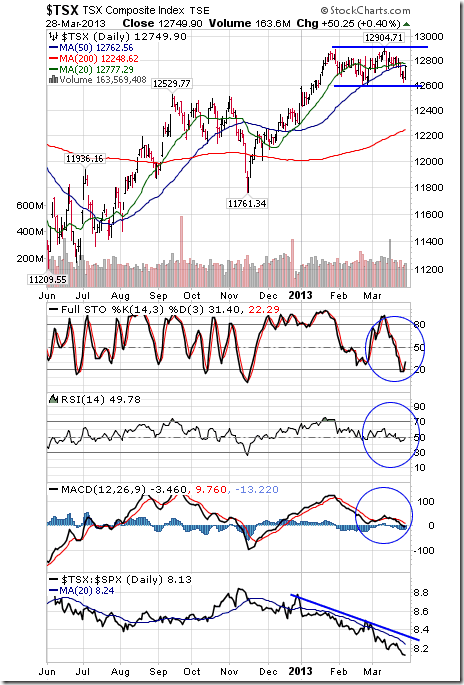
The TSX Composite Index eased 7.46 points (0.06%) last week. Intermediate trend remains up. Support is at 12,602.54 and resistance is at 12,904.71. The Index remains below its 20 day moving average and fell below its 50 day moving average. Strength relative to the S&P 500 Index remains negative. Short term momentum indicators are trending down.

clip image006 thumb12

Crude Oil gained $3.52 per barrel (3.77%) last week. Intermediate trend remains down, but will change to up on a move above $98.24. Crude remains above 20 and 200 day moving averages and moved above its 50 day moving average. Strength relative to the S&P 500 Index changed from neutral to positive. Short term momentum indicators continue to trend up.

clip image026 thumb4

….much more commentary and 40 more Charts HERE

test-php-789