Gold & Precious Metals

The Yin & Yang of Gold……


larry-edelsonOver the past week or so, gold cracked through support at the $1,583 level, then bounced back up, and then plunged anew.

Now, gold is dangerously close to giving a MAJOR sell signal. Once it closes below the $1,527 level — you can kiss gold goodbye. It will plunge to $1,380 an ounce — and possibly lower.

Ditto for silver. Once it closes below $26.40 — kiss it goodbye too. It will fall to at least $20.47 — and probably lower.

Why do I keep harping on gold and silver in this column? Because I know there are scores and scores of investors who are getting bad advice that will result in terrible losses.

Look, gold IS the ultimate store of value. That is true. And someday, gold will head north of $5,000 an ounce.

But if you want to avoid losing money in the precious metals market and instead make the most amount of money you can, you simply must get your timing right.

 Just as important, you must have an open mind when investing in gold and silver. You can’t get married to your metal (or any investment for that matter) — as if investing in precious metals was some sort of religion.

For instance, you have to realize that sometimes gold is money … and sometimes it’s not.

Right now, gold is not money. Just consider what’s happening in Japan. The wicked and aggressive devaluation of the Japanese yen is setting off a massive stampede OUT of gold and into cash and other assets.

If you don’t believe me, then read this recent article in The Wall Street Journal.

Why are the Japanese dumping gold, especially when their currency is being devalued?

It’s simple. The fall in the Japanese yen caused the price of gold in yen to spike sharply higher. So Japanese investors are cashing in their profits.

In addition, Japanese investors want to either spend their gold proceeds, or move it into other assets. They need liquidity. And holding on to gold is not a liquid situation.

It’s very easy to understand. This sort of thing is also happening in Europe, where gold demand is also down.

Why? Because if you have money in a bank, Cyprus has proven that European leaders will stop at nothing to try to solve Europe’s crisis, even if it means confiscating your money from your bank.

Gold’s not going to do you much good in that situation. If you take your money out of the bank and buy gold, how are you going to pay for the basic necessities in life?

Moreover, how are you going to move your gold out of the country, if that’s what you wish to do (which many Europeans are indeed doing)?

Moving physical gold around isn’t so easy either. It takes time and money to move your gold. And even then, you won’t know how safe it is, because in the back of your mind there’s always that fear that your gold could be confiscated.

The bottom line: While gold is indeed the ultimate long-term store of value against depreciating currencies and failing governments, there are times when forces that are seemingly bullish for gold are actually bearish.

I call it the yin and yang of gold, and for that matter, all markets. There are always two sides to a coin, two sides to a market, two sides to every piece of fundamental news out there.

Knowing which side is prevailing, why and when — are the keys to successful investing. That requires an open mind, no biases, and lots of experience with technical and cyclical analysis.

If this sounds a bit too theoretical or complex in any way, I assure you it’s not.

All you have to do is put yourself in the shoes of a Japanese investor who owns gold. The price of gold is spiking higher. Meanwhile, you know you have to get your money out of the yen because the yen’s only going to be further devalued.

You’re also frightened that North Korea’s crackpot leader, Kim Jong-un, may soon drop a bomb on Tokyo.

So you know you need cash, lots of it. Simple decision: Take advantage of the yen’s spike higher in gold, dump your gold and get liquid with cash.

Then, either pay some bills (before the yen becomes worth even less) … or get your money out of yen and into another country with a currency that’s at least losing value less quickly.

Or even better, into an investment that has a decent return, decent profit potential, and in a country and a currency in better shape than Japan’s.

Demand Falling in Europe, Too

Now put yourself in the shoes of an investor in Europe. You now know that European leaders may confiscate money from your bank account. You also are pretty much convinced that the euro is destined to fail.

Therefore you need to move your cash out of the European banking system. To do that, you have to sell your gold for U.S. dollars, and move your money, most likely to either Asia or the U.S.

I think it’s pretty easy to understand.

Later, in the not-too-distant future, the same fears of confiscation of wealth and further devaluation will hit the United States. And at that time you’ll need to move your money yet again.

There won’t be many safe-havens left at that point. So you’ll probably want to go back into gold. The new bull market in gold will then begin.

So you see, none of this is all that hard to understand provided you keep an open mind, question the conventional, and think independently.

You’ll be surprised how doing that can turn you into a successful investor.

I repeat my warnings of last week …

 Do NOT look to gold and silver for safety right nowDitto for mining shares.

 If you are loaded up with gold, silver, or mining shares and don’t want to sell, for whatever reason, then at least consider hedging.

My favorite vehicles for hedging are the ProShares UltraShort Gold (GLL) and the ProShares UltraShort Silver (ZSL). For mining shares, I suggest the Direxion Daily Gold Miners Bear 3x Shares (DUST).

 Stay mostly in the dollar now. The greenback is in an intermediate-term bull market as the euro is at the beginning of its end, and the Japanese yen is going to be aggressively devalued.

Consider purchasing the PowerShares DB US Dollar Index Bullish Fund (UUP) for a speculative long dollar play.

 Don’t be afraid to buy U.S. stocks. Though a pullback is overdue, the U.S. equity markets are very strong.

Just keep in mind that the new bull market in stocks really has nothing to do with corporate earnings or the economy. The strength in our equity markets is largely due to capital flight out of Europe and Japan, and out of European and U.S. sovereign bond markets.

Best wishes, as always …

Larry


Related posts: Important Update On Gold and Silver!


500 Ton Takedown

shapeimage 22

Whistleblower Andrew Maguire told King World News that more than a stunning 500 tons of paper gold was sold in friday’s takedown in the gold market.  Maguire also spoke to KWN about the staggering Chinese physical gold purchases.  Read what Maguire had to say in this remarkable and exclusive interview HERE


Signs Of The Times

Rationalization for reckless behaviour continues:

“Because stronger growth in each economy confers beneficial spillovers to trading to trading, [easy money] policies are not ‘beggar-they-neighbor’ but rather…’enrich-thy-neighbor’ actions.” – AP, March 25

That was Bernanke and it reminds of the big deal in the equity markets in the late 1960s. That was during the “Conglomerate” mania that celebrated the discovery that “two plus two equals five”. Deflated by the CPI, the real high for the stock market was set in 1966 and the decline amounted to 62% at the bottom in 1982. The portfolio rationalization was that institutions were very underweight in equities and the buying would go on “forever”. What’s more, with a greater presence in equities fund managers would provide stability to the stock markets. The tout was that there would be a “shortage of equities”.

Sounds like today’s central bankers buying bonds.

“Two regional Federal Reserve presidents said the central bank isn’t doing enough to spur economic growth…should keep buying bonds through the end of 2013.” – Bloomberg, March 27

The latter statement is so arbitrary. One notion is about the amount of bond buying, the other about how long it should continue. Despite the ambition of arbitrary authority to keep each of the series of bubbles going, Mother Nature and Mister Market have a way of looking after speculative excesses.

“Cyprus is the main source of foreign direct investment into Ukraine.” – Bloomberg, March 28 

Then there are the consequences of reckless behaviour by governments:

“The global pool of government bonds with triple A status, the bedrock of the financial system has shrunk 60% since the financial crisis triggered a wave of dangerous downgrades across the advanced economies. The expulsion of the U.S., the UK and France from the nine “A”s club [goes along with] the amount of “A” bonds outstanding dropping from $11 trillion to just $4 trillion now.” – Financial Times, March 26

                                                                                Perspective

The problem with central banking is that there are no longer any bankers in central banking. Too many economists, particularly of the interventionist kind. The latter spend their time and taxpayers earnings in trying to alter economic history, rather than understanding it. The most glaring error is the notion of a “national” economy. When it comes to credit markets, they have been international since at least Roman Times when Cicero observed:

“If some lose their whole fortunes, they will drag many more down with them. . . believe me that the whole system of credit and finance which is carried on here at Rome in the Forum, is inextricably bound up with the revenues of the Asiatic province. If those revenues are destroyed, our whole system of credit will come down with a crash.” – Cicero, 66 B.C. (Translation by W.W. Fowler, 1909) 

Another blunder is more subtle and that is the error in logic called a “primitive syllogism”. This insists that because two things occur at the same time they are causally related. Yes, credit does increase with a business expansion and vice versa. But credit expansion does not cause the business boom. Actually, in the final stages of a boom speculators leverage up against soaring prices. In which times, credit expansion depends upon the boom.

How could so many for so long be so wrong?

Central bankers get wages and glory for their attempt to provide unlimited funding for another sordid experiment in unlimited government.

The problem is that even with electronic printing presses and endless buying of lowergrade bonds market forces eventually overwhelm arbitrary ambition.

As for “wages and glory”, the former should be viewed as rent-seeking and the latter as ephemeral.

                                                                              Stock Markets
On a big rounding top not all stock exchanges peak at the same time, and within one market not all sectors peak at the same time.

On the big NYSE, enthusiasm was enough to register momentum and sentiment numbers seen only at important highs. That was in February and after a brief consolidation the action became even hotter, the S&P reaching its best at 1573 yesterday. 

On the way, instability arrived with an Outside Reversal Day being set close to the February high. There was another on March 25th that included the senior stock indexes, VIX, Transports, Real Estate, Banks, Junk and Municipals. The DX and the long bond did the big reversal, but in the opposite direction.

There were a few items that led this reversal, which appears to be profound. One was the celebrated 10 trading-day run for the Dow and as Ross observed, when they occur in the fourth year of a bull market it is close to the peak. The typical lead was a couple of weeks.

The other anticipation was provided by the turn up in our Gold/Commodities Index. The low was on February 22nd and breakout accomplished on March 19th. And the typical lead from the breakout has been a couple of weeks.

Often the Broker/Dealer Index (XBD) leads the high in the general market.

Last Thursday’s Pivot reviewed these and noted that the potential top “Counts out to around this week”.

Support for the decision was provided by developing “Negative Divergences” in the “Euro/Yen”, “Bullish Percent” and “Silver/Gold Ratio” models.

The advice has been to sell the rallies.

Yesterday clocked a noteworthy slump in money-center bank stocks with Citigroup slipping 3.7%. The bank index (BKX) dropped 2 percent to set the breakdown from the peak. It is only two weeks off of a multi-year high for the Weekly RSI. By comparison the senior gold stocks (HUI) plunged 4.6 percent to a multi-year low on the Weekly RSI.

                                                                         Credit Markets

The general hit to stock and commodity markets has been associated with generally firming bond prices.Treasuries have extended their move that began from a double bottom set in February-March. The TLT has rallied from the 115 level to 119.14. This is at neutral momentum and with some consolidations can continue the uptrend.

Junk remains steady as indiscriminating buyers emulate central bankers in buying risk. The dreadful sub-prime mortgage bond continue to trade at the 69.5 price level, which we take as a huge “test” of that high set early in the year. The interim low was 66.

That’s for the “benchmark”(designated as AAA.06-2) we have been following. A lesserrated A.06-2 has jumped in price from 6.12 to 7.12 a couple of days ago. Who knows what the thing is yielding but the price advance has been rather good. It also shows speculators getting into the game.

On Tuesday the Washington Post reported “Obama administration pushes banks to make home loans to people with weaker credit.” Democrats are deliberately repeating their nonsense that contributed to the housing disaster.

The ECB continues to buy Euro bonds with the benchmark Spanish Ten-Year yield declining from 5.08% last week to yesterday’s intraday low of 4.86%.

However, lesser issues as represented by Slovenia have soared from 5.40% in mid-March to almost 7 percent. The high with last summer’s panic was 7.30 percent. Perhaps the ECB is “selective” in its “buy” program.

                                                                            Commodities

The connection from central bank madness to rampant price inflation on commodities is not direct. Otherwise, the CRB would have shown an immense parabolic growth curve from when the Fed opened its doors in January 1913. Instead, there has been significant cyclical swings in commodities that confound central bankers. These cycles are set by market forces, not by arbitrary Fed ambition. This, from time to time, confounds commodity perma-bulls.

Indeed, Fed “experts” don’t understand markets. The commodity crash in 1920 was extremely violent; so violent that the Fed was very easy during most of the 1920s. In order to keep commodities from falling. Instead the “big ease” went into speculation in financial assets, and to a lesser degree into real estate and commodities.

Financial history was setting up another classic financial bubble and the Fed unwittingly added fuel to the fire.

It has been adding fuel to the fire, ever since, and lately the public has been speculating in stocks, lower-grade bonds and to a lesser degree in commodities. This presents a problem to the “inflationist” camp that believes that eventually all the “stimulus” will drive tangible assets to the moon.

Not likely, as America’s first business expansion out of a natural crash is mature and, if commodities continue their role as an indicator, is rolling over.

One way of monitoring this probability is through gold’s real price. One proxy is our Gold/Commodities Index and it has accomplished a turn up, that looks like a cyclical reversal. In which case, a cyclical decline for the orthodox world of stocks, low-grade bonds, commodities and GDP would follow.

Quite likely the CRB high of 473 in 2008 was a secular peak and the high of 370 was the
peak for the global business expansion out of the Crash.

On the nearer-term, Base metals (GYX) have taken out key support at the November low
of 359. However, the Daily RSI is oversold enough for a brief rebound. The Weekly is not
oversold.

For the grains GKX) the plunge has taken out the December low on the way to a moderately oversold on the Daily.

The Weekly RSI is not oversold.

Hot action in crude ended on April 1st with an Outside Reversal. With no significant strength in the dollar, crude, as with other commodities, succumbed to gravity. However momentum is neutral and often the good season extends into May. We would not be positioned in this one.

                                                                               Currencies

Today’s news of “fresh disasters” is the 3 1/2 percent plunge in the yen relative to the dollar. It is worth reviewing that until 1989 Japan’s policymakers (MITI) were celebrated around the world as best in history. Of course this was due to the sunshine radiating from a great financial bubble. The mechanism was called Zaitech, or in so many words–financial engineering. Since the consequent crash that began in January 1990 “they” and Zaitech have been trying to inflate another bubble and their reputations. 

Today’s Zaitech is huge, but more of the same. It reminds of the prosecution of World War One. In that horror trench warfare killed millions of young men as the generals on both sides pushed war of “attrition”. The premise was that the side that could have the most casualties would win. Someone compared the official insanity to trying to remove a screw from a board with a claw hammer. It can’t be done. In the end it was won by those who could manufacture the most ordinance and who could come up with a new tool, which was the mobility of the tank.

This was, relative to wood, the equivalent of the screw driver. No matter how big it is written or promoted, Zaitech is still a claw hammer. Some of the young staffers swinging the hammer at the Bank of Japan may not have been born as early as 1989, when MITI and the four big brokers could inflate almost anything to any price. Now they can’t, and at some point businessmen and the general public will say “No!” to the nonsense.

The financial equivalent of the screw driver will be discussed at another time. The advance on the US Dollar Index stalled out at 83.2 and it is quoted at 82.63 today. It could trade at this level for a week or so. This could get rid of the modest overbought and set the action up for the next rally. There is support at 82. Rising through resistance at 84 would launch the move to around 90. This would be an extension of the pattern it has been in so far this year.

Link to April 5, 2013 ‘Bob and Phil Show’ on TalkDigitalNetwork.com: http://talkdigitalnetwork.com/2013/04/boj-saves-japan/

 

Move Over Buffett, Here’s the New Golden Rule for Investing

In yesterday’s column, I debunked the myth that the stock market is long overdue for a pullback.

You might not believe it, but it’s true!

That being said, I’m afraid many of you walked away thinking that it’s simply a matter of (more) time passing by before a pullback or correction materializes.

That’s not the case, though.

You see, the mere passage of time doesn’t usher in pullbacks. It takes something specific to trigger them.

Or, as Deutsche Bank’s David Bianco says, dips might be inevitable, but “they don’t happen in absence of bad news or emerging risk.”

And right now, there are no emerging risks on the horizon. Don’t just take my word for it, though.

“We’ve got low inflation, improving domestic and global trends, [an] accommodative Fed, and it all adds up to a package that is a constructive backdrop for equities,” says Jim Russell, Senior Equity Strategist at U.S. Bank Wealth Management.

Indeed. That only leaves really bad news as a possible catalyst for a pullback or correction. So what type of bad news could ultimately trip up the stock market?

The opposite of what’s propelling it higher, of course!

Don’t Forget the Golden Rule

Forget a 5% pullback or a 10% correction. Some pundits and investors believe we’re in store for a massive 25% meltdown.

Fear mongers! Or maybe they’re just afraid of violating Warren Buffett’s golden rule of investing to “never lose money.”

Whatever their motivation, it doesn’t matter. The reality is, it’s going to take a sudden drop in corporate profits to collapse the stock market.

After all, stock prices ultimately follow earnings. I know I’ve told you that countless times already. But I’m afraid many of you still don’t believe it.

Maybe you just need to hear it said differently? If so, consider Larry Kudlow’s phrasing: “Profits are the mother’s milk of stocks.”

Too National Geographic for you? Ok. On second thought, maybe you just need additional proof.

Well, here it is, courtesy of Dr. Mark Perry at American Enterprise Institute (AEI).

0413-AfterTaxCorpProfits

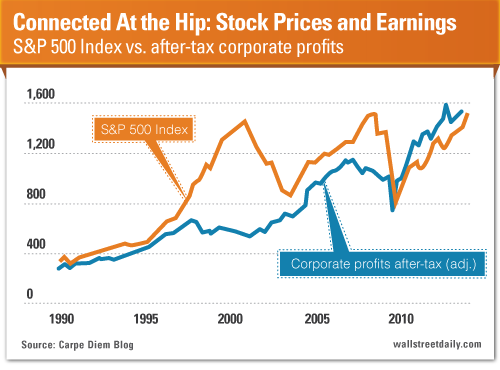
As Perry explains, a one-to-one relationship exists between stock prices and after-tax corporate profits. For every increase of $1 billion in profits, the S&P 500 rises about 1 point. That is, with two notable exceptions: the dot-com bubble and the Great Recession.

As you can see, stock prices got too far ahead of corporate earnings during those periods. Sure enough, the market restored the relationship between corporate profits and stock prices by collapsing.

Or, put simply, stock prices ultimately followed earnings.

Here’s why all this matters…

According to Perry, “In the current bull market rally… corporate profits are consistent with stock market levels.” So the one-to-one relationship is in full effect. And that means there’s nothing abnormal about the current bull market. Corporate profits are driving stock prices.

By extension, as long as corporate profits keep increasing, stock prices should, too. And that’s exactly what analysts expect to happen…

After rising for more than three years, the consensus estimate calls for profits for S&P 500 companies to keep climbing to hit a record of $109.30 this year.

Bottom line: Absent a sudden drop in corporate profits – or the Fed unexpectedly pulling the plug on its quantitative easing initiatives – a pullback or correction is not going to magically materialize.

Stay tuned for tomorrow, though. I’ll share three key metrics to help you detect any deterioration in earnings – well ahead of the average investor.

Ahead of the tape,

Louis Basenese

Sign Up for Free Daily Newsletter HERE

About Wall Street Daily

In a World of Liars, the Truth Starts Here…

The harsh reality is that you’re being lied to  every day – over and over again.

Wall Street is lying to you. The talking heads on television are lying to you. Your banker is lying to you. Your local Congressman is lying to you. Even your own broker is lying to you (mostly because he’s being lied to).

Consider: Behavioral science tells us that bankers and politicians are lying to us 93% of the time. And that Wall Street is 13 times more likely to tell a lie than the truth.

They win and we lose because our brains have been conditioned to cooperate in their con game.

But I believe you deserve the truth.

And to see that you get it, I’ve assembled a team of unbiased, seasoned investment professionals who pick apart the market’s biggest headlines on a daily basis.

Our mission?

To challenge Wall Street’s most widely accepted wisdom. And uncover the real intentions behind the greatest moneymaking machine of all time.

Along the way, we’ll also expose the profit trends others simply don’t have the experience to detect (or the courage to broadcast).

Bottom line, the most informed investor always wins. And getting you clued in is our top priority.

That’s why I’m personally challenging you to read our daily content for the next 30 days and see for yourself. If we’re doing our job effectively, you should notice it on your brokerage statement.

So don’t delay. To start getting a healthy dose of genuine, no-nonsense, 100% unbiased investment research and market commentary – i.e. THE TRUTH – justsign up below.

Ahead of the tape,


Louis Basenese
Chief Investment Strategist

A colossal (and temporary) buying opportunity

20130411-tim-priceThese are certainly days of miracle and wonder. Well, of absurd and extraordinary financial experimentation, at any rate. 

[Editor’s note: Tim Price, Director of Investment at PFP Wealth Management and frequent Sovereign Man contributor is filling in while Simon is viewing agricultural property today.]

Last week, for example, saw the Bank of Japan abandon any last pretense of restraint and topple headfirst into a gigantic pile of monetary cocaine. 

The scale of the policy is daunting: the Bank of Japan intends to double the country’s monetary base over two years via the aggressive purchase of long term bonds. 

It would be difficult to overstate the drama of this monetary stimulus (although we favour the word debauchery). 

Yet as the Japanese monetary authorities declare a holy war against deflation, it would only be fair to draw attention to the colossal opportunity being presented as the antidote to monetary intemperance, namely gold and gold miners. 

There is a clear mismatch between the prices of gold and silver mining shares and spot prices of gold and silver. But as to why the miners are trading so poorly relative to the physical is unclear to us. 

It may be because the market expects the price of gold and silver to fall (not a belief to which we subscribe, given current monetary events for example in Japan). 

It may be because the rise of gold exchange-traded funds has removed a natural bid for shares of the miners. 

And it may be because the market is waiting for goldbug hedge fund manager John Paulson to capitulate on his own holdings of precious metal mining stocks. 

Nobody knows. We are merely content to play the long– and rational– game. 

As Lee Quaintance and Paul Brodsky of QB Partners point out, “the ratio [Mining share prices to spot gold] is again at its ten year weekly low. If there is any remaining validity to the merits of investing in financial assets based on historical value, this would be the time to buy miners.” 

They go on to add (and we concur), 

“Our strong bias is that prices of bullion will rise significantly. Selling the miners at current absolute and relative valuations would be tantamount to throwing in the towel on the entire concept of value investing, now and in the future.” 

“The reality is that we cannot be 100% sure of the outcome from all the monetary mayhem in Europe, Japan and the US, and we do not have a good sense of timing if and when our outcome proves correct. . . All we can do is try to recognize value within the context of current and extrapolate-able events.” 

We agree that the temporary weakness of the price of bullion is a buying opportunityin light of Japan’s vast money-printing experiment. And the same likely holds for the price of gold mining companies. 

Bear in mind, though, that as the money printing ritual goes on, the prices of everything are being so grievously distorted. Doubt is uncomfortable in this environment. But certainty is absurd.


Until tomorrow, 
 

Tim Price 
Director of Investment, PFP Wealth Management
Sovereign Man Contributor
 
About Sovereign Man:

Simon Black?

Hi. I’m Simon Black– international investor, entrepreneur, permanent traveler, free man. This free daily e-letter is about using the experiences from my life and travels to help you achieve more freedom.

Over the last few years I’ve traveled to over 100 countries, met with a President and several diplomats, briefed sovereign fund managers, flown an aerobatic stunt plane, started several companies, hitchhiked in Bogota, taken a train across the orient, lectured on entrepreneurship in Eastern Europe, and personally provided venture capital to new start-ups.

I believe that in order to achieve true freedom, you have to be able to make money,control your time, and eliminate the mindset that you are subject to a corrupt government that is bent on degrading your personal liberty.

To get the FREE Daily Newsletter go HERE

test-php-789