
Today a legend in the business told King World News that Switzerland may be preparing to purchase a stunning 1,000 tons of physical gold. Keith Barron, who consults with major gold companies around the world and is responsible for one of the largest gold discoveries in the last quarter century, spoke about this remarkable situation and what it means for investors. Below is what Barron had to say in part II of this exclusive interview.
Personal Finance
 Good morning. Here’s what you need to know.
- Asian markets were mixed in overnight trading with theNikkei down 1.2%, falling below its five-day moving average. Markets are higher in Europe is and U.S. futures are in the green.
- Over 100 people are reported to be injured, and five to 15 are expected to be dead, after a massive explosion at a fertilizer plant in West, Texas last night. The USGS said the blast was so big it registered as a 2.1 magnitude earthquake.
- Chinese home prices were up 3.6% on the year in March, compared with 2.1% the previous month. Home prices were up in 68 of 70 cities that are surveyed. First tier cities saw a surge in prices. In Guangzhou, prices increased 11.1%, Beijing prices were up 8.6%, and Shanghai prices were up 6.4%. 29 crazy things that only happen in China >
- Initial jobless claims are out at 8:30 a.m. ET, followed by the Philadelphia Fed Survey for April at 10 a.m. ET. Consensus is for initial claims to rise to 347,000, and for the general business conditions index level to rise to 3.3. Follow the release at Business Insider >
In earnings news, Morgan Stanley reported Q1 profit ex-charges of $0.61 per share, on revenue of $8.5 billion. Analysts were looking for earnings of $0.57 per share, on revenue of $8.35 billion. Meanwhile,Pepsico Q1 earnings fell 4.6%. It reported profit of $0.69 per share, on revenue of $12.58 billion.
- Germany’s lower house of parliament approved a €10 billion bailout for Cyprus. 407 of 602 policymakers voted in favor of the aid. In a separate vote, the German parliament also approved seven-year loan extensions for Ireland and Portugal. How Portugal became a horrific economic mess >
- Japanese exports climbed 1.1% year-over-year in March, beating expectations for a 0.2% increase. The trade deficit narrowed to 362.4 billion yen, from 777.5 billion yen in February.
- EBay reported Q1 revenue of $3.75 billion, missing expectations for $3.77 billion. It also lowered Q2 guidance to earnings per share of $0.61 – $0.63 per share, on revenue of $3.8 billion – $3.9 billion, against expectations of $0.66 per share, on revenue of $3.95 billion.
- The People’s Bank of China plans to widen its yuan trading band soon. The current trading band is 1% of the daily reference rate. The central bank’s vice governor Yi Gang is quoted by the WSJ as saying, “The exchange rate is going to be more market-oriented.” Everything you need to know about the Chinese renminbi >
- UK retail sales including fuel fell 0.7% month-over-month in March. This was worse than expectations for a 0.6% decline. Cold weather was blamed for the decline in sales of clothing and household products.

 In the aftermath of the brutal takedown in gold and silver, “April 17th” John Embry spoke with King World News about why he believes the smash was orchestrated and what investors should be doing right now. Below is what Embry, who is chief investment strategist at Sprott Asset Management, had to say in part II of his interview:
Embry: “The last correction that was brutal in gold was explainable because that was the one in 2008 accompanying the global liquidity crisis that was wreaking havoc on the entire world. So at that time there were obvious reasons for the forced selling.
This time the smash and forced selling have just been totally manufactured. The intensity of this takedown and the size of the paper trades that were alluded by both Andrew Maguire and John Hathaway, in relation to the physical market, are just preposterous….
Continue reading the John Embry interview HERE
Switzerland To Buy A Stunning 1,000 Tons Of Physical Gold?
Eric King: “Andrew Maguire recently told KWN that the LBMA system was in trouble and cash settled, refusing to give entities their gold. Earlier you said to me that there is a run on gold at Scotiabank in Canada and UBS in Switzerland. What do you make of this incredible situation, Keith?”
Barron: “What we discussed earlier, the fact that ABN AMRO was refusing to give customers their gold back, is one of the primary things that has triggered this massive run on physical gold and silver….
Continue reading the Keith Barron interview HERE
Rick Rule Weighs In On The Gold & Silver Takedown
“Professional capitulation is a wonderful sign. That isn’t to say that we are ready to turn now, or we are ready to turn next week, but the set of circumstances that we have been talking about, which is the beginning of the end of the dark period, is what we are in right now.”
….read it all HERE
NOT even GOLD will SAVE YOU from the coming WORLD SYSTEMIC CRISIS – Marc Faber
……Watch the Video Below or read it all HERE

Switzerland is the place that has traditionally stood above all the rest in its reputation for financial stability.
Why? Because the currency was well-managed, the banking system was sound, and the country had a long tradition of treating capital well.
Over the last few years, however, these advantages have collapsed.
Switzerland has voluntarily surrendered banking privacy, and the many Swiss banks are now hemorrhaging cash.
Even worse, the Swiss government destroyed its reputation for respecting capital when they pegged the Swiss franc to the euro in 2011 to arrest the franc’s rapid rise.
The country’s top central banker at the time, Philipp Hildebrand, claimed that he would buy foreign currencies in ‘unlimited quantities’ to defend the peg.
This is not something a responsible steward of currency should ever say. The currency peg was nothing more than a form of capital controls… and it effectively screwed anyone that had trusted the Swiss system with their savings.
Since then, the market’s need to find a financial safe haven has only become more desperate. One only needs to look at Cyprus to see why.
Yet just a small handful of countries inspire confidence in the marketplace. And the most popular seems to be Australia.
 From a macro perspective, Australia is in much better shape than the rest of the bankrupt western hierarchy.
Though the national budget deficit has been rising over the last few years, Australia’s public debt as a percentage of GDP (less than 30%) is a tiny fraction of the US, France, Italy, etc.
Moreover, as the Australian economy is heavily dependent on resource exports, it’s a ‘commodity currency’, much like Canada. But unlike Canada which is wed to the US, Australia’s economy is much more closely tied to Asia’s growing dominance.
Perhaps most importantly, though, Australia is not printing money with wanton abandon like the rest of the world.
In fact, the RBA’s (Australia’s central bank) balance sheet has actually been -decreasing-, dropping from A$131 billion to just A$81 billion in 2012.
This constitutes a 38% decline in central bank assets in five years. By comparison, US Federal Reserve credit has grown 367% over the same period. This is an astonishing difference.
Plus, Australian interest rates here are typically much higher than in the US, Europe, or Canada. Just holding cash in an Australian bank account can yield over 4% in annual interest. It’s sad to say, but this is quite a bit these days…
(Attendees at our Offshore Tactics Workshop were able to open such accounts on the spot with an Australian bank representative; we’ll soon send out information about how you can do this as well…)
Now, there’s really no such thing as a “good” fiat currency. But given such fundamentals, it’s easy to see why Australia is replacing Switzerland as a global safe haven.
I’ve spent the last few days with some banker friends of mine, and they’ve been telling me about the surge of foreign capital coming into Australia from Europe, the US, and China.
But one thing to keep in mind, they reminded me, is that the Australian dollar has a loose correlation with the price of gold. After all, gold is Australia’s third biggest export.
Consequently, we’ll likely see a decline in the Aussie dollar if the gold correction continues to play out. This may prove to be a good entry point for individuals to get their money out of the US dollar.
Until tomorrow, 
Simon Black
Senior Editor, SovereignMan.com
Get THE ABOVE Notes from the Field (It’s Free)
Receive updates and actionable information from Simon Black as he seek out freedom and opportunities around the globe. Just click HERE to Subscribe
What Smart Minds Think on Gold
Adam Taggart
Despite plunging prices, the smart minds still see precious metals as the best option for preserving (and likely increasing) the purchasing power of one’s wealth.
John Hussman: markets are dangerously out of equilibrium; precious metals will provide security during the inevitable correction. John Mauldin: gold is essential insurance against central bank monetary recklessness. Mish Shedlock: renewed stress in the credit markets is inevitable; gold will be one of the smartest/safest places to park capital during this time. Charles Hugh Smith: cash and gold are prudent positions given market fundamentals and both will likely rise from here.
Richard Russell, an economic analysis legend, says today’s financial market conditions are unprecedented. Today’s elevated market prices are dangerously unsupported by fundamentals, and caused by manipulation and opportunistic self-interest by central planners, big banks, politicians and corporations. “What else but gold?” should investors hold at this point, he asks.
Mike Maloney is frustrated by efforts to suppress the gold and silver price, even though it’s allowing savvy investors to accumulate metal cheaply. But the false signals given by low prices keep the smaller investor, who could benefit most from protecting their wealth, from entering the market. And even though he remains confident precious metals prices will be much higher in the future, those prices will be the result of a destruction of the monetary system and a corruption of the free markets.
None of these smarter minds is a cheerleader. They arrived at their positions through empirical analysis. They are not pushing gold to make a buck or advance an ideological agenda. These are concerned men looking to find options that will help their followers prosper.
Weeks like this are just noise. In fact, they’re good opportunities to add to your positions at lower cost.
….read full article HERE
And now for a VERY FIRM OPINION – ED
DON’T BUY GOLD
Prepare for lower prices…
Dissecting an emotional market…
Plus: My overdue Bitcoin bragging rights!
Gold’s dropping. You want to buy.
But wait just a minute…
Is your desire to buy gold now based on reasonable analysis of market conditions? Or is it simply an emotional reaction to the selloff?
Let’s turn to one of your letters for some answers:
“Short-term I can understand your premise on gold,” writes a somewhat reasonable reader.
“Markets are doing well so people head in that direction. But for the long-term, I’m a buyer. I think there’s a lot of inflation coming. So I’ll slowly buy in expecting lower priced and will be excited when they fall. But later I’ll expect higher prices and will be excited as they rise… sort of.”
Sounds like you’re grasping at straws here.
I can’t make this any clearer: You shouldn’t even consider trying to buy gold right now.
After all, you are a long-term investor, correct? Give gold a chance to consolidate or move lower. When was the last time you saw any asset class permanently recovered from a violent drop the very next day? It just doesn’t work that way…
There will be snapback rallies and more downside. Expect to wait a long, long time before a suitable base forms.
Also, think about what you just wrote: Markets are doing well so people head in that direction…
Apply this line of thinking to gold. The gold market was booming. So naturally, people headed in its direction. Investors, traders, hedge funds and your crazy coworker bought gold. People wanted to own it because of its performance. Now they are leaving. And they won’t be rushing back to buy anytime soon.
Look, I know there’s a ton of shouting going on out there about where gold might end up.
Every blogger and financial journalist with 15 free minutes and a WordPress account is publishing their own takedown of gold after its big drop.
But where were these guys last month? Where were they when gold began telegraphing trouble in February after it broke below $1,650? If had to guess, I would say they simply weren’t paying attention. It’s so easy to pile on after the fact…
However, this is not your signal to jump into gold to prove them all wrong.
The loudest howls (by far) are coming from those defending gold. They pound the table about multinational conspiracies, computer trading, and the unwashed masses selling gold for all of the wrong reasons. They’ve even blamed the charts that they loved so much over the past 10 years!
I’ll pose the same question I asked the detractors:
Where were these arguments when gold was soaring higher every month? Why has the narrative suddenly changed?
Any way you twist it, powerful emotional forces are at work. Denial is in control right now. Acceptance is a long way off…
I repeat — don’t jump back into gold. It’s too soon.
If you are well versed in trading, you could try to play a snapback move in gold futures or miners.
If that’s your game, keep tight stops and expect the unexpected. This thing is just getting started…
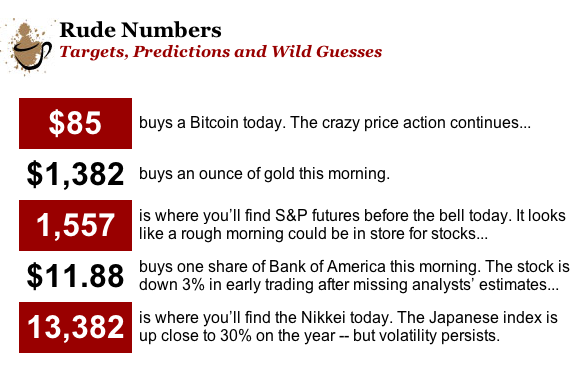

“Hey Greg, you forgot the bragging rights for calling the Bitcoin rocket blastoff and harsh landing,” writes an astute reader.
You’re right. I forgot that one. But I’m gonna strain my shoulder if I continue to pat myself on the back at this rate…
Also, remember my note last week about the Goldman report? I said shorting gold would be a risky move. Talk about a missed opportunity. In that case, running with the devil would have worked out perfectly.
[Ed. Note: Send your feedback here: rude@agorafinancial.com” target=”_blank”>rude@agorafinancial.com — and follow me on Twitter: @GregGuenthner]

- U.S. Oil Royalties Party…All AREN’T Invited!
- A new alternative to the dollar, euro… or even gold?
- Expert Reveals “It’s Too Late to ‘Save’ America…”

-
I know Mike is a very solid investor and respect his opinions very much. So if he says pay attention to this or that - I will.
~ Dale G.
-
I've started managing my own investments so view Michael's site as a one-stop shop from which to get information and perspectives.
~ Dave E.
-
Michael offers easy reading, honest, common sense information that anyone can use in a practical manner.
~ der_al.
-
A sane voice in a scrambled investment world.
~ Ed R.
Inside Edge Pro Contributors

Greg Weldon

Josef Schachter

Tyler Bollhorn

Ryan Irvine

Paul Beattie

Martin Straith

Patrick Ceresna

Mark Leibovit

James Thorne

Victor Adair