



Stocks & Equities

What Warren Buffett Is Buying Now…

“Europe is going to be around,” Warren Buffett explained on CNBC earlier this week.

He’s right. Europe isn’t going anywhere. And it’s cheap…

“Europe’s economic problems present a buying opportunity,” he said. “We’ve been buying some European stocks and companies in the past year.”

Since 1964, Warren Buffett has increased the book value of his holding company, Berkshire Hathaway, by 587,000%. That’s enough to turn a $10,000 investment into nearly $60 million. The guy knows how to make money in the markets.

And right now, he’s looking to make money in European stocks.

You might not be ready to buy Europe. But you can make some real money here… so you need to understand this opportunity.

Over the past year, a certain group of European stocks have outperformed their U.S. counterparts. What’s more… even after that run, they are still a better value than U.S. stocks today.

So based on history, we still have an excellent opportunity to get in this trade.

Let me explain…

Last April, when I updated DailyWealth readers on this opportunity, Europe was a mess. Greece was in the process of yet another bailout. And several European countries were already in recession. In short, there were plenty of reasons to be afraid of Europe. But that is often the best time to buy…

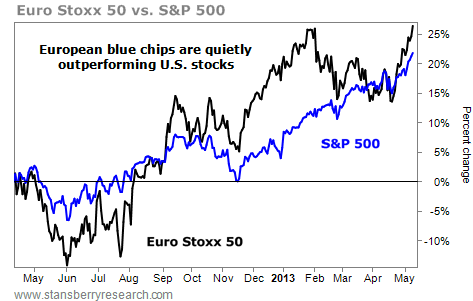
Since then, the group of European blue chips I discussed – the Euro Stoxx 50 Index – actually outperformed the S&P 500. Take a look…

0508AS-4573807E RML2P54IPJ

The Euro Stoxx 50 Index is up 26% in just over a year. You won’t read about it in the news, but that beats the 22% return in the S&P 500 over the same period. And importantly, we still have a great opportunity to buy today.

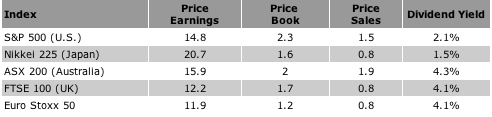
Right now, the Euro Stoxx 50 trades for just 12 times this year’s earnings. That’s 20% cheaper than the S&P 500…

These European blue chips are also cheaper than the U.S. and other major world stock markets based on just about every measure. Take a look…

Screen shot 2013-05-09 at 5.04.27 AM

The easiest way to buy European blue chips is with the SPDR Euro Stoxx 50 Fund (FEZ). Importantly, this fund doesn’t hold fly-by-night companies. It holds the largest multinational blue-chip companies in Europe…

Top holdings include Sanofi, a $146 billion health care giant based in France… Total, a $121 billion oil & gas giant, also based in France… and Siemens, a $93 billion multinational based in Germany.

The companies in this fund will still do business and make money, no matter what. They’re cheap – a much better deal than U.S. stocks. And even with Europe’s troubles, they’ve soared. We have an uptrend here.

So what are you waiting for?

If you don’t own them already, it’s time to join one of the greatest investors in history and buy European stocks.

Good investing,

Brett Eversole


Further Reading: 

In August, Brett urged readers to take advantage of “a possible 55% gain in 19 months with European stocks.” If you took his advice, you’re about halfway there in just eight months.
 
If you still can’t stand the thought of owning European stocks, Dr. David Eifrig shows you another super-safe way to diversify. “For folks worried about diversifying their assets out of U.S. dollars, this is one of the greatest ideas in the world…” Get the details here.

The Market is Now the Most Over-Bought In 4 Years

Stocks are now beyond overbought. The market ramped on Tuesday (the 17th straight Tuesday rally by the way) because traders are now playing for Tuesday rallies.

The financial media is looking for any and all reasons to justify the move, but the fact is that the market had rallied for 16 straight Tuesdays before… so why not a 17th time?

Behind this backdrop things only worsen. The divergence between stocks and the economy is growing rapidly. Stocks are now over 4% above their 50-DMAs. Anytime stocks have been this far above their 50-DMAs in the last four years we’ve seen a correction:

sc-21

The overbought nature of the market is even more obvious when you compare the S&P 500 to its 200-DMA:

sc-31

It is clear now we are in something of a blow off top. How long it will last is anyone’s guess, but investors are far too bullish given the fundamentals. The long, “risk on” trade is so lopsided it’s not even funny.

Maybe this time is different… maybe stocks will only go straight up forever. Maybe this bubble, unlike the last two, will not burst.

Or maybe it’s time to start prepping for the next stock collapse.

Investors take note, the market may be hitting new highs thanks to traders’ games, but the real economy is contracting sharply. This is precisely what happened during the market peaks before the Tech Crash and the 2008 Collapse.

We are getting precisely the same warnings this time around.

If you are not already preparing for a potential market collapse, now is the time to be doing so.

I’ve been warning subscribers of my Private Wealth Advisory that we were heading for a dark period in the markets. I’ve outlined precisely how this will play out as well as which investments will profit from another bout of Deflation.

As I write this, all of them are SOARING.

Are you ready for another Collapse in the markets? Could your portfolio stomach another Crash? If not, take out a trial subscription to Private Wealth Advisory and start protecting your hard earned wealth today!

We produced 72 straight winning trades (and not a SINGLE LOSER) during the first round of the EU Crisis. We’re now preparing for more carnage in the markets… having just seen another SIX trade winning streak…

To join us…

Click Here Now!

Best Regards,

Graham Summers


S&P 500 Snapshot: Fourth Consecutive All-Time High

The big news in the popular financial press was the Dow breaking 15,000. But readers here know that the far broader S&P 500 is my preferred gauge of the US market. The 500 hit its fourth consecutive all-time high and the fifth all-time high in six sessions. Yesterday’s 0.52% closing gain, a mere 7 basis points off its intraday high, was a close runner-up to the eurozone, where the EURO STOXX 50 rose 0.67%, but neither came anywhere near the stunning 3.55% gain in the Nikkei 225 after a four-day weekend. Reuters attributes the US gains to optimism over German data (factory orders surprised to the upside). But that seems far too specific. A prolonged bout of global QE euphoria strikes me as a more plausible explanation.

saupload SPX-130507-b thumb1

……read more HERE plus 4 more charts

Gold consumption in China, the world’s largest user after India, jumped 26 percent in the first three months of 2013 from a year ago amid strong bullion sales and rising jewelry demand, an association said.

Total consumption reached 320.54 metric tons in the first quarter, the China Gold Association said today in an e-mailed report. Purchases of gold bars surged 49 percent to 120.39 tons, while jewelry gained 16 percent to 178.59 tons, it said. Gold output in China, the world’s largest producer, gained 11 percent in the same period to 89.91 tons, according to the association.

First-quarter sales preceded gold’s slump into a bear market last month, with prices tumbling 14 percent the two days through April 15, the worst drop in three decades. The slump led to a surge in demand for jewelry, coins and bars from India and the U.S. to China. China’s imports of the metal from Hong Kong surged to a record in March, the Hong Kong government said on its website today.

“This came out better than our expectation because these sales were done before the gold market rout in April when more people rushed to buy gold,” Song Qing, fund manager at Lion Fund Management Co., China’s first asset manager to place money in foreign exchange-traded gold funds.

Bullion of 99.99 percent purity on the Shanghai Gold Exchange dropped 4.3 percent in the first quarter, and was at 294 yuan a gram ($1,486 an ounce) today. The weeklong Lunar New Year holiday, when consumers bought gold jewelry and bars as gifts in the most-important festival, was in February this year. In London, gold for immediate delivery traded 13 percent lower this year at $1,459.29 an ounce.

Elliott: Gold Is Still Best Store of Value


To contact Bloomberg News staff for this story: Feiwen Rong in Beijing atfrong2@bloomberg.net

To contact the editor responsible for this story: Brett Miller at bmiller30@bloomberg.net

How You Could’ve Made 140%… From “Armchair Farming”

Screen shot 2013-05-08 at 5.55.15 AM

Two summers ago, I visited Regina, the capital of Saskatchewan. I’ve been writing about investing in farmland there since 2008. I showed readers how to invest in Assiniboia’s farmland partnership. The price was about $26 per unit. Today, it’s about $58 per unit – plus investors have received $2.66 per unit in distributions. All-in, that’s a 140% total return.

This new idea could be even better…

In fact, a friend of mine and reader — a teacher — invested in the new company in November. It looks like he will about double his money before the summer. This new company will be public soon. It could generate returns of 20–40% annually for its investors, with fat 50% cash flow margins. And it has a lot of room to grow.

Brad Farquhar is the co-founder of Assiniboia Capital. He is our man in Saskatchewan [you may remember my two-part write-up from last year, “A Breadbasket’s Great Comeback” and “How to Double Your Money on Cropland.”] When I visited Regina, Brad drove me around and showed me several farms and I got a feel for what it’s like there and what makes it all work.

At the time, Brad’s firm was in the second year of running a partnership created to invest in canola farming. The idea was to supply farmers with their “inputs” like fertilizer and whatever else in return for a set percentage of the crops. That all ended in 2012, when Brad and his business partner Doug Emsley had an even better idea.

In November, they launched Input Capital Corp. It would provide financing to canola farmers in exchange for a fixed tonnage (not percentage) of that farmer’s canola crop. You may recognize this as a streaming deal.

The most famous streaming companies are those related to mining. Silver Wheaton, Franco-Nevada and Royal Gold are three of the largest such companies. They don’t do any mining themselves. Someone else owns the mine and runs it. The streaming companies usually get a percentage of the gold and silver that comes out of the mines they’ve invested in at some fixed price. Input Capital is similar.

So say there is a farmer that wants to expand. Annual inputs for fertilizers and the like can set them back $200 per acre. For a 4,000-acre farm, that’s $800,000 right there. Equipment could be another $1.3 million for this farm. The farmer doesn’t have that kind of money. Enter Input Capital. It can give the farmer an upfront payment for these things in exchange for a crop interest.

It works for the farmer on many levels. One, the upfront payment allows him to save by buying his fertilizer off peak season. This alone can bring a savings of $25–30 per acre, cutting fertilizer costs by 20–25%. Second, the money also allows the farmer to improve the productivity of his farm by purchasing precision equipment he wouldn’t be able to afford otherwise. Input Capital targets a 50% increase in average yield. So he gets a lot more out of his land. These are just a couple material advantages.

It works for Input Capital too because Input sets its fixed tonnage at a level where it will make an attractive return. Input gets a set tonnage and makes money depending on the pricing of the canola. Input uses crop insurance to cover its downside. Currently, canola trades for over $600 per tonne. Input would make 20% annual returns at just $500 per tonne. Even at $450 per tonne, Input’s rate of return on its investment would be over 15%.

A Dire Warning From the Daily Reckoning...

Streaming companies are great businesses. They generate lots of cash with low amounts of capital and do so with less risk than the underlying businesses they invest in. Thus, the stock market values such firms highly.

Each of the big streaming companies I mentioned earlier is worth billions. They trade for 18 times 2013 cash flow guesses. Input Capital is set up along the same lines… except it is much earlier in the development curve. In 2012, the company raised $25 million to start.

Today, Input has eight streaming agreements in place at an average investment of $1.75 million. (The agreements are for six-year terms.) The company is now looking to raise $100 million through a private placement. The aim is to go public. Once that happens, anybody can buy it.

Input also has a long runway. Canada is the largest canola exporter in the world. It made up 72% of the export market last year. Most of it wound up in China and Japan. Over the last five years, exports to China and Japan have grown at 333% and 21% clips, respectively.

There are over 20 million seeded acres in Western Canada devoted to canola. That’s over 52,000 farmers. Brad estimates that Input’s addressable market is about 20,000 farms. Input needs only about 75 of them to sign streaming agreements to put that $100 million to work.

I love this idea. You are investing with proven owner-operators who know the market. And the upside is tremendous. Even at half the valuation of the public streaming companies — and assuming Input invests the $100 million it is raising now — Input Capital could be worth $200 million.

Once public, it could be one to sock away in the old coffee can and forget about.

Sincerely,

Chris Mayer
Original article posted on Daily Resource Hunter

Chris Mayer is managing editor of the Capital and Crisis and Mayer?s Special Situations newsletters. Graduating magna cum laude with a degree in finance and an MBA from the University of Maryland, he began his business career as a corporate banker. Mayer left the banking industry after ten years and signed on with Agora Financial. His book, Invest Like a Dealmaker, Secrets of a Former Banking Insider, documents his ability to analyze macro issues and micro investment opportunities to produce an exceptional long-term track record of winning ideas. In April 2012 Chris will release his newest book World Right Side Up: Investing Across Six Continents. 


test-php-789