


Gold & Precious Metals

Gold’s Pivotal Role – The Yuan Sees Freer Convertibility this Year! (part 2)

In a continuation of the article on the rising convertibility of the Chinese Yuan towards the end of this year we look further into the path both the Chinese Yuan will follow and the changes that will follow in the global monetary system.

We feel it is inevitable that –in line with the World Gold Council sponsored OMFIF report on the subject—from which we will quote freely, that gold will move to a pivotal role in the monetary system over time. 

There is a tendency among analysts and academics to believe that academic theory will override the final changes that the monetary system will bring about. The reality of the matter is that theory will be made to bend to suit governments and their interests and then an amalgam of the interests of the most forceful nations trying to dictate such changes. This may not reflect academic wisdom but the opinion of the most powerful nation’s interests.

With this in mind it is good to look at these interests and see whether there can be an accord that will work in the global monetary system. A look at some features of the system that currently holds sway helps us to see the pressure points that lie ahead.

I.M.F. & World Bank

The first stumbling block is the I.M.F. itself. This is dominated by the U.S. voting power of 16.83% whereas 85% of votes are needed to pass a resolution there. It’s unlikely that China will accept a continuation of the U.S. control of issues that may deeply affect the Chinese. A removal of the U.S.’ overriding power must be on the cards. If that is not to happen, then what we’re seeing already among the emerging nations (the BRIC nations) led by China, where they have proposed  institutions that could take on the I.M.F. and World Bank roles as an alternative to these western controlled institutions, will move to completion. After all, it is unlikely that the U.S. would willingly relinquish the power it has, let alone in favour of China.

While China has openly expressed an interest in widening the definition of the S.D.R. the invention of the I.M.F. it is unlikely that the U.S. will be happy to see it linked to gold and with the Yuan becoming an important component of it. So far, China’s reaction has been to walk its own road and not to bow to the dictates of the U.S.

What China Wants

To emphasize that point we must be clear that China will claim as much power and control over the monetary system that its coming position in the economic tables of the world describes. Furthermore, China will want to have a similar degree of financial power as has been exercised by the U.S. for generations.

These interests are described in financial terms as China will want to improve the return on Chinese savings. Emulating the ‘exorbitant privilege’ of the dollar, under which China can absorb capital inflows from abroad at a relatively low interest rate and reinvest these as productive foreign assets earning a much higher return, has become an aim espoused by many Chinese economists and academics.

The Chinese authorities distinguish between means and ends. The overall aim is not just attaining reserve currency status. Rather, it is optimizing China’s economic power, resilience and prosperity. The internationalization of the currency is a means to that end, and the chosen routes are through increasing the use of the currency in trade and investment between China and the rest of the world, and the opening up of a carefully-controlled offshore Yuan market to facilitate that aim.

China & Gold

If central banks take a more active interest in gold, they’re likely to be imitated by private sector investors, de facto diminishing the amount of extra gold available as reserves. This set of considerations makes it unlikely that gold could re-emerge as a significant threat to fiat currencies, in the sense that it could replace them in a systemic way. The relative scarcity of gold means, that it could only ever replace a fiat currency on a fractional basis; however, even such a system is unlikely. That worked during the Gold and Gold Exchange Standards mainly because politicians and markets had faith in them. When that faith broke down in 1914, the early 1930s and early 1970s, the system could no longer be maintained. Precisely because of that experience and of the constant temptation for politicians to manipulate a standard to their short-term advantage, we will probably never see the return of a fractional Gold Standard.

The flexibility, for better or worse, of fiat currencies makes it unlikely that all politicians –including China’s— will accept abandoning them. The future monetary system will have to be pragmatic, bowing to the most influential of national politicians so that the current monetary system will be made to continue albeit with such changes that allow China and its currency to dovetail into the system that we already have.

This means a continuation of the increase in distrust of politicians, founded on suspicion that they, or central bankers, are debasing the currency. Naturally this will increase the attraction of gold as a hedge against all currencies. While politicians will continue to bow on this subject to the central banks allowing them to be independent of government, national interests will override international ones. It’s because of this set of strains that gold could become so important in the monetary system, in terms of individual national credibility that it becomes in the national interest to harness the entire gold stock within the borders of a nation.

Certainly if China decides that it is to its advantage to build a substantial store of gold, then it will ensure it can be used to lessen liquidity constraints, internationally and mollify currency crises that emanate from them.

We believe that it may well insist that other nations use their gold in the same way.

The only way this can be done effectively, is as we and OMFIF mentioned in the first part of this article: use gold as a form of ‘value anchor’ indexing currencies to gold. We see this as being somewhat brutal on some nations making them look at the realities of their currency’s value, but also reinforcing the monetary system as a whole.

 The Coming Convertibility of the Yuan

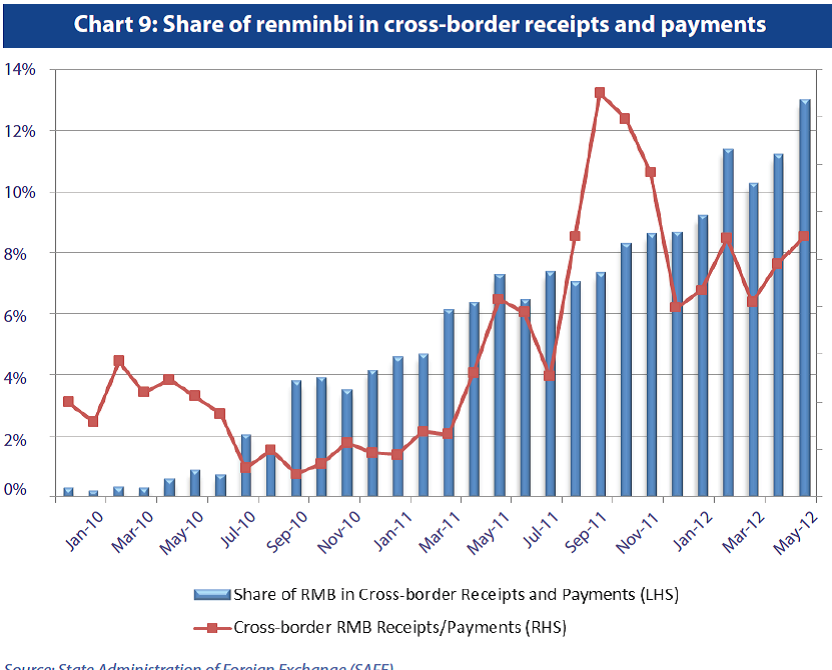
Progress in the Yuan’s international use has been concentrated on trade invoicing and settlement. In the first half of 2012, the Yuan’s share of China’s overall cross border receipts and payments stood at around 11%, up from around 7% in 2011, and only 2% in 2010 (Chart 9). Yuan flows into China for foreign direct and portfolio investment increased threefold compared with a year earlier. The authorities have built up a Yuan clearing agreement between Hong Kong and the mainland to reflect the growing pace of economic integration and de facto Yuan convertibility between these two areas. This has accompanied a sharp increase in volumes of Yuan held and traded in Hong Kong, although the amounts levelled off during the latter part of 2012.

1

Key Swap Agreements

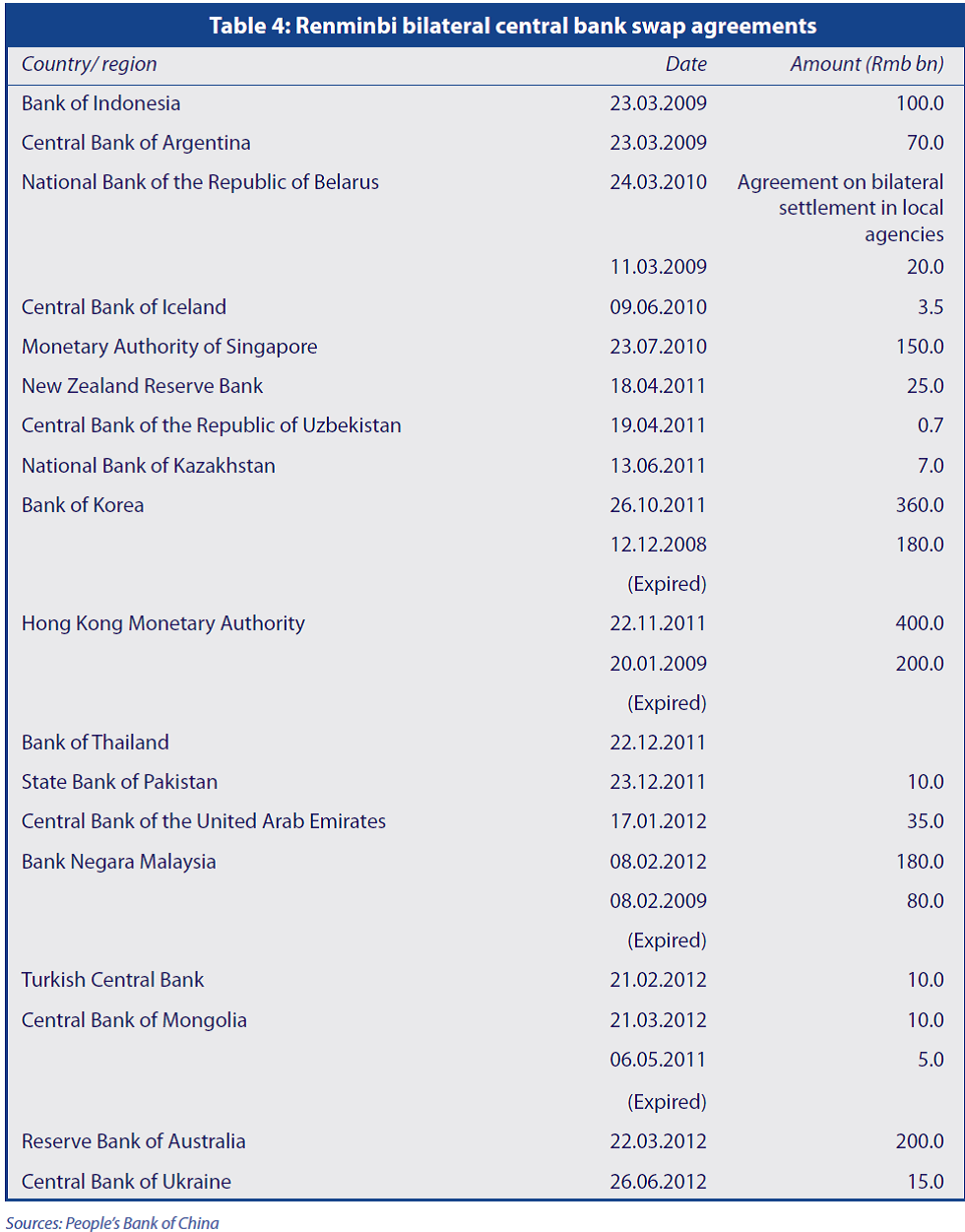
The People’s Bank of China has signed Yuan swap agreements with  foreign central banks, including Japan, South Korea, Hong Kong, Singapore, Iceland, Argentina and Australia, to provide Chinese currency liquidity to local markets abroad (Table 4). Between 10 and 15 central banks own mainly small volumes of Yuan reserves through agreements with the People’s Bank. Most of the reserve-holding is concentrated on Asia. According to the People’s Bank of China holdings also extend to Africa, Latin America, Europe and Middle East. Notable non-Asian central banks to hold Yuan reserves include the Central Bank of Nigeria (where the governor announced in 2011 that 10% of reserves would be eventually held in Yuan) and the Austrian National Bank (the first European central bank to invest in the Chinese currency). Other leading European central banks have made clear that they will not contemplate Yuan ownership until the currency is fully convertible.

2

The Chinese authorities may be prepared to make use of a number of opportunities to expand international use of the Yuan in a way that goes beyond invoicing and settlement for trade and investment. One idea put forward by Chinese economists with close links to the authorities is that China should encourage both its own borrowing entities as well as indebted western nations to issue bonds in Yuan specifically destined to be held in foreign countries official reserves. (If that were the case, China would have to proceed to full Yuan convertibility.)

Hold your gold in such a way that governments and banks can’t seize it!

Enquire @ admin@StockbridgeMgMt.com


Get it First.

Subscribe @

www.GoldForecaster.com

www.SilverForecaster.com

Legal Notice / Disclaimer

This document is not and should not be construed as an offer to sell or the solicitation of an offer to purchase or subscribe for any investment.  Gold Forecaster – Global Watch / Julian D. W. Phillips / Peter Spina, have based this document on information obtained from sources it believes to be reliable but which it has not independently verified; Gold Forecaster – Global Watch / Julian D. W. Phillips / Peter Spina make no guarantee, representation or warranty and accepts no responsibility or liability as to its accuracy or completeness. Expressions of opinion are those of Gold Forecaster – Global Watch / Julian D. W. Phillips / Peter Spina only and are subject to change without notice. Gold Forecaster – Global Watch / Julian D. W. Phillips / Peter Spina assume no warranty, liability or guarantee for the current relevance, correctness or completeness of any information provided within this Report and will not be held liable for the consequence of reliance upon any opinion or statement contained herein or any omission. Furthermore, we assume no liability for any direct or indirect loss or damage or, in particular, for lost profit, which you may incur as a result of the use and existence of the information, provided within this Report.

— Posted Tuesday, 4 June 2013


  1. The gold bears may have gotten themselves into a bit of hot water.  Please click here now.  Double-click to enlarge. 
  2. That’s the daily chart for DUST-NYSE, which is a triple-leveraged bet against gold stocks.  There’s a massive double top pattern in play now, featuring an important RSI non-confirmation.  The technical target of that top formation is $30. 
  3. Please click here now.  Double-click to enlarge.  That’s the weekly DUST chart, which portrays the big picture.  It looks like a technical “train wreck”;almost every technical indicator and oscillator on this chart is flashing a substantial sell signal.
  4. The meltdown on the DUST charts should be good news for gold stock investors, and I think it is.  Please click here now.  Double-click to enlarge.
  5. That’s the GDX weekly chart, and it looks superb.  Note the red downtrend line, where the price is now.  A move above that line could usher in a lot of momentum players.
  6. Those traders are likely already noticing the powerful buy signals being generated on key technical indicators. 
  7. GDX could make a run towards HSR (horizontal support and resistance) near $38.68, and that could cause immense pain to the leveraged bears. 
  8. The domino effect of ongoing short covering could create a violent rally in gold stocks, much bigger than what has occurred so far. 
  9. I’m especially impressed with the GDX weekly chart volume, which exceeded 100 million shares in each of the last two trading weeks.
  10. Some gold market investors wonder if technical analysis still works.  Are algorithm trading programs run by the banks simply “painting” the charts?
  11. Well, I don’t think anything has changed in recent years.  Charting has always been imperfect, and I don’t see it as any better or worse now, than in the past. 
  12. The larger HSR zones are most likely to be used by the biggest market players, while the “small potatoes” chart patterns have always been a bit of a crapshoot.
  13. So far, junior stocks are leading this rally, but most analysts are nervous, due to the enormous drawdowns that this sector has experienced.
  14.  I’m not too concerned, so I’ve been a solid buyer of GDJX and other junior-related plays, deep into my “personal surprise” zone. 
  15. The most wealth is likely built when brave investors place buys at prices they “know” are totally impossible.  Buying your personal surprise zone is like using contrary opinion analysis, but I believe it’s a much more powerful tool.
  16. Please click here now. You are looking at the GDXJ weekly chart.  The volume isn’t as strong as on the senior and intermediate stocks, but it’s still very good, especially with most investors and analysts too afraid to buy.
  17. GDXJ is up about 20% already, from the recent lows at $10.40.  That’s a huge move; annualized, junior gold stocks are rallying at a rate of about 200%. 
  18. After that kind of upside performance, you should be prepared to experience some very vicious down days, but there’s no question that the weekly GDXJ chart suggests that much bigger gains are coming.
  19. I think GDXJ can rally to about $16.73, before any of the weekly chart indicators turn negative.  That is roughly a 60% move from the low. 
  20.  Most investors in the gold community probably paid a lot more than $16.73 for GDXJ and their individual holdings, on a percentage basis, but remember that your entry prices are recaptured one price tick at a time.  All upside price movement must be viewed as good news, because it is!
  21. Traders that bought into the recent lows should try to book some light profits now.  Hold some larger “swing” positions, in anticipation of a much bigger rally.
  22. Please click here now.  That’s the hourly bars gold chart, and you can see that gold has been grinding higher over the past couple of weeks.  Take a good look at the six green arrows that I’ve highlighted on that chart.  Those are minor bouts of short covering, and I think they are like tremors before a major earthquake.  A short covering “super-rally” could literally wipe most bears right off the gold map. 
  23. All golden eyes should be focused on this Friday’s jobs report.  Almost all the recent economic reports have been weak.  The Japanese experiment with high-powered QE has been a total disaster.  Their stock market has collapsed, because so many Japanese companies do not benefit from a lower Yen.  The collapse in the Japanese bond market has cut off their funding.
  24.  Please click here now. Double-click to enlarge.  That’s the weekly EWJ-NYSE chart, a Japanese stock market proxy fund.  Technically, it’s horrific.  Rather than ending, the decline may be only just starting.  Instead of an economic boom, Japanese QE may create cost push inflation that spreads around the world.  Is the Japanese stock market crash a precursor to a US market wipeout, and a gold stocks “super rally”?  It could happen, and the only question may be, are you positioned to profit, if it does?

Special Offer For Website Readers:  Send me an Email tofreereports4@gracelandupdates.com and I’ll send you my free “Natural Gas & Oil, What Now?” report.  Which of these 2 key fuels should investors focus on now?  I’ll show you how I’m playing both of them!

Thanks!   

Cheers

   St  

Stewart Thomson

Graceland Updates

Note: We are privacy oriented.  We accept cheques.  And credit cards thru PayPal only on our website.  For your protection.  We don’t see your credit card information.  Only PayPal does.  They pay us.  Minus their fee.  PayPal is a highly reputable company.  Owned by Ebay.  With about 160 million accounts worldwide.   

Written between 4am-7am.  5-6 issues per week.  Emailed at aprox 9am daily.

www.gracelandupdates.com

www.gracelandjuniors.com

www.gutrader.com

Email: stewart@gracelandupdates.com

Orstewart@gutrader.com


Rate Sheet (us funds):

Lifetime: $799

2yr:  $269  (over 500 issues)

1yr:  $169    (over 250 issues)

6 mths: $99 (over 125 issues)


To pay by cheque, make cheque payable to “Stewart Thomson”  

Mail to:

Stewart Thomson / 1276 Lakeview Drive / Oakville, Ontario L6H 2M8 Canada


Stewart Thomson is a retired Merrill Lynch broker. Stewart writes the Graceland Updates daily between 4am-7am. They are sent out around 8am-9am. The newsletter is attractively priced and the format is a unique numbered point form.  Giving clarity of each point and saving valuable reading time.

Risks, Disclaimers, Legal
Stewart Thomson is no longer an investment advisor. The information provided by Stewart and Graceland Updates is for general information purposes only. Before taking any action on any investment, it is imperative that you consult with multiple properly licensed, experienced and qualifed investment advisors and get numerous opinions before taking any action. Your minimum risk on any investment in the world is: 100% loss of all your money. You may be taking or preparing to take leveraged positions in investments and not know it, exposing yourself to unlimited risks. This is highly concerning if you are an investor in any derivatives products. There is an approx $700 trillion OTC Derivatives Iceberg with a tiny portion written off officially. The bottom line:  

Are You Prepared?

The Biggest Dilemma Facing Investors Today

Four-plus years into a bull market and stocks keep hitting new record highs. 

The economy keeps recovering, too. Granted, it’s sluggish. But it’s a recovery, nonetheless. 

And, of course, the Fed keeps promising to backstop the whole shebang with easy money and absurdly low interest rates.

So what’s not to like about the current market backdrop? 

Well, finding bargains to profit from the continued boom keeps getting harder and harder.

In fact, the valuation boogeyman is lurking around every corner.

Beware of the P/E Creep

We know that stock prices ultimately follow earnings. But prices have gotten a little ahead of themselves.

Case in point: In the first quarter, S&P 500 companies reported earnings growth of 3.3%. Yet, on average, stock prices are already up 11.5% this year.

As Garth Friesen, Co-Chief Investment Officer at III Associates, says, “The whole move we’ve had in the S&P this year has been due to multiple expansion.”

Now, Mr. Friesen might be stretching the truth a tad. But not much. Take a look:

0613 PE Ratios

Since the beginning of the year, the trailing 12-month price-to-earnings (P/E) ratio for the S&P 500 Index has crept 12.6% higher, from 14.13 to 15.92 (as of Friday’s close).

As you can tell, the “multiple expansion” accelerated in recent weeks, too.

So with screaming bargains getting harder and harder to come by, what are investors doing? The absolute worst thing possible. 

They’re going dumpster diving in hopes of finding an undervalued gem.

Don’t Join “The Dash for Trash”

A recent analysis by Bespoke Investment Group reveals that the 50 stocks in the S&P 500 with the highest short interest outperformed the 50 stocks with the lowest short interest. (So far this quarter, the former is up 12%, versus a decline of 5% for the latter.)

So investors are betting on the most shorted stocks, simply because their valuations might be beaten down relative to the broader market.

It’s a recipe for disaster. And Bespoke rightly labels the trend “the dash for trash.” 

Whatever you do, don’t join it!

Instead, be patient and more selective. Take the time to unearth companies that trade in line with the market valuation, and benefit from accelerating sales and earnings growth rates. 

Even if the current trend of a multiple expansion for the S&P 500 Index slows down or flat-lines, these companies will demand a much higher stock price in short order.

I’m about to reveal one such company to WSD Insider subscribers.

As we speak, I’m finishing up my research report on an under-the-radar and undervalued small-cap opportunity – one that could easily double in price by the end of the year. 

It sells one of the hottest lines of specialty merchandise in the Southeast. And it won’t be long before the rest of the country catches on.

I plan to release the report next week. All you have to do to be included on the list is sign up here.

Bottom line: Finding bargains in the current market might require a little more work than in years past. But nobody ever said that stock picking is so easy a caveman could do it!

In all seriousness, as valuations start to get stretched and the average investor starts rotating into the stock market, now is the worst time to throw caution out the window. 

Instead, we need to be more and more selective if we hope to boost our profits in the months ahead.

Ahead of the tape,


Louis Basenese

Faber: The World Is a Mess & Juniors Could Double

The world’s economy is in tatters and safe havens are few and far between, says legendary contrarian Marc Faber. The banking crisis in Cyprus has shown that even bank deposits are not safe. The publisher of the Doom, Boom and Gloom newsletter, surveying the world from his perch in Hong Kong, discusses the impact of unemployment in Europe, the economic slowdown in China, asset bubbles and the turnaround prospects for precious metals miners. Faber also reveals his investment strategy for these volatile times in this interview with The Gold Report.

The Gold Report: Marc, I recently interviewed James Turk who said that Europe is in a banking crisis, but that some countries are in worse shape than others. Are things on the continent as bad as they seem to be from the headlines in the U.S.?

Marc Faber: Unemployment is high in both Europe and the U.S., particularly for young people. One reason for the high unemployment rate is that it is very difficult to find highly specialized workers for industry. Perhaps that’s due to more university students studying non-user-friendly subjects, such as philosophy. The Western world is lacking in well-trained workers who can handle industrial machines that cost $10–20 million ($10–20M). But if I need a clerical assistant for financial services, I can find hundreds and hundreds of applicants.

TGR: A lack of skilled workers sounds like an economic problem, not a banking crisis.

MF: Mr. Turk is correct that there is a worldwide banking crisis. But the crisis was caused by bailing out the global banking system. Using handouts, the governments monetized the debt structures of the European Central Bank (ECB) and its subsidiaries in countries like Spain, Italy and Portugal.

TGR: If we were to solve the economic crisis, would that solve the banking crisis? 

MF: In my view, the European economy will not suddenly recover. It has too many structural problems. One way that the so-called “banking crisis” could be resolved, though, is to let inflation rates rise. Asset prices would then shoot up, and loan portfolios would be better covered. But I do not really think that inflation is the solution.

TGR: It would be a painful solution.

MF: The danger is that the whole financial system could blow up due to the huge amount of derivatives still outstanding. Once again, excessive speculation is being fueled by artificially low interest rates, and asset bubbles exist everywhere.

TGR: Did the ECB learn from what happened in Cyprus that taxing bank deposits is counterproductive? 

370px-Greek Cyprus regions mapMF: European policymakers believe that in the next round of bank bailouts the depositors will have to pay their part, as was the case in Cyprus. The main question is who pays for what? In Cyprus, accounts up to €100,000 ($129,000) are adjudged to be safe, but accounts above that limit may lose as much as 40–60%. There is a question of social equity here: why should a depositor with €5M in a Cyprus bank lose, while a depositor with less than €100,000 sits pat?

There is also a technical problem. Say you are a homeowner in Cyprus and you sold your house for US$1M the day before they announced the confiscatory measures. The buyer paid you $1M and you deposited it in the bank. Now, you will now lose 40–60% of your money, but you haven’t done anything wrong. You just sold your house. Or what if I own no land, but have stored all of my wealth in bank deposits? The technical and political details involved in making bail outs fair—spreading out the pain—are very difficult. It may not be feasible to sanction depositors.

TGR: If Cyprus is the blueprint going forward, how should people store wealth?

MF: My asset allocation consists of 25% in equities, 25% in gold, 25% in bonds and cash, and 25% in real estate. I am hoping for the best. But I detect a growing movement toward populist governments in the Western world. Most governments are on good terms with the well-to-do. They have softened them with easy monetary policies, which have benefited people with access to capital. But the day will come when a wealth tax is instituted.

TGR: How will wealth be defined?

MF: If I were running a populist government, I would go to the people and say, “The reason why your economic conditions have worsened over the last 20 years is because of the super rich. They are stealing from the people.” And then I would declare that anyone with assets over $20M must pay a 50% one-time wealth tax. That can also be accomplished with an estate duty of 50%. The asset bar has to be sufficiently high, however, because 99.9% of Americans and Europeans do not have $20M or $50M stashed away. The higher the cut-off point, the more likely the voters will approve a confiscatory wealth tax.

TGR: Would such a tax have economic repercussions?

MF: It would be a disaster. But, regardless, people think that democracies work well. Democratic leaders bribe the electors by introducing popular measures, by handing out money to the voters and by taxing it away from the rich. That has happened again and again throughout history.

“Face it: it’s never easy to make money. If a person wants to make easy money, then he or she should not be in the stock market.”

TGR: Last time we chatted, you talked about the attractiveness of Asian equities with dividend yields of 4–7%. What are some examples of paid-to-wait equity sectors?

MF: Last year, Singapore real estate investment trusts (REITs) went up by 40%, and they are up higher this year. But I don’t think that they are the greatest bargain at the moment. Right now, high dividend-yielding stocks are moving up hugely. My sense is that we are in a market similar to the NASDAQ 100 between November 1999 and March 2000 when it rose past 100%, or the oil price between February 2008 and July 2008 when it shot up 70%. When there is upside acceleration, it’s a bad time to buy. Is it a good time to short? Yes, if you have deep pockets, maybe it’s a good time to short the equity markets. But who knows?

TGR: How far can momentum take the dividend stocks if their upward movement is not connected to company performance?

MF: Revenues are hardly growing with sales. Just look at McDonald’s or Wal-Mart. The market is going up because central banks are printing money. The money that is being printed does not go into the economic system evenly. It went into NASDAQ between 1997 and 2000, then it went into the housing market until 2007, in 2008 it went into commodities and now it goes into the broad U.S. stock market. One does not know when it will end, but it will end very badly.

TGR: You’ve talked about how U.S. stocks are overpriced compared to economic reality, but what about the junior mining market where the disconnect between the prices of gold and equities is the opposite?

MF: Junior mining stocks got hit very hard, for sure. I am on the boards of several exploration companies, and I can tell you that gold mining is a very tough business and it requires a lot of capital. One problem is that exploration companies have no cash flow. Every month, they bleed more cash to keep on drilling and to maintain overhead. If gold and copper prices do not recover, then a lot of exploration companies will simply not have the money to continue operations.

TGR: Are companies that have cash but not cash flow bargains right now?

MF: If the gold price goes up 20%, many mining stocks could double.

TGR: How high does gold have to rise for companies to survive?

MF: Each company has a different structure, but at the current gold price, a lot of projects are simply not economic at the bottom line.

TGR: You have talked about Asian markets where good opportunities still exist. How does Japan’s quantitative easing impact those stocks?

MF: Since the November lows, the Japanese market is up over 70% in yen terms and up 35% in dollar terms, so it has outperformed just about everything. My sense is that whereas many markets like the U.S. are closer to major highs, which may come this year, the Japanese markets, after 23 years of bear markets, saw their historic lows at the end of last year. The Japanese market was long overdue for a correction, which is now underway, but I do not expect new lows.

TGR: Could the slowdown in China be the tipping point for a correction?

MF: The Philippines, Indonesia and Thailand have performed superbly in the market, up four times the 2009 lows. Other Asian markets have performed miserably, like China and Vietnam, and until recently, Japan. There are opportunities in China and Vietnam, but it is difficult to know the true financial condition of Chinese companies because of so many off-balance sheet items and a lot of cheating and fraud going on. I’m not a specialist on Chinese stocks, but let us not forget that a large hedge fund in the U.S. recently had a major position in an agricultural company in China that turned out to be a fraud. I imagine that that hedge fund did its due diligence before buying so heavily into one company, so the company must have been very good at hiding the truth.

TGR: What is the safest and easiest way for investors in North America to get exposure to emerging markets?

“I would be diversified – some money in equities, some in bonds, some in real estate and some in gold and silver.”

MF: Investors can buy exchange-traded funds (ETFs). That said, I am not in favor of ETFs, but that is one way into emerging economies. Face it: it’s never easy to make money. If a person wants to make easy money, then he or she should not be in the stock market. It is very difficult to make money in stocks, because people tend not to diversify. They tend to buy popular stocks, such as Apple. And they sell stocks that are temporarily out of favor, such as mining stocks at the present time. They buy high and sell low. Not a recipe for success.

And what is safe? Traditionally, money in the bank is safe. But, as we’ve seen in Cyprus, it’s not so safe, because the deposit earns zero interest, while the cost of living increases between 5% and 10% per annum. Money left in the bank loses purchasing power.

TGR: I recently interviewed James Dines, and he predicted that the bond market will burst as soon as interest rates start to climb. Do you agree with that assessment?

MF: A tanking bond market is a possibility, but not a certainty. Bonds are selling at artificially low interest rates, and they are especially low because of central bank buying. One day, interest rates will rise, but central banks will probably continue to purchase assets.

TGR: What factor will determine whether or not bonds decline?

MF: The performance of the global economy. It is obviously not performing well at the present time. And for that reason, interest rates may stay low. I want to make one thing very clear: Interest rates will one day be higher than they are now. The question is when? This year? In five years? But the sentiment around bonds remains negative, while bullish for stocks. Holding bonds for a while is not a bad tactic: If there is a serious correction in the stock market, or a bear market in stocks emerges, the psychology driving investors could change from an inflationary psychology to a deflationary psychology.

The current 10-year U.S. Treasury yield of 1.7% is not attractive. It would be attractive with a deflationary bump. But then only for a year or two because tax revenues would collapse and more money would be printed and inflation would rebound. I am not recommending that people buy U.S. government bonds: I do not buy them. I am simply advancing an argument about why they may not collapse tomorrow. Personally, I stick with corporate bonds.

TGR: In a deflationary scenario would gold be a store of value?

MF: It would hold value better than other assets.

TGR: Do you like silver?

MF: I own physical gold, but I can see why someone would favor silver over gold.

TGR: How are you adjusting your portfolio to protect against risk in light of your gloomy predictions?

MF: I’m heavily in cash, U.S. dollars. I have reduced my equity position somewhat, but not 100%, because the stocks keep going up. I’m not actively buying equities, except in Vietnam. And I keep 25% in real estate.

TGR: Any final advice for our readers?

MF: Nobody has the faintest clue about what the world will look like in 5 to 10 years. The Middle East is a complete mess. More wars may break out, including intervention in Syria, where Bashar al-Assad has not done anything terribly wrong, I must add. It’s similar to the intervention in Libya to remove Gaddafi. What do we have now in Libya? A civil war. And then the U.S. embassy was attacked. If the Middle East goes up in flames, who knows how high the oil price will go?

There could be a shock in China, where the new premier, Li Keqiang, is anti-Western. The Chinese know that they are vulnerable as American investments continue to shift toward Asia. Regional tensions have increased substantially in Southeast Asia and in East Asia.

So I would be diversified, as I said, some money in equities, some money in cash and bonds—I only have corporate bonds, not government bonds—some money in real estate and some money in gold and silver.

TGR: Thanks for your time, Marc.

MF: You’re welcome.

RELATED ARTICLES


DISCLOSURE: 

1) JT Long conducted this interview for The Gold Report and provides services to The Gold Report as an employee. She or her family own shares of the following companies mentioned in this interview: None.
2) The following companies mentioned in the interview are sponsors of The Gold Report: None. Streetwise Reports does not accept stock in exchange for its services or as sponsorship payment.
3) Marc Faber: I or my family own shares of the following companies mentioned in this interview: None. I personally am or my family is paid by the following companies mentioned in this interview: None. My company has a financial relationship with the following companies mentioned in this interview: None. I was not paid by Streetwise Reports for participating in this interview. Comments and opinions expressed are my own comments and opinions. I had the opportunity to review the interview for accuracy as of the date of the interview and am responsible for the content of the interview.
4) Interviews are edited for clarity. Streetwise Reports does not make editorial comments or change experts’ statements without their consent.
5) The interview does not constitute investment advice. Each reader is encouraged to consult with his or her individual financial professional and any action a reader takes as a result of information presented here is his or her own responsibility. By opening this page, each reader accepts and agrees to Streetwise Reports’ terms of use and full legal disclaimer.
6) From time to time, Streetwise Reports LLC and its directors, officers, employees or members of their families, as well as persons interviewed for articles and interviews on the site, may have a long or short position in securities mentioned and may make purchases and/or sales of those securities in the open market or otherwise.


Mark Carney

imagesThe Governor of the Bank of Canada, Mark Carney, has become Governor of the Bank of England. No change in actual title, but hired at considerably higher compensation than that of the previous Governor. Mr. Carney brings to the position a pleasant visage and speaking voice. Obviously his new employers are expecting much more than that.



Although a stretch, it reminds of when England’s government appointed Isaac Newton to head up the Mint. Some have written that there was hope that the great scientist would be able to provide more than sound management. Perhaps, as an alchemist, he could conjure up something for nothing. This, of course, was well before ambitious politicians and bureaucrats discovered Keynes.

During the financial storm Carney earned accolades in Canada and glowing comments from an international financial media. Like so many others in central banking circles he has a PhD in currency depreciation and interest rate manipulation. Because Canada’s troubles were less severe than many countries there was much favourable comment about the country’s banking system and central bank.

The best thing that can be said about Canada’s banking system is that it has not been designed by the US Congress. The long tradition of sound banking started in the early 1800s when partners forming a bank were liable for twice their personal equity in the bank. The best banks became relatively big and diverse in operating in all regions of the geographically huge country. So far the folly of deposit insurance imposed by the government in 1967 has caused little harm to the banking system.

If one had to identify key reasons how Canada weathered the storm it would be that her politicians were not as forceful in insisting that mortgages be made available to those who could not meet the obligations. Another reason also involved residential real estate. The bid from Asian buyers continued in Canada. Perhaps in the US it was overwhelmed.

After the 1980 blow-off in commodities and inflation, upscale residential in Toronto and Vancouver fell to one/third of their highs. Financial markets are again faltering and Canadian real estate is vulnerable.

As the head of the Bank of Canada Mark Carney maintained considerable poise and as the saying goes “was looking good”.

For sure some of Carney’s compensation is to cover the much higher costs of London relative to those in Ottawa. But a couple of years ago when the Fed’s “Dream Team” had faltered, Carney seemed to have the central banker’s equivalent of a magic wand. Admirers of the techniques of central banking place considerable stock in timing the market. In 2007 it was widely boasted that the Fed, and to a lesser degree, the Bank of Canada could make the perfectly-timed cut in some administered rate and the financial party would continue.

Now any old financial historian would know that this claim was impossible. But somehow Carney kept “looking good” and is appointed as head of the Bank of England. In her early days, the “Old Lady of Threadneedle Street” promised to “infallibly” lower interest rates, but provided unsound banking, herself. After a couple of insolvencies she discovered sound banking.

Since the intellectuals gained influence in the 1930s unsound banking has prevailed.

As the “new broom”, Governor Carney is in rare position. Should he continue with the ancient practice of trying to make a post-bubble credit contraction go away by throwing more credit at it? Or should he work towards sound banking built upon a sound currency?

We wish him well.

BOB HOYE, INSTITUTIONAL ADVISORS – WEBSITE: www.institutionaladvisors.com

test-php-789




