
Personal Finance
Like a carefully memorized religious incantation, politicians and central bankers continually stress how their stimulus policies are designed to promote the interests and prosperity of the middle class. Cynical observers may note that this brave political stance may have something to do with gaining the support of the vast majority of voters who identify themselves as “middle class.” However, the cumulative effect of their economic programs has achieved the opposite. The middle class is being crushed under increased taxes, negative real interest rates, debased currencies and increasingly intrusive regulations.
 A large and healthy middle class is the single most important bastion of democracy and freedom in the modern world. Individuals who identify with the middle class exhibit strong support of their nation and economic system. A small, weak middle class opens the political door to dictatorial control and tyranny. This was the case in the waning days of czarist Russia when, the small Bolshevik party was able to court the discontent of the underclass to seize control over more than one hundred million people.
Many government policy decisions lead Americans to take on debt, such as Clinton’s homeownership push, Bush’s post-911 spending prescription, or the tax code’s mortgage interest deduction. As the largest debtor in the world, it is not a leap in logic to imagine the U.S. Government prefers policies that favor debtors rather than creditors. These efforts can be magnified if central bank monetary debasement destroys the value of any savings the middle class had managed to save. The explicit policy of the Federal Reserve is now to hold interest rates below the rate of inflation, which by definition discourages saving and encourages debt.In exchange for the loss of their savings, the middle class can’t point to any significant gains. Wage rates in America and Europe have been largely flat for several years. In Japan, a similar recession caused a flat economy that has lasted for more than ten years while the broader economy has largely stagnated.
Meanwhile the middle classes are reeling from price increases in many of the areas that are most vital to their lives, such as food and energy. Statistics show that the share of income that Americans must devote to these basics has increased significantly in recent years. In addition, huge new stealth taxes, such as ObamaCare, threaten to dig the hole even deeper. The combination has been a serious reduction in the net disposable income of many consumers in the middle classes. However, even these reduced incomes disqualify many in the middle from government aid programs such as mortgage relief, Medicaid, and food stamps. In short, the middle class is being squeezed between lower net earnings and higher living costs. It’s no wonder that many have turned to debt to get by.
Many of those members of the middle class, who have scraped and saved during their working lives, now face serious unemployment, often long-term in nature as old skills become redundant. In retirement, these people live often on fixed incomes. Many who are fearful of recession and the resulting market vulnerabilities of securitieshave hoarded cash in bank deposits. Today’s interest rates manipulated downwards by central banks offer depositors less than half of one percent a year on most deposits. With even ‘official’ inflation running at just over one percent, bank deposits and short-term financial instruments offer only negative yields. If a more realistic rate of inflation were widely known, almost all fixed instruments, other than those of very high risk, would offer negative real yields.
Finally, the oppressive regulations and aggressive intrusion of today’s government are reducing the incentive and raising the costs of starting and continuing in small businesses. In fact, a recent report detailed the increasing difficulties of starting a small business in America. Despite small but steady increases in the overall employment picture, more small businesses are cutting workers rather than bringing on new hires.
In short, the policies of central banks, combined with those of overbearing government, are crushing the middle class and with them the single most important bastion of democracy. Students of history recognize this trend as dangerous. People who believe that society offers no hope of improvement are often willing to enlist in open class warfare and subscribe to the views of dangerous demagogues. Perhaps this is the direction that Washington, Brussels, and Tokyo want to go? We should take great efforts in spreading the word that freedom is good for everyone, not just the rich.
John Browne is a Senior Economic Consultant to Euro Pacific Capital. Opinions expressed are those of the writer, and may or may not reflect those held by Euro Pacific Capital, or its CEO, Peter Schiff.

Global stock markets have generated lots of headlines…and rightly so with the Nikkei crashing 20% in two weeks…but we’ve also had amazing moves in currencies, interest rates and precious metals…May 22 is looking more and more like an important Key Turn Date…when Market Psychology reverses across several markets…let’s have a look at the charts from my trading perspective:
The Nikkei rallied nearly 100% in 6 months in celebration of Abe’s bold programs to end two decades of deflation in Japan. But the Japanese stock market got WAY overbought and Market Psychology (MP) was primed for a “spark” to ignite a reversal…and we got that “spark” in spades on May 22 when Bernanke hinted that he might begin to “taper” the Q program.

……read more HERE

Earnings news this week is not an influencing factor on equity markets
Economic news this week is expected to confirm that U.S. economic growth continues to limp along.
Extreme inter-day fluctuations in currencies last week triggered extreme inter-day fluctuations in the Treasury and U.S. equity markets. Look for more of the same this week.
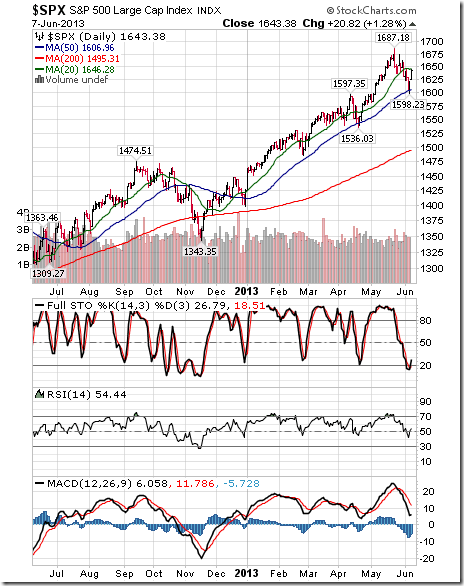
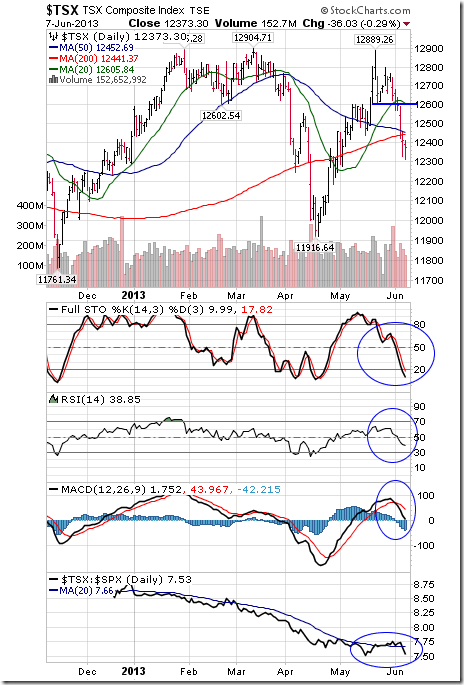
Despite gains by U.S. equity markets on Friday, short and intermediate technical signs show that U.S. equity markets (as well as equity markets in developed markets around the world) reached an intermediate peak on May 22nd. From peak to trough from May 22nd to June 6th, the S&P 500 Index dropped 5.3%, the Dow Jones Industrial Average fell 4.5% and the Dow Jones Transportation Average plunged 6.9% (The TSX Composite Index was down 4.5% during that period). Significant technical signs of a short or intermediate bottom have yet to appear.
Beyond the first couple of trading days, seasonal performance by North American equity indices in the month of June is negative. June is the second weakest month of the year for the Dow Jones Industrial Average and TSX Composite Index and third weakest month of the year for the S&P 500 Index.
The media “buzz word” is “tapering”. When will the Federal Reserve move to slow its $85 billion per month Treasury and Mortgage Backed securities purchases. When it happens, equity markets are vulnerable. Media discussion prior to the event will not help.
The Bottom Line
The intermediate corrective phase in North American equity markets remains intact. Short term strength provides an opportunity to reduce equity exposure, particularly in sectors that have a history of moving lower during a summer corrective phase. These sectors included industrials, consumer discretionary, materials and financials.
Selected sectors are setting up for seasonal trades this summer including fertilizers and gold. They already are showing signs of outperformance relative to the S&P 500 Index and the TSX Composite Index. Stay tuned for special sector opportunities as the summer progresses.
The S&P 500 Index gained 12.64 points (0.78%) last week. Trend remains up. Resistance has formed at its May 22nd high at 1,687.18. The Index remains below its 20 day moving average and bounced from near its 50 day moving average. Short term momentum indicators continue to trend down despite gains recorded on Friday.
The TSX Composite Index dropped 277.12 points (2.19%) last week. Trend changed from up to down on a move below 12,439.13. The Index fell below its 20, 50 and 200 day moving averages. Strength relative to the S&P 500 Index changed from positive to at least neutral. Technical score changed from 3.0 to 0.5 out of 3.0. Short term momentum indicators continue to trend down.
…..45 more charts and commentary HERE

 How about that? The Dow rose 207 points on Friday. Gold down $32 per ounce.
What does it mean? It looks like the big surge continues. Stocks go up. Gold goes down.
Our advice: Don’t pay it any mind.
It is like running through red lights. You do it once. Chances are nothing bad will happen. You do it twice… and still the odds are probably in your favor.
But keep it up, and unless you were born by the light of a full moon on the seventh day of the seventh month in 1977, you’re bound to run into trouble.
Stay tuned…
A Private Meeting
We shared our latest insight with members of our family wealth investment advisory service, Bonner & Partners Family Office. We were meeting, as we do every summer, at our family home in northern France. (If you are interested in what we’re about… and how to apply for membership… you can email our member liaison, Emma Walsh, at ewalsh@bonnerfamilyoffice.com.)
As we explained, a system is doomed when more people have an interest in continuing a mistake than in correcting it.
The Fed, in our view, is making a colossal error. It believes it can fix the economy as though it were repairing a garbage disposal. Just get out the tools and go to work!
That’s how Paul Krugman describes it. He thinks the economy is a machine… and economists are mechanics. And if the economy isn’t running right, it’s only because the economists haven’t fixed it properly.
So, we are supposed to believe, the Fed is jauntily tinkering, using the tools of ZIRP and QE to make the economy run better.
This is a huge mistake… but not an unpopular one. It makes it possible for the feds to finance huge deficits and pass out $100 bills out all over town.
The money goes to people who vote… write opinion articles for The Wall Street Journal… and hire lobbyists. The longer the situation goes on, the more zombies there are… and the harder they are to stop.
Zombie Feeding Frenzy
As the money flows, the organizations that get it are corrupted by it. The Associated Press reports on a zombie feeding frenzy by the military:
The Pentagon has been paying hundreds of millions of tax dollars a year to people and companies that don’t deserve it, but its financial management shortcomings are so severe that it’s made little progress in halting the errors or even measuring their magnitude, according to a report released by a Senate committee Thursday.
Although the Defense Department reported making over $1.1 billion in overpayments in fiscal year 2011 to military personnel and retirees, civilian defense workers, contractors, and others, investigators from the Government Accountability Office said that figure is not credible due to missing invoices and other flawed paperwork, as well as errors in arithmetic.
The U S Army Corps of Engineers, for example, has spent $256,000 since 2009 on an automated overpayment-detection program that has recovered just one improper payment of $20.79, GAO said.
To be even handed with Pentagon accountants, wasting a billion dollars or two out of a $700 billion budget doesn’t seem so bad. But as Everett Dirksen once put it, “A billion here, a billion there… pretty soon you’re talking about real money.”
Another recent article told us that there were more Pentagon contractors in Afghanistan than soldiers. The grunts might have all sorts of misbegotten and inappropriate motivations. But the contractors are clearly in it for a simple reason: money.
And from Defense News, we find that, as the wars wind down, the Pentagon continues to wind up:
The size of the Pentagon’s vast oversight organizations grew by more than 15% from 2010- 2012, despite efforts to pare down the US Defense Department’s bureaucracy, a Defense News analysis has found.
On August 9, 2010, then-Defense Secretary Robert Gates said the Pentagon needed to cut staff sizes. He made this task part of his efficiencies initiative – an effort to save hundreds of billions of dollars through better business practices. The military services’ incentive for accomplishing these tasks was that they would be able to get back some of that money to reinvest in other priorities.
But almost three years later, staff sizes within OSD, the Joint Staff and COCOMs have grown, prompting a new round of calls from senior Pentagon officials and defense observers to truncate the so-called “fourth estate.”
The Joint Staff, for example, grew from 1,286 people in 2010 to 4,244 people in 2012, a 230% increase.
“The problem is the bureaucracy is more resilient than even the most powerful secretary,” said Arnold Punaro, a retired Marine Corps major general, consultant and member of the Defense Business Board.
Defense secretaries come and go. Zombies just keep coming.
Regards,

Bill
P.S. We haven’t opened membership of Bonner & Partners Family Office for about 18 months. We try to keep the group small. We also try to keep membership slots for likeminded people only. The group’s mission is to protect family wealth over generations. Hardly something that appeals to the “masses.” But a number of loyal readers have joined… and it’s been a pleasure to welcome them into my family’s “inner circle” of advisors… recommendations… and gatherings.
Again, our member liaison, Emma Walsh, has details. Although we can’t guarantee there being slots available… Emma will be happy to place your name on a wait list. Here are her details again. Email address: ewalsh@bonnerfamilyoffice.com. Phone number: 1 855 849 2885.
Vancouver, Calgary and Toronto Detached Housing Priced in Gold
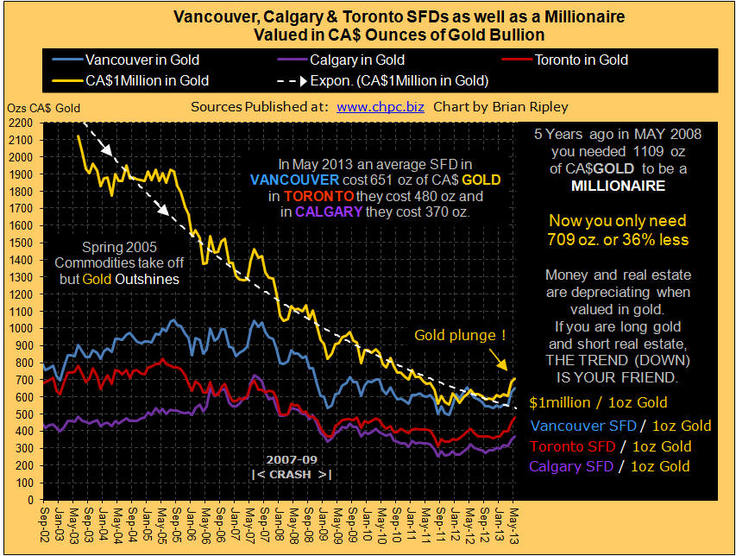
The chart above shows Vancouver, Calgary and Toronto detached housing priced in ounces of gold valued in CA$. Bullion attracts investment when credit markets contract because of its classic use as a hedge against currency depreciation and its ability to act as money, a store of value. The Millionaire Metric allows you to see what your dollar is worth and the (declining) amount of gold you need to be a millionaire. In May 2013 the spot price of gold continued to plunge driving the cost of real estate up in relation. So far it’s been a year and a half correction. In terms of value it requires 36% less gold to be a millionaire than it did 5 years ago.
…..view 12 more Real Estate Charts HERE


-
I know Mike is a very solid investor and respect his opinions very much. So if he says pay attention to this or that - I will.
~ Dale G.
-
I've started managing my own investments so view Michael's site as a one-stop shop from which to get information and perspectives.
~ Dave E.
-
Michael offers easy reading, honest, common sense information that anyone can use in a practical manner.
~ der_al.
-
A sane voice in a scrambled investment world.
~ Ed R.
Inside Edge Pro Contributors

Greg Weldon

Josef Schachter

Tyler Bollhorn

Ryan Irvine

Paul Beattie

Martin Straith

Patrick Ceresna

Mark Leibovit

James Thorne

Victor Adair