
Bonds & Interest Rates
The sell-off in government bonds has gone completely global as concerns over Federal Reserve tapering of monetary stimulus infect the market.
Everywhere this morning, bond yields are up huge as investors dump sovereign debt.
In the United States, the 10-year yield is up 6 basis points to 2.26%, its highest level in over a year.
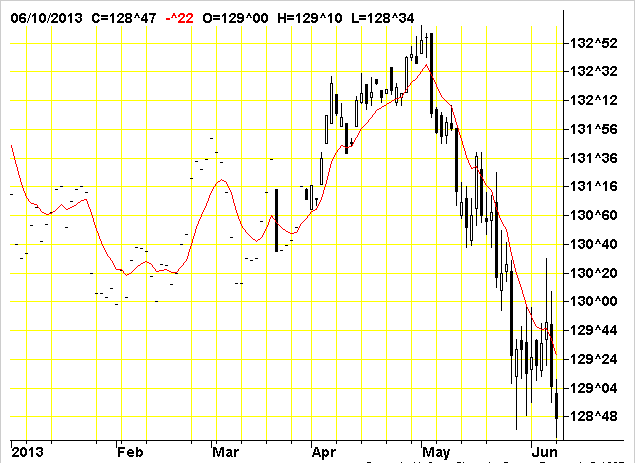
In the eurozone, French 10-year yields are up 5 basis points to 2.23%, Germany is up 3 basis points to 1.63%, Italy is up 15 basis points to 4.43%, and Spain is up 14 basis points to 4.471%.
Portuguese 10-year yields are up 37 basis points to 6.49%, and Greek yields are up 93 basis points to 10.28%.
Elsewhere in the developed world, the Japanese 10-year yield is up 5 basis points to 0.88%, Canada is up 5 basis points to 2.25%, Australia is up 11 basis points to 3.40%, and Switzerland is up 10 basis points to 0.84%.
Moving to emerging markets, Brazilian 10-year yields are up 14 basis points to 4.03% Mexico is up 14 basis points to 3.46%, Russia is up 15 basis points to 3.90%, and Turkey is up 31 basis points to 4.53%.
Treasuries and emerging market bonds have been selling off in recent sessions, but today, it definitely looks like the purge is accelerating.
Meanwhile, stocks are selling off globally as well. The Japanese Nikkei closed down 1.5% overnight following the latest Bank of Japan policy meeting.
In Europe, stocks have been heading lower all morning and most are trading near their lows of the day. Spain is down 2.7%, and Italy is down 1.7%. France is down 1.9%, and Germany is down 1.7%.
“Stocks across [Europe] are taking a shellacking to the tune of around 2% as rising German bund yields prompt accelerated losses for government bonds around the periphery,” says Miller Tabak Chief Economic Strategist Miller Tabak in an email this morning. “Yields on Spanish and Italian debt are rising to the highest in six weeks. The loss of last week’s lows for equity markets is all too much to bear in most cases and the resilient tone appears to have been snapped like a twig.”
Commodities are getting hit, too. WTI crude oil is down 1.3%, while Brent crude is down 1.5%, and NYMEX gasoline is down 1.3%., Gold is 1.2% lower, silver is down 1.5%, and platinum is down 1.3%. Agricultural commodities are all in the red with the exception of corn and soybeans, which are both flat.
In the United States, S&P 500 futures point to an open down 0.9%.
Meanwhile, the U.S. dollar is 1.9% lower against the Japanese yen, and the euro is down 0.1% against the dollar.

The recent collapse in gold price hasn’t discouraged consumers across Asia, and in particular from China and India from buying yellow metal. Taken together, China and India account for more than half of the total consumer bullion demand worldwide. What we are seeing now is an exceptional phenomenon because Indian demand for gold is up 200% from a year ago.
Gold demand in India, the world’s largest buyer, is heading for a quarterly record as imports reach 300 to 400 metric tons, the World Gold Council said in a report last week. Again, we’re only getting close to the mid-way point of the year and the amount quoted by the WGC is equal to almost half of the total shipments for all of last year. We read that banks are actually being told to discourage gold investment and suggest financial products instead. Interesting isn’t it?
It looks like Indian, Chinese and Middle Eastern consumers are taking a long-term view on the prospects for gold. I’m not surprised you would want something to decline in price to buy more for yourself, but are you sure that the recent gold price collapse is as great a buying opportunity as it seems?
Let’s look at the charts and search for some answers. We’ll start with the USD Index long-term chart (charts courtesy by http://stockcharts.com).
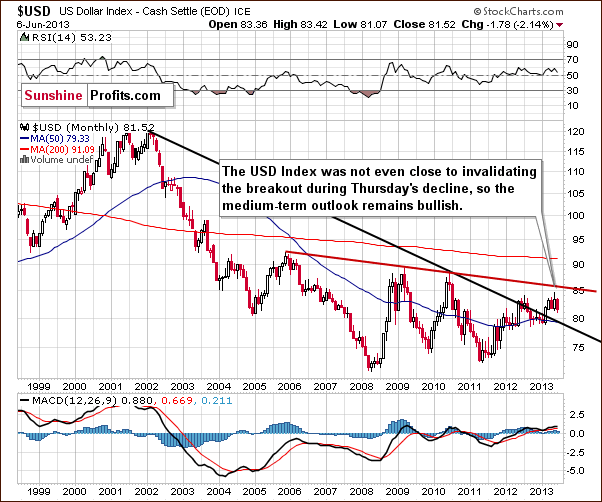
In this week’s long-term USD Index chart we see the index is still above the declining support line and the bullish medium-term outlook has not been invalidated here. That’s why last week’s decline has very little impact from this perspective. We discussed the underperformance of the precious metals relative to the USD Index several times last week beginning with Monday’s Market Alert.
… gold is responding strongly to the dollar’s rallies but responds less significantly to its declines. This is a bearish situation as it means that gold would likely decline even if the USD was just trading sideways.
This underperformance (responding less significantly to declines) was clearly taken to the extreme on Thursday.
The situation remains bullish for the USD Index. Does it look bullish for the general stock market, too? Let’s find out.
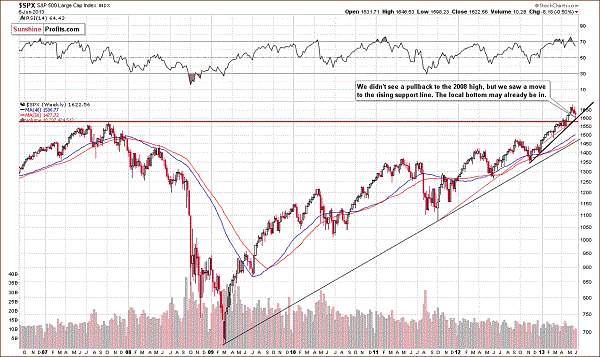
As we wrote in our essay on gold, stocks and the dollar on May 17,2013:
The situation is overbought on a short-term basis, but we do not expect to see an invalidation of the breakout above the 2007 high. If anything, we could see stocks move back to this level, which could further verify the breakout and allow them to gather strength in advance of the next rally.
Although the last correction was deeper than the previous one it doesn’t change the overall picture of the market. As long as stocks are able to hold up above the 2007 high the uptrend is not threatened. That’s why we think that the bottom for the latest decline may be in. The main buyers arguments are certainly two support lines because price levels bounced off the intersection of them.
This could mean that the bottom in the stock market is in anyway.
Now that we know how the situation looks from the perspective of the dollar and the stock market, it’s time to take a look at the yellow metal itself. (Click HERE or on image for larger view)

In this week’s very long-term gold chart, we see that the trend remains down. Despite a $20 move up last week the outlook continues to be bearish (it’s hard to take this small increase as a sign of improvement especially as we consider the whole decline.
Gold could still decline heavily based on the long-term cyclical turning point, which is due approximately this week. In both 2008 and 2009, local tops formed slightly after the cyclical turning point, so it is possible that the reversal in the downtrend won’t be seen until after the cyclical turning point once again, leaving a number of days in which further declines could be seen.
Summing up, the long-term outlook is bullish for the USD Index at this time. As for stocks, the situation remains bullish for the medium term, and although the last correction was deeper than previous one we don’t expect to see a bearish trend immediately. It seems that higher stock prices will be seen without further declines. Finally, gold’s picture provides us with bearish indications.
Overall, it seems that the final bottom in the yellow metal is not yet in.
We know keeping an eye on the market is very important to you, as you care about your savings and that’s why we hope you’ve enjoyed reading this essay and that it will help you to decide whether or not buy gold Asian style, anytime soon.
Thank you for reading. Have a great and profitable week!
Przemyslaw Radomski, CFA
Founder, Editor-in-chief
Gold Investment & Silver Investment Website – SunshineProfits.com
* * * * *
Disclaimer
All essays, research and information found above represent analyses and opinions of Przemyslaw Radomski, CFA and Sunshine Profits’ associates only. As such, it may prove wrong and be a subject to change without notice. Opinions and analyses were based on data available to authors of respective essays at the time of writing. Although the information provided above is based on careful research and sources that are believed to be accurate, Przemyslaw Radomski, CFA and his associates do not guarantee the accuracy or thoroughness of the data or information reported. The opinions published above are neither an offer nor a recommendation to purchase or sell any securities. Mr. Radomski is not a Registered Securities Advisor. By reading Przemyslaw Radomski’s, CFA reports you fully agree that he will not be held responsible or liable for any decisions you make regarding any information provided in these reports. Investing, trading and speculation in any financial markets may involve high risk of loss. Przemyslaw Radomski, CFA, Sunshine Profits’ employees and affiliates as well as members of their families may have a short or long position in any securities, including those mentioned in any of the reports or essays, and may make additional purchases and/or sales of those securities without notice.

THE MAY 22nd ‘KEY REVERSAL’ TRIGGERED A NEARLY A 700 POINT CORRECTION IN THE DJ AND a 87 POINT CORRECTION IN THE S&P. THAT MAY HAVE BEEN IT! WATCH TODAY’S TURNAROUND TUESDAY AND THE BANKING STOCKS FOR A SIGN THAT WE COULD BE HEADED TO NEW HIGHS. THE CAVEAT IS THAT IF THURSDAY’S LOWS (E.G., 1598 SPX) DOES NOT HOLD GOING FORWARD, THE ‘SELL MAY AND GO AWAY’ WILL BE RIGHT ON TARGET TO THE EXTENT OF 1525 SPX and 14198 DJ.

———————————————
Unlike Friday, the stock market didn’t provide a lot of trading excitement on Monday. The major indices spent time on either side of the unchanged mark, but were never able to achieve a good deal of separation either way as buyers and sellers alike lacked conviction. There was some initial excitement when it was announced before the open that Standard & Poor’s raised its US outlook to Stable from Negative, citing a lessening of downside risks to its AA+ rating for US sovereign debt. That positive-sounding headline helped stocks get off to a decent start, yet buying efforts soon tapered off as a concurrent rise in long-term interest rates seemed to limit the stock market’s enthusiasm for the outlook change. The yield on the 10-year note moved up to 2.23%, or roughly six basis points higher than where it settled on Friday. The move was striking considering the switch by Standard & Poor’s should have been construed as a good thing for the Treasury market. The ensuing weaknes s, though, seemed to fit with the sense that an improving economic outlook would lessen the safety premium in Treasuries and encourage a rotation into stocks. Nonetheless, not all participants are convinced that the economy will gain steam in coming months; hence, there were some underlying concerns that the jump in rates could retard the recovery as they interfere with the rebound in the housing market.
There wasn’t any economic data out on Monday, but ‘talking mouthpiece’ St. Louis Fed President Bullard did address economic conditions in a speech on the global economy. Mr. Bullard is a voting FOMC member and he walked the party line of providing a little something for everyone in the tapering debate. To wit, he suggested the low rate of inflation could be justification for the Fed to maintain its aggressive asset buying over a longer time frame and then added that an improved labor market could mean the Fed might slow the pace of its asset purchases.
The Wholesale Inventories report for April (Briefing.com consensus +0.2%; prior +0.4%) is the only piece of US data slated for release on Tuesday. It won’t be a market mover, so the direction of currencies and interest rates could be dictating factors along with any new insight from Germany’s Constitutional Court on the legality of the eurozone’s crisis-management measures.
Also, it’s TURNAROUND TUESDAY. With Monday down, can we expect a nice pop? Watch XLF (the banking ETF) and names in the sector. Goldman Sachs (GS) broke out on Monday and that could be telling us we’re looking at new highs.


Let’s begin with a reminder of where we are in the market cycle. At present, the stock market is in a mature, heavily bullish, overbought, overvalued bull market advance, near a multi-year high in the S&P 500, with consumer confidence at similar multi-year highs, with the broad perception that downside risk is insignificant, and that “tail risk” has been eliminated. This is a dangerous place to be, because it is precisely where risk aversion is scarce and hated most by investors, and where risk aversion is most likely to be rewarded in the future.
Consider the opposite. Recall the points in time where the stock market has been in a mature, heavily bearish, oversold, undervalued (or at least moderately valued) bear market decline, near a multi-year low in the S&P 500, with consumer confidence at similar multi-year lows, with the broad perception that downside risk is enormous, and that “tail risk” is growing. This is a wonderful place to be, because it is precisely where the willingness to accept risk is scarce and hated most by investors, and where the willingness to accept risk is most likely to be rewarded in the future.
Which market environment is the one where investors should generally be optimistic about multi-year market prospects? Clearly, the second. It’s a description that applies well to the 1974, 1982, 2002 and 2009 bear market lows. In contrast, the present description applies equally well to the 1972, 1987, 2000 and 2007 bull market peaks. It should be utterly obvious here that risk aversion is appropriate in present conditions.
…..read more about 2009 versus 2013 HERE

“Washington’s witch hunt can — and is — hurting the securities markets.
It can mean the difference between making oodles of money in the months and years ahead, or losing oodles of money”
I’VE NEVER BEEN MORE OUTRAGED AT WASHINGTON
The National Security Agency’s order for Verizon to turn overall customer records is an abomination on the rights and liberties of every American. I am outraged. I’m sure you are too.
I have never felt such anger at Washington. Our founding fathers must be turning over in their graves. What have we come to? Is America now a fascist state? Are we heading toward communism?
When will it stop?
I’m afraid it won’t. If you think there’s been a loss of privacy and liberty since George W. Bush took office 13 years ago, brace yourself ? it’s about to get a lot worse.
It’s what happens when governments start to fight for their survival. It happened in Rome. In Byzantium. In the Weimar Republic in Germany. And in countless other countries where governments became desperate for revenue and started losing the confidence of their citizens.
They start invading upon citizens’ privacy and liberties. They start regulating everything in sight. And they start taxing just about anything that moves.
 Why is it about to get a whole lot worse for us Americans? There are several reasons.
First, as you well know, Washington is dead broke. If it weren’t for the Federal Reserve buying $85 billion in Treasuries each month and the good graces of China and other countries still extending credit to Washington ? the government would have shut down long ago.
Second, Washington sees what’s happening in the streets of Greece, France, Spain, Turkey and other countries: Massive social unrest, protests, civil war.
So Washington is preparing to head off the same here, expecting social unrest to eventually strike our country. The Department of Homeland Security is loading up with tanks and millions of bullets, real and rubber.
Drones can now fly right over your home or business, and monitor your comings and goings.
Have a nice car that the IRS might think is too expensive for your lifestyle based on your tax return? Be careful. A drone could be reporting it to the IRS, triggering an audit.
Laptops and cell phones can be confiscated and searched ? without a warrant ? when you return from your overseas vacation.
The FBI and National Security Agency are monitoring the servers of nine huge American Internet companies, monitoring audio and video chats, how you surf the web, what you surf for and more.
Wiring money overseas for as little as $3,000 is now reportable to the government by your bank.
We live in a virtual fascist police state.
Of course, those in power in Washington will always claim that it’s all in defense of our country, to ferret out terrorism. But that’s a ruse.
It’s exactly the opposite: It’s to terrorize you into complying with every inch of red tape the government issues.
To pay every penny of tax and more they think you owe.
And to ultimately force the U.S., and eventually the global monetary system, into a cashless digital currency so they can track every penny of wealth you have.
That’s where we’re headed: George Orwell’s “1984″ — but worse.
But it’s not only happening in the U.S. It’s also taking place in France, Germany, Italy, Spain, and just about every country where governments are having financial trouble.
And it’s amazingly ironic that a true communist country like China ? for all its faults ? is going in the opposite direction. Becoming more democratic, more free, more supportive of business.
Don’t get me wrong: The U.S. is still the greatest country on the planet. I am American and always will be. Though I live overseas, I have no plans whatsoever to give up my citizenship and become an expatriate.
But I don’t like where our country is headed, not by a long shot. I am outraged.
And whether you are or you aren’t, I think it’s also critically important that you understand how Washington’s witch hunt can — and is — hurting the securities markets.
It can mean the difference between making oodles of money in the months and years ahead, or losing oodles of money.
I see three major consequences of Washington’s ? and other governments’ ? efforts to track and tax your wealth:
First, it’s going to do exactly the opposite of what the government intends. It’s going to send more and more small-business transactions underground.
It’s going to create more and more barter. More attempts at private digital currencies like Bitcoin. It’s going to send money into hiding, to the extent possible these days.
Second, it’s going to send more and more money ? and assets ? offshore. Yes, any money you place offshore, any gold or silver bullion, needs to be reported to the IRS.
But that won’t stop money and precious metals from heading offshore. In the minds of most investors ? and I agree ? the further away from Washington’s reach your money and many of your assets are, the better.
Third, and most importantly, it’s going to have a mind-boggling effect on nearly all financial markets.
Namely, it’s going to drive capital in a way that is constantly seeking out what I call “portability and fungibility.”
Portable wealth is money and assets that can be easily transported, and more easily hidden from view. Examples: Artwork, diamonds, jewelry, gold and silver coins, numismatics and more.
But portability does not stop there. Portability can also be assets that are deemed non-confiscatable, such as stocks. Own a government bond, and Washington knows you own it. Own a share in Apple, and it’s unlikely Washington will subpoena Apple for a record of your shares.
But even if it were to do so, you have an option: You can take possession of your Apple stock certificate, and get out of your brokerage account and be somewhat further removed from the government’s prying eyes.
That’s one of the reasons there’s been a rise in shareholders taking street delivery of their stock certificates over the past year or so: To get it off the grid, so to speak.
It’s also one of the reasons I see the stock market doing well for years to come. It’s a private-sector investment. Not only are there loads of companies in better shape than the U.S. government, stocks are considered an asset class free from government confiscation.
Stocks ? and especially gold and silver ? are also fungible. When you need cash, digital or otherwise, stocks and gold and silver are easily converted back to a more easily used medium of exchange.
Portability and fungibility are going to be major forces behind the next bull leg higher in gold and silver, which is now closer than ever.
Ditto for stocks. Speaking of which, the short-term correction I warned you about in my last column appears to have arrived.
The S&P 500 Index closed below 1,644.50 ? the signal I gave you in my last column ? and then promptly fell even further, shattering the
1,621 level I also gave you in that column.
The market is now positioned for a solid pullback of as much as 10 percent. But don’t let it throw you off-base. For many of the reasons I just mentioned, and others I’ve written about, the U.S. equity markets are headed much higher over the long-term.
Not despite the problems our country has, but because of them!
If you acted on my suggestion last week to purchase shares in the triple-leveraged inverse ETF, the ProShares UltraPro Short S&P 500 ETF (SPXU), then you’re sitting pretty. Hold that ETF.
Best wishes and stay tuned …
Larry


-
I know Mike is a very solid investor and respect his opinions very much. So if he says pay attention to this or that - I will.
~ Dale G.
-
I've started managing my own investments so view Michael's site as a one-stop shop from which to get information and perspectives.
~ Dave E.
-
Michael offers easy reading, honest, common sense information that anyone can use in a practical manner.
~ der_al.
-
A sane voice in a scrambled investment world.
~ Ed R.
Inside Edge Pro Contributors

Greg Weldon

Josef Schachter

Tyler Bollhorn

Ryan Irvine

Paul Beattie

Martin Straith

Patrick Ceresna

Mark Leibovit

James Thorne

Victor Adair