
Timing & trends
In six months, from Nov 16/12 to May 22/13, Japanese stock indices soared ~100% and the Yen fell ~25%…in sync with massive “quantitative easing” in Japan. The tsunami of Japanese liquidity contributed to hugely bullish Market Psychology around the world…US and European stock indices soared…many to new All Time Highs…junk bond yields fell…gold lost ~$400…everybody took on more leverage…margin debt on the NYSE hit all-time highs…BUT…on May 22/13 Market Psychology “turned on a dime”…the Nikkei fell >20%, the Yen rallied >10% and the market dared to ask, “What happens if Abe’s Grand Plan fails?” Well, if that’s the case, then the May 22/13 Key Turn Date could signal the end of four years of Central Bank inspired rallies in financial assets…with some BIG CHANGES coming across the board.
Big Picture:
For the past few years, in answer to the question, “What are we trading?” I’ve been saying that anticipation of Central Bank activity is “The” dominant factor driving Market Psychology…that seems more true now than ever as the recent tsunami of Japanese liquidity has helped to drive major American and European stock indices to All Time Highs.
Past 6 months:
Early last fall Market Psychology turned mildly bearish after the “buzz” from the Fed’s latest Q program wore off around the Sept 14/12 Key Turn Date…the US stock market drifted lower until the Nov 16/12 Key Turn Date…when the market realized that Abe was going to win the Japanese elections and begin implementing his extraordinary policies…hoping to end two decades of deflation in Japan…hoping to cause asset inflation and a weaker Yen…hoping to create inflationary expectations throughout the Japanese economy. In poker lingo, Abe went “All In.”
For six months it looked like Abe was a winner. His popularity with the electorate remained strong…Japanese stock indices soared and the Yen tumbled . The Japanese credit tsunami boosted bullish Market Psychology around the world…US and European stock indices rallied (the S+P gained ~25%)…yields on junk bonds and peripheral country bonds fell…gold was shunned and fell ~$400…the use of leverage soared…margin debt on the NYSE hit all-time highs.
Past 3 weeks:
But bullish Market Psychology got WAY overdone by mid-May 2013…Bernanke provided the “spark” to ignite a correction on May 22 when he hinted at a possible future reduction in the Fed’s easy money policies…and suddenly we had a Key Turn Date…since then the Nikkei is down >20%, the Yen has rallied >10% and the S+P was down >5% at last week’s lows.
During the six month rally phase and during the current bear phase Japan has been the LEAD PLAYER for Market Psychology. Now that Market Psychology has turned negative it dares to ask the question, “What happens if Abe’s Grand Plan fails?” My answer is that Japan has been the market’s best friend for the last 6 months…if Abe’s Grand Plan is perceived to be failing then Japan could become the market’s worst enemy.
If bearish Market Psychology persists then leverage will be reduced…margin clerks will become a force. We have seen Emerging Markets get hit…capital is seeking safety…leaving the Periphery and returning to the Center…if bearish Market Psychology persists we may see “It never rains but it pours” bear market…i.e., problems in Europe may come to the fore…problems in China may come to the fore…problems in the Mid-East may come to the fore…and these problems will collectively weigh on the market.
My short term trading:
Shortly after the May 22/13 top was made (I had been anticipating a top, but waited for a confirmation) I began to write short-dated OTM puts on the Yen…betting that the Yen would stop falling. I also wrote short-dated OTM calls on the S+P…betting that it would stop rising. I added to these positions over the next couple of weeks…also added outright shorts on the S+P…these positions have now mostly expired or have been closed out. I also wrote short-dated calls on the Euro…betting that it would stop rising…but I lost money on that trade as the Euro has been surprisingly strong. (I had also written OTM Crude calls, then after crude fell, I wrote OTM Crude puts to create a strangle…those options all expired OTM.)
I’m pretty much flat at the moment…(I’m still short some way OTM calls on the S+P that expire this week) but here are some of the short term trading ideas I’m considering: FX: The USD is oversold, the rally in the Yen and the Euro is overdone, the CAD has rallied a couple of cents but remains within a multi-month downtrend. Stocks: The “correction” in the S+P will continue…I will look to get short if a “buy the dip” rally fails…we might have seen that Thursday/Friday. Bonds: are oversold…if they don’t make a new low on a “buy the dip” stock rally then I might buy them. Gold: probably hasn’t bottomed yet…it could sell off more in a deleveraging theme…BUT…gold tumbled ~$400 or 23% during the six month Japanese inspired global stock market rally…stocks were preferred and gold was shunned…and gold suffered…but if Market Psychology is turning negative on stocks then gold could come into favor…see the “Charts” section below for my idea about buying gold Vs. stocks. Crude: oversupply will weigh on prices but escalating Mid-East tensions could take prices higher…possibly sharply higher. Risk Management: Be aware that these trade ideas in FX, Stocks, Bonds and Gold are opposite sides of the same trading theme….
Longer Term Themes:
I think the “Age of Deleveraging” (thank you Gary Shilling) is continuing…I think the USD is headed higher…stocks are headed lower…interest rates are headed higher (but best-quality bonds may rally if stocks fall)…gold is likely headed lower near term if Market Psychology remains bearish and leverage is reduced…but I’m seriously looking at buying gold against the S+P (see charts below.) From an overall investment point-of-view I think it’s a good time to be defensive…to take some money off the table now that the “exuberance” generated by the Japanese liquidity tsunami has run its course. I can easily imagine that the 6 month run to new All Time Highs in several American and European stock indices was the “Last Leg” of a four year rally driven by successive rounds of stimulative Central Bank policies…if that’s the case, then the May 22/13 Key Turn Date would signal a MAJOR turn in financial assets…and some BIG CHANGES coming across the board. With my skeptical trader’s mentality I’m happy to have >90% of my net worth in cash…35%in USD and 65% in CAD.
Charts:
We had a Weekly Key Reversal Down in the Nikkei 4 weeks ago…followed by 3 more weekly lower closes…the Nikkei is down ~22% from its May 22 KTD highs, after rallying ~100% from its mid-November lows. A bounce seems inevitable, but I’m betting we’ve seen the high.

We had a Weekly Key Reversal Up in the Yen on the May 22 KTD… followed by 3 more weekly higher closes…hedge funds that bought the Nikkei must have sold the Yen to cover their currency risk…now they have to buy back the Yen.

We had a VERY RARE and powerful Monthly Key Reversal Down in the Bond market in May…on the monthly chart this is a strong signal that the “buy the dip” April rally failed and lower prices (higher yields) lie ahead…but the bonds may catch a bid if stocks fall.

The US dollar has closed lower for 4 consecutive weeks…mostly due to Euro strength…I’ll be looking for signs that the sell-off is over to establish long US Dollar (or short Euro) positions.

Crude had a Weekly Key Reversal Up the week-before-last and last week’s close was the best since September last year. The market looks like it wants to go higher on Mid-East tensions…if those appear to ease then the “over supply” factor should weigh on prices.

Gold made its all-time high in USD terms in September 2011…but it also made a 23 year high in terms of the S+P…since then the ratio has declined ~50% (as gold fell and the S+P rallied) and it “may” be signaling a reversal around the May 22 KTD. I can easily imagine a scenario over the next few months where gold falls less than the S+P, or rallies in terms of the S+P…so I’m looking at constructing a trade where I buy gold and sell the S+P.

Futures and futures options are the best way to trade currencies, metals, stock indices and many other financial and commodity markets. Call 604 664 2842 to talk with a futures broker.

 Things have been a little erratic lately here in US, but not really headline-worthy. The economy continues to grow, sort of, houses continue to sell and stock and bond prices fluctuate but can’t seem to follow through in either direction. We are not, in short, engulfed in any kind of crisis.
But out in the world, especially in once-hot emerging markets like Brazil and China, the story is very different. As Prudent Bear’s Doug Noland explains in his most recent Credit Bubble Bulletin:
…..read it all HERE

 »» Government bonds broke their multi-week losing streak and yields fell. Sentiment shifted as concerns about imminent Federal Reserve tapering waned.
»» RBC Capital Markets anticipates the Fed will begin to gradually taper in October 2013, and complete the process by April 2014. (see table page 2)
»» Even though the recent surge in bond yields may be overdone on a short-term basis, it serves as a wake up call for investors. (page 3)
»» Global Roundup: Preview of Germany’s upcoming election. (page 4)
For the complete Weekly Report as well as Daily Updates CLICK HERE.

 There are certain times – like now – when investment markets appear to be in a state of “suspended animation.” And it’s extreme times like these when the disconnection of markets from common sense, logic and rational valuation puts our Patience and Discipline to the test in an almost overwhelming way. Rest assured, a major tipping point is coming soon, perhaps even before the next edition of this newsletter.
Since the equity markets hit their crisis bottom in early March 2009, many investors have been waiting for the second half of the global debt hurricane to hit. This bias, based on then-recent experience, makes it difficult for many to ride an uptrend with patience…after having been burned significantly by market declines that mainstream “experts” said were simply not possible. It’s also incredibly difficult to forget the emotional and financial pain caused by the 2008-9 financial crises.
This memory of fear and loss has caused many investors to be more cautious than they otherwise would have been. If one looks at rise in the U.S. or Japanese equity markets, frustration can rise pretty quickly…no one likes to “miss out” on gains after experiencing major declines.
This is especially true when U.S. markets continue grinding higher without even a normal 8-12% seasonal pullback. Japan’s markets have now corrected more than 20% from their May 22nd peaks, and the question many are asking is whether or not the U.S. and Europe will follows suit. Only time will tell.
For now, U.S. equity markets appear to have some more upside potential, based on pure momentum of the major uptrend, juiced by bullish rhetoric from the Wall Street mavens. There’s nothing rational, logical or fundamental about it. It’s just a trend in motion, which continues until it actually changes.
Experienced investors understand that the more that markets stretch to the upside beyond a sustainable level, the further and faster they drop. Anyone who has ever played with an elastic band understands this same concept – and the snap-back is always painful.
As surprising as this may sound, I actually expect that U.S. equity AND bond markets will yield average to above average returns over the next 25-27 months. This is not based on the excellent health of the U.S. economy, consumers, demographics or the sustainability of its massive personal and public over-spending. It’s based upon how much worse Europe and Japan are in these and other matters.
In all situations, it’s fundamentally about CAPITAL FLOWS. Investment capital always moves to where it perceives it will be treated best. Capital (money) is merely one form of energy, and when massive amounts of energy flow from one area to another, it causes massive changes in price. Departing capital leaves behind chaotic price declines. Arriving capital creates massive rises in prices. Think of how tides affect boats of differing quality and size.
This prediction of positive returns in U.S. based investments – including the $US – over the next couple years does not mean we’ve seen the end of market volatility because we’ve returned to “normal times” again. On the contrary, these massive shifts in institutional investment capital will serve to significantly increase volatility for short periods. This volatility will scare away even more retail investors near bottoms, leaving the gains there for disciplined big-money investors, whom I refer to as “the elephants.” Always follow the elephants, but don’t try to anticipate their movements – one misstep can be disastrous.
If things play out as our research sources have predicted, we’ll first see European bond and stock markets roll over and tumble, causing short term shocks everywhere else. Perhaps this starts in early August, with rising resistance by German citizens in respect of supporting their less-disciplined Euro comrades? Angela Merkel tries for re-election on September 22, and European banks are woefully vulnerable to the potential write-downs of the European bonds which they hold as Tier 1 Capital.
In 2014, perhaps it will then be Japan’s turn to implode, triggering a financial tsunami of fleeing capital to U.S. markets? The Japanese government and central bankers are showing their desperation with extreme forms of Quantitative Easing/Currency Devaluation intended to re-inflate their flat-lined economy. Not surprisingly, they’ve created a bubble in their equity markets, with little effect on their real economy.
In the meantime, both Gold and Silver remain near their April 15th lows, with little upward strength. As this is written, we are rapidly approaching major cycle bottoms according to the work of several of our trusted research analysts. Will we hold support around the low-mid $1,300’s or will that support break and we see a test to lower levels such as $1285 (Charles Nenner) or even $1,158 (Martin Armstrong)? If precious metals do sell-off in a big way we’ll avoid that sector until it shows signs of massive panic and major capitulation. We’ll know within a few short weeks…simply “follow the elephants” with risk controls in place.
In the meantime, the U.S. government is now being revealed – not just suspected – of being an intrusive predator upon the privacy of its own citizens. Ironically, the U.S. security agencies are re-enforcing the fears that led their country’s Founding Fathers to create the Second Amendment – the right to keep and bear arms. The sophistication and pervasiveness of their surveillance is mind-boggling and frightening, and that’s just what we know about so far.
When Republicans, Democrats and the mainstream media ALL AGREE that this level of intrusion is justified in the name of “homeland security,” and actively engage in character assassination of whistleblowers like Edward Snowden…there is a BIG problem. Is it any wonder that sales of George Orwell’s classic “1984” have sky-rocketed recently?
And over in the Middle East, the “justification” for the U.S. getting more actively involved in Syria’s revolutionary conflict is building. Could a full-out war against the Assad regime and its allies Russia and Iran (the latter of which just sent in 4,000 troops to support Assad) be a convenient distraction from all the scandals plaguing the Obama Administration and the hollowing out of Main Street courtesy of Wall Street? Wars are never entered without careful calculation, but only when public support has been raised to necessary levels. In my opinion, this one is only a matter of time.
Everything unfolds with time, so we remain vigilant for both danger and opportunity. Patience and Discipline are accretive to your wealth, health and happiness; Fear and Greed are destructive.
Andrew Ruhland of Integrated Wealth Management in Calgary

Nearly 21 months ago, one of the world’s leading analysts and proponents of gold shocked the investment community with the announcement that the yellow metal was headed south.
Most of his colleagues in the industry scoffed. But his loyal followers took action according to his explicit instructions: They bought gold hedges for protection against the decline. They liquidated their mining shares. And then they waited — sometimes patiently, sometimes anxiously — for his next major “buy” signal.
That gold analyst is Weiss Research’s Larry Edelson, and last week, I began this three-part series of fascinating interviews with him. Here’s Part II …
Martin Weiss: Larry, for the sake of those who missed Part I of this interview, please lay out the full dimensions of the opportunity.
Larry Edelson: My analysis tells me the next leg of the gold bull market will not end for three full years. It will not peak until the yellow metal is at $5,000 per ounce or more. And it will spin off a long series of trading opportunities in virtually every investment that’s tied to gold and other precious metals — bullion, shares, ETFs, plus unique trades that most investors are unfamiliar with.
Martin: Starting immediately?
Larry: Too soon to say, but we are getting very close to it, yes.
But I must repeat: Do not jump in prematurely or all the way as so many gold investors have continually done in the past 21 months or so. And certainly not with all of your money.
Martin: OK. Meanwhile, last week, you gave us very practical guidance on the wrong and right ways to buy bullion coins. Can you expand on that now?
Larry: Sure. In addition to the coins I talked about last week, there’s also a variety of gold coins available in much smaller sizes, enabling you to buy gold in relatively small increments of less than 1 ounce. The drawback has always been price: The smaller the coin, the greater the premium.
Thus, as you buy smaller and smaller denominations, you get progressively less and less gold for your money, because the premium is higher. However, some folks in the industry who favor these smaller-denomination coins set forth two counter arguments:
First, they say the premium can be recovered when you resell the coins.
Martin: Is that true?
Larry: Half true, and not always. On average, right now, you’ll probably lose half and recover half.
Look. We’re talking about “fractional coins.” And the market for the full ounce gold coins is far broader, deeper and more liquid than for these fractional gold coins. When you go to sell three years from now, you may even have to accept an additional discount with the smaller coins rather than recover part of the premium lost on the purchase.
The second argument they make is that in an economic catastrophe, the smaller gold coins would be easier to spend or swap for groceries, gas, etc.
Martin: True or not?
Larry: Perhaps. But it’s also possible that in an economic catastrophe, the full ounce coins — because of their wider distribution — would be equally easy (or easier) to spend. But who can know for sure?
Martin: Can we switch from small things to big things? If you’re a large investor and you want to invest in gold bullion in substantial amounts, where do you go?
Larry: Let’s talk about 1,000-ounce bars. Even at the best-priced dealers, you can expect to pay anywhere from 30¢ to about $1 an ounce over spot when you buy them from a good delivery brand, like Engelhard or Johnson Matthey.
However, if you’re prepared to invest substantial sums at one time, you can save almost that entire fee. You can buy gold at just pennies more than the actual spot price: Buying a “spot month” gold futures contract from your regular commodities broker and take delivery of it.
 Martin: Can you give us an example?
Larry: The contract will be for 100 ounces of gold and the commissions run between $40 and $100 — which works out to less than $1 an ounce.
The problem is that 100 ounces of gold can cost more than most investors want to lay out at one time. For instance, at $1,400 gold, to take delivery of one futures contract would involve $140,000 (100 ounces times $1,400 an ounce). It also involves buying and taking delivery of a futures contract. Not something I recommend except for the largest of investors.
A better alternative may be to buy directly from a wholesaler. Just be aware of some of the restrictions.
First, most wholesalers require minimum purchases of the precious metals.
Second, most are not set up to service small retail accounts. They are not going to give you advice, nor will they try to help you make a decision or give any other brokerage-type services. If you have a question about what to buy, how much, when and so forth, don’t go to them.
Third, most require payment in advance, before they can even lock in a price. The advance can be sent in the form of a bank wire, cashier’s check or a certified check.
Note that ingots and bars are available in sizes ranging from as small as 1 gram of gold to 10- and 100-ounce bars. Naturally, the smaller the ingot or bar, the higher the premium you’ll usually pay.
Martin: What about the kilo gold bar?
Larry: It’s the unit of choice in almost all international gold transactions. But there are pros and cons.
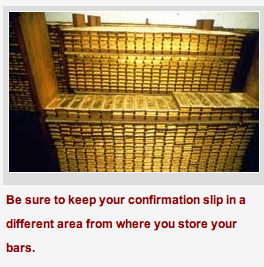
First, the positive side. Each of the bars carries a serial number. Have your dealer record the serial number and hallmark on your confirmation slip. Don’t keep it where you store the bar. If the bar is stolen, you are in a much better position to deal with the insurance company by having a readily identifiable number to cite, as opposed to reporting that “X” number of unidentifiable coins were stolen.
Also, you’re in a much better position to claim your property should the police ever recover it. So the serial number is a desirable feature of buying kilo bars.
On the negative side, they’re a relatively unattractive way to hold gold. There’s nothing beautiful about a kilo bar, compared with the artistic engravings available by buying coins. In addition, bars aren’t divisible.
Martin: Larry, I have a lot more to ask you, especially when it comes to security and storage. Plus, I want to ask you about other platforms and vehicles that can open up this tremendous opportunity to average investors who don’t want to have to worry about all the pitfalls, premium intricacies, paperwork, legal protections and whatnot. Can we do that next week?
Larry: Absolutely! See you then.
About Martin D. Weiss, PH.D.

-
I know Mike is a very solid investor and respect his opinions very much. So if he says pay attention to this or that - I will.
~ Dale G.
-
I've started managing my own investments so view Michael's site as a one-stop shop from which to get information and perspectives.
~ Dave E.
-
Michael offers easy reading, honest, common sense information that anyone can use in a practical manner.
~ der_al.
-
A sane voice in a scrambled investment world.
~ Ed R.
Inside Edge Pro Contributors

Greg Weldon

Josef Schachter

Tyler Bollhorn

Ryan Irvine

Paul Beattie

Martin Straith

Patrick Ceresna

Mark Leibovit

James Thorne

Victor Adair