
Bespoke Investment Group was formed in May 2007 by co-founders Paul Hickey and Justin Walters. Prior to founding Bespoke, Mr. Hickey and Mr. Walters worked and studied under the tutelage of famed market strategist Laszlo Birinyi. From the outset, our goal at Bespoke has been to provide clients with timely investment ideas that are presented in a way that’s easy to read and understand. Bespoke’s original content and unique ways of analyzing the market are viewed as a refreshing change from the cookie-cutter research provided by most Wall Street research shops, and this is evidenced by our large following from both individual and institutional investors as well as the financial media, which uses our work on a daily basis.
Stocks & Equities
First Reading on EPS and Revenue Beat Rates
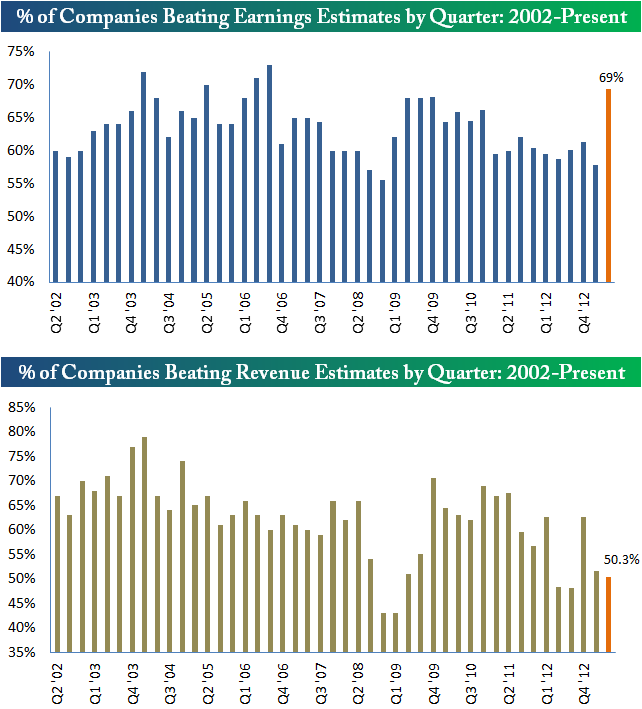
Roughly 150 companies have reported earnings since the second quarter reporting period began on July 8th. While this is less than a tenth of the total amount of companies set to report throughout earnings season, it’s enough to get an initial reading on the percentage of companies beating earnings and revenue estimates.
As shown in the first chart below, 69% of companies have beaten earnings estimates so far this season. It’s still very early, but compared to the final quarterly readings over the past few years, the earnings beat rate has gotten off to a great start. The revenue beat rate, on the other hand, has been below average at just 50%. Top line numbers have struggled in three of the last four quarters, and it’s looking like the same could be in store this quarter as well.
Looking for more earnings season analysis? Sign up for a 5-day free trial to Bespoke Premium and use “earnings” in the coupon code section on our Subscribe page to receive a 10% discount on your membership.
S&P Up 150% But Still in Fifth Place
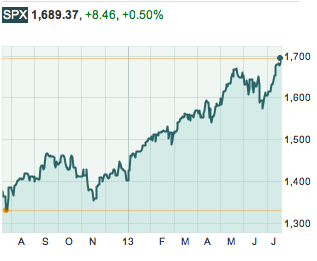
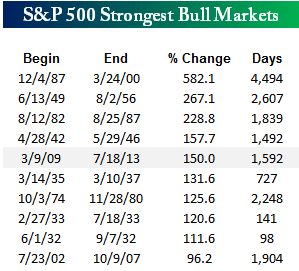 With today’s rally, the S&P 500 is now up 150% since its closing low on 3/9/09. Relative to other bull markets going back to the late 1920s, the current bull ranks as the fifth strongest of all time. As shown in the table to the right, the strongest bull market for the S&P 500 was a gain of 582.1% from December 1987 through March 2000. In order for the current bull run to move into fourth place, the S&P 500 would need to rise above 1743.4 without a 20% decline on a closing basis. Based on current levels, that translates to a gain of 3.1% from here.
For reference, we define a bull market as any period where the S&P 500 rises 20% or more (on a closing basis) without a decline in between of 20%.
About Bespoke

The recent decline in gold prices and the drain from physical ETFs have been interpreted by the media as signaling the end of the gold bull market. However, our analysis of the supply and demand dynamics underlying the gold market does not support this thesis.
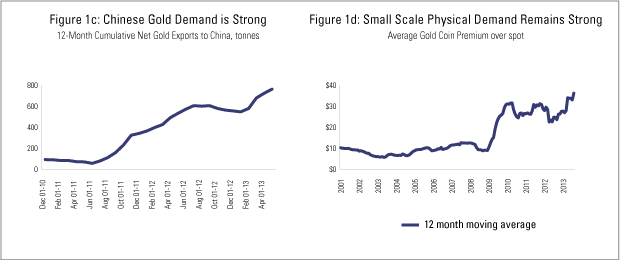
For example, Non-Western Central Banks have been increasing their holdings of gold at a very rapid pace, going from 6,300 tonnes in Q1 2009 to more than 8,200 tonnes at the end of Q1 2013 (Figure 1a) while physical inventories are declining (Figure 1b) (or being raided, as we argued in the May 2013 Markets at a Glance)1 and physical demand from large (Figure 1c) and small (Figure 1d) scale buyers remains solid.
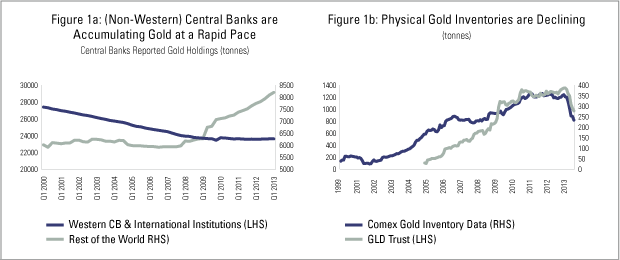
In previous articles we have argued that Western Central Banks have been filling the supply gap to satisfy the demand for physical gold.2 As shown in Figure 1a above, the official amount of gold held in the Western Central Banks and international institutions like the IMF has been steadily declining since 2000, only to stabilize at around 23,500 tonnes since 2008.
…….read more HERE

 Why are European Politicians Arguing over Central Bank Gold
In recent days we have heard that several G20 leaders of the world’s major economies discuss the possibility of Eurozone countries pooling their borrowing rights at the International Monetary Fund to provide greater leverage for the EFSF. The Bundesbank holds Germany’s Special Drawing Rights, secured by its gold reserves. Apparently, the proposal had caused tension between Bundesbank President, Jens Weidmann, and Finance Minister, Schaeuble, as well as between Weidmann and the ECB.
The Economy Minister of Germany stated that “German gold reserves must remain untouchable!”. The Bundesbank and a spokesman for Chancellor Angela Merkel also ruled out the idea. This argument harks back to the time when the government and the Bundesbank argued over whether to sell some of Germany’s gold in the second Central Bank Gold Agreement. At that time Axel Weber, the then Bundesbank President stated that gold in German foreign exchange reserves acted as a “counter to the swings of the U.S. dollar”.
Prior to that, the head of the French central Bank, M. Noyer, had said that selling gold from the reserves was like “selling the family jewels”. Unfortunately, President Sarkozy was Finance Minister at the time and forced the sale of 600 tonnes of French gold, a decision, we have no doubt he regrets to this day, because of the loss made by selling gold and buying U.S. dollars at the time. Then the gold was sold to support the advent of the Euro. Now the reason for the use of gold is very different.
As we have forecast for so long, gold’s use is being advocated as collateral for Eurozone Sovereign loans.
Of course it is easy to commit someone else’s gold to your cause, but a very different matter to get them to use it as such!
Bundesbank Gold “Off Limits”
Germany’s reaction to the proposal was understandably a rejection of the proposals by France, Britain and the U.S. to have German gold reserves used as collateral for the Eurozone bailout fund. Why should they put their gold as security to the debts of Greece, Italy and anybody else for that matter? To do so would to leave the future of their gold reserves in the hands of other governments that have a record of over-borrowing. Sadly, when other people guarantee your debt, it is almost an invitation to take their money.
Governments that have sold their gold, whether to support the U.S. dollar as it embarked on a future without backing or the advent of the euro, have the bitter memories of selling it far, far below its value today. Britain under George Brown sold half its gold reserves at the horrendous price of $275. The rest of the central bank gold sales over the last decade have been made at below $1,000. Since then, the silence from the central banks and governments that supported such sales has been deafening.
With the visible sight of currencies without any backing and indeed the entire present monetary system weakening, losing confidence and now facing a future of accelerated weakening, governments are keeping a firm grip on their gold. There have been virtually no gold sales since 2009 and from then on we have seen central banks from the emerging world, on a broad front become buyers of gold, led by Russia and, we believe, China.
Isn’t This the Government’s Decision?
Thankfully, gold and foreign exchange reserves are under the care and protection of national central banks and not governments. Central Banks generally act independently of government the world over. And there is a reason for this that goes to the present Eurozone debt crisis itself.
Imagine if politicians had control of their nation’s reserves. Their inherent habit of over-borrowing would have engulfed all these reserves by now years ago. There would be none left, for sure!
Gold and foreign exchange reserves are held to ensure that even in a war situation, the country is able to pay at least their next three months of international trade bills. They are the funds available to governments when all else has been used up.
Gold and Foreign Exchange Reserves are last resort international money.
For a nation to have any credibility financially, these reserves have to be available simply to service the needs of a nation, not their obligations. In wartime, when forgery becomes a weapon of war, gold is still internationally accepted between enemies. Until then, no matter what, these reserves must remain untouched for the sake of that nation. Politicians repeatedly keep pointing at gold reserves to cover their debts and do so as a distraction from the problem. In the Eurozone crisis, we are surprised that this issue has not been raised until now. But here it is and as before, destined to go back to the dustbin.
Capital Flight
But the situation in the debt-distressed nations of the Eurozone is getting worse by the day and not being fully covered in the media. A huge flight of capital is underway draining these nations of the capital needed to continue to function as viable nations. What appalls us is the failure of the weaker nations of the Eurozone, the PIIGS nations, not imposing Exchange and Capital Controls to prevent the wholesale flight of capital from their shores even while using the euro as their currency. The Treaty governing the Eurozone allows this, for relatively short periods. Because they have failed to do this, the capital in their banks has largely left these nations and flown to Germany and the like. Effectively this is a run on their banks. This money won’t return unless there’s good reason for doing so and only if it’s safe from either bank liquidation, a return to their old currencies or free from the danger of government control then. But the horse has bolted.
In addition, the banks holding the debt of these PIIGS nations are selling it off as fast as they can ahead of any write-downs. If you know you are going to have 50% of it written off, it pays to sell it for any price higher than 50%.
Member’s Only
Gold’s Path Back to Center Stage in the Monetary System
Get the rest of the report. Subscribe @
Legal Notice / Disclaimer
This document is not and should not be construed as an offer to sell or the solicitation of an offer to purchase or subscribe for any investment. Gold Forecaster – Global Watch / Julian D. W. Phillips / Peter Spina, have based this document on information obtained from sources it believes to be reliable but which it has not independently verified; Gold Forecaster – Global Watch / Julian D. W. Phillips / Peter Spina make no guarantee, representation or warranty and accepts no responsibility or liability as to its accuracy or completeness. Expressions of opinion are those of Gold Forecaster – Global Watch / Julian D. W. Phillips / Peter Spina only and are subject to change without notice. Gold Forecaster – Global Watch / Julian D. W. Phillips / Peter Spina assume no warranty, liability or guarantee for the current relevance, correctness or completeness of any information provided within this Report and will not be held liable for the consequence of reliance upon any opinion or statement contained herein or any omission. Furthermore, we assume no liability for any direct or indirect loss or damage or, in particular, for lost profit, which you may incur as a result of the use and existence of the information, provided within this Report.

 Famous ‘High Low Logic Index’ is no longer bullish
A market timing indicator with a stellar long-term record is now in “sell” mode.
The last time this indicator generated a sell signal was in late 2007, just before the Great Recession.
……read more HERE
 So how do these guys do it?
The Bottom Line:
Peter Lynch and Warren Buffett have both been extremely successful following a simple approach that any investor can emulate. George Soros has become successful using an approach that is impossible to emulate – predicting market moves and trading aggressively.
Curiously, many amateur investors appear to be taking the ‘impossible’ route, by trying to predict the market and making frequent trades.
Perhaps we should pay more attention to the simple lessons of Buffett and Lynch
…..read how each of these Great Investors does it HERE

-
I know Mike is a very solid investor and respect his opinions very much. So if he says pay attention to this or that - I will.
~ Dale G.
-
I've started managing my own investments so view Michael's site as a one-stop shop from which to get information and perspectives.
~ Dave E.
-
Michael offers easy reading, honest, common sense information that anyone can use in a practical manner.
~ der_al.
-
A sane voice in a scrambled investment world.
~ Ed R.
Inside Edge Pro Contributors

Greg Weldon

Josef Schachter

Tyler Bollhorn

Ryan Irvine

Paul Beattie

Martin Straith

Patrick Ceresna

Mark Leibovit

James Thorne

Victor Adair