
Personal Finance
 Another lazy summer day. The Dow sold off a few pennies on Friday. Gold rose $8.
The airport in Paris must be the most efficient in the world. Our cab drove up at exactly 6 a.m. By 6:04, we were having a cup of coffee, waiting to board the plane. In just four minutes, we’d gotten our ticket, been inspected by security and made it to the gate.
Now we’re on the plane, flying over the Pyrenees… thinking…
Good As Gold
Over the last 10,000 years, humans have tried two different kinds of “money.” They began with exchanges based on credit – “You give me a chicken… I’ll pay you back later, maybe by helping you build a new wigwam.”
Then, when society became too large and extensive, they switched to gold and silver. The advantage of this was obvious: You didn’t have to remember who owed what to whom. You could settle up right away. “You give me a chicken. I give you a little piece of silver. Done deal.”
Periodically, governments were tempted to go back to credit systems. Essentially, they issued pieces of paper – IOUs – and declared them “money.” Usually, these hybrid systems began with some collateral backing up the paper. Issuers typically had gold in their vaults and agreed to exchange the paper for metal at a fixed rate. Holders of the paper money were told that it was “good as gold.”
In some cases, people believed the IOUs were better than gold. When John Law began modern central banking in France, he backed his paper money with shares in a profit-seeking business – the Mississippi Company. You could take his scrip and imagine that it would grow in value along with the profits of the company.
Trouble was, the Mississippi Company never made any profit. It was a failure… and a fraud. Great prospectus. Few real investments. When people realized, they wanted to get rid of their paper money as soon as possible. In 1720, the system collapsed, and John Law fled France.
Later in the 18th century, the French tried again. This time, the revolutionary government backed its new paper money with revenues from the church properties they had seized. This didn’t last very long, either. The system blew up in 1796. Napoleon Bonaparte, on the scene at the time, declared, “While I live, I will never resort to irredeemable paper money.”
Richard Milhous Nixon didn’t seem to get the memo. In 1971, he changed the world monetary system. Thenceforth, it would be based on irredeemable paper money. We are now in year 42 of this new experiment with modern, credit-based money.
All right so far? Well, yes… as long as you don’t look too carefully.
Nothing More Than Promises
When you have a system based on credit, rather than bullion, deals are never completely done. Instead, everything depends on the good faith and good judgment of counterparties – including everybody’s No. 1 counterparty: the US government. Its bills, notes and bonds are the foundation of the money system. But they are nothing more than promises – debt instruments issued by the world’s biggest debtor.
A credit system cannot last in the modern world. Because, as the volume of credit rises, the creditworthiness of the issuers declines. The more they owe, the less able they are to pay.
As time goes by, the web of credit spins out in all directions, entangling not just the present, but the future too. It stretches out over the entire society… one person owes another… who owes a third… whose debt has been pledged to a fourth… who now depends on it to pay a fifth… and all calibrated in the IOUs of sketchy value from a sixth. Have you got that?
Total debt in the US now measures more than twice what it was – in proportion to GDP – in 1971. And GDP itself has been goosed up by credit. Every time someone borrows money to spend… the spending shows up in GDP.
It looks great… on paper. There’s only so much gold. But there is no reasonable limit on how much of this new credit-based money you can create. As it increases, it gives people more spending power. GDP goes up. Employment goes up. Prices – especially asset prices – go up.
Naturally, everybody loves a credit system… until the credits go bad. Then they wish they had a little more of the other kind of money. Wise governments, if there are any, take no chances. They may feed the paper money to the people. But they hold onto gold for themselves. Throughout history, the most powerful governments were those with the most gold.
“Remember the golden rule,” they used to say. “He who has the gold makes the rules.”
When push comes to shove, governments need gold, not more IOUs with their presidents’ pictures on them.
Which brings us to the point of today’s Diary.
Unraveling an Unruly Skein
Britain famously and foolishly sold much of its gold at the very worst time, at the end of the 1990s, when gold was trading at a 20-year low.
But how about the US? Does it have any gold left? That is the question recently posed by Eric Sprott:
Central banks from the rest of the world (i.e., non-Western central banks) have been increasing their holdings of gold at a very rapid pace, going from 6,300 tonnes in Q1 2009 to more than 8,200 tonnes at the end of Q1 2013. At the same time, physical inventories have declined rapidly since the beginning of 2013 (or have been raided, as we argued in the May 2013 Markets at a Glance), and physical demand from large- and small-scale buyers remains solid.
As we have shown in previous articles, the past decade has seen a large discrepancy between the available gold supply and sales. The conclusion we have reached is that this gold has been supplied by central banks, which have replaced their holdings of physical gold with claims on gold (paper gold).
Analyzing the gold sales figures over the last 12 years, Sprott noticed that there was far more gold sold than mined. Where did it come from?
Some of it is easily accounted for in jewelry and private holdings. But, generally, the private sector is a buyer and an accumulator of gold, not a seller. And the quantities released to the market have been so great, Sprott believes they could have come only from central banks.
But if they have sold such massive quantities over the last 10 years, how much do they have left? Maybe not much.
Which wouldn’t be surprising. Western central banks are committed to their credit-money system. They intend to stick with it. And they know that unraveling this unruly skein of credit would be extremely painful.
Selling gold into the bull market of the last 12 years probably seemed like a very smart move. We’ll see how smart it was later, when the credit-based money system blows up.
Dear Readers are advised to hold onto their gold. It’s the kind of money that works.
Regards,
Bill

A Trader and an Economist go into a bar… both look at a market…The Trader is biased to believe that the price is wrong…while the Economist believes that the price is usually right…at least according to a recent article published in The Economist magazine. As a trader my first thought was, “Why is that?” Are traders more cynical than economists? Are traders “real world” while economists are “academia?” Are traders willing to grant that the price might be right, if only for the moment…because they “know” that the price will change…and therefore it’s only a matter of time until the price is wrong?
That last thought really got me thinking about the way I trade…I “know” that a market’s price is going to change…and I believe that all the research and analysis and thinking that I do gives me some idea about “why” it might change. I’m aware that I’m still tempted to guess “when” it might change…but I don’t need to “know” that…I can simply wait for the market to confirm that it’s changing…if indeed it is…before I put on a trade. To consider “how much” it might change I need a time frame…and hopefully I will use the same time frame for both my analysis and my trading!
I’ve traded futures and options since the mid-1970’s and I’ve learned a lot of things about trading the hard way. In hindsight, it seems I was also an incredibly slow learner…or simply too hard-headed to change when I needed to…I’ve noticed that as I’ve gotten older my “style” of trading has changed and I expect it will continue to change as I change and as markets change.
When I talk about trading I often describe myself as more of a “poet” than an “engineer”…but I still believe that it’s very important to have a defined method…to write down what I think about a market…and what I’m planning to do…and to later review what I wrote and see what I can learn from that.
R.A.C.E.R.
My trading method is continually evolving…lately I’ve come up with the Acronym R.A.C.E.R. to describe my trading method. It stands for Research (all kinds of markets and relationships) Anticipate ( a potential trade) Confirmation (wait for the market to show me that the time is right to make the trade) Execute (make the trade) Risk management (contingency plans for what I will do if the trade isn’t working).
I need a defined trading method to protect myself, from myself…because I’m pre-disposed to making impulsive trading decisions…both to get into and out of a market. I watch markets closely and (sometimes) I have a pretty good “feel” for what’s happening…unfortunately impulsive trading hasn’t been a truly successful trading style for me…probably because it gets the time frame of my analysis badly out-of-sync with the time frame of my trading!
CHART SECTION:
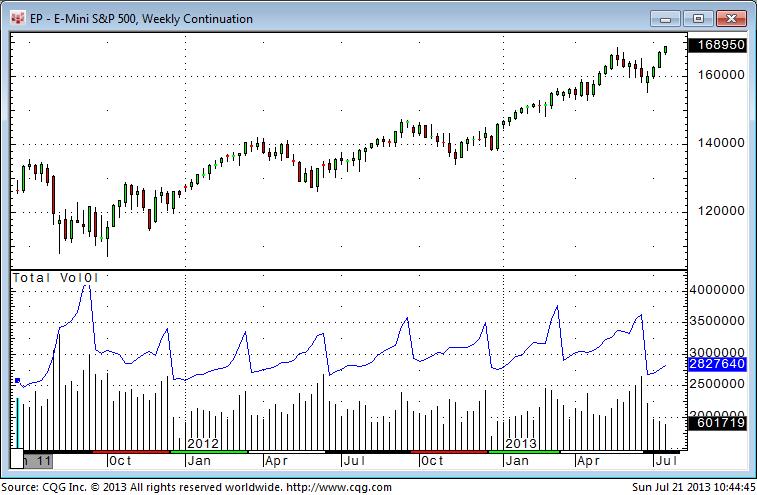
The S+P 500 stock index closed at new All Time Highs last week…this means that the May 22 high was NOT a Major Turn Date…that the decline from May 22 into June 24 was a “buy the dip” opportunity…indeed, Market Psychology changed dramatically on June 24 (when Bernanke “changed his tune”) and June 24 may turn out to be a Key Turn Date Up similar to Nov 16 last year (when the market decided that Abe was going to be the next Japanese PM.) I haven’t bought the current rally…in part because I’d been short during the decline from the May 22 highs and couldn’t “make a 180” to becoming bullish. I haven’t sold it short either, although I did “anticipate” that the rally off the June 24 lows would “peter out” and the market would roll over and make new lows…but there was no “confirmation” of a roll over so I’ve just been on the sidelines. The relatively low volume the past three weeks doesn’t support a strong rally…although volume figures may be a little misleading given the recent front month contract rollover and the summer doldrums. I also note that last week American equity mutual funds received their highest weekly inflow of new cash since June 2008…in other words, retail players are piling into this market at ATH. This market looks like it wants to keep going higher and it has the Fed’s “accommodation” at its back…you have to think that die-hard shorts are also throwing in the towel! My Trading Theme for the US stock market is that it feels toppy… Market Psychology seems even more “What, me worry?” now than it was prior to the May 22 Turn Date.
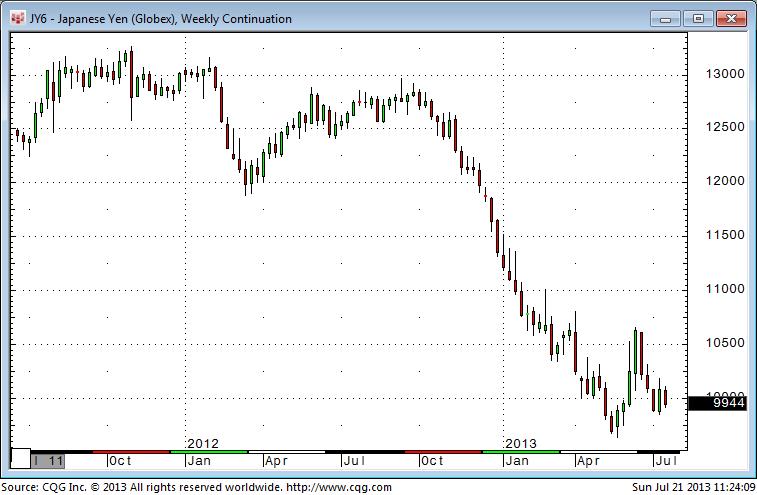
The Japanese Yen began a steep slide in November last year when Market Psychology determined that Abe was going to win the elections and begin to implement his aggressive policies to end two decades of deflation in Japan. This weekend he solidified his grip on power by winning a majority in the Upper House…this should clear the way for him to implement his policies…which “should” mean a weaker Yen and a stronger Japanese stock market. If that doesn’t happen then perhaps the majority election win was already factored into prices. My Trading Theme for currencies is that the USD is in the early stages of a multi-year bull market.
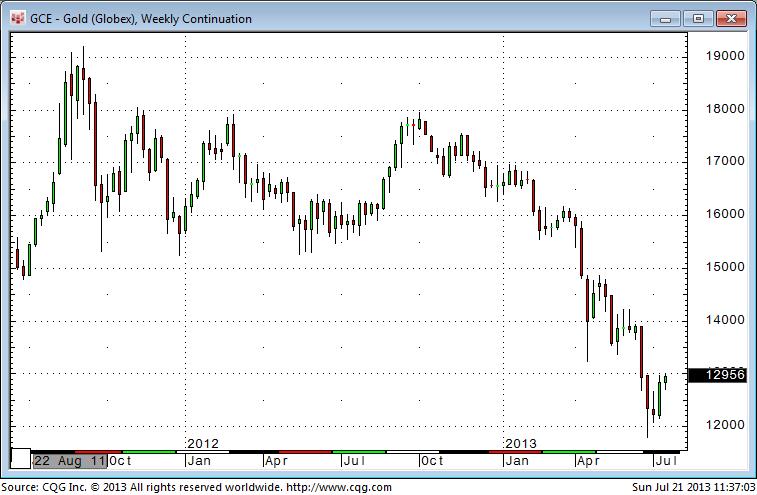
Gold dropped $600 or ~30% from last fall’s highs to the three year lows made in June…where it generated a Monthly Capitulation Buy Alert (Ross Clarke, Institutional Advisors) for only the 4th time in the last 40 years. As previously noted in this blog I took a modest long position in gold in late June. So far, so good, but this looks like a corrective rally with heavy overhead resistance around $1350. Gold shares have also bounced from an extremely over-sold position…as has the ratio of gold shares to gold. My trading theme for gold has been that the $1900 high in September 2011 would be THE high for a long time…but…I think this decline will find a bottom and we will eventually see new All Time Highs.
Gold relative to the S+P 500: I’m keeping an eye on this chart…”anticipating” a possible buying opportunity…but a long way from seeing any kind of “confirmation” that the time is right to take a position. Gold has fallen over 50% against the S+P since August of 2011 (as gold fell and the S+P rallied) and the ratio is now at 5 year lows. I can imagine a time (maybe before this year is out) when Market Psychology turns negative on the stock market and bullish on USD and gold!
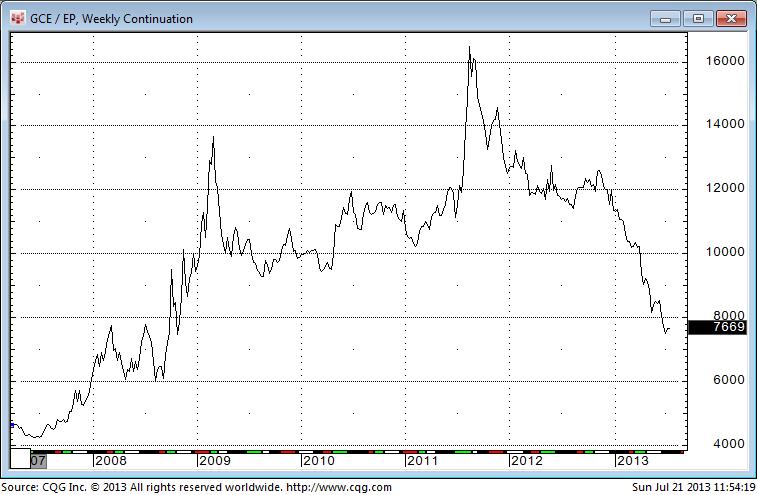
WTI Crude Oil: It’s interesting that WTI Crude is rallying as North American production of crude (and Nat Gas) is growing by leaps and bounds. Is this a Mid-East Geo-Political story? I watched Joe Petrowski, CEO of Gulf Oil, forecast $50 crude ahead due to rising supply. My Trading Theme for crude is that supply pressures prices lower.

Futures and futures options are the best way to trade currencies, metals, stock indices and many other financial and commodity markets. Call 604 664 2842 to talk with a futures broker.

According to CNBC, the recent volatility in gold prices has left not only investors and traders puzzled about what is going on with the precious metal.
“Nobody really understands gold prices and I don’t pretend to understand them either,” Federal Reserve chief Ben Bernanke told the Senate Banking Committee on Thursday in response to a question on why gold prices have been volatile.
Today, gold climbed up over $1,322 per ounce after the U.S. dollar slipped against other currencies. It is the yellow metal’s highest level since June 20. In this way, gold broke above a key technical level at $1,300. That level had been tested a few times in the last one-and-half weeks and after today’s breakout investors are probably wondering what to do next. Can we find any guidance in the charts?
In today’s essay we examine other markets to see if there’s anything on the horizon that could drive gold prices higher or lower shortly. We’ll start with the USD Index very long-term chart charts courtesy by http://stockcharts.com.)
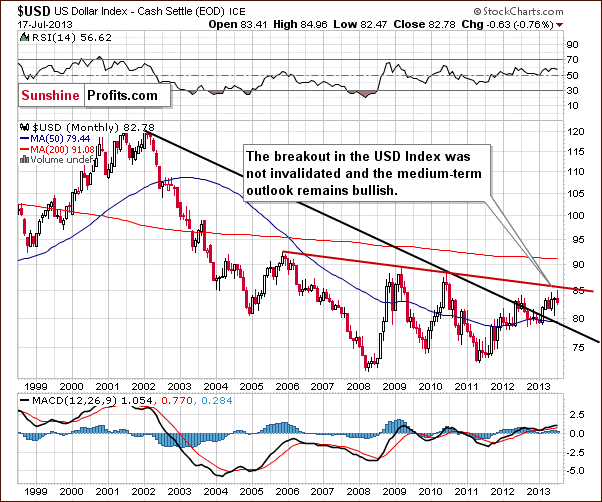
The situation in the long-term chart hasn’t changed recently. The breakout above the declining support/resistance line (currently close to 79) has not been invalidated. Therefore, the situation remains bullish.
Now, let’s zoom in on our picture of the USD Index and see the medium-term chart.
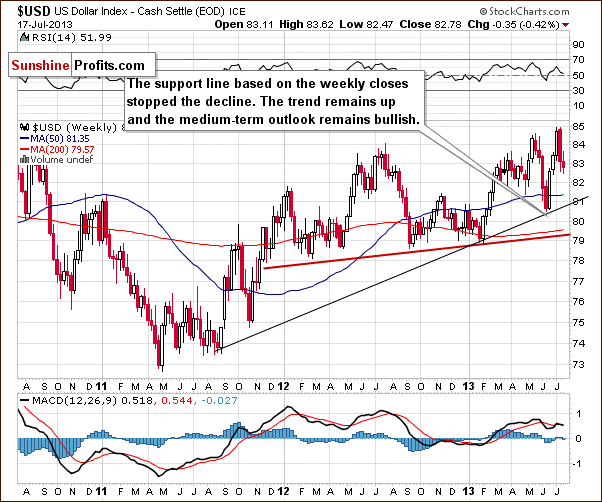
On the weekly USD Index chart we see that the recent declines didn’t take the index below 82, so the medium-term uptrend is not threatened. The reason is that the medium-term support line was not broken – it was not even reached. From this perspective, the situation remains bullish and we can expect the dollar to strengthen further in the coming weeks.
Let’s check if the short-time outlook is also bullish.
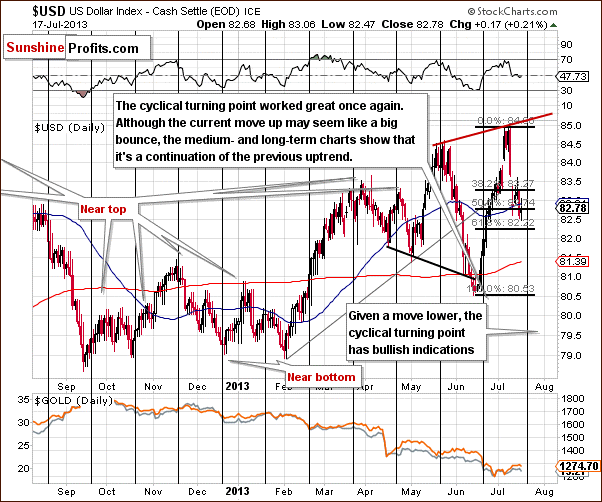
From the short-term perspective, we see that the USD Index dropped last week, but it hasn’t declined below the 61.8% Fibonacci retracement level based on the June – July rally. Despite the dollar increased after Ben Bernanke’s testimony, the U.S. currencyslipped against other currencies once again in the recent days. Although the dollar declined below the Wednesday’s intra-day low at 82.47 today, the 61.8% Fibonacci retracement level close to 82.20 is still valid and serves as support.
If the buyers manage to push the USD Index higher, we might see an increase to the June top or even to the rising resistance line based on the May high and June peak before another pause is seen. However, taking a look at the long-term charts, we see that the next significant resistance is currently close to 86 (86.4) – the declining red line.
Consequently, from the short-term perspective, the recent decline still seems to be a counter-trend bounce. It means that we could see another rally soon, especially when we factor in the cyclical turning point which is just around the corner. Taking a look at medium- and long-term charts, both outlooks for the dollar remain bullish. This is a bearish piece of information for metals and miners.
Once we know the current situation in the U.S currency, let’s find out what happened during the last several days and check the current situation in stocks. At the beginning, let’s take a look at the long-term S&P 500 chart.
Click HERE or on Chart for Larger Image

In the recent days, stocks moved up once again and broke above the May top. At this moment, the breakout is still not invalidated, but from this perspective, we see that the recent decline was likely nothing more than another correction and the outlook continues to be bullish.
We would prefer to see 2 more weekly closes before saying that another upswing is very probable. It is likely at this time but not to any great extent.
Let’s check if the short-time outlook is also bullish
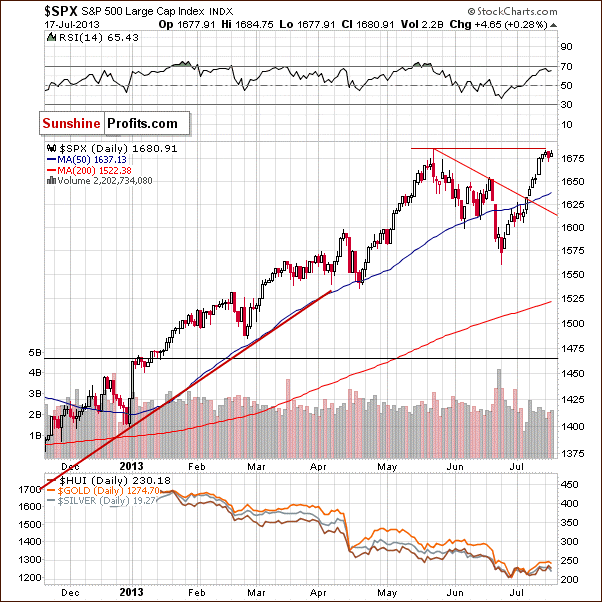
During the past week, the S&P 500 Index has continued its rally as expected. Prices climbed up to new historical highs on Thursday. The S&P500 index gained 0.5%, afterreaching a daily high at 1,693.12. The breakout above the May 22 local top is a positive sign, but some short-term uncertainty cannot be excluded here.
Let us move on to the financial sector, which often leads the general stock market, for more clues regarding the future moves of the S&P500 – we’ll use the Broker-Dealer Index as a proxy here.
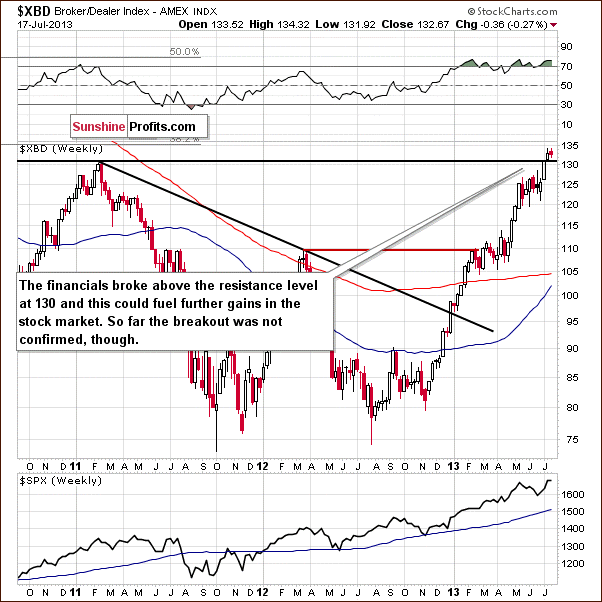
As we wrote in our essay on gold, stocks and the dollar on July 12,2013:
(…) financials broke above the resistance level at 130. This could fuel further gains in the stock market.
On the above Broker-Dealer index chart, we see that last week‘s breakout is still not invalidated. The situation improved a bit (it’s closer to being verified), and the outlook is a bit more bullish.
The situation for stocks in the medium term is still quite bullish although it’s a bit uncertain in the short term. It seems that we could see further gains in the stock market, but then again, a consolidation could be seen first. It might seem that gold started to trade along with the stock market and the bullish implications are already resulting in higher prices of the yellow metal.
Once we know the current situation in the dollar, the stock market and the financial sector, let’s take a look at the Correlation Matrix. This is a tool, which we have developed to analyze the impact of the currency markets and the general stock market upon the precious metals sector (namely: gold correlations and silver correlations).
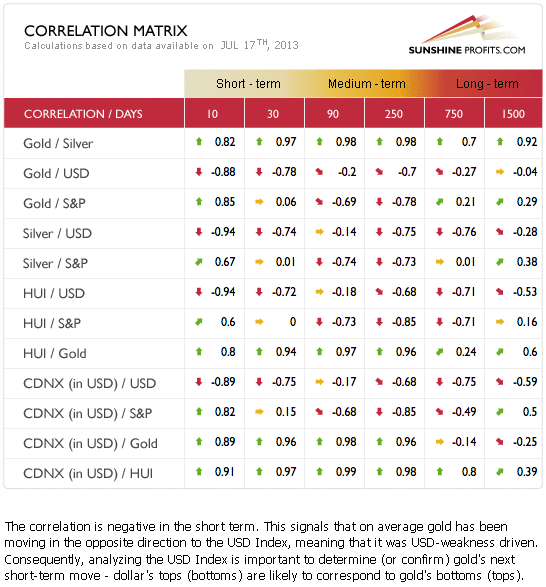
The short-term correlation between the metals and the USD Index is negative at this time and has been very weak recently. Gold started to respond to the dollar’s price moves (up when the dollar declined and down when the dollar rose) but we feel that was just a temporary phenomenon and the metals will likely continue underperforming.
All-in-all, with a bullish outlook for the dollar and regardless of whether the negative correlations between the metals and the dollar persist or not, the overall implications for the precious metals are bearish.
Summing up, the USD Index corrected almost to the final 61.8% Fibonacci retracement level but didn’t decline below it. If the buyers manage to push the USD Index higher, we might see another rally soon. This is in tune with the medium and long-term trends and also with dollar’s cyclical turning point. The implications are bearish for the precious metals sector.
Thank you for reading. Have a great and profitable week!
Przemyslaw Radomski, CFA
Founder, Editor-in-chief
Gold Investment & Gold Trading Website – SunshineProfits.com
* * * * *
Disclaimer
All essays, research and information found above represent analyses and opinions of Przemyslaw Radomski, CFA and Sunshine Profits’ associates only. As such, it may prove wrong and be a subject to change without notice. Opinions and analyses were based on data available to authors of respective essays at the time of writing. Although the information provided above is based on careful research and sources that are believed to be accurate, Przemyslaw Radomski, CFA and his associates do not guarantee the accuracy or thoroughness of the data or information reported. The opinions published above are neither an offer nor a recommendation to purchase or sell any securities. Mr. Radomski is not a Registered Securities Advisor. By reading Przemyslaw Radomski’s, CFA reports you fully agree that he will not be held responsible or liable for any decisions you make regarding any information provided in these reports. Investing, trading and speculation in any financial markets may involve high risk of loss. Przemyslaw Radomski, CFA, Sunshine Profits’ employees and affiliates as well as members of their families may have a short or long position in any securities, including those mentioned in any of the reports or essays, and may make additional purchases and/or sales of those securities without notice.

It may have been a modest effort, but modest was still good enough to carry the market to record highs last week. Even more interesting – and perhaps a little surprising – is that volume was growing on the way up. That suggests traders at least have a little faith in the budding rally.
The $64,000 question is, do we/you really believe the market is capable of rallying in late July and early August (historically a tepid time of year) after it’s already advanced 6.3% in just four weeks? Stocks are already over-extended, and shouldn’t be able to keep chugging at their recent pace. The answer: Never say never… especially during earnings season.
We’ll put that answer under the microscope in a moment, after we paint the bigger picture with last week’s and this week’s economic numbers.
Economic Calendar

 If you think gasoline is expensive now, imagine the price when Iran and Israel start lobbing nukes at each other.
Am I having a nightmare? No, I’m fully awake. That snoozing you hear is an energy market blissfully unaware of potential major war in the Middle East. The shooting could begin as soon as this year.
The world’s financial markets are completely discounting the very real possibility of an Israeli-Iranian war. Years of anger, threats and caustic rhetoric have put the so-called “experts” to sleep. Their blindness is incredibly dangerous for everyone.
Just look what’s happening RIGHT NOW. Israeli jets are already flying into Syria and Lebanon, disabling air-defense systems. Why?
To me, it’s obvious. Israel is clearing the path for a first strike against Iran’s nuclear missile launchers.
Israel’s Benjamin Netanyahu is not kidding. He will not allow Iran to have nuclear weapons. If he can’t stop them through negotiations, he will do whatever it takes.
Most people discount the possibility of an Israeli “first strike” for logistical reasons. They believe Israel would need U.S. cooperation to strike deep inside Iran. We could certainly make it easier for them. The U.S. could provide aerial refueling and other support while Israel drops the bombs.
With his nation’s very survival at stake, Netanyahu is also preparing to go it alone.
Some think Iran’s newly elected Hassan Rouhani, who takes over as president next month, will extend an olive branch. This is pure fantasy!
Rouhani is a wolf in sheep’s clothing. He was hand-picked by Iran’s Supreme Leader Ali Hosseini Khamenei to for two purposes …
First, Rouhani needs to satisfy Iran’s increasingly restless public. The massive protests of the last few years represent a real threat to Iran’s theocratic regime. The daily struggles created by economic sanctions are real. Rouhani must convince them he is working to end the country’s economic isolation.
Second, Rouhani will buy time with the Western powers by pretending to be a moderate, reasonable leader. Meanwhile the nuclear and missile programs will move forward. The Iranian regime believes that once it has nuclear warheads and missiles to deliver them, it can force an end to the devastating economic sanctions.
I believe both the U.S. and Iran underestimate Netanyahu’s willingness to go to war. One way or another, he will stop Iran from obtaining nuclear weapons.
Netanyahu’s “Face the Nation” appearance last week was a clear warning to the United States and other world powers. Incredibly, almost no one noticed. (See my publisher Brad Hoppman’s excellent July 17 analysis of the media missing the mark.)
The Obama administration is not blind. They know war between Iran and Israel is all but certain. They are doing all they can to postpone the inevitable.
The U.S. has its own reasons to stop Iran. So do other regional powers like Saudi Arabia. They simply want Israel to do the dirty work.
The good news: Iran will not have a chance to nuke Israel.
The bad news: The war to stop it will be ugly.
Here is how I think events will unfold …
- An Israeli strike on Iran nuclear facilities and missile development infrastructure will lead to …
- Vicious air war over Syrian, Lebanese and Iraqi airspace, followed by …
- An Israeli land invasion of Lebanon to neutralize Hezbollah’s rocket capacity, while …
- Iran tries to choke off oil exports through the Strait of Hormuz!
Then it will get even worse …
- Egypt’s paramilitary Muslim Brotherhood will obstruct the flow of oil through the Suez Canal.
- The final blow: an Iranian missile strike on Saudi oil fields.
When all this happens — and it will — world markets will suffer the worst one-day loss since 9/11. Crude oil could skyrocket to as high as $200. I expect to see gold make daily jumps of $100 or more.
If U.S. carrier groups in the Arabian Sea come under fire, we could see $300 oil and $2,000 gold — or even more!
I refuse to be guilty of willful blindness. That’s why I’m telling my subscribers how to prepare.
In Global Resource Hunter, I am planning hedges against the stock market’s visceral reaction to the coming Israeli strike. And my Junior Resource Millionaire subscribers will get recommendations designed to rack up substantial profits in the coming crisis. In both services, I am aiming to help members to maximize their profit potential in the wild swings we will see for both commodities and equities.
Whatever you do, keep your eyes open your eyes and prepare for the inevitable. You can survive — and even profit — from the trouble ahead. Don’t wait too long.
Best wishes,
James


-
I know Mike is a very solid investor and respect his opinions very much. So if he says pay attention to this or that - I will.
~ Dale G.
-
I've started managing my own investments so view Michael's site as a one-stop shop from which to get information and perspectives.
~ Dave E.
-
Michael offers easy reading, honest, common sense information that anyone can use in a practical manner.
~ der_al.
-
A sane voice in a scrambled investment world.
~ Ed R.
Inside Edge Pro Contributors

Greg Weldon

Josef Schachter

Tyler Bollhorn

Ryan Irvine

Paul Beattie

Martin Straith

Patrick Ceresna

Mark Leibovit

James Thorne

Victor Adair