
Stocks & Equities
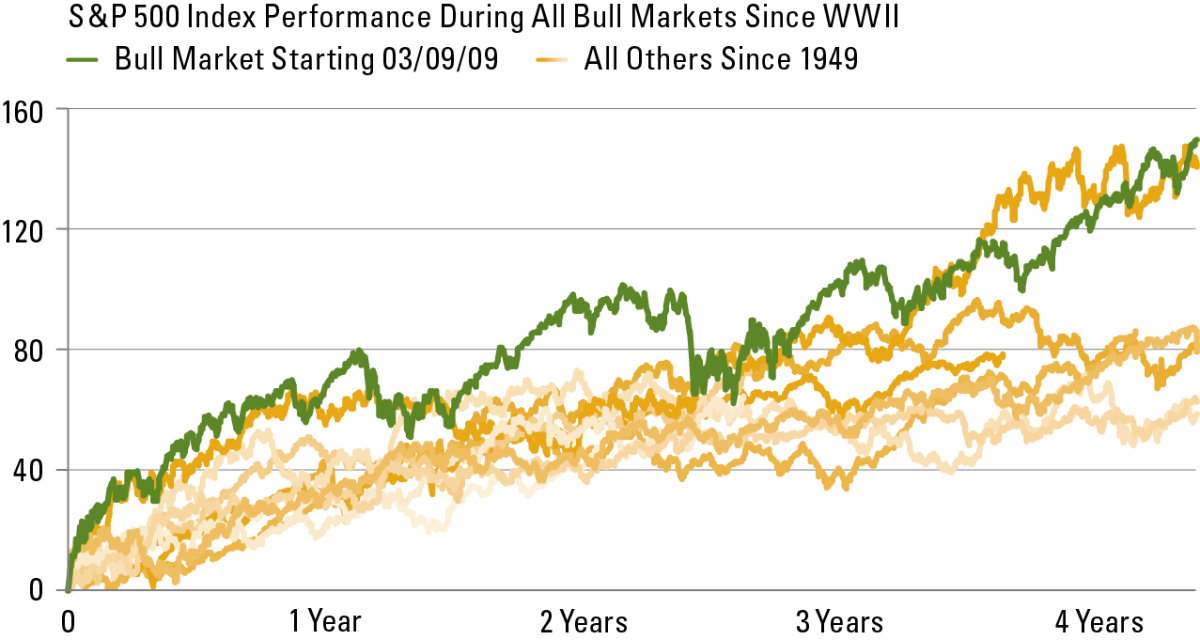
This unkillable stock market rally seems to get no respect. U.S. stocks have been snubbed by investors this year.

1. Gold has staged a strong rally, and the recent action has created more positive signals, from a technical perspective.
2. Please click here now for larger version. That’s the weekly gold chart, and a key downtrend line has been penetrated. Note the breakout move that I’ve highlighted with a blue circle.
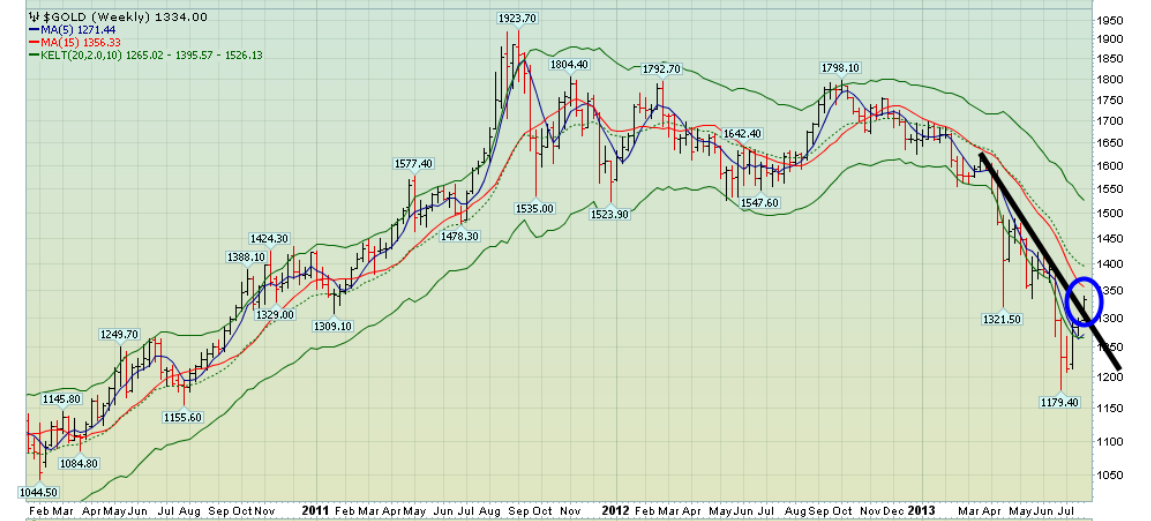
3. I’m a seller here, but not a top caller. When the gold price rises, traders must be sellers, and gold is certainly rising now!
4. Gold has jumped about $160, from the $1180 area lows. Significant sell-side HSR (horizontal support & resistance) sits in the $1320 – $1340 area.
5. To view that HSR, please click here now . Note the black HSR lines that I have annotated on this weekly chart. Traders should be sellers in this price area.
6. I consider the act of booking losses in the gold market to be an act of “tactical madness”. Sell positions that have a profit.
7. Gold is arguably the world’s greatest asset, so stop-losses are not required when trading it without leverage.
8. There is another line of resistance on the weekly chart, that traders can use for profit booking. To view it, please click here now .
9. Note the rising black trend line. From current price levels, resistance should come in the $1375 area.
10. There is no such thing as selling “too early”; if gold rises to $1375, $1400, or even higher. No error is made by traders who sell in the $1280 – $1340 area, provided that what they sell, is at a profit!
11. In the big picture, gold can go quite a bit higher. On the weekly chart, I use the 5, 15 series of moving averages (MA) as a key indicator, and they are beginning to look quite bullish. Moving average signals are best applied to potential trending movements, rather than to price ranges.
12. Please click here now . Note the sell signal that occurred back in the fall, in the $1700 area. If a moving average buy signal occurs soon, nobody knows whether gold will begin a trending move, or just grind sideways in a trading range.
13. In the market, there is a role for “cheerleading”, and my suggestion is that the gold community should cheer for an uptrend to begin, if the 5, 15 MA series shows a crossover buy signal.
14. In the short term, gold also looks good. Please click here now . You are looking at the daily chart for gold. The $1300 zone is now buy-side HSR, and the green downtrend line also offers good support.
15. Note the position of my stokeillator, at the bottom of that chart. While the overall technical picture is strengthening dramatically, short term tacticians will be sellers here. Once the stokeillator lines cross into a sell signal, gold is likely to rest, but not for long!
16. Gold has staged an impressive rally, gaining about 14% from the lows near $1180. Gold stocks have done much better, and investors know that I have not endorsed the “growth with safety” trade (sell gold stocks and buy bullion).
17. Gold stocks are a “potential growth with very real risk” trade. Investors who want to get richer need to be serious risk takers, and the current GDX chart shows that potential reward can quickly become very real.
18. Please click here now . That’s the GDX daily chart. While gold has rallied by about 14%, GDX has surged 22% higher.
19. Volume analysis is arguably more important than price analysis, as many technicians know. Note the 3 volume bars that I’ve highlighted.Those huge bars suggest that the technical breakout above the downtrend line could be a significant one.
20. GDX now has 3 minor buy-side HSR lines beneath the current price, and the gold stock bears appear to be nervous and confused.
21. I believe the market should be viewed as a war. To view your gold stocks opponent (the bears) in the great gold war, please click here now .
22. That’s the daily DUST-nyse chart. DUST is a triple-leveraged bet against gold stocks (via GDX), calculated on a daily basis. The bears appear to be on fire, technically. In only 3 weeks, the price of DUST has crashed by about 50%.
23. While DUST is oversold in the very short term, I want you to look at the buy-side HSR in the $70 area. This is a very high-priced ETF, and the main uptrend (highlighted in black) has just been “vaporized”. DUST should rally from here, but to what price point? Supply is directly overhead.
24. The massive volume bars on the GDX chart and the horrific technical damage that is clearly apparent on the DUST chart indicate that the bulls are beginning to win some battles. A break under $70 on that DUST chart could literally wipe the bears off the price map. Bullish gold stock investors have a number of solid reasons to feel confident now, but let’s not get too cocky!
Jul 23, 2013
Stewart Thomson
Graceland Updates
website: www.gracelandupdates.com
email for questions: stewart@gracelandupdates.com
email to request the free reports: freereports@gracelandupdates.com
Stewart Thomson
email: stewart@gracelandupdates.com
email: stewart@gracelandjuniors.com
email: stewart@gutrader.com




Gold juniors need to get back to the basics, says Eric Coffin, and it is going to take large discoveries to get the market excited again. In this interview with The Gold Report, the publisher of Hard Rock Analyst explains how the new economics of gold production require investors to concentrate on companies with three specific qualities, and names the regions that could generate breakout projects. Source: Kevin Michael Grace of The Gold Report
The Gold Report: Federal Reserve Chairman Ben Bernanke indicated last month that the Fed would begin to taper quantitative easing in September. The equity markets responded quite negatively to this. In the wake of this response, do you think the Fed is committed to this new policy?
Eric Coffin: I think the Fed is committed to tapering, but I suspect it will happen a little more slowly than some people think. Bernanke’s quite cognizant that when he does taper it’s going to have an impact on the markets. But you can’t keep buying $85 billion worth of bonds a month forever. Bernanke has backed off a bit himself on this issue and was back to using 6.5% as his unemployment target. If the U.S. keeps creating jobs at the pace of 175,000 to 200,000 per month, it will take a long time to get unemployment to 6.5%—probably 18 months or more.
TGR: We’ve seen these hints about a slowing down or an end to quantitative easing (QE) for some time now, haven’t we?
EC: A lot of people in the goldbug community can’t stand Bernanke and I think they give him less credit than he deserves. I think these occasional hints he drops about ending QE early are completely intentional. He’s testing the market to see how it will react and indirectly talking bond yields up in a way that doesn’t induce some full blown panic. I think if we see him say he might move up the QE schedule and the market doesn’t freak out—that will be the time he starts tapering. He’s trying to get us used to the idea.
TGR: We’ve seen gold rebound in July. Why do you think this is happening, and do you think it’s likely to continue?
EC: Some of it, a lot of it really, is due to the Fed backing off on its short-term tapering comments. And it’s partially due to gold falling to $1,180/ounce ($1,180/oz). That’s getting into the range a lot of the technicians were calling as a bottom. I don’t completely accept technical analysis, but a lot of people who trade gold and commodities are chart traders, so you can’t ignore those patterns.
The other factor is that we’ve been getting down to pricing that’s below the all-in cost for the gold mining sector, which means we’re going to see cutbacks in production. This will flush out the supply pipeline pretty quickly. Ironically, it seems the gold market is taking the end of QE more seriously than other markets. I would like to think that means QE ending is partially or even largely priced into the gold market. Unfortunately, we won’t know that for sure until the Fed actually pulls the trigger and decreases the bond buying.
TGR: Do you think that one big discovery could excite the whole market and bring investors back to the table?
EC: This market feels more and more like the markets I saw back in the 1980s and 1990s. That’s not to say I think that the commodity cycle is necessarily over. If you go back to those markets, it was quite common that what would ignite them wasn’t big moves in the commodities. It was almost always two or three big discoveries that really got traders excited and reminded them why they buy these crazy stocks.
I’ve talked myself into chasing companies with resources just because their ounces have gotten cheaper and cheaper over the last two years. While I think those companies will definitely catch bids if the gold price starts moving substantially, my gut feeling is that if you’re looking for really large percentage gains in the near-term, they’re going to come from discoveries.
TGR: Do you think that some regions will come back faster than others?
EC: Areas that are easier from a logistical and permitting point of view, areas that are mining friendly, will probably come back faster. This basically means North America or large swaths of it. Other areas like Central and Eastern Europe also look interesting and have a lot of discovery potential. A number of Central and South American countries—even though they’re good areas geologically—will have a much more difficult time.
TGR: What about Mexico?
EC: Mexico has a couple of pretty big advantages. It has a good mining act and a well-understood and fair permitting system. It has gotten a lot better security-wise. Infrastructure is good in a lot of areas, and basic costs are also good. Mexico’s geology has generated many highly oxidized and relatively soft and brittle deposits. This enables companies to set up heap-leach operations, which means that capital expenditures (capexes) are relatively low.
In the state of Sonora, a half-dozen gold mines have opened up in the last three or four years with average cash costs in the $400–450/oz range. The all-in costs probably aren’t much more than $600–650/oz. By world standards that’s really, really good.
TGR: Do you think the Yukon is still an area play?
EC: Not in the sense that just being in the Yukon is going to give you market cap and financing. It basically comes down to individual companies now and many of the companies involved there a couple of years ago have moved on. There certainly are successful explorers there.
TGR: The three criteria you cited for successful companies are strong management, strong projects and cash. Given how difficult it has been and will be to raise financing, would you say cash is the most important criterion?
EC: It’s definitely a really important one, but I wouldn’t value a company solely in terms of cash. Unless a company has strong targets and management that’s willing to be proactive about those targets, there’s no real rush to buy it.
TGR: Considering how bad it has been for junior mining equities, what is it that keeps you excited? What is it that keeps you in the market?
EC: I’ve always been a discovery guy, and I’m always looking for good development stories. Being there for the big drill hole and swinging for the fences is probably what keeps me interested. I don’t think we’re done discovering new deposits. It has never been easy, and it is probably getting harder, but the big discoveries are what get everybody excited. When they work, you see these stocks going up 400%, 500%, 1,000%. That’s what keeps people in the game.
TGR: Eric, thank you, for speaking to us today.
EC: The Gold Report readers can access my exclusive interview with a company that has made HRA subscribers gains of 750% over the past seven months. Click here to access this and our special subscription offer now.
About Eric Coffin
Eric Coffin is the editor of the HRA (Hard Rock Analyst) family of publications. Responsible for the “financial analysis” side of HRA, Coffin has a degree in corporate and investment finance. He has extensive experience in merger and acquisitions and small-company financing and promotion. For many years, he tracked the financial performance and funding of all exchange-listed Canadian mining companies and has helped with the formation of several successful exploration ventures. Coffin was one of the first analysts to point out the disastrous effects of gold hedging and gold loan-capital financing in 1997. He also predicted the start of the current secular bull market in commodities based on the movement of the U.S. dollar in 2001 and the acceleration of growth in Asia and India. Coffin can be reached at hra@publishers-mgmt.com or the website www.hraadvisory.com.
DISCLOSURE:
1) Kevin Michael Grace conducted this interview for The Gold Report and provides services to The Gold Report as an independent contractor.
2) Streetwise Reports does not accept stock in exchange for its services or as sponsorship payment.
3) Eric Coffin: I was not paid by Streetwise Reports for participating in this interview. Comments and opinions expressed are my own comments and opinions. I had the opportunity to review the interview for accuracy as of the date of the interview and am responsible for the content of the interview.
4) Interviews are edited for clarity. Streetwise Reports does not make editorial comments or change experts’ statements without their consent.
5) The interview does not constitute investment advice. Each reader is encouraged to consult with his or her individual financial professional and any action a reader takes as a result of information presented here is his or her own responsibility. By opening this page, each reader accepts and agrees to Streetwise Reports’ terms of use and full legal disclaimer.
6) From time to time, Streetwise Reports LLC and its directors, officers, employees or members of their families, as well as persons interviewed for articles and interviews on the site, may have a long or short position in securities mentioned and may make purchases and/or sales of those securities in the open market or otherwise.
Streetwise – The Gold Report is Copyright © 2013 by Streetwise Reports LLC. All rights are reserved. Streetwise Reports LLC hereby grants an unrestricted license to use or disseminate this copyrighted material (i) only in whole (and always including this disclaimer), but (ii) never in part.
Streetwise Reports LLC does not guarantee the accuracy or thoroughness of the information reported.
Streetwise Reports LLC receives a fee from companies that are listed on the home page in the In This Issue section. Their sponsor pages may be considered advertising for the purposes of 18 U.S.C. 1734.
Participating companies provide the logos used in The Gold Report. These logos are trademarks and are the property of the individual companies.

 THINGS THAT MAKE YOU GO HMMM…
Nigel Farage and Marina Hyde Go for A Pint
The Painful Truth: Greece Needs a Debt Haircut Now
Gold Futures Hiccup Indicates Demand Outpacing Supply
“Detroit Will Rise Again”: Glimmers Of Defiance After City’s Bankruptcy
Man With Plan
How an Airline Buyer’s Buddies Crashed, Burned
Now That Detroit’s Gone Bust, Is Your City Next?
How To Spot a Liar
Maybe It’s May?
Cooking the Numbers in Buenos Aires
CHARTS THAT MAKE YOU GO HMMM…
WORDS THAT MAKE YOU GO HMMM…
AND FINALLY

-
I know Mike is a very solid investor and respect his opinions very much. So if he says pay attention to this or that - I will.
~ Dale G.
-
I've started managing my own investments so view Michael's site as a one-stop shop from which to get information and perspectives.
~ Dave E.
-
Michael offers easy reading, honest, common sense information that anyone can use in a practical manner.
~ der_al.
-
A sane voice in a scrambled investment world.
~ Ed R.
Inside Edge Pro Contributors

Greg Weldon

Josef Schachter

Tyler Bollhorn

Ryan Irvine

Paul Beattie

Martin Straith

Patrick Ceresna

Mark Leibovit

James Thorne

Victor Adair