
Currency
 Quotable:
“There are two trains running in East Asia, each fueled by hollow rhetoric and propelled by dangerous, self-deluding myths. Each of these locomotives heeds only its own signal, and the danger grows by the season that, if there is no coordination, a huge wreck might one day ensue.
“The two trains are, of course, China and Japan. The former, long decrepit, its wheels rusted by decades of Communist mismanagement of the economy, has lately worked up a huge head of steam. China surprised the world by announcing it had “discovered” previously unaccounted-for economic production equivalent to the output of entire countries, say, Austria, for example. Whoops: “Off the tracks! We’re coming through!”
“The other country, Japan, a longtime economic superstar, had been in the doldrums for over a decade, a victim of high costs, excessive regulation and a slow-to-adapt mentality in a fast-changing world. Japan is enjoying something of a revival, at least in a near-term economic sense, and today, the country’s conservative leadership is feeling its oats, evidently in no mood to play second fiddle to an accelerating China.
“Competition exists between these two countries on many levels, as do animosities both recent and old.” – Howard French
Commentary & Analysis
Collision course: China and Japan…Starring the Eurozone, with US in a cameo
Countries have interests. Most have allies. All have enemies (real, perceived, and of the manufactured variety). In times of economic turmoil enemies appear more menacing. The normal jockeying for position by a country during the good times, may often be perceived as a threat (or opportunity to manufacture a threat) by another during the bad times. It seems China and Japan, because of the inordinate impact of global rebalancing on current account surplus countries, may be locked into this game of “perceived or real” threat for some time. Interestingly, the key global economic policy choice being made inside the Eurozone could grease the slides along a collision course for China and Japan. The impact of such a collision would likely lead to an end of the euro currency regime as we know it, but the potential impact on the global economy would be even worse.
Read on …Currency Currents 24 July 2013

Yesterday, gold climbed up to over $1,347 per ounce after the U.S. dollar slipped against other currencies. The American currency dropped to a one-month low slightly below 82 after extending a broad decline for a third session. Investors are probably wondering if it will drop any further.
The recent price action suggests that market players are still long the dollar, which could weigh on the greenback, said Hiroshi Maeba, head of FX trading Japan for UBS in Tokyo.
What if he is right? Will the buyers manage to push the USD Index higher? What impact could such action have on the gold’s chart? Could it trigger a correction?
Today, gold slipped as investors took profits after a sharp four-day rally which pushed prices up to a one-month top in the previous session. Can the yellow metal climb higher in the near term? Is the final top already in? Can we find any guidance in the charts?
In today’s essay we examine the US Dollar Index once again and the gold chart from the perspective of the Australian dollar to see if there’s anything on the horizon that could drive gold prices higher or lower shortly. We’ll start with the USD Index very long-term chart to put this gold chart into perspective (charts courtesy by http://stockcharts.com.)
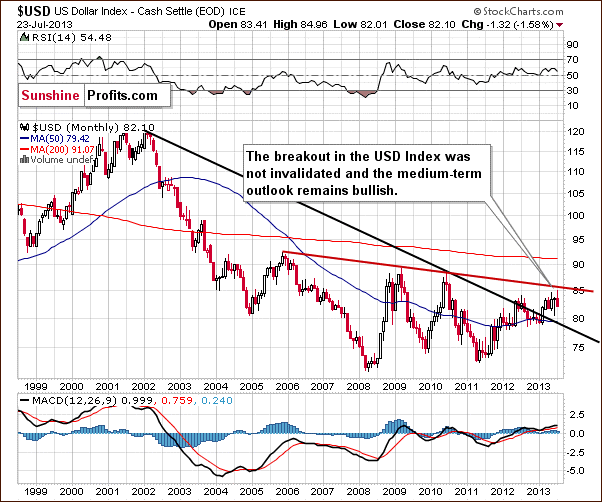
As we wrote in our essay on gold, stocks and the dollar on July 22,2013:
The situation in the long-term chart hasn’t changed recently. The breakout above the declining support/resistance line (currently close to 79) was still not invalidated.
From this perspective the situation remains bullish.
Now, let’s zoom in on our picture of the USD Index and see the medium-term chart.
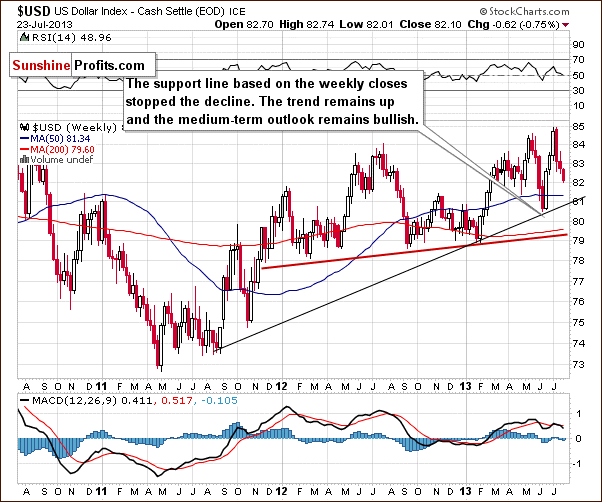
When we take a look at the above chart we can see that the USD Index has declined once again. Despite this fact, the recent declines haven’t taken the index below 81, so the medium-term uptrend is not threatened. The reason for this is that the medium-term support line hasn‘t been broken, in fact, it hasn’t even been reached.
From this perspective, the situation remains bullish, and we can expect the dollar to strengthen further in the coming weeks.
Now, let’s check to see if the short-time outlook is also bullish.
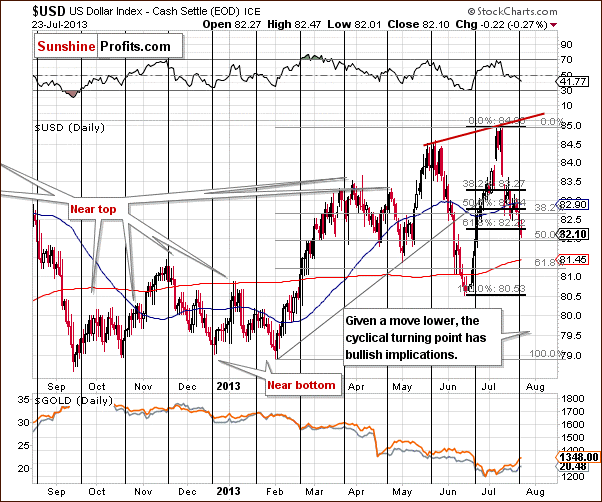
It is. From the short-term perspective, we see that earlier this week, the U. S. dollar dropped slightly below the 61.8% Fibonacci retracement level based on the June – July rally. It also declined to slightly above 82 on an intra-day basis on Tuesday. The move below this level is not confirmed, however.
Moreover, when we factor in the Fibonacci price retracement based on the entire February – July rally, we see that the USD Index moved to the 50% Fibonacci retracement level which is at the 82 level. In fact, the existence of this level might explain why dollar moved slightly below the short-term 61.8% retracement.
All in all, from the price perspective, it still seems that a rally will follow.
The most important factor on the above chart supporting the bullish case is the cyclical turning point which is in play right now. It’s quite possible that we will see its impact on the dollar this week, and this can lead to a bigger pullback. This provides us with strong bullish implications from this perspective.
Combining both perspectives – a move to the upside is still likely to be seen. If the buyers manage to push the USD Index higher, we might see an increase to the level of the June top or even to the rising resistance line based on the May high and June peak before another pause is seen. Taking a look at the long-term charts, however, we see that the next significant resistance is currently close to 86 (86.4) – the declining red line in the chart.
Consequently, from the short-term perspective, we see that the recent decline still seems to be a counter-trend bounce. When we factor in the cyclical turning point we could see another rally soon. Taking a look at medium- and long-term charts, both outlooks for the dollar remain bullish. This is a bearish piece of information for metals and miners.
To make the U.S. dollar perspective complete, let’s analyze the impact of the American currency upon the precious metals sector. Let’s take a look at the Correlation Matrix (namely: gold correlations and silver correlations).
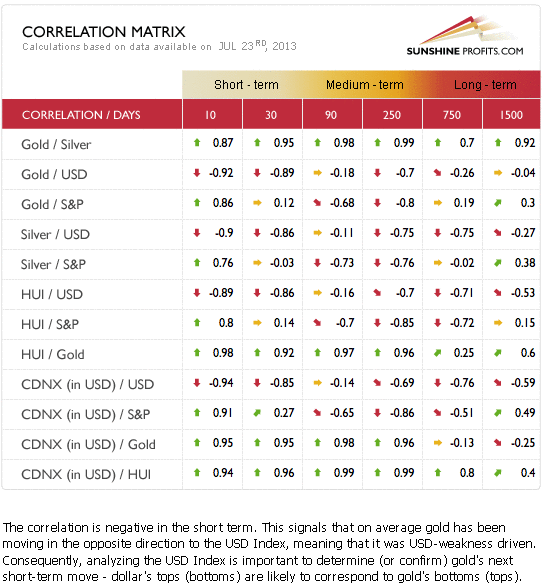
We have seen negative correlation between the metals and the USD Index. Taking the short-term, bullish outlook for the USD Index into account, the implications for gold, silver, and the mining stocks are clearly bearish at this time.
Once we know the current situation in the U.S currency and its impact upon the metals, let’s turn to our final chart. Today, we would like to present you an interesting chart which may provides important clues about further gold’s price movements: the chart of gold from the perspective of the Australian dollar.
Click HERE or on chart for larger image

On the above chart, we see that the price of gold in Australian dollars has moved up and almost reached the declining resistance line. At this point, it’s worth mentioning the previous local top. We saw a pullback to this resistance line in June, but the buyers didn’t manage to push gold above it. This resulted in strong declines which took the price all the way down to the April bottom area. If we see similar price action here, gold priced in Australian dollars will likely decline once again. Such a triple-bottom, in this case, would likely mean a breakdown below the previous lows in the price of gold seen from our regular USD perspective, similar to what was seen in June.
Summing up, the situation in the USD Index is particularly interesting this week. Prices are close to the final Fibonacci retracement level and right at the cyclical turning point (and following a sharp decline). A rally seems quite likely in the cards for the short term, and this will probably have a very negative impact on the precious metals.
Thank you for reading. Have a great and profitable week!
Przemyslaw Radomski, CFA
Founder, Editor-in-chief
Gold Investment & Silver Investment Website – SunshineProfits.com
* * * * *
Disclaimer
All essays, research and information found above represent analyses and opinions of Przemyslaw Radomski, CFA and Sunshine Profits’ associates only. As such, it may prove wrong and be a subject to change without notice. Opinions and analyses were based on data available to authors of respective essays at the time of writing. Although the information provided above is based on careful research and sources that are believed to be accurate, Przemyslaw Radomski, CFA and his associates do not guarantee the accuracy or thoroughness of the data or information reported. The opinions published above are neither an offer nor a recommendation to purchase or sell any securities. Mr. Radomski is not a Registered Securities Advisor. By reading Przemyslaw Radomski’s, CFA reports you fully agree that he will not be held responsible or liable for any decisions you make regarding any information provided in these reports. Investing, trading and speculation in any financial markets may involve high risk of loss. Przemyslaw Radomski, CFA, Sunshine Profits’ employees and affiliates as well as members of their families may have a short or long position in any securities, including those mentioned in any of the reports or essays, and may make additional purchases and/or sales of those securities without notice.

 I had the chance to reconnect with technical gold trader Gary Savage, publisher of the Smart Money Tracker daily gold market commentary and trading service, which has outperformed most of the world’s hedge funds in 2011 and 2012.
It was a powerful conversation as Gary indicated that gold has finally confirmed a breakout, which if holds, suggests we are likely entering the next “C-wave” move or final “bubble phase”.
With the completion of yesterday’s breakout in gold, Gary noted that,
…….read more HERE

 Detroit’s bankruptcy cites more than $18 billion in debts, but the city has one asset that could help its balance sheet considerably: its art collection.
The Detroit Institute of Arts has one of the nation’s oldest and most valuable public art collections, with pieces by Vincent van Gogh, Henri Matisse and Rembrandt van Rijn. Experts say the collection is easily worth more than $1 billion.
In May, the city’s emergency manager, Kevyn Orr, sparked an uproar when he requested an inventory of the collection. Orr’s spokesman, Bill Nowling, told reporters that while Orr doesn’t want to sell the collection, all of the city’s assets had to be valued and considered as part of its financial plan.
(Read More: Detroit joins list of failed US towns)
“We have to look at everything on the table,” he told the Detroit Free Press in May, adding that the city has a “responsibility to rationalize all the assets of the city and find out what the worth is.”
Pamela Marcil, a spokeswoman for the Institute, said a team from Christie’s auction house visited the museum in May, though their purpose remains unclear. While Christie’s requested to send a larger team in June, it’s unclear whether the second group ever visited the Institute, the spokeswoman said.
Christie’s declined comment.
Local cultural supporters and museum groups say selling any of the collection would be a crime. The Institute issued a statement after the bankruptcy filing that said it is “disappointed that the emergency manager determined it was necessary to file for bankruptcy.” It added that the “collection is in trust for the public and we stand by our charge to preserve and protect the cultural heritage of all Michigan residents.”
(Read More: What’s Next for Detroit? Long Court Battle)
At the moment, it appears the state agrees. Michigan Attorney General Bill Shuette said, in a statement, the Detroit Institute of Arts’ collection is held by the city in a charitable trust for the people of Michigan. He said “no piece in the collection could be sold, conveyed or transferred to satisfy debts or obligations.”
What’s more, experts in art law say that many of the pieces in the Institute were bequests from wealthy collectors that could contain restrictions on their sale.
Still, bankruptcy experts said the collection’s fate could be determined by a bankruptcy court. While creditors can’t force the city to sell any particular asset under Chapter 9, they can reject a plan that they conclude doesn’t include sufficient asset sales or payments.
“We can’t ask for the art to be sold, but we can ask for more asset sales and then it’s up to the city,” said one attorney representing Detroit’s creditors.
(Read More: Detroit bankruptcy could hit millions of retirees)
While the museum, which is expected to draw more than 500,000 visitors this year, is owned by the city and is funded with support from a special tax from three counties that’s expected to raise about $23 million a year for the next 10 years. Residents who pay the tax get free admission.
Among the museum’s top works is a Van Gogh “Self Portrait” from 1887. Experts said it could be worth more than $100 million. A Van Gogh self-portrait sold at auction in 1998 for $71 million, but prices for top art works have soared in the past decade.
(Read More: Art Is the Next Gold: Novogratz)
The museum’s other classics include Rembrandt’s “The Visitation,” James Whistler’s “Nocturne in Black and Gold,” and “The Wedding Dance” by Pieter Bruegel the Elder, as well as works by Claude Monet, Matisse and Caravaggio.
This story was originally published by CNBC.
Read more: http://www.businessinsider.com/bankrupt-detroit-could-sell-its-billion-dollar-art-collection-2013-7#ixzz2ZwXp7bHv

Monetary history teaches us that governments always abuse their money-printing powers. Debt crises are not new. The scale and scope of today’s debt crisis, however, is unprecedented.
Video created in cooperation with http://www.GoldSilverWorlds.com
Top Comments
-
· 9

Good video, simple and to the point.
All Comments (24)

As an old voice over guy, it hurts me to hear the narrator, who has a great voice, but little sense of the content, pronounce the word statist incorrectly…like static as opposed to state-ist. Was no one supervising?
This video has several excellent parts and it’s missing the mark slightly in several others. I appreciate what they’ve done and at the same time would like to have seen it be all it could have been,
· in reply to Karma King (Show the comment)-
They’re dealers providing a service in exchange for a markup. I’m sure you’re familiar with the concept.
They aren’t selling THEIR gold, which I’m sure they hold plenty of individually.
· in reply to halfcab123 (Show the comment) 
Brilliantly produced. Brilliantly distilled. For more detail google “criticism of fractional reserve banking”
·
Jct: True, I’ve had little success with our English blacks and whites, but why them first, are they brighter than us? Same malfunctioning chips systems everywhere, same math. Besides, I don’t have to convince the masses that the bank software needs debugging, I just need to offer a debugged LETS timebank program.
· in reply to Zoopy Joobles (Show the comment)
If Gold is the answer, why are they selling it ?
·
you cant convince the government …. hopefully we can awaken the interest of the people to do their own research what to accept as medium of exchange
· in reply to AquaBuddhaDeluge (Show the comment)-
money is about quality and not quantity….and so far you still can purchase physical gold and silver…. in regards to the inflation model – sure you get new money because the collateral e.g. the government is using us a a collateral by increasing taxation and inflating away our savings…
· in reply to kingofthepaupers (Show the comment) -
True – that would be Marx Vision of a nationalized currency system… I personally favor a monetary system that does not allow a small elite (gov or bankster) to print money out of thin air, which can then be use to bribe politicans, to destroy international trade with subisides/restrictions or finance wars…..in a uncovered paper money system people will end up in slavery because in such a system property rights do not exist.
· in reply to endtheillusion (Show the comment) -
Aristotle came to the conclusion that “In effect, there is nothing inherently wrong with fiat money, provided we get perfect authority and god-like intelligence for kings”.
· in reply to ymom11 (Show the comment) -
no need to – they are purchasing already for a long time…
· in reply to Zoopy Joobles (Show the comment) -
Good video, simple and to the point.
· 6 
All good points, however it seems like gold propaganda. It left out the fact that all US fiat money is created with debt attached as a loan. Because of this, there is more debt to bankers than exists money in existence and the debt is growing. To participate in markets people need this debt attached currency and it makes everyone a debt slave to the bankers. Fiat currencies have and can work when the government is responsible e.g. American Colonial Scripts.
·-
Gold is not the end-all be-all. Its value is easily manipulated by those who have cornered the market like what has been done to diamonds. Gold backed currencies can be inflated or deflated by those who own the vast majority of the world’s wealth. The best answer is a responsibly managed fiat which has rarely existed in history.
· in reply to ymom11 (Show the comment) 
You say in the video that the govt needs the banks to print the money. Actually the govt could print the money itself and save itself the costs of the interest payments on the bank printed debt notes.
marketoracle.co.uk/Article3489
1.html ·
I’m not so keen on the inflation that would bring about, but I sincerely wish you luck in convincing the govt to stop borrowing :o)
· in reply to endtheillusion (Show the comment)-
Jct: What a piece of trash, as if there would ever be enough yellow or silver rock to go around. Screw the Gold Standard of Money, poor people have no gold, only bullion brokers are cheering this on. Better the Time Standard of Money, join a LETS timebank for some interest-free credits. Forget low-tech rock, think high-tech credits. The inflation model is silly, no one gets any new money without putting up collateral. Seems they forgot the doubled collateral when they doubled the money! Har har!
· -
Now convince over two billion Indians and Chinese of this.
· in reply to kingofthepaupers (Show the comment) 
What a great video….I also recommend “Money as Debt” a 46 minute cartoon…Very important.
·
this is complete garbage
·
Thank you! FINALLY, this is a video that I want to share. It addresses the main issues very clearly and yet doesn’t confuse those who are new to the subject.
· 11-



-
I know Mike is a very solid investor and respect his opinions very much. So if he says pay attention to this or that - I will.
~ Dale G.
-
I've started managing my own investments so view Michael's site as a one-stop shop from which to get information and perspectives.
~ Dave E.
-
Michael offers easy reading, honest, common sense information that anyone can use in a practical manner.
~ der_al.
-
A sane voice in a scrambled investment world.
~ Ed R.
Inside Edge Pro Contributors

Greg Weldon

Josef Schachter

Tyler Bollhorn

Ryan Irvine

Paul Beattie

Martin Straith

Patrick Ceresna

Mark Leibovit

James Thorne

Victor Adair
Thank you! FINALLY, this is a video that I want to share. It addresses the main issues very clearly and yet doesn’t confuse those who are new to the subject.