
Stocks & Equities
Focus this week is on the FOMC meeting. The Fed is expected to announce the beginning of tapering include a reduction in monthly purchased from $85 billion to $70-$75 billion.
Ed Note: Michael Campbell interviewed Don Vialoux, one of the Premier Technical Analysts in the Country this weekend on Money Talks. Mike starts the interview asking Don about Seasonality, specifically if September is generally a tough month: {mp3}moneytalkssept14DonVailoux{/mp3}
Economic news other than the FOMC meeting announcement is expected to be mixed this week.
Earnings news this week will focus on FedEx and Oracle when they report on Wednesday.
Short term momentum indicators for broadly based equity indices around the world and most U.S. sectors are overbought, but have yet to show signs of peaking.
Medium term technical indicators are overbought. Dow Industrials, TSX Composite Index and the S&P 500 Index have reached a zone of resistance.
Seasonality in the second half of September is negative. Indeed, this period is the weakest period in the year for broadly based North American equity indices.
Other events that could influence equity markets this week include the debate on Syria, the budget debate, negotiations on the debt ceiling, higher energy costs and declining earnings estimates.
The Bottom Line
U.S. equity markets reached an intermediate peak on August 2nd. Strength last week has returned broadly based equity indices to near resistance levels. The current correction is expected to last until at least October. Preferred strategy is to maintain a healthy cash position for possible entry into the favourable seasonal trade in October.
Ed Note: Don analyses 42 Charts in the Equity, Interest Rate, Commodity & Currency Markets in this Comphrehensive Monday Report HERE
Quick view of the S&P, TSX, Gold, Bonds & US Dollar Below:
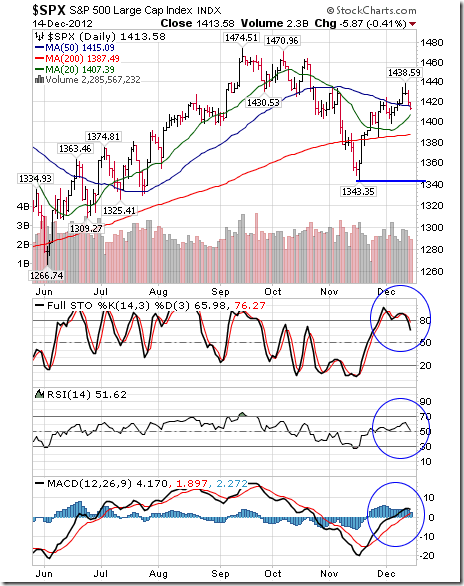
The S&P 500 Index gained 32.82 points (1.98%) last week. Trend remains neutral. Resistance is at 1,709.67 and support is at 1,627.47. The Index moved above its 20 and 50 day moving average. Short term momentum indicators are overbought, but have yet to show signs of peaking. Notice the overhead resistance between 1680 and 1710.
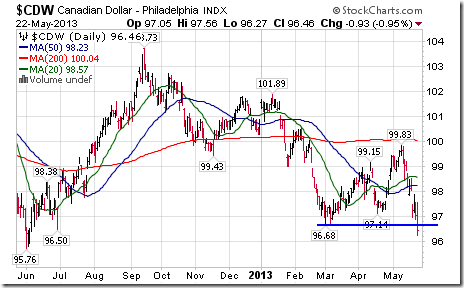
The TSX Composite Index fell 97.52 points (0.76%) last week. Trend remains up. The Index remains above its 20 day moving average. Strength relative to the S&P 500 Index changed from positive to negative. Technical score changed to 2.0 from 3.0 out of 3.0. Short term momentum indicators are rolling over from overbought levels.
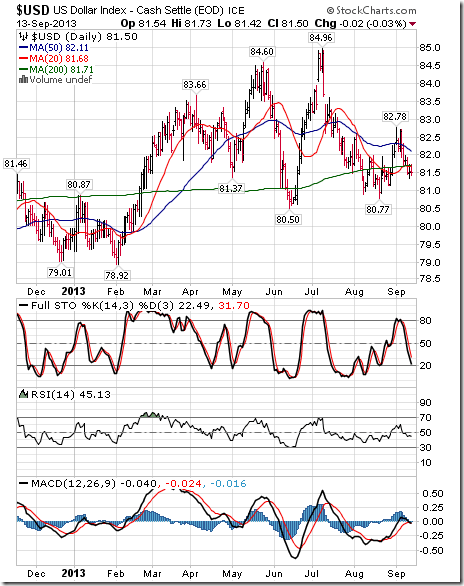
The U.S. Dollar fell 0.69 (0.84%) last week. The Index moved below its 20, 50 and 200 day moving averages. Short term momentum indicators are trending down.
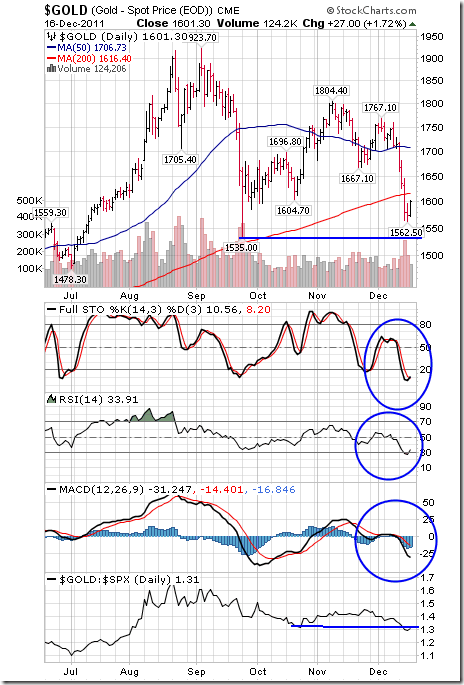
Gold plunged $77.90 per ounce (5.62%) last week. Trend remains up. Gold fell below its 20 and 50 day moving averages. Strength relative to the S&P 500 Index changed from neutral to negative. Technical score fell to 2.5 to 1.0 out of 3.0. Short term momentum indicators are oversold, but have yet to show signs of bottoming.
The yield on 10 year Treasuries slipped last week by 4 basis points (1.36%). Trend remains up. Yield remains above its 20 day moving average. Short term momentum indicators are overbought.
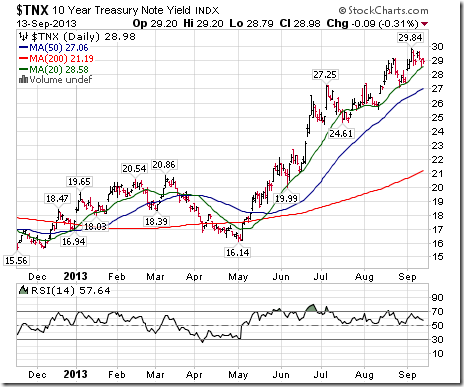
…..read more of Don’s analysis of 42 Charts in the Equity, Interest Rate, Commodity & Currency Markets in this Comphrehensive Monday Report HERE

 The entire Money Talks with Michael Campbell including the 1st 1/2 hour beginning with Michael’s Economic & Financial Commentary: {mp3}moneytalks sept14lcommentary{/mp3}
The second hour of MoneyTalks starts with Michael interviewing one of the Premier Technical Analysts in the Country, Don Vialoux. Mike begins the interview asking Don about Seasonality, including if September is generally a tough month: {mp3}moneytalkssept14DonVailoux{/mp3}

“U.S. Manufacturing Renaissance is Fact not Fiction”
 QUESTION: Is there a “manufacturing renaissance in the USA.”
ANSWER: Yes. This is developing for two primary reasons. First: the 2011 law that has blocked Americans from starting businesses overseas. Second: many companies including auto manufacturers who rushed to Mexico to manufacture cars are coming back. Ford no longer employs anyone at its Hofu Plant in Japan and the Cuautitian Plant in Mexico both opened in 1981.
Clearly, there is plenty of proof to indicate that there is rising factory output, strong manufacturing production gains, and lower labor costs for the first time in a long-time given the less militant unions that chased jibs away. American workers are more attractive than ever before. For a major Japanese auto manufacturer in the 90s, I was asked to explain how the American plant had higher productivity numbers the a similar plant in Japan. I visited the plant and discovered they employed people who had been in Detroit and lost their jobs thanks to the unions. They moved to California and worked non-union. Productivity rose, they were more happy, less confrontational, and had outperformed the Japanese. The whole thing was the union created confrontation out of everything so the perception that American workers were lazy was actually wrong.
Add to this the natural gas boom underway in the U.S., which many believe will lower energy costs for U.S. manufacturers dramatically, and what you have is a resurgence of the manufacturing sector that has been shrinking as a percentage of the economy for several decades thanks to unions. The USA is probably the most competitive in the world on a global basis. This is also caused by much higher taxes in Europe the will not get any better. The downside, USA needs taxes and we will see rising taxes that will destroy thus new manufacturing renaissance.
Nonetheless, as in all things, the U.S. “manufacturing renaissance” is also cyclical in addition to these structural changes. Therefore, the sector is doing as well as would have been predicted under any circumstances at this point in an economic recovery, however, that provides the incentive to return. Without the cyclical boom in the economy, the manufacturing would not return home. Those who try to downplay this trend as purely cyclical, are clearly speaking from their ivory towers and lack the hands-on contacts that I have had over the years. When the Euro was forming, we developed the strategies for Japanese companies needing to open in Europe. We looked at labor costs, taxes, and currencies. We put those who did not need skilled labor in Ireland and manufacturers in Britain. We were called in to Mercedes and met with the board of director at Daimler Bends. So we participated directly in this decision making process. This is not what I “think” foes on – it is what goes on.
U.S. Manufacturing Renaissance is Fact not Fiction. The question is when will taxation kill it? What destroyed American manufacture is perspective. A woman was very demanding and confrontational. Her husband split and eventually met a girl 20 years younger. The wife then says he left her for the “young girl” he met after the break up. That is the explanation she prefers because there is no responsibility on her part. This is the same problem. It is better to say it was the greed of manufacturers seeking low costs rather than to say unions became too confrontational with no sense of competitiveness and politicians kept raising taxes that made the products too expensive and uncompetitive. It is a two-way street.
…..read more postings at Armstrong Economics HERE

As I mentioned in my last post there is a disturbing possibility that gold’s intermediate cycle has topped, and done so in a left translated manner. For clarification, left translated cycles often lead to lower lows. In this case if gold did top on week 9 and the intermediate cycle is now in decline, then the odds are high we are going to see the June low of $1179 tested and broken before the next intermediate bottom.


 Prudent Bear’s Doug Noland marks the fifth anniversary of the collapse of Lehman Brothers — and the near-collapse of the global financial system — by asking whether the system’s flaws have been fixed.
….read it all HERE


-
I know Mike is a very solid investor and respect his opinions very much. So if he says pay attention to this or that - I will.
~ Dale G.
-
I've started managing my own investments so view Michael's site as a one-stop shop from which to get information and perspectives.
~ Dave E.
-
Michael offers easy reading, honest, common sense information that anyone can use in a practical manner.
~ der_al.
-
A sane voice in a scrambled investment world.
~ Ed R.
Inside Edge Pro Contributors

Greg Weldon

Josef Schachter

Tyler Bollhorn

Ryan Irvine

Paul Beattie

Martin Straith

Patrick Ceresna

Mark Leibovit

James Thorne

Victor Adair