
Mike's Content
 Michael’s daily comment on the demonization of profit.
In 2010, Fed Chairman frontrunner, Janet Yellen stated that, “For my own part, I did not see and did not appreciate what the risks were with securitization, the credit ratings agencies, the shadow banking system, the S.I.V.’s — I didn’t see any of that coming until it happened.” Yikes!!!
– reported in the New York Times

Speculators got less bullish on gold, selling long contracts at the fastest pace this year as prices fell the most in almost three months on prospects for less central-bank stimulus. Goldman Sachs Group Inc. said the retreat has further to go.
The net-long position held by hedge funds and other large speculators fell 16 percent to 84,929futures and options in the week ended Sept. 10, U.S. Commodity Futures Trading Commission data show. Long holdings dropped 10 percent, the most since December, and short bets increased 9.8 percent. The net-bullish position across 18 U.S.-traded commodities slid 4.1 percent, with investors adding to bearish wagers on wheat and corn.
Gold resumed its retreat, heading for the first annual loss in 13 years, after coming within 3 percentage points of a bull market on the threat of military strikes on Syria. The U.S. and Russiaagreed Sept. 14 on a plan for Syria to surrender its chemical weapons. Speculation Federal Reserve Vice Chairman Janet Yellen will become the next head of the central bank after former Treasury Secretary Lawrence Summers withdrew his name may support gold this week before a Fed meeting that economists expect will curb stimulus.
“The market is trying to find a price for gold in an environment where the Fed begins cutting back its assistance,” said Donald Selkin, who helps manage about $3 billion of assets as chief market strategist at National Securities Corp. in New York. “The temporary sparkle that we had seen because of Syria is disappearing.”
Price Declines
Futures slumped 5.6 percent to $1,308.60 an ounce last week in New York. Gold retreated 21 percent this year as some investors lost faith in the metal as a store of value, erasing almost $59 billion from the value of exchange-traded products and spurring at least $26 billion in writedowns by mining companies. Fifteen analysts surveyed by Bloomberg expected prices to fall again this week, with seven bullish and three neutral. It was the most bearish survey since June 21.
The Standard & Poor’s GSCI gauge of 24 commodities declined 2.2 percent last week, the most since June, led by gold and a 9.1 percent drop in silver that was the biggest loss since June. The MSCI All-Country World Index of equities climbed 2.2 percent and the Bloomberg Dollar Index, a gauge against 10 major trading partners, slipped 0.7 percent. The Bloomberg U.S. Treasury Bond Index rose 0.3 percent. Gold futures rose 0.7 percent today to settle at $1,317.80.
….read more on Goldman’s View HERE

 In this week’s issue:

Stockscores Market Minutes Video
This week, I discuss why you should stick with the long term trend and avoid doubt. Watch it on YouTube by clicking here.
As a trader, how you judge success will have an effect on how you approach the market. Define success incorrectly and you may doom yourself to failure before you ever make a trade. I think unrealistic expectations are a major reason why most people cannot make it as traders. I want to help by showing you how to judge performance and what your expectations should be.
Conventional wisdom leads most to judge success using percentage gain over a time period. This seems to make a lot of sense but it has problems over time. Anyone can get lucky in the relative short term, making them think that they are smart because the market hands them some nice returns. However, the market cycles and if you fail to catch one of the strong up cycles that lets everyone be a winner, you will probably lose it all.
Risk management needs to be part of your criteria for judging success.
It is also important to recognize that the stock market is extremely hard to beat and it is nearly impossible to know what one individual stock will do. With good strategy testing, you can judge what a set of rules will achieve over a large number of trades and use that as your gauge.
Therefore, it is dangerous to judge success over a small number of trades.
A strategy’s potential is measured by its expected value. A strategy that is wrong 90% of the time can still be a great money maker if it makes a lot when it is right. With the same logic, there are strategies that are almost always right but which still lose money because the gainers are outweighed by the losers.
So, do not judge success the way you judge performance on a test, it is about how much you make when you are right versus how much you lose when you are wrong.
Each trade does not have an equal weighting in the measure of overall success. In my trading, I find that I have lots of small winners and small losers that tend to balance each other out. However, it is the occasional big winners that serve as the source of most of the profits.
You have to be patient to let the big winners happen.
Let’s know go through an example of how a trading strategy might work.
Suppose you have a set of rules which, after exhaustive testing, has the following characteristics:
Right 70% of the time, wrong 30% of the time
When it is right, the average profit is two times the average loss
The most common profit is one times the average loss
Once in ten trades, there is a profit that is five or more times the average loss
How would unrealistic expectations destroy the potential of this strategy?
What would happen if the trader expected to never be wrong and, as a result, hung on to his losers until they became winners? Since some trades will never be winners, this would mean he would have much larger losers than the disciplined trader who used stop loss points and planned his losses. Instead of having an average reward for risk of two to one, it might be one to two.
What would happen if the trader judged her performance one trade at a time? With each win – elation. With each loss – despair. This emotional rollercoaster would affect their ability to make the right trading decisions and eventually the trading rules would be broken. The trader would fall apart.
What would happen to the trader who did not understand the expected value of their trading strategy? They would likely fail to limit downside and maximize upside. They would think it was good to make a certain amount of money on a trade rather than judge their success by how much reward they earned for the risk that they took. In time, they would be broke.
Finally, what would happen to the trader who failed to let the big trades happen? Since the majority of their profits come from a minority of their trades, the strategy that they tested and found to be profitable would fail to be so in real trading. The emotional desire to lock in fast profits rather than let the winners run would turn them in to traders with a high success rate but not a lot of profits.
Change how you judge success so that you can approach the market with the mindset of the winning trader. This may contribute more to your success than your ability to pick the right stocks.

A good approach to finding winning stocks is to look for sectors that are showing strength and then look inside those sectors for stocks leading the way. I like to look for Sectors that have been oversold but are showing signs of a turn; I do this each week by looking through about 1400 Exchange Traded Funds to see where there is strength that stands out.
For the past few weeks, I have noticed that money is coming in to the Rare Earth sector. This is a small sliver of the mining market but important because of their use in cell phones. The ETF for this group is REMX, the chart is below.

1. REMX
REMX broke its long term downward trend line early in September after the formation of a rising bottom. This is a typical chart pattern set up that comes at the turning point of a downward trend in to an upward trend. I think it is very early stage of a turnaround where the probability of success is still relatively low but the upside potential is much more significant here than if you wait for the turnaround to develop further.

2. T.RES
T.RES, REE has been doing very well over the past four days, I think it is due for a few days of profit taking so consider a pullback an opportunity to enter with a better reward for risk. This is a longer term trade that may require patience early as the market takes time to catch on to the optimism that is building.

References
- Get the Stockscore on any of over 20,000 North American stocks.
- Background on the theories used by Stockscores.
- Strategies that can help you find new opportunities.
- Scan the market using extensive filter criteria.
- Build a portfolio of stocks and view a slide show of their charts.
- See which sectors are leading the market, and their components.
Disclaimer
This is not an investment advisory, and should not be used to make investment decisions. Information in Stockscores Perspectives is often opinionated and should be considered for information purposes only. No stock exchange anywhere has approved or disapproved of the information contained herein. There is no express or implied solicitation to buy or sell securities. The writers and editors of Perspectives may have positions in the stocks discussed above and may trade in the stocks mentioned. Don’t consider buying or selling any stock without conducting your own due diligence

Looking at the charts of crude oil, we clearly see that the major factor, which has driven the price of light crude in the recent weeks was the uncertainty around Syria. At the beginning of the previous week, crude oil began to drop after Russia offered to help put Syria’s chemical weapons under international control. Although the U.S. President Barack Obama said that he will still continue efforts to convince politicians to back military action, Russia’s proposal raised the chance that a U.S. military strike would be delayed or averted. In the following days, we saw two-day small bounce up in crude oil prices as investors worried about whether diplomatic efforts to eliminate Syria’s chemical weapons would avert military action that could disrupt oil supplies from the Middle East. These diplomatic efforts intensified as Russia warned that a U.S. strike could unleash extremist attacks and carry the country’s bitter civil war beyond Syria’s borders. However, this improvement was only temporary and crude oil slipped on Friday as the United States and Russia worked on a plan for Syria to surrender its chemical weapons.
On Saturday, U.S. Secretary of State John Kerry and Russian Foreign Minister Sergei Lavrov agreed to back a nine-month U.N. program to destroy Syrian President Bashar al-Assad’s chemical arsenal. In this way, the U.S. agreed to call off military action against Syria in a deal with Russia. It’s not hard to guess how this event affected oil prices. Today, crude oil has lost over 2% and is trading below $107 a barrel once again.
Once we know the situation around Syria, let’s move to the most important event of the current week – the Federal Open Market Committee meeting. FOMC is meeting for two days from Tuesday with expectations high that policymakers will decide to reduce the monthly $85-billion bond purchases. On a side note, we recently published a detailed analysis (in Sep Market Overview report) of 8 ways in which the situation could evolve based on what the Fed will do regarding the QE program and the way it is announced.
Earlier this month, the weaker-than-expected U.S. payroll numbers for August raised doubts about whether the Federal Reserve will start paring its massive stimulus and resulted in higher prices of light crude. On Friday we saw similar price action as the weak consumer sentiment and retail sales data bolstered the view that Fed policymakers will slow an exit from the U.S. central bank’s bond-buying program.
What will be the decision? By how much the central bank will cut its monthly asset purchase program? What impact will it have on the markets? Will it trigger a further rally in crude oil or a decline? We’ll get answers these questions on Wednesday. Meanwhile, let’s move on to the technical part of our Oil Update. Just like a week ago, we take a look at the charts from different time perspectives to have a more complete picture of the current situation in the oil market.
Let’s start with a look at the monthly chart of light crude (charts courtesy by http://stockcharts.com).
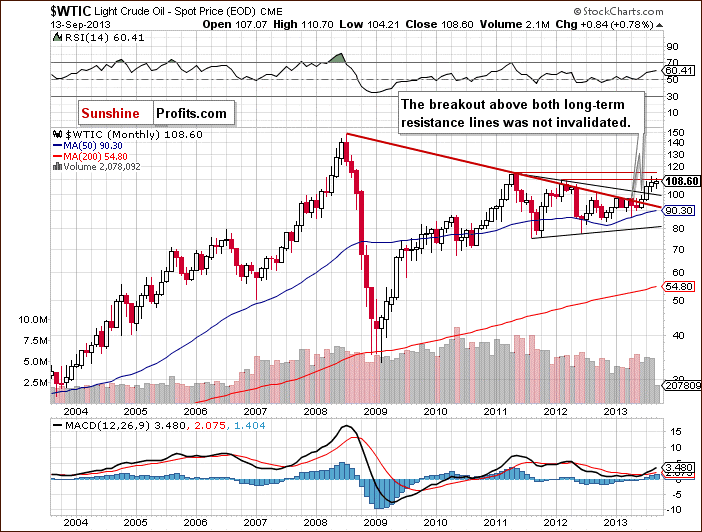
Looking at the above chart, we see that the situation hasn’t changed much. Light crude still remains above the two long-term declining resistance lines: one of them (bold red line) is based on the July 2008 and the May 2011 highs, and the second one is based on the September 2012 and March 2013 highs (the upper black line).
From this perspective the picture is bullish and the breakout above these two long-term declining resistance lines hasn’t been invalidated.
Now, let’s zoom in on our picture of the oil market and see the weekly chart.
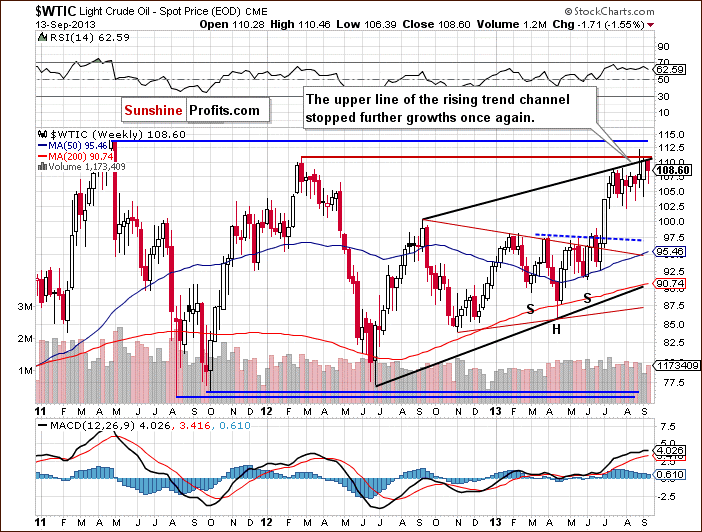
Quoting our last Oil Update:
(…) crude oil reached the strong resistance zone based on the March 2012 top and the upper border of the rising trend channel once again.
Taking the above into account, we should consider two scenarios. If the buyers manage to break above this strong resistance zone, the first price target will be close to the May 2011 top. However, if they fail, history will likely repeat itself and the price of light crude will come back to the consolidation range.
On the above weekly chart, we see that light crude started the previous week above $110 per barrel, but the strong resistance zone stopped the rally once again. Oil bears quickly noticed the opportunity to go short and triggered a corrective move, which pushed the price of crude oil slightly above $106. Despite this drop, light crude rebounded in the following days and closed last week above $108 per barrel.
From this point of view, the situation is somewhat mixed, but with a bullish bias. On the one hand, crude oil still remains slightly below the May 2011 top, which is a bullish factor. On the other hand, there was a third unsuccessful attempt to break above this level, which resulted in a decline to the consolidation range, and such price action doesn’t look so bullish.
Now, let’s check the short-term outlook.
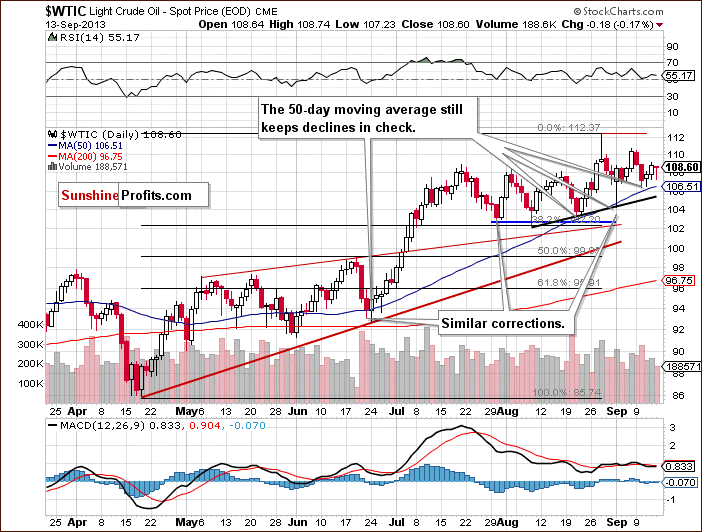
On the above chart we see that the situation has deteriorated since our last Oil Update was published. Since the beginning of the previous week the price of light crude has dropped and reached below $107 per barrel. Although, oil bears tried to push the price below this level on Wednesday, their attempt failed and crude oil rebounded above $109 in the following days. Last session of the week wasn’t so good, but oil bulls didn’t give up and pushed the price of light crude from its daily low to over $108 per barrel.
As you see on the daily chart, slightly below weekly low there is the 50-day moving average, which stopped the decline in June and, again, at the end of August. In both previous cases this moving average encouraged buyers to act, which resulted in sharp rallies in the following days. Please note that we also saw similar price action at the beginning of September. If history repeats itself, the moving average will likely stop a downward move in the coming days.
At this point it’s worth mentioning that the current correction is still shallow and smaller than the previous one (from the August 28 top to the September 3 low), which is a bullish factor. What’s interesting, even if the price of crude oil drops below the weekly low (to about $103), both corrections will be similar and the uptrend will not be threatened.
Where are the nearest support levels? The first is the 50-day moving average (currently at $106.51). The second one is the Tuesday low at $106.39. The third one is the rising line based on the August lows (close to $105.36). The next one is a zone (between $102.22 and $103.50) based on the bottom of the previous corrective move (the August 21 low) and the August low. In this area, there is also the 38.2% Fibonacci retracement level, which reinforces this support zone.
Summing up, although there was a downward move at the beginning of the previous week, which took the price of light crude slightly above $106, technically, the short-term outlook is still bullish. The uptrend is not threatened at the moment, because the recent decline was shallow and smaller than the previous one.
Once we know the current outlook for crude oil, let’s examine the NYSE Arca Oil Index (XOI) once again to find out what the current outlook for the oil stocks is and to check if they confirm or invalidate the above analysis of the crude oil market.
Let’s start with the long-term chart.
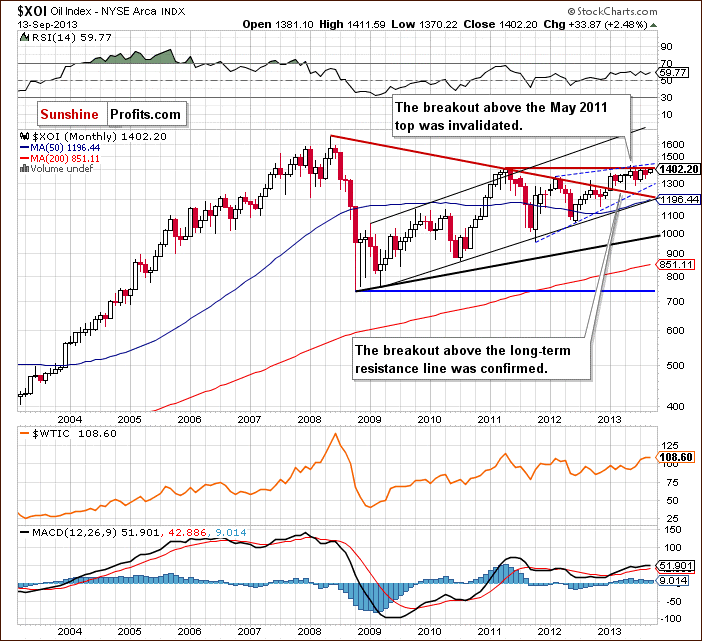
On the above chart, we see that the situation hasn’t changed much and all of what we wrote in our last Oil Update is still up-to-date today.
(..) we’ve been seeing a consolidation in the recent months and the NYSE Arca Oil Index is trading between the July top and the July low.
The XOI remains quite close to the May 2011 top and it’s still above the previously-broken long-term declining resistance line based on the 2008 and the 2011 highs and the breakout hasn’t been invalidated. The oil index also remains in the range of the rising trend channel.
Taking the abovementioned observations into account, the situation is still bullish.
Let’s take a closer look at the weekly chart.
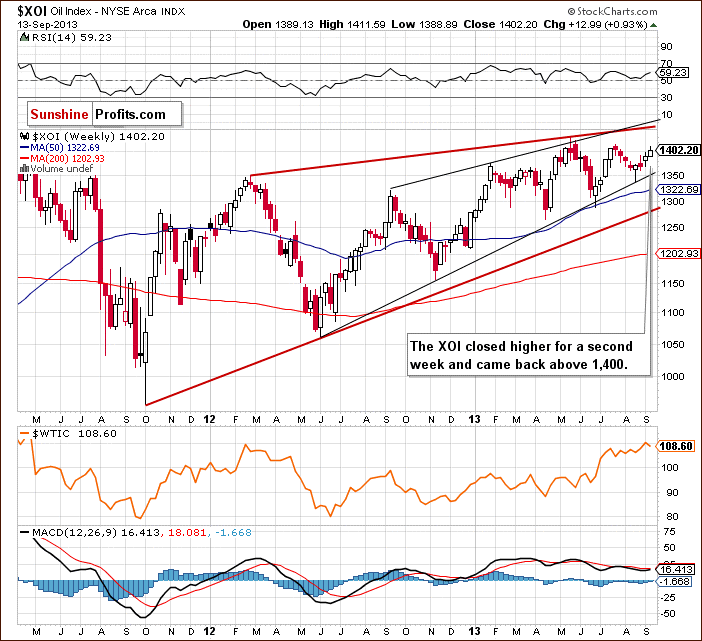
Looking at the above chart, we see that the oil stock index continued its upward move in the previous week and climbed above 1,400. In this way the XOI moved away from the medium-term support line. Keep in mind that this strong support line (marked in black) stopped the decline in June, which resulted in a rally in the following weeks.
Despite the recent growth, we should still keep an eye on the above-mentioned support line, because it is also the lower border of the rising wedge. As you know, this is a bearish pattern and if buyers fail and XOI moves below the short-term support line, it will likely lead to a decline which may take the oil index at least to the lower medium-term support line (the red one).
The medium-term uptrend is not currently threatened, and the situation remains bullish.
What about the relationship between light crude and the oil stocks?
When we take a look at the above chart and compare price action in both cases, we clearly see that oil stocks were stronger in the previous week, as they closed higher for a second week. At the same time light crude close the whole week below the closing level of September 6, 2013. Additionally, light crude still remains below the strong resistance zone based on the March 2012 top and the upper border of the rising trend channel.
Now, let’s turn to the daily chart.
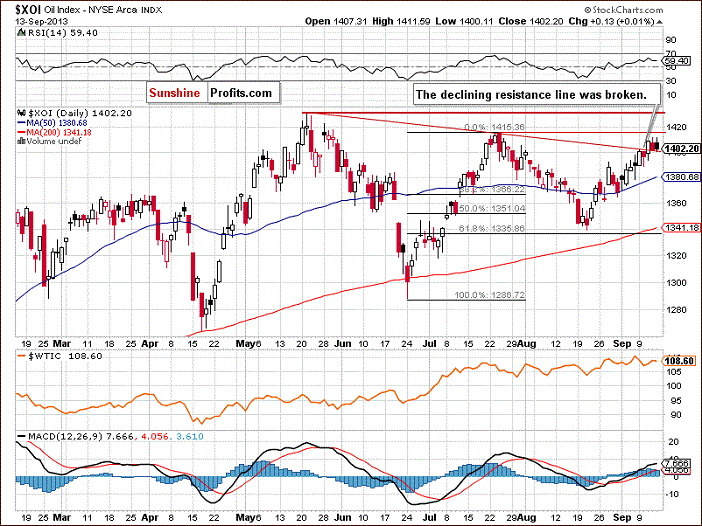
As you see on the above chart, the 50-day moving average stopped further declines at the end of August. This strong support encouraged investors to push the oil index higher, which resulted in an increase above the 61.8% Fibonacci retracement level (based on the entire July-August decline). As we wrote in our previous Oil Update, the next resistance level was the declining line based on the May and July highs (currently close to the 1,404 level).
On the above daily chart we see that oil bulls managed to push the oil index above the previously-mentioned declining line based on the May and July highs. In this way the last resistance level below the July top was broken.
In this case, the next target for buyers is the July peak, and then the May top.
The nearest support is around 1,393 (the September 11 low), the second one is at the 50-day moving average (currently at 1,380.68). The next support zone is based on the August 27 and August 30 lows (1,361-1,364), and a further one is based on the August 21 bottom and the 61.8% retracement level (1,338-1,339).
Now, let’s comment on the relationship between the WTI and the XOI in the short term. Despite the negative divergences at the beginning of the previous week, the second half looked pretty much the same in both cases and we saw declines.
Summing up, from the long- and medium-term perspectives the outlook for oil stocks remains bullish and the uptrend is not threatened at the moment. Taking into account the relationship between light crude and the oil stock index, we can conclude that the oil stocks have been outperforming oil since our first Oil Update was published.
Speaking of relationships, let’s take a closer look at the chart below and check the link between crude oil and gold. Has it changed in the recent days? Let’s examine the daily chart.
Quoting our last Oil Update:
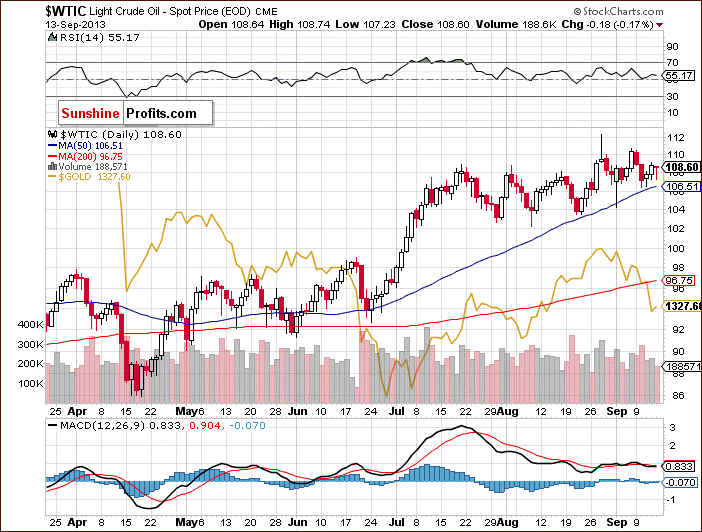
(…) crude oil was trading in the narrow range between the Tuesday’s bottom and top. What’s interesting, at the same time gold declined once again. In other words, the consolidation in light crude triggered another move lower in gold.
Last week we saw similar price action, but in this case, the negative divergence was even more visible. In the first half of the previous week both commodities declined. However, after this downward move light crude rebounded in the following days and erased over 61.8% of its decline. What did happen with gold at the same time? The yellow metal extended its decline and dropped to a five-week low slightly above 1,300 an ounce.
Taking the above into account, it’s worth taking a closer look at the medium-term outlook for gold.
Let’s turn to the weekly chart of the yellow metal.
In our last Oil Update we wrote:
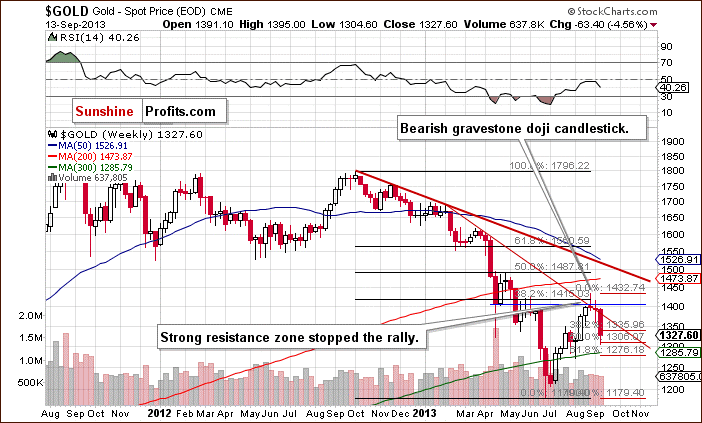
(…) the medium-term situation seems quite bearish and if gold drops below the declining resistance line based on the October 2012 and February highs the outlook will be even more bearish.
As you see on the above chart, after gold’s attempts to move above the strong resistance zone failed and the breakout was invalidated, the yellow metal dropped below the abovementioned declining resistance line and accelerated the decline. On Friday, gold reached the 50% Fibonacci retracement based on the June-August rally. In this way, the shiny metal lost almost 6% for the week. It is gold’s biggest weekly loss since June.
Summing up, taking the long and medium-term relationship between light crude and the oil index into account, we can conclude that the oil stocks have been outperforming oil since our first Oil Update was published. In the past, we saw negative divergences between WTI and the XOI many times. In the previous week, the oil index closed higher for a second week and broke above important resistance. Meanwhile, crude oil erased only over 61.8% of its last week’s decline, which confirms weakness of oil in relation to oil stocks.
Looking at the relationship between crude oil and gold, we noticed another negative divergence.Although both commodities declined in the first half of the week, the second half was quite different. As we previously wrote, after this downward move light crude rebounded in the following days and erased over 61.8% of its decline. Meanwhile, the yellow metal extended its decline and dropped to a five-week low. Additionally, the recent decline in crude oil is still smaller than the previous one and the uptrend is not threatened at the moment. At the same time, the downtrend in gold remains in place.
Taking this into account, it seems that the short-term link between the yellow metal and crude oil will wane even more in the coming weeks.
ST outlook: bullish
MT outlook: bullish
LT outlook: bullish
Thank you.
Nadia Simmons
Sunshine Profits‘ Contributing Author
Gold Trading Tools and Analysis – SunshineProfits.com
* * * * *
Disclaimer
All essays, research and information found above represent analyses and opinions of Nadia Simmons and Sunshine Profits’ associates only. As such, it may prove wrong and be a subject to change without notice. Opinions and analyses were based on data available to authors of respective essays at the time of writing. Although the information provided above is based on careful research and sources that are believed to be accurate, Nadia Simmons and his associates do not guarantee the accuracy or thoroughness of the data or information reported. The opinions published above are neither an offer nor a recommendation to purchase or sell any securities. Nadia Simmons is not a Registered Securities Advisor. By reading Nadia Simmons’ reports you fully agree that he will not be held responsible or liable for any decisions you make regarding any information provided in these reports. Investing, trading and speculation in any financial markets may involve high risk of loss. Nadia Simmons, Sunshine Profits’ employees and affiliates as well as members of their families may have a short or long position in any securities, including those mentioned in any of the reports or essays, and may make additional purchases and/or sales of those securities without notice.


-
I know Mike is a very solid investor and respect his opinions very much. So if he says pay attention to this or that - I will.
~ Dale G.
-
I've started managing my own investments so view Michael's site as a one-stop shop from which to get information and perspectives.
~ Dave E.
-
Michael offers easy reading, honest, common sense information that anyone can use in a practical manner.
~ der_al.
-
A sane voice in a scrambled investment world.
~ Ed R.
Inside Edge Pro Contributors

Greg Weldon

Josef Schachter

Tyler Bollhorn

Ryan Irvine

Paul Beattie

Martin Straith

Patrick Ceresna

Mark Leibovit

James Thorne

Victor Adair