
Energy & Commodities

Biggest Oil Discovery in 50 Years

New Find Is Three Times as Big as the Bakken

Screen Shot 2013-09-18 at 6.25.50 AMThe latest U.S. find isn’t just massive; it’s also yet another sign the U.S. shale oil boom is still in its infancy… That’s why you can still make a fortune in new American energy. And yes, you can still do it in Texas. Just ask Dr. Kent Moors. And ask the drillers, too, because these guys are about to uncork a vast new reserve before anyone else even shows up


Investors searching for the best stocks to buy now often look toward the shale oil boom and, in particular, at key finds such as the Bakken formation in North Dakota or the Permian Basin in west Texas.

But a fresh development in the Permian Basin has made the U.S. oil industry take notice – and that’s not easy given the dramatic shale oil finds across the country.

In fact, the U.S. Geological Survey called this find the largest discovery in the last 50 years in the Permian Basin.

I’m talking about the Cline Shale.

Dr. M. Ray Perryman, head of the economic analysis firm The Perryman Group, told Rigzone “The information coming out on the Cline shale indicates up to 30 billion barrels of recoverable oil, which is substantially larger than other large plays.”

To get an idea of what this means, consider that the Eagle Ford in Texas is believed to have approximately 10 billion barrels of recoverable oil and the Bakken 11 billion barrels.

That means the Cline Shale has at least three times the amount of recoverable oil as two of the biggest shale oil finds in the United States.

Clearly, if you’re looking for the best energy stocks to buy now based on the shale oil boom, you need to find out as much as you can about the Cline Shale.

Where the Cline Shale Fits In

Texas has a number of overlapping oil fields, and the Cline Shale happens to be one of them.

And it’s a really, really big one.

The 1.6 million-acre formation lies over a large area on the eastern shelf of the Permian Basin, running about 9,000 feet underneath a 10-county swath of Texas. It averages about 70 miles wide from east to west and roughly 140 miles wide from north to south.

The key target zone for oil production is between 200 and 500 feet thick. The Cline is also known as the Lower Wolfcamp because some of it lies beneath the already-known Wolfcamp shale formation to the west.

That means a few fortunate companies can drill wells with stopping points in both shale formations.

Meanwhile, the potential of the Cline Shale could exceed even the impressive estimate of 30 billion barrels of recoverable oil.

Oil companies like Devon Energy Corp. (NYSE: DVN) have only just begun to drill in this formation.

“We’ve had some encouraging results in the Cline, and we are hopeful and optimistic about our prospects for being successful in this play,” Devon spokesperson Chip Minty told the Texas Tribune.

The company hasn’t made a lot of noise about its results so far because it is so early in the Cline’s development. In total, fewer than 100 wells have been drilled to date in the Cline Shale.

But some of those wells have already produced 400 to 800 barrels per day of oil equivalent with 60% to 75% oil production. That’s just a hint of the extraordinary potential that the Cline Shale holds, both for the oil industry and investors.

The Best Stocks to Buy Now in the Cline Shale

To find the best energy stocks to buy to capitalize on the black gold that’s just starting to flow out of the Cline Shale, one need only look at the companies that got there first…

Of course, there’s Devon Energy, which drilled many of the early wells.

Other companies already drilling in the Cline include Apache Corp.(NYSE: APA), Gulfport Energy Corp. (Nasdaq: GPOR), and another pioneer in the region, Laredo Petroleum Holdings Inc. (NYSE:LPI).

Laredo’s founder, Chairman and Chief Executive Officer (CEO) Randy Foutch, has hinted that the Cline Shale could end up being one of the most profitable shale formations in the United States.

“We believe the Cline shale exhibits similar petrophysical attributes and favorable economics compared to other liquids-rich shale plays, such as in the Eagle Ford and Bakken shale formations,” Foutch told the American Association of Petroleum Geologists Explorermagazine last year.

Another company with drilling operations in the Cline as well as nearby, Breitling Oil & Gas, has planned an initial public offering for late this year or early in 2014.

“We are in a hotbed area with great infrastructure from legacy conventional plays, we have access to a talent pool for workers and equipment is already in the area,” Breitling CEO Chris Faulkner toldRigzone.

But as optimistic as this seems, the Cline Shale picture could get even brighter. As more wells are drilled in the Cline Shale, it is very likely that the estimates of the amount of recoverable oil will keep rising. That’s just what happened with the Bakken and Eagle Ford shale formations.

This exceptionally promising location virtually guarantees success for the companies drilling in the Cline, making them the best energy stocks to buy to take advantage of this new shale oil play.

Note: The profits from the next stage of the shale oil boom could dwarf the initial windfalls, according to Money Morning Global Energy Strategist Dr. Kent Moors. The key to finding the best stocks to buy in the next wave of the boom, Dr. Moors says, is technology

Related Articles:


“We have NEVER been this overextended”

Is the Stock Bubble About to Burst?

Ben Bernanke has created the mother of all bubbles.

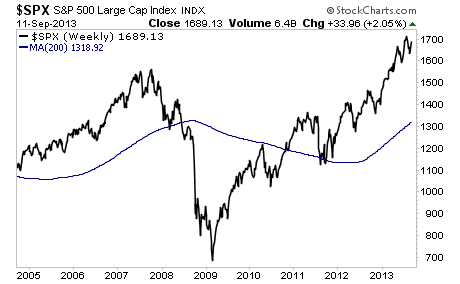
Today, the S&P 500 is sitting a full 30% above its 200-weekly moving average. We have NEVER been this overextended above this line at any point in the last 20 years.

Indeed, if you compare where the S&P 500 is relative to this line, we’re even MORE overbought that we were going into the 2007 peak at the top of the housing bubble.

phoenixcapital-9075dd9c-318a-479e-9eff-a0322f1de6c2-v2

We all know how bubbles end: BADLY. 

This time will be no different. The last time a major bubble of these proportions burst, we fell to break through this line in a matter of weeks.

We then plunged into one of the worst market Crashes of all time.

By today’s metrics, this would mean the S&P 500 falling to 1,300 then eventually plummeting to new lows.

This is not doom and gloom. This is a fact. The Fed has created an even bigger bubble than the 2007 one.

The time to prepare for this is not once the collapse begins, but NOW, while stocks are still rallying. Stocks take their time moving up, but when they crash it happens VERY quickly.

Yours in Profits,

Graham Summers 


With the above in mind, I’ve already urged my Private Wealth Advisory clients to start prepping. We’ve opened six targetted trades to profit from the stock bubble bursting.

We’ve also taken care to prepare our finances and our loved ones for what’s coming, by following simple easy to follow steps concerning our savings, portfolios, and personal security via my Protect Your Family, Protect Your Savings & Protect Your Portfolio reports.

I’ve helped thousands of investors manage their risk and profit from market collapses. During the EU Crisis we locked in 72 straight winning trades and not one loser, including gains of 18%, 28% and more.

In fact, we’re currently on another winning streak having locked in FOURTEEN winning trades in the last two months, including gains of 10%, 11%, 21% and 25%.

All for the the small price of $299: the annual cost of a Private Wealth Advisory subscription.

To take action to prepare for what’s coming… and  start taking steps to insure that when this bubble bursts you don’t lose your shirt.

Click Here Now!


The Need for a New Economics

Screen Shot 2013-09-17 at 10.11.27 PMIn today’s Outside the Box, my good friend George Gilder, the well-known techno-utopian, attempts with some success to turn economics on its ear. “The economy is not chiefly an incentive system,” he asserts, “it is an information system.” And information, truly understood, is about the introduction of novelty, or “surprise,” into a system. In the case of the economy, it’s about invention and entrepreneurship. The new information that is injected gets converted into knowledge; and thus, says George, it is accumulated knowledge, rather than money or material, that constitutes true wealth.

And thus the economy is driven not so much by powerful people and institutions wielding the levers of the economic machine as it is by the ever-increasing power of information and knowledge. Economists and the governments they work for often appear to prefer a deterministic, no-surprises (and too-big-to-fail) economy, but that way lies economic stagnation. If determinism worked, socialism would have thrived.

Knowledge is centrifugal: it’s dispersed in people’s heads, and that has never been more true than in the Age of the Internet. And it is this universal distribution of knowledge which feeds back to the economy through the creative insights and entrepreneurial efforts of people worldwide that constitutes our chief hope for economic growth in the era opening up before us, where the limits of monetary manipulation and material extraction are becoming painfully apparent.

Here is a telling sentence from George:

Whether fueled by debt or seized by taxation, government spending in economic “stimulus” packages necessarily substitutes state power for knowledge and thus destroys information and slows economic growth.

The writing is on the wall: either we reinvent ourselves and our global economy, or the noise that is obviously building in the system will overwhelm the creation and transmission of knowledge, and the great human quest for the democratization of wealth will fail. But, as George says, “[C]apitalism is not a system of equilibrium; it is an engine of disruption and invention…. A capitalist economy can be transformed as rapidly as human minds and knowledge can change.” So we do have plenty of grounds for hope.

For the young among my readers, George Gilder wrote the seminal work Wealth and Poverty(which has been recently updated) back in the early ’80s, selling over 1 million copies and influencing a generation. He was Ronald Reagan’s most-quoted living author. He has written many books since then, but his latest book, Knowledge and Power, is in my opinion even more important.

When you combine Gilder’s work with Nassim Taleb’s Antifragility, along with the ideas that appeared in the recent Outside the Box piece by Charles Gave on the natural rate of interest, you can begin to get a real sense of why the design of the current monetary system is so flawed. Gilder’s work is foundational to that understanding. We have given our central banks a mandate far outside their actual capabilities: we’ve made them responsible for employment. With their limited tools, they have set about to improve employment but are disseminating corruption in their communications to the markets, in ways they neither intend nor understand. The framework that dominates the thinking of current central bankers simply does not encompass the new paradigm being advanced by Gilder, Taleb, Gave, and others.

Once you grasp the futility of the current structure, you can begin to make sense of the direction of the economy and understand how to position portfolios for continuing periods of exceptional volatility. In one of the great human ironies, the drive to reduce the fragility of the system in fact creates an even more fragile system, until we have a Minsky Moment on steroids. But that’s a topic for yet another book. I have talked George into writing a summary of Knowledge and Power for today OTB, but it does no more than skim the surface. His books should be included in your fall reading.

George and I have spent many hours talking about new technologies and their implications. Longtime readers know I have a deep fascination with technology and creativity. I have recently been able to get my great friend Pat Cox (who knows more about such things than I have forgotten) to agree to come and write for Mauldin Economics. We will shortly be launching a newsletter focused on technologies that have the potential to transform our society — and ways to invest in them. Pat Cox should be a familiar name to readers of Outside the Box, and I can’t tell you how thrilled I am to be able to work together with him, exploring the fascinating new world that is being created all around us.

I am still thinking through the implications of what I saw on my recent trip to North Dakota. There was just so much positive energy and potential everywhere that it makes you want to come up with ways to transfer that process in every area of the economy. Ironically, if it was up to the federal government as currently comprised, the Bakken oil play wouldn’t exist. It is messy and chaotic and not at all capable of being directed by a central planner. In short, it is massively successful, without one dollar of government money funding the individual businesses. There are no Solyndras in North Dakota. I’m sure there are lots of small failures here and there, but they haven’t cost taxpayers any equity money.

It is a busy week for me here in Dallas, with lots of meetings and research and writing piling on top of one another, plus family, gym, and other personal commitments. Tomorrow I get to have lunch with my friend Kyle Bass and go from there to spend a few hours with Dr. Woody Brock, who is in town for a speech. However much time I have with Kyle or Woody is not enough, as there are just too many ideas to capture in a few hours. But we all talk fast and try to get in as much as possible. I live for these times.

I think I’ll hit the send button and turn back to my reading. I just had a huge database of over 500 city pension plans pop into my inbox, and that is going to capture my attention for the next few hours. You gotta love having readers who can access just about anything and get it to you. When I come up for air I’ll write about what I learned this week. And speaking of weeks, you have a good one.

Your finding out that yoga hurts analyst,


John Mauldin, Editor
Outside the Box
JohnMauldin@2000wave.com

The Need for a New Economics

By George Gilder

Why is it that so many Americans seem to believe that government spending, fueled by debt or taxes, can drive economic growth and wealth creation? Why do they believe that low interest rates, enforced by the Federal Reserve, can somehow spur business and investment? Why do they imagine that money and consumer demand impel the economy forward?

The reasons, I believe, are rooted in an economic confusion between knowledge and power. Many economists believe that growth is impelled by the exercise of power, represented by money creation and by government spending and guarantees. By manipulating the so-called “levers of the economic machine,” government power can enlarge demand, inducing businesses to invest and consumers to spend. This process is seen to generate the demand that fuels economic growth.

These images of the economy of power are part of the very creation story of economics in an era of new machines and sources of energy. The first economic models were explicitly based on the dynamics of the steam engine then impelling the industrial revolution. Isaac Newton’s physical “system of the world” became Adam Smith’s “great machine” of the economy, an equilibrium engine transforming coal and steam into economic growth and progress.

Exploring technology investments over recent decades, however, I found myself preoccupied less with sources of power than with webs of knowledge in a field of study called Information Theory. On one level this theory was merely a science of networks and computers. Its implications, however, would change our deepest concepts of the nature of wealth. It would show that wealth is not money or power or demand. It is essentially the accumulation of knowledge.

Information theory effectively began with Kurt Godel’s demonstration in 1930 that all logical systems, including mathematics, are intrinsically incomplete and depend on axioms that they cannot prove. This epochal finding is often obscured by elaborate explanations of the intricate mathematics he used to prove it. But as John Von Neumann in his audience was first to recognize, Godel’s proof put an end to the idea of the universe, or the economy, as a mechanism. Godel’s proof, as he himself understood, implied the existence of autonomous creation.

Godel’s proof led directly to the invention by Alan Turing of a universal generic computer, a so-called Turing machine. By this abstract conception, which became the foundation for all computer science, Turing showed that no mechanistic computer system could be complete and consistent.  Turing concluded that all logical systems were intrinsically oracular.

Computers could not be Smithian “great machines” or Newtonian “systems of the world.” They inexorably relied upon human programmers or oracles and could not transcend their creators. As Turing wrote, he could not specify what these oracles would do. All he could say was that “they could not be machines.” In a computer, they are programmers. In an economy, they are entrepreneurs.

In 1948 a rambunctiously creative engineer, Claude Shannon, from Bell Labs and MIT, translated Godel’s and Turing’s findings into a set of technical concepts for gauging the capacity of communications channels to bear information.

Shannon resolved that all information is most essentially surprise. Unless messages are unexpected they do not convey new information. An orderly and predictable mechanism, such as a Newtonian system of the world or Smithian great machine, embodies or generates no new information.

Studying information theory for decades in my exploration of technology, I finally found the resolution to the enigmas that currently afflict most economic thought. A capitalist economy is chiefly an information system, not a mechanistic incentive system. Wealth is the accumulation of knowledge. As Thomas Sowell declared in 1971: All economic transactions are exchanges of differential knowledge, which is dispersed in human minds around the globe. Knowledge is processed information, which is gauged by its news or surprise.

Surprise is also a measure of freedom and criterion of creativity. It is gauged by the freedom of choice of the sender of a message, which Shannon termed “entropy.” The more numerous the possible messages that can be sent, the more uncertainty at the other end about what message was sent and thus the more information there is in the actual message when it is received.

In Knowledge and Power, I sum up information theory as the treatment of human communications or creations as transmissions down a channel, whether a wire or the world, in the presence of the power of noise, with the outcome measured by its “news” or surprise, defined as entropy and consummated as knowledge.

Since these communications or creations can be business plans or experiments, information theory supplies the foundation for an economics driven not by equilibrium and order but by surprises of enterprise that yield knowledge and wealth.

Information theory requires that such a process be experimental and its results be falsifiable. The businesses conducting entrepreneurial experiments must be allowed to fail or go bankrupt. Otherwise there is no yield of knowledge and thus no production of wealth. Wealth does not consist in material capital that can be appropriated by the greedy or the government but in learning processes and knowledge creations that can only thrive in freedom.

After all, the Neanderthal in his cave had all the material resources and physical appetites that we have today. The difference between our own wealth and Stone Age poverty is not an efflorescence of self-interest but the progress of learning, accomplished by entrepreneurs conducting falsifiable experiments of enterprise.

The enabling theory of telecommunications and the internet, information theory offered me a path to a new economics that could place the surprising creations of entrepreneurs and innovators at the very center of the system rather than patching them in from the outside as “exogenous” inputs. It also showed that knowledge is not merely a source of wealth; it is wealth.

Summing up the new economics of information are ten key insights:

1) The economy is not chiefly an incentive system. It is an information system.
2) Information is the opposite of order or equilibrium. Capitalist economies are not equilibrium systems but dynamic domains of entrepreneurial experiment yielding practical and falsifiable knowledge.
3) Material is conserved, as physics declares. Only knowledge accumulates. All economic wealth and progress is based on the expansion of knowledge.
4) Knowledge is centrifugal, dispersed in people’s heads. Economic advance depends on a similar dispersal of the power of capital, overcoming the centripetal forces of government.
5) Creativity, the source of new knowledge, always comes as a surprise to us. If it didn’t, socialism would work. Mimicking physics, economists seek determinism and thus erroneously banish surprise.
6) Interference between the conduit and the contents of a communications system is called noise. Noise makes it impossible to differentiate the signal from the channel and thus reduces the transmission of information and the growth of knowledge.
7) To bear high entropy (surprising) creations takes a low entropy carrier (no surprises) whether the electromagnetic spectrum, guaranteed by the speed of light, or property rights and the rule of law enforced by constitutional government.
8) Money should be a low entropy carrier for creative ventures. A volatile market of gyrating currencies and grasping governments shrinks the horizons of the economy and reduces it to high frequency trading and arbitrage in a hypertrophy of finance.
9) Wall Street wants volatility for rapid trading, with the downsides protected by government. Main Street and Silicon Valley want monetary stability so they can make long term commitments with the upsides protected by law.
10) GDP growth is fraudulent when it is mostly government spending valued retrospectively at cost and thus shielded from the knowledgeable judgments of consumers oriented toward the future. Whether fueled by debt or seized by taxation, government spending in economic “stimulus” packages necessarily substitutes state power for knowledge and thus destroys information and slows economic growth.
11) Analogous to average temperature in thermodynamics, the real interest rate represents the average returns expected across an economy. Analogous to entropy, profit or loss represent the surprising or unexpected outcomes. Manipulated interest rates obfuscate the signals of real entrepreneurial opportunity and drive the economy toward meaningless trading and arbitrage.
12) Knowledge is the aim of enterprise and the source of wealth. It transcends the motivations of its own pursuit. Separate the knowledge from the power to apply it and the economy fails.  

The information theory of capitalism answers many questions that afflict established economics. No business guaranteed by the government is capitalist. Guarantees destroy knowledge and wealth by eliminating the precondition of falsifiability. Unless entrepreneurial ideas can fail or businesses go bankrupt, they cannot succeed in creating new knowledge and wealth. Epitomized by heavily subsidized and guaranteed leviathans, such as Goldman Sachs, Archer Daniels Midland, Harvard and Fanny Mae, the crisis of economics today is crony statism.

The message of a knowledge economy is optimistic. As Jude Wanniski wrote, “Growth comes not from dollars in people’s pockets but from ideas in their heads.” Capitalism is a noosphere, a domain of mind. A capitalist economy can be transformed as rapidly as human minds and knowledge can change.

As experience after World War II when US government spending dropped 61 percent in two years, in Chile in the 1970s when the number of state companies dropped from over 500 to under 25, in Israel and New Zealand in the 1980s when their economies were massively privatized almost over-night, and in Eastern Europe and China in the 1990s, and even in Sweden and Canada in recent years, economic conditions can change overnight when power is dispersed and the surprises of human creativity are released.

Perhaps the most powerful demonstration that wealth is essentially knowledge came in the rapid post world war II revival of the German and Japanese economies. Nearly devoid of material resources, these countries had undergone the nearly complete destruction of their physical plant and equipment. As revealed by decades of experience with unsuccessful ministrations of foreign aid, the mere transfer of financial and political power is impotent to create wealth without the knowledge and creativity of entrepreneurs.

Information Theory is a foundation for revitalizing all the arts and sciences, from physics and biology to mathematics and philosophy. All are transformed by a recognition that information is not order but disorder. The universe is not a great machine that is inexorably grinding down all human pretenses of uniqueness and free will. It is a domain of creativity in the image of a creator.

In the same way, capitalism is not a system of equilibrium; it is an engine of disruption and invention. All economic growth and human civilization stem from the surprises of creativity and the growth of knowledge in a domain of constitutional order.

The great mathematician Gregory Chaitin, inventor of algorithmic information theory, explains that to capture the surprising information in any social, economic, or biological science requires a new mathematics of creativity imported from the world of computers. He writes: “Life is plastic, creative! How can we build this out of static, eternal, perfect mathematics? We shall use post-modern math, the mathematics that comes after Godel, 1931, and Turing, 1936, open not closed math, the math of creativity…”

Entropy is a measure of surprise, disorder, randomness, noise, disequilibrium, and complexity. It is a measure of freedom of choice. Its economic fruits are creativity and profit. Its opposites are predictability, order, low complexity, determinism, equilibrium, and tyranny.

Predictability and order are not spontaneous and cannot be left to an invisible hand. It takes a low-entropy carrier (no surprises) to bear high-entropy information (full of surprisal). In capitalism, the predictable carriers are the rule of law, the maintenance of order, the defense of property rights, the reliability and restraint of regulation, the transparency of accounts, the stability of money, the discipline and futurity of family life, and a level of taxation commensurate with a modest and predictable role of government. These low entropy carriers bear all our bounties of surprising wealth and progress.


Outside the Box is a free weekly economic e-letter by best-selling author and renowned financial expert, John Mauldin. You can learn more and get your free subscription by visiting http://www.mauldineconomics.com.

To subscribe to John Mauldin’s e-letter, please click here:
http://www.mauldineconomics.com/subscribe

To change your email address, please click here:
http://www.mauldineconomics.com/change-address

To unsubscribe, please refer to the bottom of the email.

Outside the Box and MauldinEconomics.com is not an offering for any investment. It represents only the opinions of John Mauldin and those that he interviews. Any views expressed are provided for information purposes only and should not be construed in any way as an offer, an endorsement, or inducement to invest and is not in any way a testimony of, or associated with, Mauldin’s other firms. John Mauldin is the Chairman of Mauldin Economics, LLC. He also is the President of Millennium Wave Advisors, LLC (MWA) which is an investment advisory firm registered with multiple states, President and registered representative of Millennium Wave Securities, LLC, (MWS) member FINRAand SIPC, through which securities may be offered. MWS is also a Commodity Pool Operator (CPO) and a Commodity Trading Advisor (CTA) registered with the CFTC, as well as an Introducing Brok er (IB) and NFA Member. Millennium Wave Investments is a dba of MWA LLC and MWS LLC. This message may contain information that is confidential or privileged and is intended only for the individual or entity named above and does not constitute an offer for or advice about any alternative investment product. Such advice can only be made when accompanied by a prospectus or similar offering document. Past performance is not indicative of future performance. Please make sure to review important disclosures at the end of each article. Mauldin companies may have a marketing relationship with products and services mentioned in this letter for a fee.

Note: Joining the Mauldin Circle is not an offering for any investment. It represents only the opinions of John Mauldin and Millennium Wave Investments. It is intended solely for investors who have registered with Millennium Wave Investments and its partners at www.MauldinCircle.com or directly related websites. The Mauldin Circle may send out material that is provided on a confidential basis, and subscribers to the Mauldin Circle are not to send this letter to anyone other than their professional investment counselors. Investors should discuss any investment with their personal investment counsel. John Mauldin is the President of Millennium Wave Advisors, LLC (MWA), which is an investment advisory firm registered with multiple states. John Mauldin is a registered representative of Millennium Wave Securities, LLC, (MWS), an FINRA registered broker-dealer. MWS is also a Commodity Pool Operator (CPO) and a Commodity Trading Advisor (CTA) registered with the CFTC, as wel l as an Introducing Broker (IB). Millennium Wave Investments is a dba of MWA LLC and MWS LLC. Millennium Wave Investments cooperates in the consulting on and marketing of private and non-private investment offerings with other independent firms such as Altegris Investments; Capital Management Group; Absolute Return Partners, LLP; Fynn Capital; Nicola Wealth Management; and Plexus Asset Management. Investment offerings recommended by Mauldin may pay a portion of their fees to these independent firms, who will share 1/3 of those fees with MWS and thus with Mauldin. Any views expressed herein are provided for information purposes only and should not be construed in any way as an offer, an endorsement, or inducement to invest with any CTA, fund, or program mentioned here or elsewhere. Before seeking any advisor’s services or making an investment in a fund, investors must read and examine thoroughly the respective disclosure document or offering memorandum. Since these firms and Mauld in receive fees from the funds they recommend/market, they only recommend/market products with which they have been able to negotiate fee arrangements.

PAST RESULTS ARE NOT INDICATIVE OF FUTURE RESULTS. THERE IS RISK OF LOSS AS WELL AS THE OPPORTUNITY FOR GAIN WHEN INVESTING IN MANAGED FUNDS. WHEN CONSIDERING ALTERNATIVE INVESTMENTS, INCLUDING HEDGE FUNDS, YOU SHOULD CONSIDER VARIOUS RISKS INCLUDING THE FACT THAT SOME PRODUCTS: OFTEN ENGAGE IN LEVERAGING AND OTHER SPECULATIVE INVESTMENT PRACTICES THAT MAY INCREASE THE RISK OF INVESTMENT LOSS, CAN BE ILLIQUID, ARE NOT REQUIRED TO PROVIDE PERIODIC PRICING OR VALUATION INFORMATION TO INVESTORS, MAY INVOLVE COMPLEX TAX STRUCTURES AND DELAYS IN DISTRIBUTING IMPORTANT TAX INFORMATION, ARE NOT SUBJECT TO THE SAME REGULATORY REQUIREMENTS AS MUTUAL FUNDS, OFTEN CHARGE HIGH FEES, AND IN MANY CASES THE UNDERLYING INVESTMENTS ARE NOT TRANSPARENT AND ARE KNOWN ONLY TO THE INVESTMENT MANAGER. Alternative investment performance can be volatile. An investor could lose all or a substantial amount of his or her investment. Often, alternative investment fund and account managers have t otal trading authority over their funds or accounts; the use of a single advisor applying generally similar trading programs could mean lack of diversification and, consequently, higher risk. There is often no secondary market for an investor’s interest in alternative investments, and none is expected to develop.

All material presented herein is believed to be reliable but we cannot attest to its accuracy. Opinions expressed in these reports may change without prior notice. John Mauldin and/or the staffs may or may not have investments in any funds cited above as well as economic interest. John Mauldin can be reached at 800-829-7273.

Bitcoin as a hedge against the Fed

UnknownLooking for a hedge against the Federal Reserve? Try bitcoin. That at least is the view of Cameron and Tyler Winklevoss, who are heavily invested in the virtual currency.

Bitcoin, which is created through a cryptographic process rather than by a central bank, attracted attention earlier this year when its price swung wildly. The supply of bitcoins is set at 21 million, which has led to many comparisons between bitcoin and gold.

Indeed, the Winklevoss brothers, speaking at the Value Investing Congress in New York on Tuesday, mentioned the scarcity and durability of both assets as reasons for why people refer to bitcoin as digital gold or gold 2.0.

….go HERE fjor some of the highlights of their talk

9 Things The Winklevoss Twins Taught Me About Bitcoin

The most noteworthy Bitcoin facts imparted to an audience of investors at the Value Investing Congress are listed HERE

Give Up the Shale Gas Fantasy & Profit When the Bubble Bursts

book-coverThe numbers don’t lie—but politicians and industry bigwigs do. While pundits still wax poetic about an era of American energy independence, Bill Powers, author of the book “Cold, Hungry and in the Dark: Exploding the Natural Gas Supply Myth,” sees productivity plummeting in almost every major shale play. In this interview with The Energy Report, Powers tells us to forget about LNG exports and a manufacturing boom and get positioned for a bust. How? Invest in energy equities. Powers names his favorites for maximum returns when the bubble bursts.

The Energy Report: Your last interview in May stimulated more discussion on how much natural gas supply we actually have in North America. Have there been any significant developments since then to support your views on the long-term supply picture?

Bill Powers: More data points have come in supporting my views and making it very clear that the Fayetteville and Haynesville shales are now in decline and the Barnett had a very steep, 17% decline in H1/13 on a year-over-year (YOY) basis. It is now producing about 4.6 billion cubic feet a day (Bcf/day), which is substantially down from its peak of near 6 Bcf/day. The facts are starting to show that declines for the older shale plays such as the Barnett, Haynesville, Fayetteville and Woodford are very serious. More important, once production growth from the Marcellus slows down, it will no longer be able to offset declining production from shale plays as well as conventional, offshore, CBM and tight sands production, which are all in terminal decline.

TER: Have companies been overproducing?

BP: There are still about 40 rigs running in the Haynesville. That’s dry gas with no associated liquids. Virtually every one of those wells will be uneconomic at under $6 per thousand cubic feet ($6/Mcf) and probably closer to $7/Mcf. About 80% of production will come within the first two years for most Haynesville wells, so current gas prices have an outsized influence on an individual well’s economics. There are still a number of companies out there willfully drilling uneconomic wells, which boggles my mind. These companies are continuing to drill to keep their production from collapsing entirely.

Last year, Chesapeake Corp. (CHK:NYSE) wrote down 4.6 trillion cubic feet (4.6 Tcf) of proven reserves from its Barnett and Haynesville shale wells. At the end of 2012, Southwestern Energy Co. (SWN:NYSE) wrote down the proven reserves of its Fayetteville Shale assets from 5 Tcf to 3 Tcf. Other companies, such as BHP Billiton Ltd. (BHP:NYSE; BHPLF:OTCPK) and BP Plc (BP:NYSE; BP:LSE), took huge write-downs. BG Group Plc (BRGYY:OTCQX; BG:LSE) also took a big write-down due to poor performance of its Haynesville wells. The list goes on and on. These reserves were supposed to have a 90% confidence level of being producible and generating a 10% rate of return using existing technology.

The low price of gas alone isn’t causing these write-downs. A lot of it has to do with the poor performance of these wells. There’s been a lot of evidence put forward by myself, Art Berman, who wrote the forward to my book, and David Hughes, that the shale industry has overbooked its reserves by approximately 100%. The write-downs of the last few years have largely proven this out. More importantly, if shale operators are writing down reserves at the rate we’ve seen, this also speaks volumes about the total recoverability of all shale gas in the United States.

The two really bright spots right now are the Marcellus and the Eagle Ford. There have been thousands of wells drilled through the Marcellus over the years for both the Oriskany, directly underneath the Marcellus, and the Trenton Black River Trend, also below the Marcellus. Operators have had the advantage of using a very good cheat sheet to know where to drill first for the best wells. Additionally, all the knowledge operators gained in developing other shale plays has greatly accelerated the ramp-up in Marcellus production. For example, operators began drilling horizontal wells early in the lifecycle of the Marcellus due to experience gained in the Barnett, Fayetteville and Haynesville. The strong growth in the play has really been the only thing that has kept gas production even close to flat this year in the U.S. As I discussed earlier, it will not be long before future shale wells will not be able to replace production from older wells.

The decline will become more evident once the aerial extent of the Marcellus fields becomes more clear. This is starting to happen in southwestern Pennsylvania, where Range Resources Corp. (RRC:NYSE), one of the most aggressive producers in the region, is now saying in its investor presentation that it and other operators have defined the outer limits of some fields. Once you run out of the high-quality, liquids-rich drilling locations in Washington County (southwestern PA), you will get a very large fall-off in productivity.

TER: Why all the production overestimates regarding U.S. shale reserves?

BP: Many of the people promoting the 100-year myth were doing it for either financial or political reasons. Let’s look at why the U.S. government promoted the myth. The government has the idea that if the U.S. were to become an LNG exporter through the rapid development of shale, we would lessen the importance of Russia on the world’s stage. Ernest Moniz, who’s the head of the Department of Energy, is a big advocate of exporting LNG. He recently granted the fourth LNG export license to Dominion Cove Point LNG (D:NYSE) to open an export facility in Cove Point, Maryland.

Industry mainly wanted the ability to sell acreage to latecomers. Chesapeake Energy championed this model by generating a lot of excitement after making a discovery and then selling out a significant chunk of that acreage to a latecomer, who would almost always overpay. This strategy was actually discussed by the former CEO, Aubrey McClendon, in an October 2008 conference call. Industry needed money to develop its own acreage and also to generate higher stock prices so they could acquire other assets or companies more cheaply. David Hughes has talked about how it would require $42 billion ($42B) to keep gas production flat in the U.S., while shale operators only generate around $32–33B dollars a year in revenue, and probably closer to only $8–9B in cash flow. They are far outspending their cash flow to drill additional wells.

Looking at academia’s role, there was a case where Penn State put forward a very optimistic report that was paid for by the industry and that payment was not disclosed. After a community group discovered this, the dean of the Earth Sciences Department redacted the report and reissued it with numerous changes and proper disclosure as to the source of the funding. The report discussed the economic impact on Pennsylvania from the Marcellus and made some very optimistic projections.

Unlike a lot of people who make statements about the amount of gas that’s out there and provide little or no empirical evidence to support their claims, I have almost 600 footnotes in my book that explain exactly where my estimates of future shale gas recoveries come from.

Other promoters of the 100-year supply myth include people such as T. Boone Pickens, who has a very self-interested agenda to get natural gas vehicles onto the road. Pickens, who said on CNBC in 2011 that the U.S. will recover 4,000 Tcf and has never provided any support for this statement, promoted this patriotic idea that we should convert our vehicle fleet to natural gas rather than buying oil from the “enemy.” Pickens has been known to refer to certain oil-exporting nations as the “enemy.”

However, Pickens almost never discusses the fact that he is one of the largest owners of Clean Energy Fuels Corp. (CLNE:NASDAQ), a company that is one of the biggest providers of natural gas refueling stations and that stands to benefit significantly from the growth of natural gas vehicle adoption. The legislation that T. Boone Pickens is advocating for in the Pickens Plan, which includes large tax credits and grants to the natural gas vehicle (NGV) and NGV refueling industry, would benefit him uniquely because he owns approximately 18.1 million (18.1M) shares of Clean Energy Fuels stock. Pickens’ shares are currently valued at around $230M. There are very few people, and you can count them on one hand, who want to discuss the reality of shale gas, which my book does.

In addition, the Securities and Exchange Commission (SEC), after heavy lobbying, changed its rules in 2010 to allow for a significant increase in proven undeveloped reserves to be booked, so the SEC was also complicit in the perpetuation of the shale gas myth. Without this change in how shale gas reserves were booked in 2010, most shale operators would have been forced to take large write-downs rather than booking increases in reserves. I believe this rule change by the SEC grossly distorts the value of a company’s reserves since it allowed for a large increase in the booking of proven undeveloped reserves.

TER: What other economic consequences do you see if and when your views become reality?

BP: I think it will be similar to the housing crisis, where a handful of people saw it coming and profited from it. There was significant evidence that housing prices were unsustainable, but most people were surprised when the housing bubble popped. People from Alan Greenspan to Ben Bernanke and others had a lot of information about the economy and how unsustainable house prices were, but did not want to talk about it publicly. There’s a saying that “the impossible can become the inevitable in the blink of an eye.” I think this will happen with natural gas. For example, in the first week of December 2000, gas prices went from around $4/Mcf to over $10/Mcf in only a few trading sessions. This was due to falling production, lower storage levels and a cold spell that set in across much of the United States. This price spike was the first of numerous spikes during the last decade.

In the late 1990s, Enron and other companies like Calpine Corp. (CPN:NYSE) built dozens of natural gas-fired power plants on the belief that the price stability between 1984 and 1999 would continue for several more decades. The build-out of gas-fired power plants was led by large demand increases from the electricity generation industry at a time of falling production. Few remember that U.S. gas production fell from 2002 to 2007.

Shale gas is a finite resource. When prices start to escalate, unfortunately, the situation will be even worse than the spikes we had in the early part of the 21st century, and even more so than the 1970s. From 2000–2010, we were able to increase our imports of LNG, and in the 1970s we built dozens of nuclear-fired power plants and hundreds of coal-fired power plants to reduce demand for natural gas. Now we are seeing the nuclear industry in decline, with five plants shutting down this year out of 104 plants, and many more closing in the next two to three years. Dozens of coal-fired power plants will be shutting down before mercury emissions laws take effect in 2015 and few new plants are likely to be built given the stringent emissions standards.

Even worse, for the first time in the industry’s history, world LNG trade shrank last year. We are seeing record-high global prices for LNG with no sign that this is going to slow down or reverse. When the U.S. is forced to go back out and try to secure cargos to import LNG, the prices we will be forced to pay are going to be much higher. The current price of LNG in Chile, Brazil and Argentina is $14–15 per million British thermal units ($14–15/MMBtu). In Japan and Korea it’s been over $16/MMBtu. Even Mexico is currently importing LNG at $16/MMBtu due to demand outstripping supply and lack of pipeline capacity to connect to U.S. markets. The U.S. is going to be forced to pay much higher prices when it will not be able to meet its own domestic needs, as shale gas rolls over and Canadian imports decline as the country begins exporting LNG to Asia via British Columbia.

TER: If we don’t have excess gas supply, will that lead to a bust in the planned LNG export terminal business?

BP: Barring a major new shale gas discovery in the very near future, the future of U.S. LNG exports will have to do with how much domestic demand falls off. A lot of these terminals will probably get built only to lie dormant when the government declares force majeure and cancels overseas contracts. Politicians will look at their constituents and see all sorts of suffering, from higher electricity bills to higher food prices to higher home heating bills, and say they are going to pull the export licenses from all these LNG plants. As I say in my book, “Overseas customers do not vote.”

TER: To address your earlier analogy to the housing bust, what are some actual investments investors may want to consider to for profit opportunity in the event of a shale gas crisis?

BP: Right now I think there are some great ideas out there. Three of my favorite Canadian companies areBellatrix Exploration Ltd. (BXE:TSX)Advantage Oil and Gas Ltd. (AAV:NYSE; AAV:TSX) andArsenal Energy Inc. (AEI:TSX)—I’m a director with Arsenal and the company just had some very good news. My favorite company in the United States would be Denbury Resources Inc. (DNR:NYSE), which is very active in CO2 flooding in the Gulf Coast as well as in the Rocky Mountain region.

Advantage has a great Montney play at Glacier, where it has built out its infrastructure. However, the company is not overproducing its fields at a time of low Canadian gas prices. I think management’s done a great job and as gas prices rise, the company has tremendous leverage.

Bellatrix is a significant producer that will have room to grow. It has great Cardium acreage and is very leveraged to the Duvernay Shale. The company has significant upside from here.

Arsenal Energy trades at a very low multiple of valuation on any metric and has enjoyed very strong results in North Dakota as well as in central Alberta. It’s 75% oil. Again, I am a director and shareholder.

In the United States, Denbury has a very large inventory of projects it continues to develop and is far and away the industry leader at tertiary oil recovery. It gets Louisiana Light pricing for its oil and generates very significant cash flow, even at substantially lower prices. There’s almost no exploration risk for the company given that it is reestablishing production via CO2 flooding from previously depleted fields.

TER: What should investors be doing now to benefit from or protect themselves from what you believe lies ahead?

BP: I think that energy equities will provide some of the best returns available anywhere over the next 10 years, similar to what we saw in the 1970s. Shortly after the U.S. eliminated convertibility of the U.S. dollar into gold in 1971, which I consider a default, we saw massive inflation. Oil and gas and precious metals and equities related to these two sectors were among the very few investments that paid off in that era. The returns in those investment classes were fantastic, whereas just about everything else, from government bonds to general equities to tech stocks, got destroyed. I think we’re heading toward a similar period. Even though natural gas has been one of the only commodities left behind by the flood of liquidity over the last five years, it is also one of the most volatile commodities. I am looking for a period of serious outperformance by natural gas over the next decade.

TER: Care to take a shot on where you think gas prices may end up in the next few years?

BP: The U.S. is heading toward world gas prices. To recap, this means double-digit prices within the next three to five years for a number of reasons. First, in addition to lower U.S. production, our imports from Canada are going to be diverted toward Asia through LNG exports. Canadian production continues to fall, and 2013 will mark the 12th year since it peaked. Canada will be unable to export to both the U.S. and Asia due to lower production and record domestic consumption. Second, the U.S. is now far more reliant on natural gas to generate electricity than it was in the 1970s. The U.S. got out of that gas crisis by building nuclear and coal-fired power plants, not through increased gas production. Last, this time it’s going to be very difficult to destroy demand because we are starting to see manufacturing come back to the U.S. and coal and nuclear plants are closing.

TER: Thanks for joining us today and updating us on your thinking.

BP: Thank you. I greatly enjoyed our interview.

Bill Powers is an independent analyst, private investor and author of the book “Cold, Hungry and in the Dark: Exploding the Natural Gas Supply Myth.” Powers is the former editor of Powers Energy Investor, Canadian Energy Viewpoint and U.S. Energy Investor. He has published investment research on the oil and gas industry since 2002 and sits on the board of directors of Calgary-based Arsenal Energy. An active investor for over 25 years, Powers has devoted the last 15 years to studying and analyzing the energy sector, driven by his desire to uncover superior investment opportunities. You can follow Powers on Twitter at @billpowers1970 or visit www.bill-powers.com.

Related Articles


Want to read more Energy Report interviews like this? Sign up for our free e-newsletter, and you’ll learn when new articles have been published. To see a list of recent interviews with industry analysts and commentators, visit our Interviews page.

DISCLOSURE: 
1) Zig Lambo conducted this interview for The Energy Report and provides services to The Energy Report as an independent contractor. He or his family own shares of the following companies mentioned in this interview: None. 
2) The following companies mentioned in the interview are sponsors of The Energy Report: None. Streetwise Reports does not accept stock in exchange for its services or as sponsorship payment.
3) Bill Powers: I or my family own shares of the following companies mentioned in this interview: Arsenal Energy. I personally am or my family is paid by the following companies mentioned in this interview: None. My company has a financial relationship with the following companies mentioned in this interview: None. I was not paid by Streetwise Reports for participating in this interview. Comments and opinions expressed are my own comments and opinions. I had the opportunity to review the interview for accuracy as of the date of the interview and am responsible for the content of the interview.
4) Interviews are edited for clarity. Streetwise Reports does not make editorial comments or change experts’ statements without their consent. 
5) The interview does not constitute investment advice. Each reader is encouraged to consult with his or her individual financial professional and any action a reader takes as a result of information presented here is his or her own responsibility. By opening this page, each reader accepts and agrees to Streetwise Reports’ terms of use and full legal disclaimer.
6) From time to time, Streetwise Reports LLC and its directors, officers, employees or members of their families, as well as persons interviewed for articles and interviews on the site, may have a long or short position in securities mentioned and may make purchases and/or sales of those securities in the open market or otherwise.


 

test-php-789