

Timing & trends

Russell: 3 Things I’m Watching

For the first time in history, ALL the major central banks are printing money. One of two things will occur. If they continue to print, their respective currencies will lose their purchasing power, and we’ll have inflation or even hyper-inflation. If the central banks pull back on their printing, we’ll have crashing markets and a world depression. This is the problem with creating ever more debt. Ultimately, the debt owns you, and the compounding process renders the debt situation unsustainable, which is what the CBO has just warned us about.

The underlying problem is the common man’s desire for profits — his insatiable greed. Eventually, greed becomes its own worst enemy. To “grow” the economy, you must have expanding credit. Eventually, credit, when compounded, becomes unsustainable — particularly when a nation can print all the money it wants out of thin air. Thus, the acceptance of fiat money spells the eventual death of an economy.

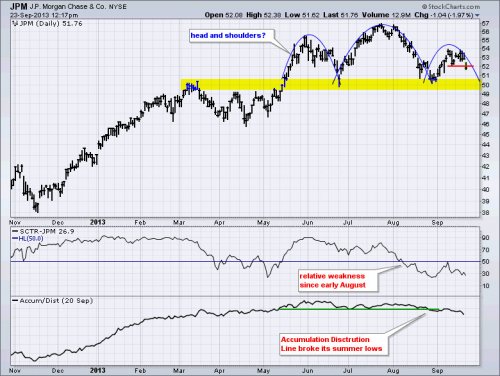
Below I show a chart of JP Morgan, the biggest bank in the US. Here we see a textbook head-and-shoulders pattern that I think should break down. JPM was just hit with a huge $900 million fine, based on its notorious trader, known as the “London Whale.”

jpm-23-sep-2013

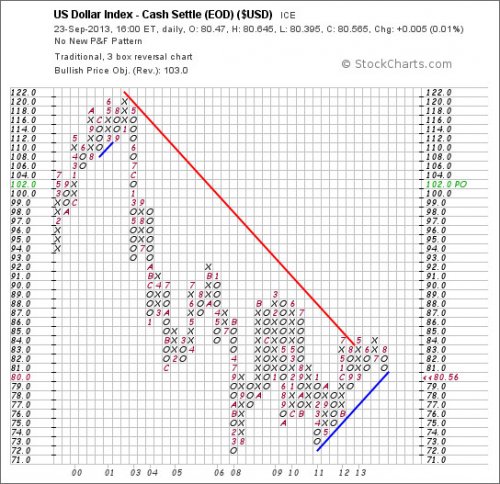
Another choice place I’m watching is the US dollar. The US dollar has dropped three boxes on the P&F chart. If the dollar hits the 79 box, it will have issued a clarion sell signal. So at any rate, I’ve got my eye on the dollar.

usd-23-sep-2013

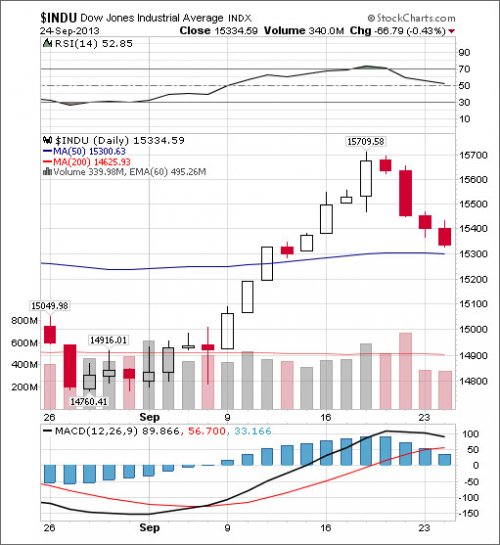
Here’s something that bothers me. Below we see the D-J Industrial Average. As you can see on the chart, over the last four trading sessions, the Dow has declined each day. Is this the sign of a market top that is subtly breaking down? If this declining action continues, I’ll really begin to wonder whether something ominous is in the cards.

indu-24-sep-2013


To subscribe to Richard Russell’s Dow Theory Letters CLICK HERE. 

About Richard Russell

Russell began publishing Dow Theory Letters in 1958, and he has been writing the Letters ever since (never once having skipped a Letter). Dow Theory Letters is the oldest service continuously written by one person in the business.

Russell gained wide recognition via a series of over 30 Dow Theory and technical articles that he wrote for Barron’s during the late-’50s through the ’90s. Through Barron’s and via word of mouth, he gained a wide following. Russell was the first (in 1960) to recommend gold stocks. He called the top of the 1949-’66 bull market. And almost to the day he called the bottom of the great 1972-’74 bear market, and the beginning of the great bull market which started in December 1974.

Letters are published and mailed every three weeks. We offer a TRIAL (two consecutive up-to-date issues) for $1.00 (same price that was originally charged in 1958). Trials, please one time only. Mail your $1.00 check to: Dow Theory Letters, PO Box 1759, La Jolla, CA 92038 (annual cost of a subscription is $300, tax deductible if ordered through your business).

If This Is Success, Then Give Us Failure!

Screen Shot 2013-09-26 at 4.05.06 PMThe lack of follow-through after the Fed’s historic announcement last week leaves us wondering:

Have equity investors already priced in “QE Forever”? If so, is there nowhere left to go but down?

We will leave that thought on the table… get up… and look out the window.

It’s been six years since Bear Stearns went broke and five years since Lehman Bros. declared bankruptcy. What, exactly, has changed? 

We wish we had been there. We would have loved to see the look on former Bear Stearns boss Jimmy Cayne’s face. He was once the richest player on Wall Street, with a stake in Bear Stearns worth more than a billion dollars. 

In July 2007, he was playing bridge in a championship match when executives of Bear Stearns came to the table.

“Uh, Jimmy… can we talk to you for a minute?”

“Not now. Can’t you see I’m in an important game?”

“But Jimmy, there’s something you should know… something that can’t wait.”

“All right already. What is it? Blurt it out, man!”

“OK. We’re broke. Two of our hedge funds collapsed last night. We’ve got no choice. We’ve got to seek Chapter 11 status immediately.”

Poor Jimmy. That moment marked the end of his greatness… and prefigured the Great Deleveraging, which would begin a year later when Lehman Bros. bit the dust. 

Cayne later sold his billion-dollar stake in Bear Stearns for $61 million — and he was lucky to get that. 

As every sentient biped knows, the developed world entered a financial crisis in 2008. Actually, the first cracks appeared a year earlier with Bear Stearns and distress in the most junky of all junk debt markets — subprime.

By 2007, this toxic debt had fallen so far below prime that you couldn’t find it with a metal detector. Besides, there was no metal — precious or base — in it. It was all paper. And the paper wasn’t worth a fraction of what people had paid for it.

But the Lehman bankruptcy marked the beginning — and, as it turned out, the end — of the Great Deleveraging. 

Thereafter, the feds were on the case… sandbagging the levies… dusting the forests with fire-killing chemicals… drilling escape holes for those trapped below the surface… pushing the debris out of the way… and in general making sure that the disaster was held in check.

For this, an adoring press awarded them hosannas and hoorays. Their photos appeared in popular business magazines along with captions describing them as “heroes” and “geniuses.” After all, the federal emergency workers had not merely pulled Goldman Sachs’ nuts out of the fire; they had saved an entire civilization and way of life. 

They were successful in preventing a Great Depression. Everybody said so.

Was there ever a better time to be a central banker?

The press took their words… examined them carefully… and uttered not a critical word. And no one mentioned that the words were hollow, meaningless or plain stupid. 

Instead, people thought they were being cagey… or intentionally opaque… as though the bankers were playing such a high-stakes game that they were not under any obligation to let their employers know what the hell they were actually doing. (An art mastered by none other than “the Maestro” himself, Alan Greenspan.)

And now we look around and wonder: What has improved? How have the problems, imbalances and excesses of 2007 been addressed?

One big change, perhaps, is the real estate market in the U.S. It is no longer so bubbly. Ordinary people no longer expect to get rich by buying residential property. Now, it’s the turn of big private equity outfits such as the Blackstone Group to try to make a fortune on bricks and mortar. (The group’s real estate division now has a staggering $64 billion in assets under management.)

Apart from that…

The big banks… have they been broken down and broken up? 

No. They’re bigger than ever.

Health care… education… defense… finance… Have the zombie sectors been brought under control? 

No. They are more out of control than ever. And they’re devouring an ever-larger piece of GDP.

And has excess debt — the real cause of the 2008 financial crisis — been eliminated, or at least reduced? 

Don’t make us laugh…

n the U.S. private sector, debt has been cut back… but only a little. The household savings rate rose to 6% immediately following the crisis. Now it has slipped back to about 4%. 

And total debt (public and private) is higher than ever — thanks to “help” from the feds.

According to former chief economist at the Bank for International Settlements William White (one of the few economists to accurately predict the subprime meltdown), total debt in the developed countries as a percentage of GDP is 30% higher now than it was in 2007.

The feds decided to fight fire with fire. To solve the debt problem, they added debt! The genius of this plan was, we admit, not immediately obvious. But over time, the elegant brilliance of it has practically blinded us.

The feds have always had one overriding goal: to transfer money and power to themselves. They create no wealth. They can get it only by taking from others. The crisis — which was nothing more than a natural market correction in an unnaturally extreme debt cycle, caused largely by the feds — gave them cover for larceny on an even grander scale. 

TARP, QE, ZIRP, Operation Twist — none has had a net positive effect on the real economy. 

Debt is the problem; each of these fixes has left us with more of it. Obviously, that’s not the way to fix things. But from the feds’ point of view, the program has worked beautifully. 

Had the correction been allowed to run its course, deleveraging would have wiped out many investors and many companies — especially in the finance sector. 

Instead, thanks to the feds’ interventions, they are still in business… still profiting from the feds’ debt-friendly policies… and still recycling much of the cash back to the feds. 

News flash: The feds’ easy money goes into the pockets of their friends, clients, supporters — and into their own pockets, too. 

Meanwhile, in the real world, people are struggling. From Bloomberg, a sobering story of a 77-year-old former vice president of marketing for Oral-B who’s been forced to flip burgers to make a wage:

“It seems like another life. At the height of his corporate career, Tom Palome was pulling in a salary in the low six figures and flying first class on business trips to Europe.

“Today, the 77-year-old former vice president of marketing for Oral-B juggles two part-time jobs: one as a $10-an-hour food demonstrator at Sam’s Club, the other flipping burgers and serving drinks at a golf club grill for slightly more than minimum wage…

“Even many affluent baby boomers who are approaching the end of their careers haven’t come close to saving the 10-20 times their annual working income that investment experts say they’ll need to maintain their standard of living in old age.

“For middle-class households, with incomes ranging from the mid-five to low six figures, it’s especially grim. When the 2008 financial crisis hit, what little Palome had saved — $90,000 — took a beating, and he suddenly found himself in need of cash to maintain his lifestyle. With years, if not decades, of life ahead of him, Palome took the jobs he could find.”

Actually, this report has a positive message. It helps settle our nerves. Even at 77, if we make it that far, we may be able to find work flipping burgers! 

Heck, we might like flipping burgers!

But most people will take little comfort from this story. Most people would rather sit at home and collect their pensions. 

But the feds are ahead of them. Reducing the rate of return on safe investments, the feds have taken trillions of dollars from the pockets of people such as Mr. Palome. 

Their savings earn little income. And the pension funds into which they pay their money have a hard time keeping up with their commitments. Deficits grow. Defaults and cutbacks loom. 

Household income is back to levels not seen since 1984. And the number of people with real jobs as a percentage of the working age population has never been lower. 

If this is success… then give us failure!

Regards,

Bill Bonner
for The Daily Reckoning

This essay was originally featured in the Diary of a Rogue Economist


[Ed. Note: If you’re not content to let your income and retirement erode before your eyes, like Bill mentioned, then join our retirement open call. We’re down to just a handful of spots remaining (see here or below for full details.) 

If you’re even the least bit curious about how you can create your dream retirement in just 30 days, you owe it to yourself to visit this link. Once the few spots left are spoken for, they’re gone. Perhaps for good. 

Why take the chance on missing out on what could be the market’s most lucrative opportunities? 

Click here now for the full details.]


BillBonnerBill Bonner is the founder of Agora Inc. and cofounder of The Daily Reckoning. He is also a three-time New York Times best selling author.

For Oil and Gas Producers, It’s All About Assets: GPOR, GST, SYRG

The industry is focusing on liquid-rich plays, but some gassier regions offer solid returns, asserts Joel Musante, senior research analyst for oil and gas exploration and production with Euro Pacific Capital. With oil trading over $100 per barrel, liquids-rich plays are most attractive. Prices may pull back, even though the surge in merger and acquisition activity suggests that some companies might believe that these price levels are here to stay. Ultimately, producers must consider development costs as well as product types and margins to enhance returns. In this interview with The Energy Report, Musante discusses oil and gas companies with the right combinations.

The Energy Report: Joel, how do you identify winners in the crowd of junior oil and gas companies?

Joel Musante: I look for companies with an attractive property base, good dealmakers and resilient leadership. It’s important to have a good land position where a company could drill commercially economic wells. Many smaller E&Ps have limited financial resources, so it is also important not to overpay for properties. A poorly structured, overleveraged balance sheet could be the death knell for a junior oil and gas company. Good dealmakers usually find creative ways to buy quality properties at attractive terms. I think it is also important to have a resilient management team that can stick it out through the rough patches, which seem to be inevitable in the oil and gas industry.

TER: In the past you’ve identified keys to an oil and gas company’s success, such as valuable properties, access to funding and strategic leadership. How do those criteria rank in importance to you?

JM: It is hard to rank which criteria will be most important for a company’s success, because it depends on external factors as well. Properties are very important, but I’ve seen strong management teams do pretty well with a mediocre property base and unfocused management teams fail with good properties. Access to funding is critical in many cases to growing production and reserves, but companies generally build their investor base up over time.

TER: Are there any innovations in technologies that you find especially interesting?
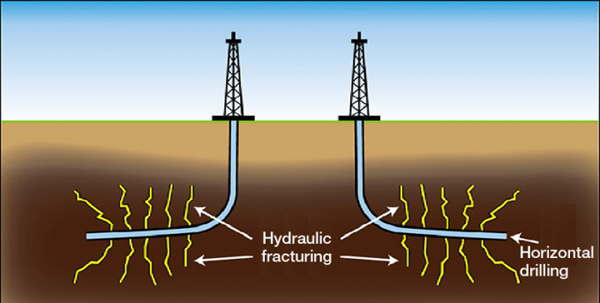
horizontal-drilling-600px-1JM: The improvements in horizontal drilling and hydraulic fracking is the most recent innovation that has changed the landscape of the oil and gas industry, making it possible to develop oil and gas deposits in shales and other tight formations. But this is old news at this point. Currently, most oil and gas companies utilizing this technology are trying to improve these operations in their specific development areas by finding the optimal frack design. The ultimate goal is usually to optimize returns by improving recoveries, increasing production rates and lowering costs. Some investors may find a discussion boring about the optimal number of frack stages or whether to use ceramic or sand-based proppant, but that’s where we are at now.

TER: Is there a sweet spot for the oil and gas mix in the companies’ proved reserves?

JM: When you’re talking about reserves, liquids are generally better than gas because the margins are better. However, when deciding on the best place to drill a new well, you also have to take into account the investment cost. In this case, it seems like the wet gas plays or volatile condensate/oil plays earn the highest returns. These parts of the reservoir typically have a lot of energy, resulting in higher production rates and better recoveries. This will drive the economics of the well even though the product mix may include more NGLs and natural gas, which realize lower prices than oil. By drilling in the oil window, the price realizations may be higher, but production rates and recoveries are often less. In the natural gas window, production rates and recoveries could be high, but price realizations are low.

TER: West Texas Intermediate (WTI) has ranged from $100 per barrel ($100/bbl) to $110/bbl since early July, while natural gas has remained stuck below $4 per million British thermal units ($4/MMBtu). Is this the new normal for oil and gas?

JM: I model for $90–100/bbl oil prices and $3–4/MMBtu gas prices on a going-forward basis. Obviously, the prices could go above that, but I think we lack the demand to keep prices much higher than that. If prices go below that, I don’t see them staying there for very long because development would likely fall off at lower prices.

TER: What struck me about the oil price was that it was very clearly confined within the range of $100–110/bbl since July, after lingering below $100/bbl for months before that. I’m wondering whether it’s going to stay that high, or is there something that’s going to pull it back down?

JM: There could have been a number of factors that contributed to the surge in prices. Some pipelines came online and alleviated the supply bottleneck in the mid-continent region of the country. This narrowed the gap between West Texas Intermediate and Brent prices, which had been trading at above $100/bbl for some time. The WTI price benefited from the new pipelines, increasing to above $100. The push for U.S. involvement in the civil war in Syria was also a contributing factor. Oil tends to be viewed, I think, as a hedge against the inflating dollar and concerns about the Federal Reserve’s quantitative easing policy.

TER: How are these prices affecting the earnings of the companies you cover? Are oil-rich companies doing better than companies with more gas reserves?

JM: I would say that in general, oil-rich companies are doing better. Many gas companies have already moved to a liquid development strategy by acquiring and developing properties in liquid-rich plays. But there are still some attractive places to drill for natural gas, where a company can earn high returns. It will usually take very low well costs and/or very high production rates and recoveries.

TER: What is Euro Pacific Capital forecasting for prices in the fourth quarter?

JM: I’m generally using about $3.50/MMBtu for natural gas and for oil my price deck going forward is $90/bbl. I think these levels are sustainable.

TER: The dollar’s strength has been buffeted by news from the Fed, including Larry Summers’s withdrawal and the decision to continue quantitative easing. How is the dollar’s strength influencing oil and gas prices?

JM: Oil trades inversely to the strength of the dollar. Generally, if the dollar weakens then oil prices increase and vice versa. One trend we have seen recently was an increase in M&A activity in the oilier plays like the Bakken and Eagle Ford. While not necessarily related to a weaker dollar, I think it does suggest that oil and gas producers have taken a more bullish stance on commodity prices.

TER: Has Gulfport Energy Corp. (GPOR:NASDAQ) continued its strong showing in the Utica?

JM: Yes, it continues to drill very solid wells that are consistent with what we expect from the play.

TER: Your research has indicated that pipeline infrastructure is inadequate for some of the plays whereSynergy Resources Corp. (SYRG:NYSE.MKT) and Gulfport Energy are working. Is this a serious crimp in their future or just a temporary setback?

JM: No, I don’t think it is a serious crimp. I believe it is more a result of the quality of the oil and gas plays, at least in the case of Gulfport and Synergy. Gulfport and other companies see great potential in the Utica play in Eastern Ohio, given the early well performance in the play. As a result, these companies have implemented aggressive development plans in the regions, even though Ohio historically has not been a major oil and gas producer and lacks pipeline and processing infrastructure. Infrastructure in the Wattenberg Field in Colorado was insufficient to handle the acceleration in development that was caused by the success of horizontal drilling and hydraulic fracking. Synergy and other companies operating in the Wattenberg Field may experience some temporary setbacks, but horizontal development of the play has enhanced their portfolios considerably.

TER: There’s some softness now in NGL prices because so much NGL has been produced. How is that affecting your companies?

JM: Many companies are drilling in NGL-rich areas, so that heightened production resulted in a price correction. Companies can still drill economic wells, but the price that they get for the NGLs is just not as high, so you have to take that into account. As it turns out, in many cases, even though it might lower your returns, the returns are typically still attractive enough to justify the drilling of the well.

TER: You have buy recommendations for Gulfport Energy, Synergy Resources and Gastar Exploration Ltd.(GST:NYSE). Can you talk a little bit about each of them and what is causing you to issue a buy?

JM: Gulfport has 136,000 acres in a lease hold in what is probably the sweet spot of the Utica play, which means the company should enjoy years and years of drilling opportunities in one of the more economic places to drill in North America. Its acreage is very concentrated, with an average working interest of about 95%. The company will be a likely takeover target, once development is further along.

Synergy is more or less a pure-play Wattenberg name. The Wattenberg is one of the premier oil and gas plays. Some leading operators have estimated that 36 wells could be drilled on a spacing unit, which is quite a large number. I don’t know of any other play where someone has made such a claim. A deep inventory of high-return well prospects is driving the underlying value of the stock. For a small company, Synergy has a strong management team. They’re not promotional and they make good decisions.

Gastar Exploration Ltd.’s acreage position in the Marcellus is very economic even though the product mix is gassy. Additionally, the company built a significant leasehold position in a new play in Oklahoma called the Hunton Limestone oil play. It is still early days, but the Hunton play could be a game changer for Gastar. Management has pulled off some pretty impressive acquisitions.

TER: Can you offer us any parting thoughts on the energy markets and how to play them in the current circumstances?

JM: The summer driving season is behind us and we’re going into a lower-demand season for oil. Additionally, the geopolitical issues in Syria have quieted down, so I’d be a little cautious about a price correction for oil. We may see a pullback there.

TER: All right, Joel, thank you very much for your time.

Joel Musante is a Senior Research Analyst covering the oil and gas exploration and production sector with Euro Pacific Capital. Musante has nearly 15 years of research experience through research analyst positions with W.R. Huff Asset Management; Dresdner Kleinwort Wasserstein; Ferris, Baker Watts, Inc., and C.K. Cooper & Co. In 2011 he was ranked No. 1 in The Wall Street Journal “Best on the Street” analyst stock-picking survey for the oil and gas sector. Musante holds a Master of Business Administration degree from the University of Rochester Simon School of Business and a Bachelor of Science degree in geology and geophysics from the University of Connecticut.

Want to read more Energy Report interviews like this? Sign up for our free e-newsletter, and you’ll learn when new articles have been published. To see a list of recent interviews with industry analysts and commentators, visit our Interviews page.

Related Articles


DISCLOSURE: 
1) Tom Armistead conducted this interview for The Energy Report and provides services to The Energy Report as an independent contractor. He or his family owns shares of the following companies mentioned in this interview: None.
2) The following companies mentioned in the interview are sponsors of The Energy Report: None. Streetwise Reports does not accept stock in exchange for its services or as sponsorship payment.
3) Joel Musante: I or my family own shares of the following companies mentioned in this interview: None. I personally am or my family is paid by the following companies mentioned in this interview: None. My company has a financial relationship with the following companies mentioned in this interview: Euro Pacific Capital has performed investment banking services for Gulfport and Synergy within the past 12 months, and expects to receive or intends to seek compensation for investment banking services from Gulfport, Synergy and Gastar Exploration within the next three months. Euro Pacific makes a market in Gulfport Energy and Synergy Resources. I was not paid by Streetwise Reports for participating in this interview. Comments and opinions expressed are my own comments and opinions. I had the opportunity to review the interview for accuracy as of the date of the interview and am responsible for the content of the interview. 
4) Interviews are edited for clarity. Streetwise Reports does not make editorial comments or change experts’ statements without their consent.
5) The interview does not constitute investment advice. Each reader is encouraged to consult with his or her individual financial professional and any action a reader takes as a result of information presented here is his or her own responsibility. By opening this page, each reader accepts and agrees to Streetwise Reports’ terms of use and full legal disclaimer
6) From time to time, Streetwise Reports LLC and its directors, officers, employees or members of their families, as well as persons interviewed for articles and interviews on the site, may have a long or short position in securities mentioned and may make purchases and/or sales of those securities in the open market or otherwise.




I received my credit card statement today. Here is what it said, in fine print: If you make only the Minimum Payment each month, we estimate it will take 81 year(s) and 5 month(s) to fully repay the outstanding balance. Our estimate is based on the New Balance shown on this statement and your current credit card account terms.

Wow. 81+ years if you make only the minimum payment !

Hence: pay off your credit card every month. I taught my kids a while ago that credit cards are not “credit” cards, they are debt cards or convenience cards.

Modern day-to-day life, for example to book a flight, to reserve a rental car or to buy goods online, require a “credit” card. As such have one, maybe two. I actually have 3 to make accounting easy: one for personal use, one for Prestigious Properties business and one for my holding company on non-Prestprop business. That’s it.

I carry & personally guarantee a lot of debt. Lots. Why can I sleep well at night ?

Because we own assets, with income producing characteristics. We are in the real estate investing business. Assets usually appreciate in value, in time due to inflation and property upgrades. That is why it makes sense to carry debt, at 2.8% for a CMHC insured mortgage to 3.5% for a conventional mortgage, to buy assets that yield 5 to 6%. That is also referred to as “good debt”, as opposed to “bad debt” for depreciating assets or life’s conveniences.

I pay the credit cards off every month, and so should you. If you are unable to pay off your credit card every month, it becomes a very expensive debt card very very quickly, as interest rates are routinely in the 18-22% range. This is very expensive “credit” especially in the current low interest rate environment. A good strategy is to use cheaper debt, say a secured LOC (line of credit) to pay off credit card debt. Or if you have poor money management habits get one linked to your bank account, i.e. it acts like a debit card. Or get pre-paid cards. The high interest is why banks or large retailers are so eager to give you such a card, as they can make a fortune off you. Don’t be fooled into it.

I also do not have a car loan, another expensive form of debt. When I was younger and our family had a lot less money we bought cars in cash, usually old used ones. Only once I did my first real estate flip in Canmore I bought a new car, in 2003 – only 10 years ago – in cash. Cars are very expensive habits, easily costing between $5000 to $10,000 a year if one counts gasoline, insurance, repairs, oil, tires and depreciation. 50 cents per kilometer is the rough true cost of a car. Thus, if you drive 10,000 km a year it is $5000/year; if you drive 20,000 km it is $10,000. A car loan at 7% coupled with the car’s depreciation can put you financially behind even if you have a decent wage. Don’t get a car loan. Lease a small car if you must, or better: get a used one, paid for in cash.

Instead of paying $40,000 for a new car, why not buy one for $10,000 and invest $30,000 into income producing real estate. In 5 years the $40,000 car is worth $20,000 at best, so you lost $20,000. With a $10,000 car, now worth $6000, and $30,000 invested in real estate your networth in 5 years might be $46,000 to $56,000 depending on the real estate, i.e. you are $26,000 to $36,000 ahead just by downsizing to a used car and investing into an appreciating asset, via TFSA or RRSP, or in cash.

Real estate investing beats car investment and “credit” cards by a wide wide margin !

Don’t be a debt-beat !

Thomas Beyer, President

Prestigious Properties Group

www.prestprop.com


“Fed will do what it takes,” declared Narayana Kocherlakota, President of the Federal Reserve Bank of Minneapolis and member of the Federal Open Market Committee. In a speech today he stated, “Doing whatever it takes … will mean that the FOMC is willing to continue to use the unconventional monetary policy tools that it has employed in the past few years. Indeed, it will mean that the FOMC is willing to use any of its congressionally authorized tools to achieve the goal of higher employment, no matter how unconventional those tools might be…

Moreover, doing whatever it takes will mean keeping a historically unusual amount of monetary stimulus in place—and possibly providing more stimulus—even as: Interest rates remain near historic lows.”

test-php-789