Bonds & Interest Rates

Fed President Explains Next Move

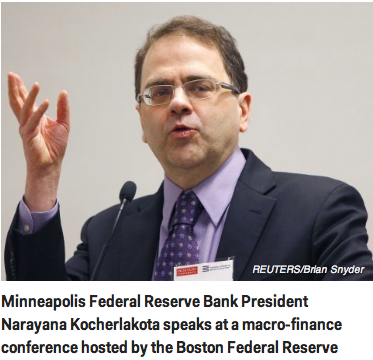
Screen Shot 2013-09-27 at 7.07.44 AMToday, Minneapolis Fed President Narayana Kocherlakota, is suggesting we may need even more stimulus to get unemployment down and the economy humming.

The dovish Fed official employs buzz phrases like “whatever it takes,” and he even suggests the Fed should ignore warnings of asset bubbles as it stimulates.

…..read it all HERE

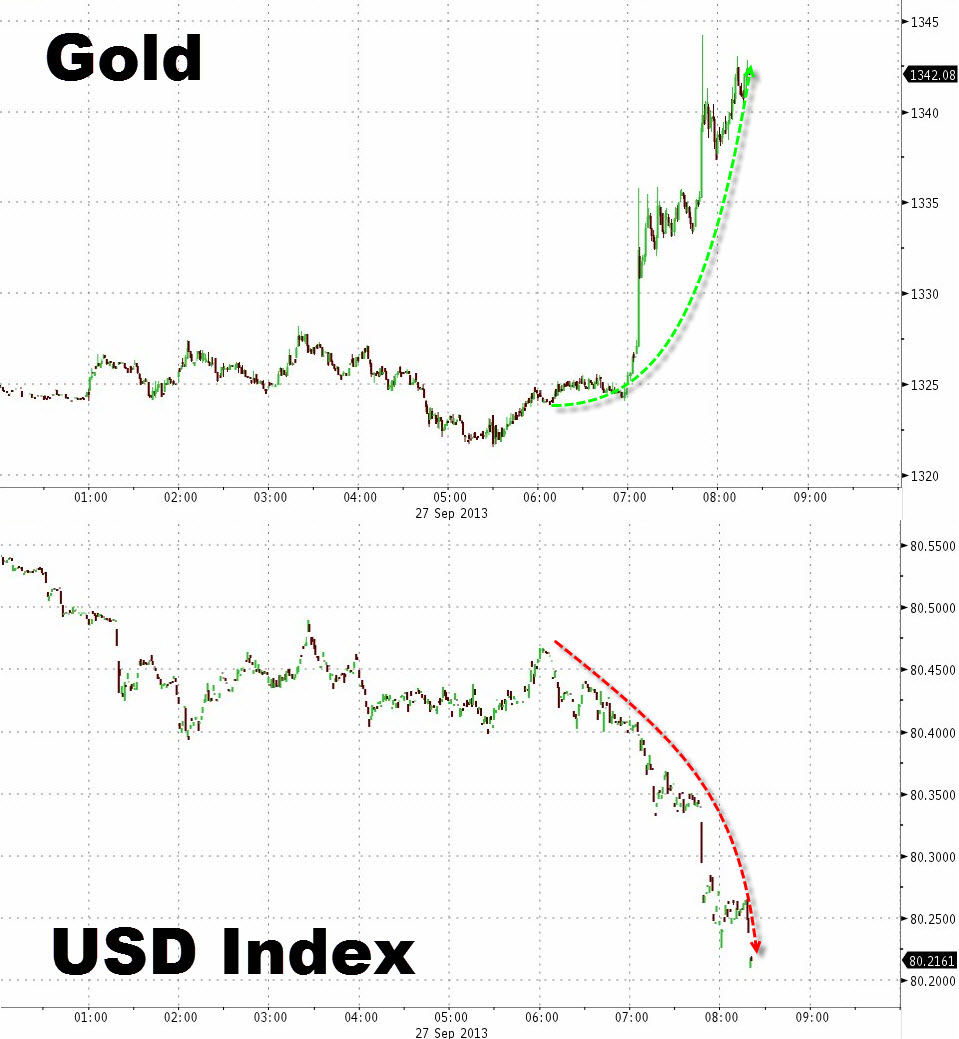
Traders Are Greatly Rotating From USD To Gold

It would appear that between the fears of a government shutdown and the battle over the ‘full faith and credit’ of the US, traders have decided that the stroke-of-midnight agreement is potentially less viable this time as both parties feel the other has more to lose. The USD is being sold against all majors and gold, silver, and WTI crude is well bid as investors seek the safety of hard assets over printable fiatOf course, that could all change on the next economic data or Washington headline… buckle up…
 20130927 gold

Chart: Bloomberg

EUR is nearing 8-month highs at 1.3550 as the USD Index presses down to near 7 months lows.

….read ZeroHedge’s feature article on Gold HERE


Gold Markets are not Efficient, Don’t Reflect Fundamentals & Understate Gold’s Market Value (part 1)

specialreportThis is a series on how and why the gold markets fail to reflect the true balance of demand and supply in gold and silver prices. Many investors expect and believe that the gold price is an accurate reflection of demand and supply, but it isn’t.

In a perfect market the exact weight of demand and supply on a daily basis would be reflected in the daily prices. In both gold and silver markets this is just not true. Many of these factors are common to all markets, but in the gold market the different factors on a broad front are wider and more complex than most. The extent of market liquidity is a key factor in the efficiency of markets so we need to know just how responsive to prices is the liquidity of the gold market.

It’s naïve to expect markets to be perfect in a very imperfect world and where large investors have a disproportionate power to influence precious metal prices –aided by the different structures of different global markets and their relationships to each other—so the most important point for both traders and investors is that they realize this and adjust their trading and investment with these factors in mind. Of course, the real skill is being able to synthesize these factors into an understanding of where gold and silver prices will go and when.

But this subject has major relevance today. We know that global demand for gold is as strong as ever right now, if not stronger, so why isn’t this being reflected in the gold price?

Will the demand eventually find its way into the open global market and impact the gold price? Or has it been knocked away from doing so?

Why does New York have such an impact on precious metal prices when, particularly in the case of gold it is a minor player in terms of demand and supply [7% of global annual demand]?

 With China and India the main physical gold buyers, why isn’t the market in one of those countries and dominating it when combined they account for around 70% of global demand?

How easy is it for prices to be managed and manipulated?

We hear much talk about market manipulation by various institutional bodies, but have you thought just how the different gold markets can do this by their structure and through the institutions that provide market liquidity?

Seashore

As we start this series, it’s good to have an analogy on which to hang the picture so we have a clear picture at the end of the series. An analogy that best portrays the interaction of different market influences in the gold and silver market is the seashore. There are three influences: the current, tide and waves. The current is the most dominant influence as it dominates the other two influences.

But the tides are the most dominant noticeable influence to us. They dominate the wave action completely. But in the increasingly short-term world of financial markets, it’s the moment to moment wave action that absorbs the media and unfortunately the traders and often investors. This wave action can be gently and placid on wind free days, but can be whipped up into a raging surf with its furious mist just as easily. But the surf and wind has barely any influence on the actions of the sea, even though they rivet our attention.

Here again we would be naïve to believe that the sea-shore of financial markets would be allowed to act and react smoothly to the underlying influences.

In a commodity market, the bulk of the product is negotiated between user and supplier by an ongoing contract for a specific amount. Anything above or below that amount is supplied to or bought from the open market or exchange. But surprisingly enough, it is the marginal amount bought and sold and the price at which this is done that determines the price that the bulk of demand and supply is priced at.

In the gold market, we will look at the most efficient part of the market where 90% of physical gold is traded, the London Gold Fix.

The Gold Fix

One market where there is close communication between the various professionals is the London gold Fix. Think of a pyramid shape with the 5 gold bullion banks in London (seewww.goldFixing.com) at the top. These communicate on a twice daily basis at 10.30 in London’s morning and at 3.00 p.m. there to set the gold price at which all gold deals dealt there are priced. Each of these banks has its own clients who are buying and selling and many of these have internal clients buying and selling within their own walls. Each professional ‘nets’ out the supply and demand before he takes his ‘net’ position up the pyramid to the higher level until the overall, net position of his bullion bank in the structure is netted out and used as a basis for determining the Fix. If the price they are considering changes their net position and raises the demand or supply, he has another price is looked at. Once the five banks are in agreement over a particular price, then the price is set for all deals being transacted at that particular fix.

In this way demand and supply as reflected in the banking system is smoothed out. But there are so many other factors that influence the gold market that detract from an accurate picture. It’s these that we will examine. You will then see just how easily gold prices can be deflected from giving and accurate balance of demand and supply. In some cases, such ‘deflections’ are outright price manipulations without the manipulators buying and selling physical gold. We have seen this year, in April alone, cases where buying and selling of gold has been engineered by banks and their largest clients, and very successfully so. But we will also look at other ways this can be done. It can even be done with the banks absent from the picture.

We conclude this first part by emphasizing that if the gold market were truly efficient the gold price would be much higher and with far less volatility.
A SIGN OF BETTER TIMES AHEAD

image005

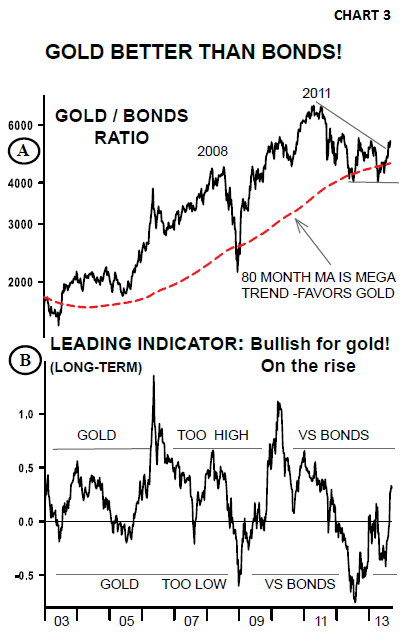
This chart is so important we really want you to take a hard look at what it’s telling us.

Very simply, this ratio chart compares gold to bonds. When it rises, gold is stronger than bonds. And when it declines, gold is weaker than bonds.

We call this our inflation-deflation barometer. Why?

Gold tends to rise during inflationary or generally good economic times. That’s why the ratio’s been rising over the past decade.

Ed Note: This is just a portion of this article, more charts and points made in the article Seeds of Change Growing


insights from the front lines of gold, silver platinum and palladium investing

An Investing Opportunity of a Lifetime: Lessons from the Sprott Precious Metals Roundtable


What happens when you bring together four of the top minds in the precious metals investing space to share insights from the front lines of gold, silver platinum and palladium investing? These excerpts from a Sprott Resources Roundtable featuring Gloom, Boom and Doom Report Publisher Marc Faber, Sprott Asset Management Chief Investment Strategist John Embry, Sprott Global Resource Investments Founder Rick Rule and Sprott Asset Management Founder Eric Sprott prove that great minds think big.

Sprott Resources: Marc Faber, help us understand the Federal Reserve’s recent announcement regarding tapering.

Marc Faber: When the Fed began Quantitative Easing 1 (QE1) in 2008, I said it would continue until QE99. So I’m not so surprised by the “no tapering decision.” But this money printing has numerous unintended consequences and actually does not help the economy much. Asset purchases benefit maybe 1% of the population, the super-rich. I’m not complaining because I own stock, bonds and real estate, but from a social point of view, it’s undesirable because it creates widening wealth inequality and dissatisfaction among the majority of voters. This could lead to more votes for a populist leader who will then tax the wealthy more heavily.

SR: You are based in Asia. China, India and Russia have been very big buyers of gold bullion. What is behind that trend?

MF: In the Far East, we have a tradition of owning physical gold, but what is new is the Chinese government encouraging citizens to own gold. I believe that in the face of political instability and a lack of faith in the U.S. dollar, Asians will continue to accumulate physical gold and silver.

SR: What is the component that you have in your own portfolio of precious metals? And to add onto that, would you comment on the fact that precious metals shares are vastly oversold and they are a complement to physical bullion holdings?

MF: I recommend an asset allocation of about 25% in equities; 25% in fixed income, securities and cash; 25% in real estate; and 25% in precious metals—gold, silver. I think I have around 25% in gold whereby I don’t value my gold. I have it and it’s my insurance policy. It is important that one day when the so-called shit hits the fan—and I think the Fed is well on its way to creating that situation—you have access to your gold, that it is not taken away.

SR: John Embry, you went through the market correction in 1975–1976. Would you share some perspective from that time?

John Embry: That’s a very good question because there’s a remarkable correlation with what is happening today. For the first three years of the 1970s, the gold price rose almost sixfold, and there was great enthusiasm. Then from 1974 to 1976, it was virtually cut in half. At that point, you could cut the pessimism with a knife it was so thick. Then, gold rose another eightfold from there. The price correction of the last two years has been even more counterintuitive than it was in the 1970s. The sentiment arguably is even more negative, yet the fundamentals are better than they were in the 1970s, so I think we’re setting up for a major reversal. The only thing we’re debating here today is whether it’s going to happen tomorrow, next week or several months from now. It’s just a matter of short-term timing because everything is in place.

SR: We have seen an incredible correction. During the upward trend we have seen during the past 10 years, we have had a number of corrections along the way, including some “puke” days. It looked like we had a bottoming at around $1,200 an ounce ($1,200/oz). We’ve corrected back to $1,300/oz, and now we seem to be heading upward. Can you help us put some perspective on that?

JE: We have had, from top to bottom, over a $700/oz correction in the past two years. That attests to the power of the central banks, the Bank for International Settlements (BIS), the bullion banks and their ability to control the paper market aggressively. I think that is coming to an end because it has driven the price down to remarkably undervalued levels. Talk of gold going to $1,000/oz and below is ridiculous. It’s not going to happen. I think this is a fabulous opportunity because it’s hugely undervalued and the fundamentals are compelling. We’re just on the verge.

SR: What happened to the gold shares in that period?

JE: Gold shares were similarly under pressure, but their subsequent gains were historic. After gold topped in 1980 and then started to re-rally, the gold shares exploded again. You’re talking in many cases, ten- or twentybaggers. So I wouldn’t get discouraged here for the simple reason that I think gold and silver shares are now as cheap as they’ve ever been in history relative to where they are going. So it’s a great buying opportunity, but very few people seem to be willing to take advantage of it.

SR: Rick Rule, what is happening in the platinum and palladium sector?

Rick Rule: Platinum and palladium benefit from all of the factors concerning precious metals. They have for many centuries fulfilled the same roles with regard to stores of value and mechanisms for transferring or storing wealth as gold and silver. Where they differ a bit is on the supply side. All of us know that a lot of the gold and silver that has been mined historically has been stored in vaults. So in the near term, supply considerations in gold and silver have to do with sellers’ intentions. I, like the prior speakers, believe that the holders’ intentions will turn very bullish, and it will be very good for gold and silver prices. But platinum and palladium supplies are different. They don’t get stored. They get used.

Currently, worldwide stocks of finished platinum and palladium bullion are less than one year’s platinum and palladium fabrication demand. The supply story gets more interesting because as a consequence of not having any stored bullion, the only supply is new mine supply and recycled supply. That new supply is very, very concentrated. South Africa constitutes 75% of world platinum supply and 39% of world palladium supplies. Russia supplies 13% of platinum supplies, 41% of palladium supplies. In many cases, current metal prices do not earn the cost of production. The consequence is that new mine supply, which is the most important source of supply, is declining. This isn’t something that’s going to occur in the future. It’s something that is occurring right now. Further, costs are going up because workers’ wages have to go up. Social take in the form of taxes, rents and royalties have to go up, but they can’t because the industry doesn’t earn its cost of capital. On the demand side, platinum and palladium provide incredible utility to users. We anticipate that the utilization of platinum and palladium will continue to grow even in the face of supply declines. There is only one way that dichotomy can be resolved, and that’s in the form of price.

It is also worth knowing that just in the last year and a half, platinum and palladium have begun to enjoy elevated status from an investment point of view. The physical inventory held by exchange-traded products (ETPs) like our own Sprott Physical Platinum and Palladium Trust have increased dramatically. This could exacerbate an already-troubled supply-demand imbalance.

SR: Eric Sprott, what is going on in the silver market?

Eric Sprott: Marc indicated that he was a 25% investor in precious metals; I am probably an 80% investor in precious metals. Silver COMEX inventories have held up even though the price has gone down. It’s sort of an interesting contrast with gold where there were huge redemptions in the ETFs. Those redemptions, in my mind, were created to solve the physical shortage. We had 700 tons of ETF liquidation. That would represent close to 50% of all mine supply annually, in other words, an increase in supply. But it was needed because we definitely have a shortage.

I continue to believe that silver will be the investment of the decade because 1) of its industrial uses and 2) it will take very little investment demand to really move things along.

We have years where people are buying 50 times more silver than gold, and yet mine production is only 11:1 silver versus gold. By my calculation, we only have 3 oz of silver available for investment purposes for every ounce of gold. Every time I’m talking to metal dealers, my favorite question is: What part of your business is silver, and what part is gold? And almost everyone says, 50/50. I guarantee you, that cannot continue.

What I really want to talk about is what I think is the investment opportunity of my lifetime. I happen to very firmly believe that within the next year, gold will be through $2,000/oz. I’ve chosen $2,400/oz as a target of where it will be in a year. That has amazing implications for gold equities. Back in 2000, I was beginning to aggressively buy mining stocks. At the time, I thought if gold could ever get to $400/oz, maybe these companies whose costs then were $300/oz could earn $100/oz and we could make three or four times our money. With most producers averaging around $1,000/oz costs, if the gold price goes to $2,400/oz, you have $1,400/oz of margin. That is 14 times the opportunity in 2000.

I totally subscribe to the manipulation of gold and silver and the shortages of gold and silver. I’ve written many articles asking whether the central banks have any gold left and what is going to happen to gold when they finally give up the ghost, which I believe is coming. That is why I think the opportunity in the equities is spectacular. Of course, also I’m a great believer in owning physical gold and silver with my particular emphasis on silver these days.

View the Sprott Precious Metals Roundtable webcast here.

Swiss-born Marc Faber, who at age 24 earned his Ph.D. in economics magna cum laude from the University of Zurich, has lived in Hong Kong nearly 40 years. He worked in New York, Zurich and Hong Kong for White Weld & Co., an investment bank historically managed by Boston Brahmins until its sale to Merrill Lynch in 1978. From 1978 to 1990, Faber served as managing director of Drexel Burnham Lambert (HK), setting up his own investment advisory and fund management firm, Marc Faber Ltd. in mid-1990. His widely read monthly investment newsletter Gloom Boom & Doom Report highlights unusual investment opportunities. Faber is also the author of several books, including “Tomorrow’s Gold: Asia’s Age of Discovery” (2002), which spent several weeks on Amazon’s bestseller list and is being translated into Japanese, Chinese, Korean, Thai and German. He also contributes regularly to leading financial publications around the world. Much also has been written about Faber. Nury Vittachi, one of Asia’s most popular writers and speakers, published “Riding the Millennial Storm: Marc Faber’s Path to Profit in the Financial Markets” (1998). The Financial Times of London described him as “something of an icon” and Fortune called him a “congenital contrarian and shrewd Swiss investment advisor.”

John Embry is chief investment strategist at Sprott Asset Management and Sprott Gold and Precious Minerals Fund. He also co-chairs the Central GoldTrust Board of Trustees. An industry expert in precious metals, his experience as a portfolio management specialist spans more than 45 years. He joined Sprott in 2003, after 15 years as vice president of equities at RBC Global Investment.

Rick Rule, founder and chairman of Sprott Global Resource Investments Ltd., began his career in the securities business in 1974. He is a leading American retail broker specializing in mining, energy, water utilities, forest products and agriculture. His company has built a national reputation on taking advantage of global opportunities in the oil and gas, mining, alternative energy, agriculture, forestry and water industries.

Eric Sprott has over 40 years of experience in the investment industry. In 1981, he founded Sprott Securities (now called Cormark Securities Inc.), which today is one of Canada’s largest independently owned securities firms. After establishing Sprott Asset Management Inc. in December 2001 as a separate entity, Sprott divested his entire ownership of Sprott Securities to its employees. Sprott’s predictions on the state of the North American financial markets have been captured throughout the last several years in an investment strategy article that he authors titled “Markets At A Glance.” Sprott has been widely recognized for his strategic insights and his accurate market predictions over the years. His newest ventures are Sprott Money Ltd. and Sprott Physical Platinum and Palladium Trust.

DISCLOSURE: 
1) Streetwise Reports does not accept stock in exchange for its services or as sponsorship payment.
2) Interviews are edited for clarity. Streetwise Reports does not make editorial comments or change experts’ statements without their consent. 
3) The interview does not constitute investment advice. Each reader is encouraged to consult with his or her individual financial professional and any action a reader takes as a result of information presented here is his or her own responsibility. By opening this page, each reader accepts and agrees to Streetwise Reports’ terms of use and full legal disclaimer
4) From time to time, Streetwise Reports LLC and its directors, officers, employees or members of their families, as well as persons interviewed for articles and interviews on the site, may have a long or short position in securities mentioned and may make purchases and/or sales of those securities in the open market or otherwise.

Streetwise – The Gold Report is Copyright © 2013 by Streetwise Reports LLC. All rights are reserved. Streetwise Reports LLC hereby grants an unrestricted license to use or disseminate this copyrighted material (i) only in whole (and always including this disclaimer), but (ii) never in part.

Streetwise Reports LLC does not guarantee the accuracy or thoroughness of the information reported.

Streetwise Reports LLC receives a fee from companies that are listed on the home page in the In This Issue section. Their sponsor pages may be considered advertising for the purposes of 18 U.S.C. 1734.

Participating companies provide the logos used in The Gold Report. These logos are trademarks and are the property of the individual companies.

test-php-789