
Energy & Commodities
“There are more companies basing – consolidating sideways for long periods of time – and rising out of bases in energy than in any other sector”
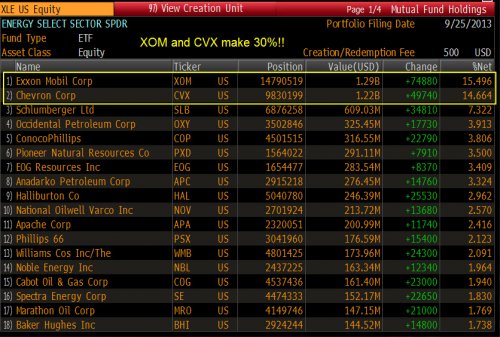
The Energy Select Sector SPDR (XLE) is widely used to invest in energy stocks, especially in the age of the exchange traded fund (ETF) portfolio. Many technicians will do sector performance analysis using this fund as on the S&P Sector ETF chart at Stockcharts.com (here). The problem with this ETF is that it is capitalization-weighted in which the top two stocks – Exxon and Chevron – represent 30% of the entire fund. The performance of these two stocks has held the sector back, masking the true and stellar performance of energy stocks this summer.
…read the rest HERE


Ben Bernanke and the U.S. Federal Reserve Board have stated that it was their desire to become more “Transparent” in their communications with the public. This was to be in contrast to the cryptic language preferred by Bernanke’s predecessor Alan Greenspan.
The accompanying chart indicates that the Fed is talking more (as evidenced by the word count of the Federal Open Market Committee post meeting statements). However, judging by the market’s total confusion over “Tapering” the rate of QE3, or money-printing, more words apparently don’t equate with more clarity.
While it is laudable for the Fed to attempt to be more transparent, the Fed is finding it tough, especially when claims that the economic data is forcing it to back down from their plans to “Taper.” Instead, of making pithy and concise comments, we get mealy-mouthed statements containing wordy and tortured rationales.
Well, on the bright side, this may be a new Fed “indicator.” When the Fed feels that it needs more words to explain things, it may be an indication that they feel a need to defend a continuation of their massive liquidity experiment that has been in place for over five years now.
Using that guidepost, I suppose we can expect more liquidity and generally increasing prices for riskier assets.
The opinions expressed in this report are the opinions of the author and readers should not assume they reflect the opinions or recommendations of Richardson GMP Limited or its affiliates. Assumptions, opinions and estimates constitute the author’s judgment as of the date of this material and are subject to change without notice. We do not warrant the completeness or accuracy of this material, and it should not be relied upon as such. Before acting on any recommendation, you should consider whether it is suitable for your particular circumstances and, if necessary, seek professional advice. Past performance is not indicative of future results.
Richardson GMP Limited, Member Canadian Investor Protection Fund.
Richardson is a trade-mark of James Richardson & Sons, Limited. GMP is a registered trade-mark of GMP Securities L.P. Both used under license by Richardson GMP Limited.

 Botching the Exit
The Fed’s blinking on tapering was due to their concern over the uptick in interest rates following Mr. Bernanke’s musings in June. While the markets soared on his back-peddling, there are reasons to worry. The economy is still weak despite trillions of stimuli. Today, even the Fed is addicted to low interest rates. And coming soon are the negotiations between the White House and Congress which could trigger a Federal shutdown next month. Ironically, none of this is going to give the economy a boost.
We believe that America botched the “exit” partly because nobody has tried it on this scale before….
The Rest…HERE
 I know what you’re thinking, punk. You’re thinking: “Did he fire six shots or only five?” Now to tell you the truth I forgot myself in all this excitement. But being this is a .44 Magnum, the most powerful handgun in the world, and will blow your head clean off, you’ve gotta ask yourself a question: “Do I feel lucky?”
Well, do ya, punk?
The Dow finally broke its losing streak yesterday. It rose 55 points. Gold fell $12.
Nothing dramatic. Nothing conclusive. Or even persuasive.
Stocks are going up… or down. No one knows for sure.
We’re not gamblers. So we’re out of US stocks… and our “Crash Alert” flag flies… not because we think stocks are going down, but because we think the weight of risk lies on the downside.
That said, the feds have added $3 trillion in cash and some $23 trillion in credit guarantees over the last five years. Something had to happen to the money, right?
Don’t bother looking for it in the trailer parks. Hourly wages are no higher. And fewer people (as a percentage of the workforce) have jobs than ever before.
Household incomes are stagnant. So you won’t find it under middle-class seat cushions, either…
Real estate? Ultra-low mortgage rates hardly hurt…
But only stocks have skyrocketed…
According to former Merrill Lynch economist David Rosenberg, since the March 2009 low there has been a near-perfect correlation between a higher S&P 500 and the expansion of the Fed’s balance sheet.
So, we can plausibly assume the Fed will continue to push up stock prices – at a rate of about $85 billion per month… or about $1 trillion a year.
We may even assume that, by back-tracking on its own forward guidance, the Fed has now embarked on a new stage of perpetual money-pumping. And that investors might now anticipate trillions more dollars’ worth of stock buying.
From bearish fund manager John Hussman:
Investors may draw on this decision as evidence that the Federal Open Market Committee (FOMC) has placed a safety net below the market… and that the surprising extension of its current policies could spark a short-term speculative blow-off top.
We don’t deny it. Under these conditions, the bulls might be right. They might bet on a blow-off with much higher stock prices. They might make money.
Dear readers who are feeling lucky might take a chance. Buy some call options. Who knows? They could pay off big!
But dear readers are warned: Gamblers gotta know when to fold ‘em… and know when to walk away, too.
A bet on a blow-off top is a bet that: (1) the economy is not really recovering, (2) the Fed won’t taper, (3) with no real recovery, the cash goes into speculations, and 4) the most likely speculative market is stocks.
This is not a bad bet. “As long as the music is playing, you’ve got to get up and dance,” said former Citigroup boss Chuck Prince. But it’s risky. Because they don’t hold up cue cards to tell you when they’re going to pull the plug. Instead, as the end approaches, the party grows wilder and wilder.
Ah yes, dear reader, they don’t make it easy. The closer you are to disaster, the harder it is to leave. Just before the blow-off turns into a blow-up, stocks are typically going straight up. Who wants to leave the party then?
But when the lights go out, suddenly everybody rushes for the exits. But it’s too late. Bodies pile up in the doorways. It is impossible to get out.
The same is true of the entire Fed intervention. The more the central bank intervenes, the more dependent the economy becomes, and the harder it is to exit. They say they will head for the door when the numbers improve… but as soon as they make a move to the exit, the numbers will collapse.
In this sense, too, the bulls are reading the latest Fed announcement correctly. The Fed will keep at it until the bitter end. It will feed the market with more cash and credit. Then it will find it impossible to back up. Instead, it will keep going until we get a blow-off top in stock prices.
The bulls don’t realize they are subject to the same phenomenon: Gambling on a blow-off top is hard to stop. Gamblers do not walk away from 100%-a-year gains. They stay at the table… and go right to the end… from the blow-off to the blow-up.
There’s a better way to play this situation. By “anti-gambling”…
More next week…

 Michael explains how the IPCC report on “Climate Change” is put together, and how that lead to the somewhat embarrassing 2007 report. The 2013 report was released today, and despite the disagreement between sides in this debate, Mike points out the one thing everyone can agree on.


-
I know Mike is a very solid investor and respect his opinions very much. So if he says pay attention to this or that - I will.
~ Dale G.
-
I've started managing my own investments so view Michael's site as a one-stop shop from which to get information and perspectives.
~ Dave E.
-
Michael offers easy reading, honest, common sense information that anyone can use in a practical manner.
~ der_al.
-
A sane voice in a scrambled investment world.
~ Ed R.
Inside Edge Pro Contributors

Greg Weldon

Josef Schachter

Tyler Bollhorn

Ryan Irvine

Paul Beattie

Martin Straith

Patrick Ceresna

Mark Leibovit

James Thorne

Victor Adair