
Currency
Canadian August building permits were down 21.2% from July. This decline followed a 21.4% increase the previous month and was the result of lower construction intentions in both non-residential and residential sectors. With this decline, the trend in the value of building permits has become relatively flat since the beginning of 2013.
The Canadian dollar is weak this morning, trading down 25pts to 96.68 in December futures.
Drew Zimmerman
Investment & Commodities/Futures Advisor
604-664-2842 – Direct
604 664 2900 – Main
604 664 2666 – Fax
800 810 7022 – Toll Free

I love gold. I love its history. I love the role it’s had in many monetary systems. I love the beauty of gold. I love the versatile uses of gold.
I love gold coins. I love objects made of gold. I love gold’s role in new technologies.
But gold is not the end-all, be-all of the investment world. Nor is it the world’s savior. It is not even a very good hedge against inflation.
The hate mail will pour in again. I’m sure of it. But I have my reasons for giving you the truth, and nothing but the truth, about gold. As despised as I’ll be for the facts I give you today, you need to know the truth.
There are all too many myths and propaganda out there about gold, and if you get caught up in them, you most assuredly will lose the shirt off your back investing in gold.
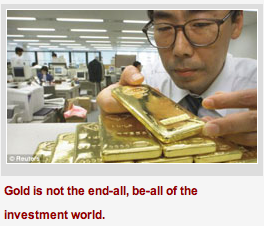 The fact of the matter is that the chief reason promoted to invest in gold — inflation — is dead wrong.
Consider the following:
 At the depths of the depression in 1929, an ounce of gold sold for $20. The Dow Industrials was at 40.
An ounce of gold today is roughly $1,300. It has increased 65 times over.
But the Dow Industrials stands at about 15,000. That’s 375 times more than it was in 1929.
And that means since 1930, the Dow has outperformed gold 5.8 times over.
In 1980, gold sold for $850 an ounce. The Dow Industrials was at 824.6. Since then, gold has increased 1.5 times over, and the Dow 18 times.
In 1980, the average price of a single-family home in the U.S. was $68,700.
Today it’s $223,222. It’s increased 3.3 times over (despite the real estate crash five years ago).
Gold’s up just over 50 percent since then.
Now, on the flip side of the coin, since the year 2000, gold’s gained more than 400 percent.
But the Dow Industrials are up a meager 29 percent.
So you see, overall, gold is not as great an inflation hedge as most would like to believe. Certainly not the gold promoters, who want you to buy gold at every twist and turn in the market, forever telling you that it’s the world’s best inflation hedge, when in reality, it is not.
The fact of the matter is this:
First, there are times when gold is a great inflation hedge, and there are times when it is not.
Second, there are times when gold goes up, and there are times when gold goes down, just like any other market or asset class.
Therefore, to maximize your profits in gold, you need to know when to be aggressively in gold, and when not to.
As a corollary, to also maximize your profits, you need to ignore the white noise about gold.
Gold is one of the most emotional markets on the planet, one of the world’s most recognized investments, all over the world.
Yet, it is also the market where the biggest lies are told, the biggest myths are perpetuated, and where the largest amount of misinformation is spread.
I tell you this only because it’s my job to help you protect your wealth. I have no vested interest in doing anything but that.
So bring on the gold investors — and especially the gold dealers and promoters — who will want my scalp for writing this column today. I don’t really give a hoot. All I care about is spreading the historical truth, not BS, propaganda or market myths.
That said, there will soon come a time when it is prudent to load up on gold, but we’re not there yet.
The simple reason is gold’s interim bear market is not yet over.
As you know from my previous columns, I expected a cycle low to form by Oct. 3. We got that low, right on cue at $1,276.90, one day early, on Oct. 2.
But that low did not break the prior low at $1,178. That means the interim bear market is not over yet, and that gold will likely bounce around in a tight trading range for the next few months, then do a swan dive heading into January of next year, where I expect gold will move below $1,178 — and likely bottom around the $1,035 level, or just slightly lower, under $1,000.
And then I will tell you to “back up the truck” on gold. For, you see, during gold’s ensuing new bull market leg higher — it will finally play catch-up with inflation, it will also rise as European and U.S. governments fall from their perches into a heap of rubble — and gold will begin an ascent that will take it to well over $5,000 an ounce.
Timing, in life and in the markets, is everything. Gold is not immune to that law. And it’s just not time for gold to shine again.
If you own gold from much lower levels, as I do and my subscribers do as well, then hold that gold. It’s great insurance. But don’t back up the truck on new purchases yet. Wait until I tell you to do so.
Best wishes, and stay tuned …
Larry
About Larry Edelson
With over three decades of experience in precious metals and natural resource markets, Larry Edelson has played a pivotal role in training Weiss Research staff and in guiding Weiss Research’s customers to prudent investments in these sectors.
His Power Portfolio and Real Wealth Report provide a continuing education on natural resource investments, with recommendations aiming for both profit and risk management. His team of technical analysts helps enhance the timing of investment recommendations with the aim of continually improving performance results for investors.
Mr. Edelson is also an accomplished analyst and writer, making substantial contributions to Weiss Research’s Safe Money Report andUncommon Wisdom.
He holds a B.A. degree from Columbia University. Mr. Edelson got his start on Wall Street in 1978. By 1980, he had his own firm active in international brokerage, financial analysis and money management.
In the mid-1980s, Mr. Edelson was one of the largest gold traders in the world, responsible for as much as $1.4 billion in daily gold trading volume on the Comex in New York, in today’s dollars. Mr. Edelson also managed several multi-million-dollar natural resource and commodity-based private investment funds.
Widely respected throughout the financial industry for his forecasts, Mr. Edelson has successfully called nearly all the major turning points in the world’s macro-economic trends, including …
-
The Stock Market Crash of 1987 and its subsequent rally to new highs by 1990.
-
The 21-year bear market in precious metals.
-
Major turning points in the currency markets, including the now multi-year-long decline in the dollar.
-
The peak of the stock market bubble in 2000.
-
The new bull market in natural resources that began in 2001.
-
One of the only analysts in the world to correctly identify in 2004 the start of the major bull markets in Asian economies and stocks.
Frequently quoted in international press, including Forbes, Bloomberg, CBS MarketWatch and more, Mr. Edelson travels extensively through Asia each year, bringing his followers first-hand analysis and accounts of the vibrant emerging economies.

Jimmy Kimmel conducts a hilarious experiment with the general public.

Harvard Economic Historian Niall Ferguson lay’s down some hard facts surrounding the US government shutdown, the pending budget ceiling, and projections for US Treasury Expenditures in the years ahead. A must read.
Click here to read more.
Robert Levy
Border Gold Corp.
rlevy@bordergold.com | 888.312.2288


-
I know Mike is a very solid investor and respect his opinions very much. So if he says pay attention to this or that - I will.
~ Dale G.
-
I've started managing my own investments so view Michael's site as a one-stop shop from which to get information and perspectives.
~ Dave E.
-
Michael offers easy reading, honest, common sense information that anyone can use in a practical manner.
~ der_al.
-
A sane voice in a scrambled investment world.
~ Ed R.
Inside Edge Pro Contributors

Greg Weldon

Josef Schachter

Tyler Bollhorn

Ryan Irvine

Paul Beattie

Martin Straith

Patrick Ceresna

Mark Leibovit

James Thorne

Victor Adair