
Stocks & Equities
“The current bullish uptrend remains intact which requires that we maintain exposure to the equity markets for the time being.”
Leading up to last week the threat was that if the government was shut down that the markets would tumble. I made it clear that this was unlikely to happen as the “markets” have seen this before, and with the Federal Reserve remaining fully committed to artificially inflating asset prices, there was little downside risk present.
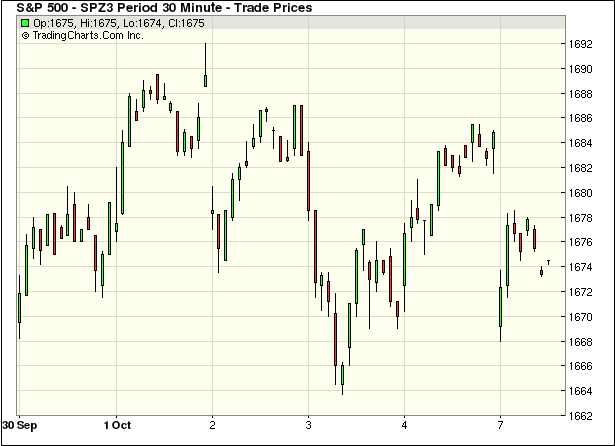 So, for all the “fuss and turmoil” the markets really paid very little attention to the antics in Washington.
While market volatility certainly increased in the past week – there was no violation of any support levels or the current bullish trend. In fact, as I stated this past week in our daily blog posting:
“As you can see the market reached its peak in July as the Federal Reserve reiterated its position that it would not be tightening its accommodative policy anytime soon. That rally from the June lows had taken the markets to an extreme overbought condition that needed a correction/consolidation process to resolve. However, it is important to notice that the May/June correction NEVER triggered a ‘sell signal.’
The significant difference is that the correction which began in August took the markets down to the longer term uptrend but triggered the issuance of a “sell signal” in the process. This change in dynamics required our models to reduce equity risk by 25%. (Portfolio models are holding 75% of target equity allocations currently.)
The subsequent market bounce, following a collision of announcements in September with Larry Summers stepping out of the race for Federal Reserve Chairman, ostensibly putting Janet Yellen in the seat, Obama stepping back from military action in Syria and the Federal Reserve not “tapering” their current bond buying program at their September meeting, seemed like the selloff was over.
However, that rally failed on two levels:
1) The markets failed to break out to a new high; and
2) The “sell signal” was not reversed.
This suggested that the corrective process was still in play, and despite the rally, kept the portfolios holding increased cash positions.
The recent government shutdown/debt ceiling debate drama is certainly providing the necessary catalyst for the continuation of the current corrective process. However, the markets, at this point, have not violated any short/intermediate/or longer term support levels that would warrant significantly reduced equity exposure. The current bullish uptrend remains intact which requires that we maintain exposure to the equity markets for the time being.”
The rally off of that short term weekly support on Friday kept the markets in play for the time being. However, the upcoming debate over the debt ceiling certainly puts the markets at risk in the short term and is something that we should remain very mindful of.
>> Read More. Download This Weeks Issue Here.
About Lance Roberts
Lance Roberts is the General Partner & CEO of STA Wealth Management, Host of the “Streettalk Live” Daily Radio Show (streamed live at www.streettalklive.com), and Chief Editor of the X-Report and the Daily X-Change Blog.
Follow me on Twitter: @streettalklive

Is Crude Oil Ready for Further Growth? What Impact Could It Have on Gold?
One of the main events of recent days was the first U.S. government shutdown in 17 years. Light crude dropped to a new monthly low at $101.05 on concerns that this event would reduce demand for black gold in the world’s largest oil consumer market. In the previous week, the yellow metal also declined and dropped below $1,300 an ounce. Despite this declines, on Wednesday, both commodities rebounded sharply supported by a weaker U.S. dollar as commodities priced in the greenback became less expensive for holders of other currencies. Additionally, in the second half of the previous week we saw similar price action in both cases.
Taking the above into account, investors are probably wondering: what could happen if the recent positive divergences between both commodities remain in place? Can we find any guidance in the charts? Let‘s take a look at the charts below and try to find answer to this question. We’ll start with the daily chart of crude oil (charts courtesy by http://stockcharts.com).
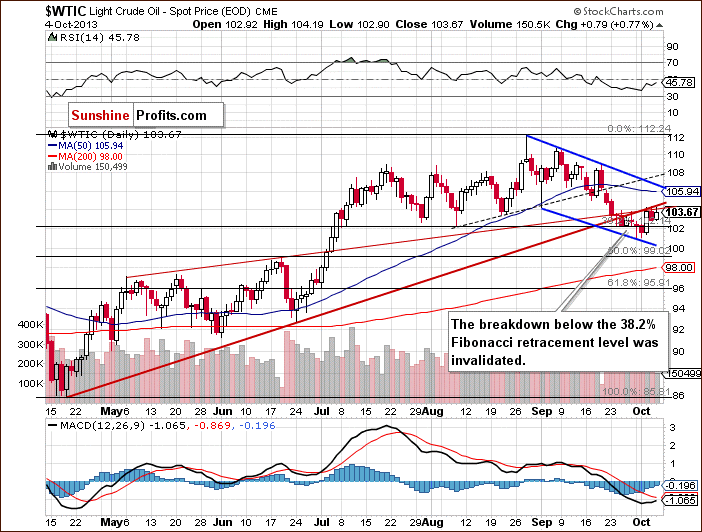
On the above chart, we see that the situation improved slightly in the previous week. Last Monday, crude oil dropped to a new monthly low of $101.05 per barrel. With this move the price of crude oil declined not only below the August low, but also below the 38.2% Fibonacci retracement level. Despite this drop, we saw a pullback, which erased most of the losses late in the day.
In the following days, we saw further improvements as oil bulls managed to hold this level. This positive event triggered another pullback, which pushed light crude to the previously-broken rising medium-term support line on Wednesday. Additionally, the price of light crude came back above the 38.2% Fibonacci retracement level and the breakdown below this level was invalidated. Although crude oil closed Wednesday almost at the rising medium-term support/resistance line, the buyers didn’t have enough strength to break above this resistance until the end of the previous week.
Looking at the above chart, we see that crude oil remains in the declining trend channel. Therefore, if we see a breakout above the medium-term support/resistance line, we could see a move up to the declining short-term resistance line based on the Aug. 28 and Sept. 19 highs – currently close to the $106.4 level (marked with blue).
Please note that the nearest support is the September low and the 38.2% Fibonacci retracement level. If it is broken, the next one support zone will be slightly below $100 per barrel where the 50% Fibonacci retracement level intersects with the June high.
Once we know the current short-term outlook for crude oil, let’s take a closer look at the chart below and check the link between crude oil and gold. Has it changed since our previous essay on oil and gold was published? Let’s examine the daily chart.
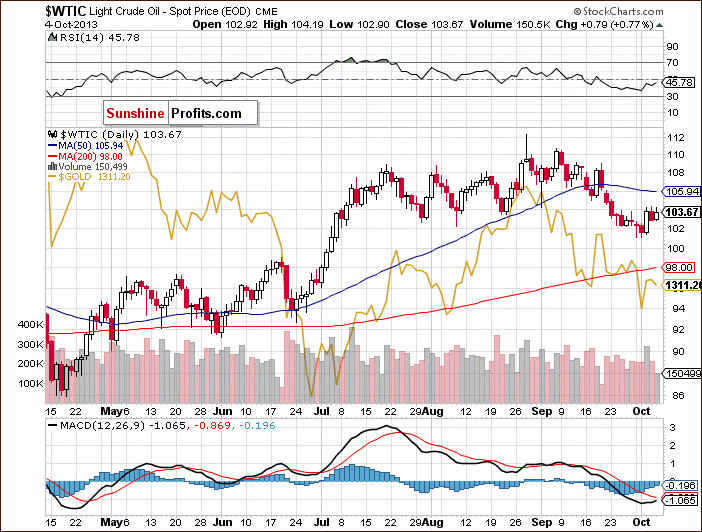
Looking at the above chart, we see similar price action in both commodities at the beginning of the previous week. They declined on Monday, however, in the case of crude oil, the buyers managed to hold the September low in the following days, which resulted in a sharp pullback on Wednesday. Meanwhile, gold declined and reached its new lowest level since the August top. Despite this drop, the rest of the week looked similar for both commodities.
Summing up, looking at the relationship between crude oil and gold, we notice similar price action in both commodities in the previous week. Therefore, if this relationship remains in place, we could see some strength on a short-term basis in case of the yellow metal and crude oil. However, we should still keep in mind that the recent decline in crude oil is just slightly bigger than the previous ones and light crude remains above the 38.2% Fibonacci retracement level, which forms strong support. From this point of view, the uptrend is not threatened at the moment. At the same time, the downtrend in gold remains in place and the yellow metal remains below the declining resistance line, which has already successfully stopped buyers several times.
Thank you.
Nadia Simmons
Sunshine Profits‘ Crude Oil Expert
* * * * *
Disclaimer
All essays, research and information found above represent analyses and opinions of Nadia Simmons and Sunshine Profits’ associates only. As such, it may prove wrong and be a subject to change without notice. Opinions and analyses were based on data available to authors of respective essays at the time of writing. Although the information provided above is based on careful research and sources that are believed to be accurate, Nadia Simmons and his associates do not guarantee the accuracy or thoroughness of the data or information reported. The opinions published above are neither an offer nor a recommendation to purchase or sell any securities. Nadia Simmons is not a Registered Securities Advisor. By reading Nadia Simmons’ reports you fully agree that he will not be held responsible or liable for any decisions you make regarding any information provided in these reports. Investing, trading and speculation in any financial markets may involve high risk of loss. Nadia Simmons, Sunshine Profits’ employees and affiliates as well as members of their families may have a short or long position in any securities, including those mentioned in any of the reports or essays, and may make additional purchases and/or sales of those securities without notice.

 Ouch! Politicians and groups like organized labour are arguing their unrealistic position of doubling Canadian Pension Plan contributions. Michael reveals the numbers on what an individual, especially the Self-Employed could do better on their own.

Money Talks Michael Campbell interviews Josef Schachter, Canada’s leading independent energy analyst and founder of Schachter Asset Management
 Campbell: One of the things that comes out of the blue are solutions to things that we didn’t see coming. For example in the early 1980’s we had the National Energy Policy projecting huge jumps in the price of oil that didn’t manifest because they couldn’t anticipate fuel injection being so much more efficient than carburetors.
 Anyone who bought the media buzz about a September reduction of QE – called the “taper” – was very surprised when the Federal Reserve announced that stimulus would continue unabated. According the the official narrative, inflation is under control and the labor market is steadily improving. Why wouldn’t a modest taper be announced?
The reality is that the economic indicators the Fed claims to rely on to decide when to taper are all dependent on stimulus money. This is not a mystery to Ben Bernanke. Instead, this entire saga amounted to little more than a “taper fakeout” which sent hard asset investors for a loop.
Months of Anticipation
We can forgive the financial media for being blindsided by the Fed’s non-taper. Even after decades of deception, journalists by-and-large still believe that it is their job to report official pronouncements as fact. Every month of 2013, one Fed official or another has openly discussed the need for or possibility of tapering. In January, it was Lockhart; in February, Bullard; Plosser brought it up in March; and Williams talked taper in April.
Bernanke finally took up the taper torch in May, but it wasn’t until June that he hinted the Fed might start tapering QE “later this year” and end it entirely by the middle of 2014.
The markets went wild on these progressively foreboding statements, sending Treasury and mortgage rates upward and driving gold and silver into their biggest correction since the secular bull market started a decade ago. In spite of Bernanke’s caveats that the bulk of the stimulus would continue for the foreseeable future and that the federal funds rate would remain at record lows, the markets braced for the easy-money spigot to begin closing.
I was on the major news networks calling the Fed on its bluff, but once again, my forecasts were dismissed by anchors and co-panelists. [See the new video: Peter Schiff Was Right – Taper Edition] Then, on September 18th, the Fed did exactly what I expected.
A Möbius Strip
When the Fed announced that it was backtracking on its previous indications, Bernanke cited the “tightening of financial conditions observed in recent months” as a major reason for delaying the taper.
As an academic economist focused on the history of monetary policy, Bernanke had to know that warning of tapering would cause the market to prepare by raising rates. This is part of a clever strategy to appear serious about withdrawing stimulus but have a convenient excuse to (forever) delay the exit.
After all, if interest rates surged on the mere talk of tapering, imagine what would happen if tapering actually began!
Taper Talk Is Cheap
Bernanke may not understand how to grow a healthy economy, but he’s not foolish enough to dream that he can end QE without affecting interest rates. The real message behind Bernanke’s excuse for putting off tapering is that there is never going to be a taper. If the economy shows sign of improving, the Fed will start talking about tapering again. This will send interest rates higher, which the Fed can point to as “tight financial conditions” in need of further stimulus.
Sure enough, the day after the fakeout was announced, St. Louis Fed Chief James Bullard jumped onto the airwaves claiming that a tightening decision might come as early as October.
While some analysts think the Fed is in disarray, I think they’re trying to have their cake and eat it too. By hinting but not delivering on tightening, they can keep investors second-guessing themselves and ignoring the fact that the promised recovery never materialized.
Regime Uncertainty
On September 18th, the S&P and Dow closed at new record highs on news of the Fed’s taper fakeout. Precious metals surged as well. Whether this precipitated Bullard’s renewed advisory on tapering the following day I do not know, but his comments had the effect of smacking down the previous day’s gains.
Uncertainty over the Fed’s intentions leaves US investors in a bind. Even prominent Wall Street money managers are truly frightened by this market.
My advice remains the same: focus on long-term fundamentals, take advantage of discounts, and avoid the US Treasury bubble. While unfortunate timing may have cost some gold buyers short-term losses, the difference between $1300 and $1800 for gold will look less important when it is trading at $3000 or $5000.
This much is certain, when QE does unravel, the fallout will be devastating. In the meantime, opportunities abound for the precious metals investors.
Just this week, when gold failed to rally on the government shut down, as many assumed that it would, it promptly sold off $40 per ounce, as disappointed speculators bailed out. However, gold investors know that a government shut down in-and-of-itself is not bullish for gold. What is bullish for gold is that the shut down will soon end, and any government functions that were temporarily shut down will start right back up again.
In the end, it’s the government that will shut the economy down. But the one thing they will never shut down is the printing press. Now that is really bullish for gold.
…………..
Peter Schiff
C.E.O. of Euro Pacific Precious Metals
email: info@europacmetals.com
website: www.europacmetals.com
Peter Schiff is CEO of Euro Pacific Precious Metals, a gold and silver dealer selling reputable, well-known bullion coins and bars at competitive prices.
For the latest gold market news and analysis, sign up for Peter Schiff’s Gold Report, a monthly newsletter featuring contributions from Peter Schiff, Doug Casey, and other leading experts. Click here for your free subscription.

-
I know Mike is a very solid investor and respect his opinions very much. So if he says pay attention to this or that - I will.
~ Dale G.
-
I've started managing my own investments so view Michael's site as a one-stop shop from which to get information and perspectives.
~ Dave E.
-
Michael offers easy reading, honest, common sense information that anyone can use in a practical manner.
~ der_al.
-
A sane voice in a scrambled investment world.
~ Ed R.
Inside Edge Pro Contributors

Greg Weldon

Josef Schachter

Tyler Bollhorn

Ryan Irvine

Paul Beattie

Martin Straith

Patrick Ceresna

Mark Leibovit

James Thorne

Victor Adair