
Gold & Precious Metals
A couple weeks ago I posted these same charts talking about the pending breakout (in either direction) with silver, gold and mining stocks. Fast forwarding to this week its clear this sector continues its struggle to rally. Key support levels are now being tested and if these levels fail prepare for a sharp correction with mining stocks showing the most downside potential of roughly 25% for the GDX ETF trading fund.
Let’s take a quick look at what is going on…
Gold Trading Chart:
The chart of gold shows price being wedge into the apex of the down sloping resistance trend line and the rising support trendline. Gold was trading below this level but has since bounced. But if gold closes the week below this line in the sand the price could start to fall quickly and test the $1200 per ounce within a week or two.

Read Full Report including Silver & Stocks: http://www.thegoldandoilguy.com/articles/silver-gold-miners-sell/
Chris Vermeulen


Last month, Americans were transfixed by the amateur theatrics undertaken by the Washington political establishment in connection with the debt ceiling crisis. The bad faith, poor tactics and wholesale avoidance of reality were offered by all players in very large doses. When the Republican leadership finally capitulated (thereby bringing down the curtain on the tawdry production), it soon became apparent that sound and fury had signified nothing except another exercise in can kicking. Public approval of Congress sank to the lowest level on record, and has only dissipated due to the unmitigated disaster of the Obamacare launch. But as bad as domestic approval has become, the behavior of the U.S. government has played far worse internationally.
A year before, European politicians faced what looked like the same situation of national default.But after fraught negotiations, they at least achieved the illusion of a political compromise. The narrative that emerged is that Europe was better able and more willing to compromise. Although this shallow conclusion overlooks key fundamental differences between the political structure of theU.S and the European Union (EU), it nevertheless has created the perception of lost American leadership. Since America owes its continued economic strength to its perceived political might, such changes could be dangerous in the extreme. However, the reality is that the European political machine is just as dysfunctional and completely insulated from the interests of its citizens.
In order to force political union and the creation of a European super state, often against democratic wishes, several EU nations created the Eurozone and issued their own single currency. However, unlike the United States, the EU is not yet a unified federal state, with a single treasury. Furthermore, many important EU nations, such as the UK, are not members of the Eurozone. Therefore, while the European Central Bank (ECB) may exert moral suasion, it has no executive power over non-Eurozone members of the somewhat politically disparate EU.
In the United States, Fannie Mae and Freddie Mac were rumored by Wall Street to have an implicit federal government guarantee. As such, they were enabled to over borrow at extremely low rates. A similar dynamic existed with smaller, so-called ‘peripheral’ nations within the Eurozone, including Greece, Portugal and Spain. These overly indebted, economically questionable nations were able to over borrow at low rates under the implicit guarantee of far stronger members of the Eurozone, such as Germany and the Netherlands.
When the over borrowing of the Eurozone periphery nations reached levels that caused concern within the bond markets, the gap in bond yields between the southern and northern tier of the Eurozone threatened extreme instability. To narrow the gap, Eurozone banks were ‘persuaded’ politically by Brussels to load up on the bonds of failing southern banks and national governments. In return the ECB treated these suspect holdings as prime deposits.
This mirage worked well until the recession of 2007/8. Bad loans then placed banks under strain that threatened survival. It exposed the inherent lack of explicit EU national support for Eurozone banks and even nations. It even threatened the existence of the euro, by then the world’s second currency.
The ECB can and does create trillions of dollars of fiat euros. Also, it borrows hundreds of billions of dollars from the Fed by means of currency swaps. But unlike the U.S. dollar, the euro is not the international reserve currency. In addition, unlike the U.S. with its single Treasury, the EU has separate national treasuries. Therefore, international lenders have shown a far higher willingness to loan to the U.S. (There likely will be a limit for the U.S. Treasury as well, but that threshold has yet to be identified.)
But it is important to realize that it was the real and present danger of a bond collapse that finally spurred coordinated political actions in Europe, not any forward-thinking preemptive policy moves. Such a crisis has not hit the United States. Should it, the U.S. will be forced into action as well. The big difference of course is that the solvent Germans have been able to bail out the insolvent Greeks and Spaniards.Who will be there for the United States? It is unlikely that Canada has the resources.
The current U.S. political practices of irresponsible spending, a massive creation of fiat money and the covert debasement of the dollar may never succeed in eventually spurring real political action and meaningful policy changes. Instead the bond market will call the tune. When bond investors finally head for the exits, hard choices will have to be made that will likely include deep and politically agonizing spending curbs, similar and possibly worse than those exerted now in Europe.
John Browne is a Senior Economic Consultant to Euro Pacific Capital. Opinions expressed are those of the writer, and may or may not reflect those held by Euro Pacific Capital, or its CEO, Peter Schiff.
 This work is licensed under a Creative Commons Attribution-NonCommercial-NoDerivs 3.0 Unported License. Please feel free to repost with proper attribution and all links included.

…[But] You Have To Be Careful”
Due to the significance of the next few weeks’ market action, yesterday’s Sunday note to blog subscribers is posted below…
—
Greetings and Good Sunday,
Following another week of sideways trading action in the precious metals and mining sector, consensus among the experts remains conflicted.
According to technical gold trader Gary Savage, short positions are buildingfor another overnight attack on the price of gold to occur within the next 30-45 days. This takedown Gary noted, may be the final plunge to $1000 before a powerful launch takes gold higher, to the $1800-$1900 level by next summer.
This potential collapse Gary noted, “Will bottom in a v-shape and come roaring back out…[because] three funds that have been trying to drive this down…will flip and go long…so I think the buying pressure…is going to be huge.”
Billionaire Jim Rogers also noted during an interview this week that the consolidation in metals and miners has been an anomaly–which following 12 years of steady increases in the price of gold should be expected. Jim further advised that listeners, “Be worried and get prepared,” for a major systemic collapse to occur in the US sometime between now and 2016.
Such an event may present another 2008-style liquidity crisis Jim noted, with those maintaining large levels of cash and fungible metals being likely shielded.
When asked his thoughts on investing in the mining sector, Jim concluded bysaying that, “If you figure out the right mine [and] the right company, you could make a fortune…[and] you’ll make a lot more in the right mine than in the commodity…[but] you have to be careful.”
As a final item of note, I’ve compiled a list of a few companies founded and led by mining entrepreneurs who have historically found “the right mines” and built “the right companies”–making their shareholders absolutely wealthy in the process. That list is called, the Da Silva “Legendary Mine Builders” Index, and as a special thank you for supporting my work, I’d like to offer you a copy at $50-OFF.
To receive a copy of that report at $50-OFF, simply click HERE.
As we find a bottom and launch higher in the metals and miners as billionaire Eric Sprott and trader Gary Savage expect, we’ll finally, “Get to brag about making several 100′s of percent while [our] ‘stock buddies’ will be sitting on huge losses,” Gary noted over the weekend. In the meantime however, “We’ll have to endure the taunts of all our friends and associates that are ‘getting rich’ in stocks.”
That’s all for now. Best in health, wealth, and happiness in the new week ahead!
Best,
Tekoa Da Silva
Bull Market Thinking
U.S. equity index futures were higher this morning. S&P 500 futures were up 3 points in pre-opening trade. Index futures are responding to a 2.86% increase in the Shanghai Composite Index following greater release of China’s economic reforms.
Boeing added $3.87 to $139.95 after announcing aircraft sales at the Dubai airshow valued at over $100 billion.
Fertilizer stocks moved higher on news that a Russian billionaire has acquired a 21.75% interest in Uralkali. Uralkali previously triggered selling pressure on fertilizer stocks when the company said that it would discontinue an agreement to jointly market fertilizer with a Belaruskali. The change in ownership raises the possibility that a joint agreement to effectively control fertilizer prices will resume. Potash Corp added $0.60 to $33.00.
Goldcorp (GG $24.34) is expected to open higher after Citigroup upgraded the stock from Neutral to Buy. Target is $28.00.
Microsoft fell $0.61 to $37.23 after Bank of America/Merrill downgraded the stock from Neutral to Under Perform. Target is $30.
Nucor (NUE $53.61) is expected to open lower after Citigroup downgraded the stock from Buy to Neutral. Target is $55.
Baxter International (BAX $68.13) is expected to open higher after Credit Suisse upgraded the stock from Neutral to Outperform. Target was raised from $73 to $80.
Economic News This Week
October Retail Sales to be released at 8:30 AM EST on Wednesday are expected to increase 0.1% versus a decline of 0.1% in September. Excluding auto sales, October Retail Sales are expected to increase 0.1% versus a gain of 0.4% in September.
October Consumer Prices to be released at 8:30 AM EST on Wednesday are expected to be unchanged versus a gain of 0.2% in September. Excluding food and energy, October Consumer Prices are expected to increase 0.1% versus a gain of 0.1% in September.
October Existing Home Sales to be released at 10:00 AM EST on Wednesday are expected to slip to 5.16 million units from 5.29 million units in September.
September Business Inventories to be released at 10:00 AM EST on Wednesday are expected to increase 0.3% versus a gain of 0.3% in August.
FOMC Meeting Minutes are to be released at 2:00 PM EST on Wednesday.
Weekly Initial Jobless Claims to be released at 8:30 AM EST on Thursday are expected to slip to 335,000 from 339,000 last week.
October Producer Prices to be released at 8:30 AM EST on Thursday are expected to decline 0.2% versus a drop of 0.1% in September. Excluding food and energy, October Producer Prices are expected to increase 0.1% versus a gain of 0.1% in September.
The November Philadelphia Fed Index to be released at 10:00 AM EST on Thursday is expected to fall to 11.9 from 19.8 in October
Canada’s October Consumer Prices to be released at 8:30 AM EST on Friday are expected to remain unchanged versus a gain of 0.2% in September.
September Retail Sales to be released at 8:30 AM EST on Friday are expected to increase 0.5% versus a gain of 0.2% in August
The Bottom Line
Economic sensitive sectors with strong positive seasonality traits (e.g. Industrials, Consumer Discretionary, Technology and most recently Materials) are leading equity markets on the upside. Preferred strategy is to accumulate equity markets and sectors with favourable seasonality on weakness in order to take advantage of the October 28th to May 5th period of strength.
Equity Trends
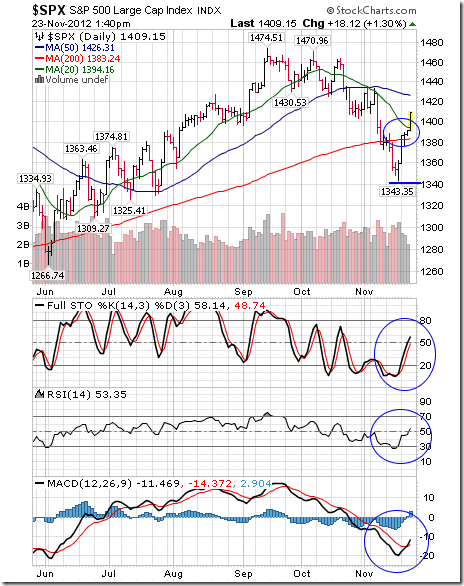
The S&P 500 Index gained 27.57 points (1.56%) last week. Trend remains up. The Index closed at an all-time high. The Index remains above its 20 day moving average. Short term momentum indicators have returned to overbought levels.
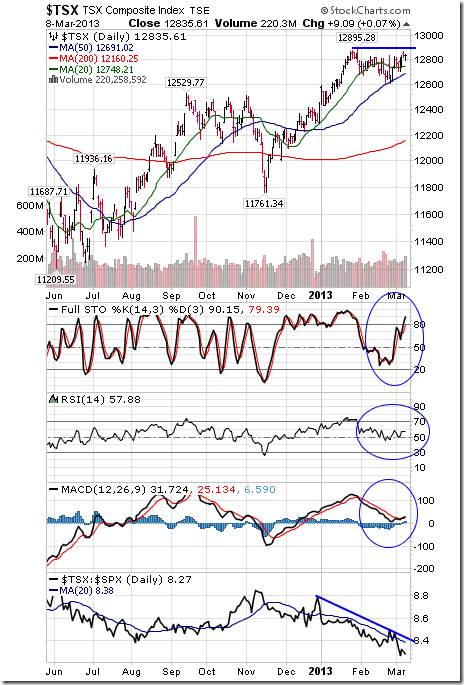
The TSX Composite Index added 104.24 points (0.78%) last week.
Upward trend was confirmed on Friday on a move above 13,471.06 (Score: 1.0). The Index remains above its 20 day moving average (Score: 1.0). Strength relative to the S&P 500 Index changed from neutral to negative (Score: 0.0). Technical score based on the above indicators slipped to 2.0 from 2.5 out of 3.0. Short term momentum indicators have returned to overbought levels.
….View 43 more charts HERE


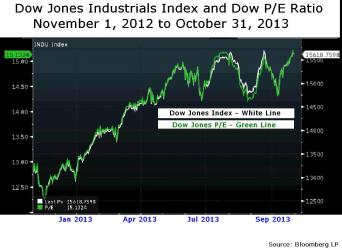
The Dow reached 16,000 for the first time this morning.
That got me thinking about the book titled Dow 36,000: The New Strategy for Profiting from the Coming Rise in the Stock Market which was published in the year 2000. 13 years later and only 20,000 points short!
The news of “Dow 16,000” appears to be celebrated a little more than previous milestones since it coincides with the S&P 500 hitting 1,800 for the first time on the same morning.
With all the celebrating and headline frenzy, there has not been much chatter all with respect to what has driven the Dow to this new high. Almost all of the gains over the past two years have been the result of easy monetary policy. Corporate non-financial earnings have essentially been flat over this time, and financial earnings have been largely subsidized by the U.S. Federal Reserve paying interest (which it never did until a couple of years ago) on the $3 trillion of commercial bank excess reserves held on deposit at the Fed.
“Dow 16,000” should serve as a reminder to us to ask when earnings growth is coming. Will an economy that is more sluggish that the Fed and private economists expected be able to produce more earnings? Can companies cut even more costs (and employees) to squeeze out more earnings in order to justify their share prices?
At “Dow 16,000” these questions carry more weight than at “Dow 15,000” and “Dow 14,000” etc. If earnings don’t materialize, then maybe more Quantitative Easing will be required. Bulls might be happy to know that the next Fed Chairman Janet Yellen won’t have many qualms about doing this regardless of the long-term costs and ramifications.
The opinions expressed in this report are the opinions of the author and readers should not assume they reflect the opinions or recommendations of Richardson GMP Limited or its affiliates. Assumptions, opinions and estimates constitute the author’s judgment as of the date of this material and are subject to change without notice. We do not warrant the completeness or accuracy of this material, and it should not be relied upon as such. Before acting on any recommendation, you should consider whether it is suitable for your particular circumstances and, if necessary, seek professional advice. Past performance is not indicative of future results.
Richardson GMP Limited, Member Canadian Investor Protection Fund.
Richardson is a trade-mark of James Richardson & Sons, Limited. GMP is a registered trade-mark of GMP Securities L.P. Both used under license by Richardson GMP Limited.


-
I know Mike is a very solid investor and respect his opinions very much. So if he says pay attention to this or that - I will.
~ Dale G.
-
I've started managing my own investments so view Michael's site as a one-stop shop from which to get information and perspectives.
~ Dave E.
-
Michael offers easy reading, honest, common sense information that anyone can use in a practical manner.
~ der_al.
-
A sane voice in a scrambled investment world.
~ Ed R.
Inside Edge Pro Contributors

Greg Weldon

Josef Schachter

Tyler Bollhorn

Ryan Irvine

Paul Beattie

Martin Straith

Patrick Ceresna

Mark Leibovit

James Thorne

Victor Adair