
 As the modern world seems to move directly from one crisis to another, today one of the wealthiest people in the financial world spoke with King World News about where we are in the end game and gold, as well as what investors should be doing right now with their own money. Rick Rule, who is business partners with billionaire Eric Sprott, also discussed what is happening with the metals and opportunities for investors to make a fortune going forward. Below is what Rule had to say in this candid and powerful interview.
Personal Finance
Rule: “The truth is that right now stock markets are confident. It would appear people think that Yellen is going to do an absolutely great job, and I guess if the job involves a debasement of the currency, she will….
“Ben Graham once observed that in the very short-term markets are voting machines, and long-term they are weighing machines. Meaning, in the short-term they measure people’s perceptions and prejudice, and in the long-term they measure value.
Ben Graham famously said, ‘Money was made arbitraging between the way people vote and the way things are.’ And I think paying attention to the gold price at today’s price makes about as much sense as sense as paying attention to it at $1,900 did. The truth is that they are both short-term aberrations.
It is completely consistent with gold’s trading in the past that this has been a cyclical decline in a secular bull market. Remember, from 1974 to 1976, in the midst of the most historic run in gold in my memory, where gold went from $35 to $850 an ounce, in the middle of that epic run there was a decline from $200 an ounce, to $100 an ounce. People who didn’t have the courage or the cash to stay the trade in the 50% decline, missed an 850% 4-year run. Investors can ignore that at their own peril.”
Rule added: “Right now we are focused broadly on natural resources. More specifically the public and private resource issuers in Canada and Australia, and probably more specifically than that on the precious metals side of the equation.
It’s been very rare in my 35-year career that attractive precious metals companies are priced at or below our estimate of fair market value. The last time we saw this set of circumstances occur was in 1999/2000. The last time before that was in 1991.
So this would seem to be a set of circumstances that occurs every 10 years. When this set of circumstances occurs, it generally is in fairly bleak markets like the ones that we are in today. My experience in the prior two periods like this has been that aggressive allocation to the best precious metals related explorers or developers in the junior sector, on a global basis, generate tremendous rewards in the ensuing 3-to-5-year time frame.
So we are focused on providing catalytic capital on a private placement basis, with warrants, to very high quality exploration and development stage juniors in the precious metals business. But we also see great opportunities in many areas in resources including energy. Sprott has recently secured a mandate to co-fund and co-manage a global catalytic capital mining fund with the largest of the Chinese state-controlled non-ferrous metals mining companies. So we are very excited about that business.
It is beginning to feel like the big state-owned enterprises, the sovereign wealth funds, and the big private equity players, sense enough opportunity that it now appears funding will be available to the sector over the next 12 months. We are very excited to be part of that process.”
IMPORTANT – Due to recent market action, KWN will be releasing major interviews all day long today.
The audio interviews with Gerald Celente, David Stockman, Art Cashin, Dr. Stephen Leeb, John Hathaway, Bill Fleckenstein, James Turk, Andrew Maguire, William Kaye, Dr. Paul Craig Roberts, Eric Sprott and Jim Grant are available now. Other recent KWN interviews include Marc Faber and Felix Zulauf — to listen CLICK HERE.

• SURVEY: What Financial TV Network Do You Watch? (Business Insider)
• Americans Recover Home Equity at Record Pace (Bloomberg)
• Nine reasons the filibuster change is a huge deal (Washington Post), see also One huge effect of filibuster reform: Obama can actually fire people (Washington Post)
• Active Managers Stink? Blame These All-Too-Common Fund Flaws (Barron’s)
• What Constitution? Example of how the police can search your car without a warrant or your consent (boingboing), see also Drivers Stopped at Roadblock Asked for Saliva, Blood (NBC DFW)
• The World’s Most Powerful Computer Network Is Being Wasted on Bitcoin (Gizmodo)
• NASA Announces Plan for Capturing Asteroid (National Geographic), see also Will an Asteroid Destroy You Before You Finish This? (Bloomberg)
• The iconic lead statuette of the Maltese Falcon from the 1941 film of the same name (Bonhams)
• The music video for ‘Like a Rolling Stone’ by @bobdylan is an innovative digital take on an old theme (WSJ), see also Official Interactive Video for “Like A Rolling Stone“ (Bob Dylan)
• Day JFK Died We Traded Through Tears as NYSE Shut (Bloomberg)

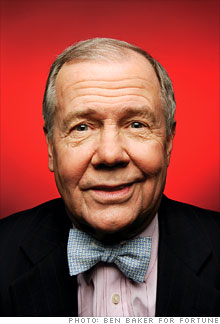 The initial reaction from many following this month’s key gathering of communist-party leaders in China was of disappointment as Tuesday’s blueprint left much to be desired. But on Friday came a significantly more in-depth document regarding issues like land reform, easing of the one-child policy and cleaning up pollution.
It’s all left famed investor Jim Rogers believing “the most important economic event of the next 10 to 20 years is what happened in Beijing.” And it’s something he says has been largely ignored, notably by Western media.
During a visit at the Wall Street Journal, the former George Soros partner–who retired from Wall Street at age 37 to live a second life as world traveler—equates the plenum to those in 1978 and 1993. The first followed Mao Zedong’s death and ushered in Deng Xiaoping’s reformist agenda and his effort to remake China’s economy, while 1993’s plenum included a vow to deal with money-losing state enterprises.
In the just-concluded gathering, which occurred a year after President Xi Jinping became party chief and was seen as his stage to set forth the agenda for his possible 10-year tenure, reform was hoped to be a big focus.
Mr. Rogers, who moved with his family to Singapore seven years ago, senses change is coming.
The land reform includes increased rights for farmers. This group has long seen land taken from them but now are in position to amass large tracts for more-efficient production in a country struggling to keep up with a populace that has increasing amounts of money to spend on food.
Chinese agriculture has been ruined since Mr. Mao’s tenure, says Mr. Rogers, capped off by the Cultural Revolution, during which teens were sent to the country to work on collective farms. But while current efforts, if followed through, could take upwards of a generation to really bear fruit, Mr. Rogers sees Chinese agriculture as a sector in which to invest, as well as railroads, medical care and defense.
“These industries will do well even” even if the country’s stock market collapses, he contends. Mr. Rogers has been buying Chinese stocks, including financials, for the first time since 2008; he previously was a purchaser in 1999 and 2005.
Also seen changed by his perspective is politicians’ resolve. “The overriding concept” from the plenum is “when in doubt, the market will decide.” For a state-controlled economy, that sounds like a 180 to past practices.
So why think the new leadership isn’t just giving reform lip service? Mr. Rogers admits he can’t be sure, but the investor—who came to New York from China and will soon be back in country–senses something different. “As previous administrations tried to change, they ran into the bureaucracy.” But now, policy makers “seem to have the wind at their back” and leaders have “put a lot of prestige on the line.”
The reform effort would come amid years of talk about China’s economy being a bubble or that its ascendance will end. Mr. Rogers says that reminds him what Europeans said about the US after the Civil War. Then, the New World was still considered an untamed backwater. But he notes things change quickly: Within a generation after World War I, the undisputed No. 1, the United Kingdom, was no longer that.

Here are today’s videos:
Gold Fibonacci Lines, MACD, & Hedging Tactics Charts
HUI MACD Histograms Analysis Chart
T-Bond Yield Weighs On Gold Chart
Thanks,
Morris
Unique Introduction For Web Readers: Send me an email to alerts@superforcesignals.com and I’ll send you 3 of my next
Super Force Surge Signals free of charge, as I send them to paid
subscribers. Thank you!
The Super Force Proprietary SURGE index SIGNALS:
25 Super Force Buy or 25 Super Force Sell: Solid Power.
50 Super Force Buy or 50 Super Force Sell: Stronger Power.
75 Super Force Buy or 75 Super Force Sell: Maximum Power.
100 Super Force Buy or 100 Super Force
Sell: “Over the Top” Power.
Stay alert for our Super Force alerts, sent by email to subscribers, for both the daily charts on Super Force Signals at www.superforcesignals.com and for the 60 minute charts at www.superforce60.com
About Super Force Signals:
Our Super Force signals are created thru our proprietary blend of the highest quality technical analysis and many years of successful business building. We are two business owners with excellent synergy. We understand risk and reward. Our subscribers are generally successful business owners, people like yourself with speculative funds, looking for serious management of your risk and reward in the market.
Frank Johnson: Executive Editor, Macro Risk Manager.
Morris Hubbartt: Chief Market Analyst, Trading Risk Specialist.
Email:
Mail:
SFS Web Services
1170 Bay Street, Suite #143
Toronto, Ontario, M5S 2B4
Canada

Stocks inched higher at the open on Friday after theDow industrials closed above 16,000 for the first time, amid a dearth of data and ahead of a holiday-shortened week in the United States.
The Dow Jones industrial average .DJI fell 4.11 points or 0.03 percent, to 16,005.88, the S&P 500 .SPX gained 1.48 points or 0.08 percent, to 1,797.33 and the Nasdaq Composite .IXIC added 9.915 points or 0.25 percent, to 3,979.07.
From Bloomberg:
Time Warner Cable Inc. surged 7.7 percent on renewed takeover speculation. United Continental Holdings Inc. (UAL) climbed 2.4 percent after billionaire David Tepper said that his “big play in the market” is airlines. Foot Locker Inc. rallied 3.6 percent after it posted higher-than-estimated quarterly earnings. Ross Stores Inc. (ROST) plunged 7.5 percent after cutting its earnings forecast.
The Standard & Poor’s 500 Index rose 0.1 percent to 1,798.14 at 10:18 a.m. in New York. The U.S. equity benchmark is poised to end the week little changed, halting a six-week streak of gains. The Dow average fell 11.78 points, or less than 0.1 percent, to 16,021.77.
“I don’t see any reason why the market shouldn’t go up,” Karyn Cavanaugh, a vice president and market strategist at ING U.S. Investment Management in New York, said in a phone interview. Her firm oversees $196 billion. “There’s not really any bad news. We have a little bit of a pullback and then people jump in and say, ’Hey, I want a piece of this.’”
The S&P 500 rallied yesterday after three days of losses as data showed weekly jobless claimsfell to the lowest level since September and a confidence survey indicated American consumers became less pessimistic this month. The Dow average has climbed 0.3 percent this week, headed for its seventh straight weekly gain, the longest streak since January 2011.
Not Inflated
Economic stimulus from the Fed has helped the S&P 500 soar 166 percent since its March 2009 low. The index rallied 26 percent this year, poised for its best annual performance in a decade. The gauge traded for about 17 times its companies’ reported earnings at its last record on Nov. 15, the highest valuation since May 2010.
Tepper, the hedge-fund manager who runs Appaloosa Management LP, said stock markets are not inflated as economies in the U.S., Europe and China are on “firm ground.” He said that while he remains bullish on U.S. stocks, markets may fall 5 percent to 10 percent when the Fed curbs its monthly stimulus program. He said his firm recently bet against U.S. Treasuries as a hedge.
“I know there’s talk about bubbles, this is not one,” Tepper said in an interview with Bloomberg Television’s Stephanie Ruhle at the Robin Hood Investors Conference in New York yesterday.
United Continental
United Continental rose 2.4 percent to $38. Goldman Sachs Group Inc. also lifted its rating on the world’s biggest airline to buy from neutral.
Foot Locker rallied 3.6 percent to $38.10. The largest U.S. athletic shoe retailer posted third-quarter earnings of 68 cents a share, exceeding the average analyst estimate by 2 cents.
Time Warner Cable, the second-largest U.S. cable company, jumped 7.7 percent to $130.18. Charter Communications Inc., backed by billionaire John Malone, is in talks with banks about financing an attempt to buy Time Warner Cable, the Wall Street Journal said yesterday. CNBC reported today that Comcast Corp. investors are pushing for the company to make its own bid for Time Warner Cable.
Ross Stores tumbled 7.5 percent to $74.25. The retailer of discount designer wear lowered its forecast for fourth-quarter earnings to no more than $1.01 a share, after previously predicting as much as $1.03. That fell short of the average analyst estimate of $1.08.
Intel Corp. (INTC) lost 2.7 percent to $24.54. The world’s largest maker of semiconductors saidrevenue will be approximately unchanged in 2014. The company predicts the personal-computer market, measured by units, to be down in the ‘low single-digit’ percent, Chief Financial Officer Stacy Smith said.
Abercrombie & Fitch Co. slid 3.8 percent to $33.63. The retailer was cut to market perform from outperform at Wells Fargo Securities.
To contact the reporters on this story: Inyoung Hwang in London at ihwang7@bloomberg.net; Nick Taborek in New York at ntaborek@bloomberg.net
To contact the editor responsible for this story: Cecile Vannucci at cvannucci1@bloomberg.net


-
I know Mike is a very solid investor and respect his opinions very much. So if he says pay attention to this or that - I will.
~ Dale G.
-
I've started managing my own investments so view Michael's site as a one-stop shop from which to get information and perspectives.
~ Dave E.
-
Michael offers easy reading, honest, common sense information that anyone can use in a practical manner.
~ der_al.
-
A sane voice in a scrambled investment world.
~ Ed R.
Inside Edge Pro Contributors

Greg Weldon

Josef Schachter

Tyler Bollhorn

Ryan Irvine

Paul Beattie

Martin Straith

Patrick Ceresna

Mark Leibovit

James Thorne

Victor Adair