
Stocks & Equities
QUESTION: From reading your blog, my understanding of your view is that all relationships are in flux with respect to markets and market drivers, except for confidence. For example, the stock/bond relationship can change over time, so stocks do not ultimately go up or down based on what bonds do but based on where confidence stands. If that is correct, then I would submit that both stocks and bonds globally reflect a high degree of confidence in the authorities to “manage” the situation without an accident. European bond market yields reflect complete confidence in the EU and ECB. The US stock market is exactly positively correlated to the belief that the Fed has things under control (see Wednesday’s reaction). Logically, loss in that confidence would obliterate stocks. Yet you suggest we are on the verge of a massive collapse in confidence in government and its agencies and that stocks will double. How do I reconcile?

ANSWER: I am finishing up a new book on the global economy. The interpretation ofCONFIDENCE you assume is actually post Great Depression. This relationship between bonds and stock did not exist previously. Even when the Federal Reserve was formed and people argue that was a Jekyll Island Conspiracy, they too judge the past by the present. When the Fed began it had a direct tool to manage the economy. To stimulate it would buy corporate paper stepping in when banks would not lend. That made PERFECTeconomic sense. However, that was 1913. When World War I erupted and government needed to borrow, they instructed the Fed to buy their debt and not corporate. As always, they never returned the Fed to its original intent – a quasi-FDIC for banks.
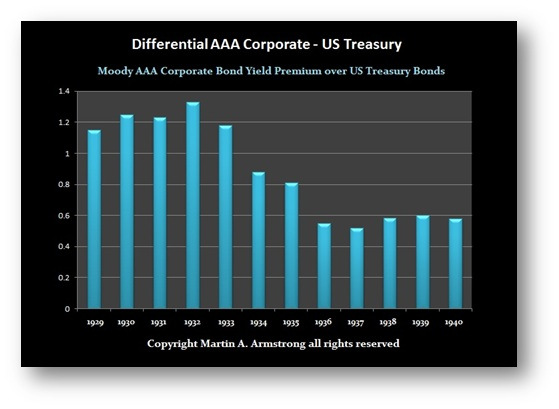
The rates today no longer reflect CONFIDENCE in the state – only manipulation by the state. You will see divergences emerge between state bond rates and private. This took place even during the Great Depression. What will emerge is capital will migrate to stocks and private sector bonds at first for yield. This will cause the central banks to eventually have to buy government debt themselves (monetize) or allow rates to rise. This is what the Fed Tapering is all about. I have already reported that the Fed was going around and informing the banks to re-calibrate their models. They have been warning behind the curtain that they DO NOT SEE a flight to quality for the next decline. This is part of the negative nonsense coming from Summers.
There will be a split with this post-Great Depression thinking that government debt is best. This is the change on the horizon and the Fed even knows this. So open your mind and observe the subtle movements that are revealing the change in trend on the threshold of this chaos. Our sources are real. I do not bullshit with my “opinion” for like assholes, everyone has one. I report facts. That is what my clients expect. I am neither Republican nor Democrat. I am for practical economics.
Tax Revolts and that 309 Year Cycle – read it all HERE

In this Weekend Report I’m going to show you the Chartology of gold, from my perspective, for the last 17 years or so. As you know I don’t pay lip service to the cycle guys, Elliot Waver’s or the many different disciplines that folks use to analyze the markets. My goal is to give you an unbiased look at the markets strictly from a Chartology perspective that is unique for our site.
In this look at gold I’m going to use several different concepts that I’ve shown you in the past to try to give you a feel of where we maybe headed. We’re going to look at neckline symmetry rails, neckline extension rails, reverse symmetry and just your everyday support and resistance points on a chart. I hope to paint a fairly accurate picture of where the gold market may find an important low based on the charting concepts listed above.
1…NECKLINE EXTENTIONS
Before we look at gold I want to show you some of these charting concepts so you will have a better understanding of what I’m showing when we get to gold. The first thing I would like to show you is a neckline extension rail. Many times when a neckline is broken you will get an immediate backtest and then the move will take place. There is a saying I uses that goes like this, a neckline never dies it just slowly fades away. By that I mean you can extend the neckline way out in time and it can still be active even though the original move has completed and the price objective met.
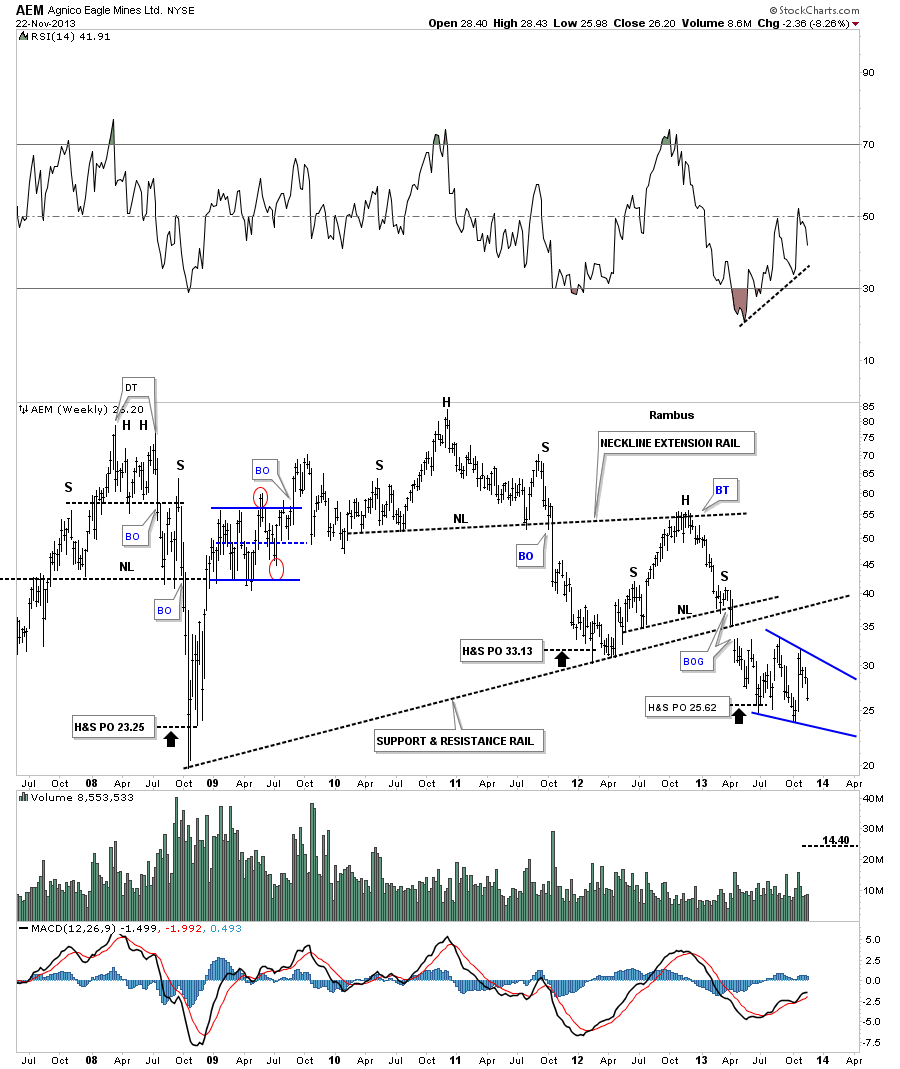
AEM was one of the first big cap precious metals stocks to form its high and breakdown while the rest were still building out their topping patterns. There are three H&S tops on this weekly chart below but we’re just interested in the middle one that formed back in 2010 – 2011. After reaching its price objective down at 33 or so it then had a counter trend rally that took the price action all the way up to the old neckline that I’ve labeled, Neckline Extension Rail. As you can see AEM tried for several months to breakout above that neckline extension rail but failed. That failure created the head portion of another H&S top which reached its price objective down at the 25.62 area where its currently trying to form a blue falling wedge.

Last night, Apple confirmed that it bought Israeli-based startup PrimeSense, the company best known for helping Microsoft develop the motion-tracking technology used for the Xbox Kinect.
The price of the acquisition is reported to be $360 million, which makes it one of Apple’s biggest purchases.
As the Guardian points out, this means Apple is going to put PrimeSense’s technology to work. Apple’s other big buys: PA Semi, which has been used to develop iPhone chips; Authentec, which was used for the fingerprint scanner in the iPhone 5S; Quattro Wireless which became iAd; and so on …
So, what’s Apple going to do with it? We’re speculating here, but it sure seems like PrimeSense’s 3D technology will be used in the Apple TV. It may or may not work its way into a full-on Apple television, but it seems fairly certain it will be in the little Apple TV box.
PrimeSense is primarily known for 3D sensors, which are used for gesture-based interactions. So, imagine swiping your hands in the air, and stuff on your screen moves — that’s what PrimeSense does.
In September, Mark Gurman, one of the best Apple reporters in the world, said, “we have been consistently hearing from our sources that Apple is thoroughly testing Xbox Kinect-like motion sensors for future TV-related products. When Apple plans to release motion-controlled TVs, however, is uncertain.”
Perhaps with the PrimeSense team in-house, Apple will be able to smooth out the kinks in its motion-based technology and implement it in a forthcoming version of the Apple TV.
Read more: http://www.businessinsider.com/apples-acquisition-of-primesense-may-be-for-tv-2013-11#ixzz2lhIvBfXy

Oil prices tumbled on Monday after a groundbreaking agreement aimed at curbing Iran’s nuclear program eased tensions in the region and raised the prospect of more oil exports from the country.
The preliminary accord, which was struck between Iran and six world powers, offers the Middle East nation $7 billion in immediate relief from economic sanctions.
The U.S. government estimates that Iran has lost about $80 billion in revenue as oil sales slumped by 60% since the start of 2012 as a result of the sanctions.
Iran sits on about 9% of the world’s proven oil reserves. But its crude oil output is languishing at 20-year lows, the International Energy Agency said in a recent report.
Related: What the deal means for Iran’s oil sector
The preliminary deal suspends certain sanctions on gold and precious metals, Iran’s auto sector, and petrochemical exports, but won’t allow Iran to increase oil sales above one million barrels per day for six months.
Still, some analysts reckon Iranian exports could climb in the near term because sales have fallen short of that limit in recent months. And if the deal goes well, and sanctions are relaxed further, Iran could be pumping much more oil into world markets by the end of next year.
“From a big picture perspective, the deal… opens up the possibility of at least one million barrels per day of Iranian crude returning to world markets by the fourth quarter of 2014,” said ClearView Energy Partners analyst Kevin Book.
Reduced political risk and the prospect of rising Iranian oil supplies weighed on energy prices in Monday trading.
Brent crude for January delivery fell 1.6%, or $1.77, in London, to $109.3 per barrel. Light crude in New York lost $1.32 to $93.52 a barrel.
Book said the impact of the Iranian deal on oil prices would have been greater were it not for the loss of most Libyan production in recent months. Oil exports from the north African state have dwindled due to ongoing political turmoil.
Related story: U.S. to seize Manhattan skyscraper secretly owned by Iran
World stock markets were also buoyed by the Iran deal as cheaper energy prices could give a much-needed boost to economic growth.
Germany’s DAX index rose 0.95% in European trading, while the CAC added 0.6% in France.
In Asia, Japan’s Nikkei closed up 1.5% and Australia’s ASX All Ordinaries put on 0.3%. 

(Reuters) – When Aimee Brittain’s team hits the stores in a commando-like fashion on Thanksgiving night in search of Black Friday deals, they’ll stand out from the crowd in their matching “very bright blue” shirts. They’ll scatter when they hit the store, and the shirts will help them see each other quickly.
It’s different for the Goldman sisters. Stephanie Goldman, a Cliffside Park, New Jersey, public relations executive, and her sisters Nadine Kleinman of Highland Park, New Jersey, and Valerie Goldman of Washington, D.C., travel in a pack, flooding one zone at a time.
The strategy, honed when Stephanie was a young teen, has helped them score priority bargains, like the time they got $900 worth of clothes from Ann Taylor for about $100. They went that Black Friday to an outlet store, already full of discounted items, hit the clearance rack, where prices were further reduced, then tacked on the credit-card application discount.
This year, Black Friday starts earlier than ever, with some retailers, including Wal-Mart, opening early on Thanksgiving evening. About 140 million people were expected to shop over the four-day weekend, according to the National Retail Federation.
Goldman, Brittain and other warriors who will prowl for deals on the busiest of shopping days took time from their mission planning to share war stories and tips to those who want to spend less and get more on the day after Thanksgiving. Here are their tips and tales:
SET YOUR STRATEGY
A Black Friday neophyte will shop without a plan. The veteran shopper knows where to go and when, what to buy, and how much to pay.
Goldman and her sisters start months ahead. Over calls and emails, they analyze sales flyers and figure out where the best deals are on the items they want to buy. Many flyers have been available for weeks – Macy’s and Toys R Us for example – collected on sites such as BlackFriday.com.
Brittain, 35, who lives near Atlanta, starts later, but plans to a more extreme degree. A week before Thanksgiving, she and her pack – family and friends including her cousin, her grandmother and an aunt – will pore over the circulars and craft plans right down to the amount of space available in their cars to cart away their booty.
USE THE BUDDY SYSTEM
Brittain’s crew take teamwork seriously. They hit a specific store and go to multiple departments at once, keeping each other on speed-dial to discuss items they have spotted or if someone needs a helping hand. “We call it divide and conquer. It’s battle. It’s war,” she says.
The strategy has paid off handsomely, says Brittain, who writes the prettyfrugaldiva.com blog. “All my kitchen supplies have been purchased at Black Friday sales, and I haven’t paid more than $5 for them.”
That includes a blender, mixer, coffee maker and electric can opener.
The Goldman clan travels as a pack, Stephanie says, allowing honest assessments about clothing choices and whether the price is really a bargain. Once they’re on the move, they will shop for eight to 14 hours.
Even if you can’t field a team, shop with a wingman. Christina Wojciechowski, 37, of Orchard Park, New York, goes with one partner, either her brother or sister-in-law. When she heads out late Thanksgiving night, it is not only comforting to have someone you know with you, she says, but you can help each other find what you’re looking for.
THE FIRST (PRICE) CUT IS THE DEEPEST
Lining up typically starts on Thanksgiving night, when the first wave of stores get ready to open. This presents the toughest decision: Where do you start?
That first location has to be worth the investment of time, but not at the expense of other deals. Wojciechowski heads out about 10 p.m. and usually goes to a store that sells clothing.
The lines at the electronics stores, where they sell a handful of deeply discounted items like a $1,000 55-inch flat-screen TV for $500 and a $400 laptop for $178, are likely to be considerably longer. And at the electronics store, the front of the line probably sacrificed Thanksgiving dinner to get there – Best Buy will open at 6 pm on the holiday this year.
Even the best deal isn’t worth the stress of spending hours waiting in line for a store to open, says Wojciechowski. Instead she pops into drugstores like CVS and Rite Aid on Black Friday because they typically offer deals on small electronics and toys and usually aren’t crowded.
PACK SUPPLIES
Being on email lists, Facebook fan pages for retailers and checking on deal sites will offer clues on added bonuses and could provide access to special coupons or unadvertised deals.
Bring your lists, loyalty cards, and coupons. Load up your smartphone with coupon-offering apps like CouponSherpa or RetailMeNot, or apps for stores where you will shop. You’ll be able to check for last-minute deals while you’re in the field.
And don’t forget fuel. David Bakke, an editor at the personal finance site MoneyCrashers.com, brings juice and energy bars to avoid stopping as he goes from store to store.
FAILURE IS NOT AN OPTION
Going for a big-ticket item involves risk, since the competition is intense. But Jen Smialek, 32, a Boston-based freelance writer and web designer, has learned many stores have consolation prizes. The deals might not be as good, she says, but could be nearly the same.
Smialek says the key is talking to a store employee about the “extra” inventory that will be wheeled out during the day to take the place of the cleaned-out doorbuster deals. Or talk a manager into giving you a sale price on a similar item.
You have nothing to lose by asking, and Smialek says it has been a winning proposition for her. She recalls going after a TV deal with a nearly $1,000 markdown.
“I was able to get her to reduce the price of the TV I had, to match the doorbuster sale. No fuss, no muss, in and out of the store in 30 minutes with what I came for at the price I wanted.”
(This version of the story corrects Aimee Brittain’s age in paragraph eight to 35 from 45.)
(Follow us @ReutersMoney or here Editing by Linda Stern and Jeffrey Benkoe


-
I know Mike is a very solid investor and respect his opinions very much. So if he says pay attention to this or that - I will.
~ Dale G.
-
I've started managing my own investments so view Michael's site as a one-stop shop from which to get information and perspectives.
~ Dave E.
-
Michael offers easy reading, honest, common sense information that anyone can use in a practical manner.
~ der_al.
-
A sane voice in a scrambled investment world.
~ Ed R.
Inside Edge Pro Contributors

Greg Weldon

Josef Schachter

Tyler Bollhorn

Ryan Irvine

Paul Beattie

Martin Straith

Patrick Ceresna

Mark Leibovit

James Thorne

Victor Adair