
Gold & Precious Metals
It’s unlikely that gold has bottomed.
The steady drip lower in gold and silver prices continued over the past week, and the inevitable test of the July cycle lows drew closer.
There is now nothing standing in the way of gold making a push to $1,180 and silver similarly moving to $18.
This year’s downtrend in gold has essentially been on pause since gold bottomed in July. But that could soon change if gold breaks below the key $1,180 level.
Weighing on the market is a resumption of selling by exchange-traded funds. After plunging earlier this year, ETF holdings stabilized during the summer.
Now ETF investors are back in selling mode, having liquidated 1 million ounces over the past month, with 600,000 ounces of that coming over the past week.
Gold ETF Holdings
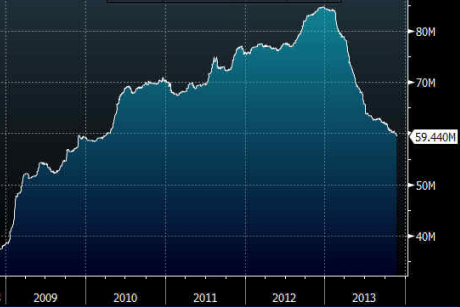
The renewed decline in ETF holdings suggests that investor liquidation is not over. Contrary to what some had believed, the “weak hands” in the market haven’t all exited.
Were the Fed to taper its bond-buying program in December or early next year as many expect, that could spook jittery investors, prompting more selling by ETFs.
In this context, our confidence is growing that gold will break below the current $1,180 cycle low and make a push to the psychologically significant $1,000 mark in 2014.
GOLD (YTD)
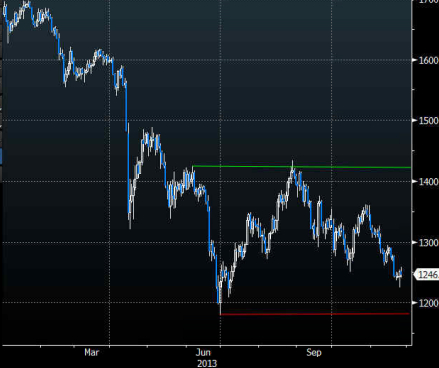
SILVER (YTD)
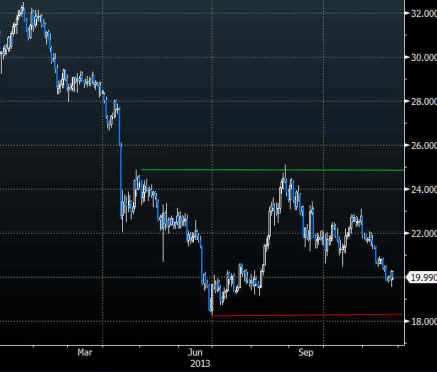
PLATINUM (YTD)
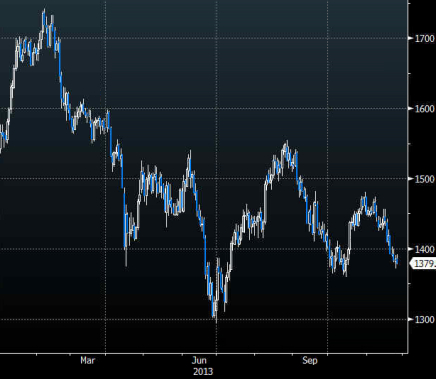
PALLADIUM (YTD)
….read page 2 HERE

 Goldman Sachs is slowly releasing their best ideas for 2014. The first two are attached below. If you have some ideas for 2014 feel free to share with the group. Here’s Goldman’s first two (via WSJ MoneyBeat):
“Long 5-Year Eonia/Short 5-Year U.S. Treasurys.”
“The market reaction to the strengthening of ‘forward guidance’ could, contrary to our expectations, be associated with a flattening of the two-to-five year U.S. curve, at least initially.
…
“Currently, a very accommodative monetary policy stance is largely priced in in the U.S., while the market is underestimating the possibility that the European Central Bank can provide further easing, even by cutting the deposit rate below zero,”
“Long S&P 500/Short AUD”
“This reflects what is perhaps the largest overarching theme of our market outlook – a belief that developed-market equities are well placed as long as US yields do not rise too quickly. The specific implementation of this trade recommendation that we will track is a long position in Dec 2014 S&P 500 futures, and a corresponding short position in Dec 2014 AUDUSD futures. Given our forecasts for both assets, with an S&P year-end target of 1900, and a year-end AUD target vs. the USD of 0.85, we see scope for both legs of the trade to generate potential returns.”
This post originally appeared at Pragmatic Capitalism. Copyright 2013.
Read more: http://pragcap.com/goldman-sachs-2-big-ideas-for-2014#ixzz2lqeTvH2s

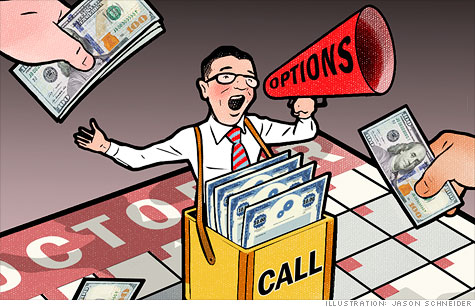 Chaotic markets have left investors scrambling for ways to boost returns without taking on excessive risk. But there’s a simple strategy that can make a virtue out of market volatility: Build a portfolio around high-quality stocks with generous dividend yields to offer a cushion against market swings, and juice even more income from those stocks through the strategic use of options.
Options contracts give an investor the right to buy or sell a stock at a future date and specific price. The demand for options, along with their prices, typically rises when market volatility flares up, as has been the case of late. The Chicago Board Options Exchange Volatility index (VIX), the most common measure of investor fear, spiked above 40 during August and September — double its long-term average. As a result, buyers have been flocking to options.
And therein lies your opportunity. To reap more income from dividend-paying stocks you already own, you can sell “covered calls,” granting another investor the right to buy a stock you own at a higher price in the future (known as the strike price). You pocket money from the option sale, which you get to keep no matter what happens with the stock down the road. “It’s a strategy that can improve your odds of success and provide superior returns over time,” says Michael Khouw, director of equity derivatives trading at Cantor Fitzgerald.
Here’s how. Let’s say that you bought the stock of drug maker Abbott Laboratories (ABT, Fortune 500), which was trading at $51 a share in mid-September and had a dividend yield of 3.8%. You could then have sold a call option, which at the time was trading for $1.03 a share, granting another investor the right to buy your Abbott shares for $55 at any point until mid-January. If the stock price stayed below $55, you would continue to own the stock, but you’d still keep the $1.03 per share you got for selling the call option. When it expired, you could sell another round of options against the stock, boosting your income yet again.
If, on the other hand, Abbott shares traded above the call option’s $55 strike price before mid-January, you might be forced to sell your shares and miss out on some of the upside in price appreciation. In that case, you’d realize a 7.8% profit on the stock, pocket the $1.03 per share from the option sale, and collect the quarterly dividend payment. Not exactly a horrific outcome.
To reduce the likelihood of being forced to sell a stock you want to hold onto, Khouw recommends selling call options with a strike price comfortably above the current market price — say, 10% higher — even if that means settling for a smaller cash payment upfront. “This is not a trading strategy — it’s an investing strategy,” he notes.
And it’s a strategy that makes sense for the foreseeable future. “Heightened volatility isn’t going away anytime soon,” says Sam Stovall, chief investment strategist for Standard & Poor’s Equity Research. You may not enjoy the rocky ride, but at least you can capitalize on it.
–A former compensation consultant, Janice Revell has been writing about personal finance since 2000.

Merkel secures coalition deal but agreement faces SPD vote. After two months of negotiations following Germany’s general election, the right-of-center grouping of Chancellor Angela Merkel has finally forged a deal with the left-leaning Social Democrats (SPD) to form a government. Germany will largely maintain its fiscal conservatism, although the country will introduce a minimum wage and strengthen labor-market rules. The deal now needs the approval of SPD’s 474,000 members, with the results of a vote due on December 14.
U.S. defies China with flight of unarmed B-52 bombers. The U.S. has got involved in the islands dispute between Japan and China in the East China Sea by flying two unarmed B-52 bombers in the area without informing Beijing. China had created an Air Defense Identification Zone around the islands and warned of military action against planes flying in the region if notification wasn’t given. Japanese airlines also flew through the area without first telling China. When the dispute first arose a year ago, trade between China and Japan was badly hit.
H-P’s stock jumps following earnings beat. H-P’s (HPQ) shares spiked 7% premarket after the IT giant swung to a net profit of $1.41B from a loss of $6.85B a year earlier, with adjusted EPS coming in at $1.01 and topping expectations, as did revenue despite falling 3% to $29.1B. However, sales fell in five of H-P’s six business segments, with demand for personal computers collapsing. CEO Meg Whitman said she was moving H-P to “a new style of IT” based on cloud computing and in which consumers can produce mobile phones in kiosks with 3D printers.
Top Stock News
Top U.S. banks’ mortgage payouts could hit $104B. JPMorgan (JPM) and Bank of America (BAC) are among eight leading U.S. banks that could have to pay a further $56.5-104B to settle mortgage-related claims, S&P calculates. However, the country’s largest banks have estimated capital buffers of $155B combined, which would be enough to absorb the losses. S&P doesn’t expect the legal liabilities to hurt the banks’ ratings.
SEC looking at Morgan Stanley and Citigroup over foreign hiring. Morgan Stanley (MS) and Citigroup (C) have reportedly received requests for information about their overseas hiring practices from the SEC, which is looking at whether the banks breached laws relating to foreign bribery by recruiting the family members of the well-connected in order to win business. The firms join JPMorgan (JPM) in being scrutinized over the issue, with the latter under criminal and civil invesigations.
RBS faces possible criminal probe over small-business claims. The U.K.’s Serious Fraud Office (SFO) is reportedly thinking of starting a criminal investigation into accusations that the bank looked to profit by forcing “vibrant” small companies out of business and then seizing their assets. The SFO has been interviewing former executives of affected firms. The agency is deciding whether RBS acted unlawfully or just engaged in bad business practices.
Aramark looks to raise $1B in IPO. Stadium food and clothing vendor Aramark reportedly intends to raise up to $1B in its IPO, which could take place in December. Aramark would use the money to repay some of its debt of $5.7B – a legacy of the $6.3B deal that took the company private in 2007. Aramark’s IPO comes at the same time as that of Hilton, both of which could ensure that a banner year for public listings ends with a bang.
Bankruptcy judge to issue ruling on AMR-US DOJ deal. AMR (OTCQB:AAMRQ) and US Airways (LCC) are due to find out today whether Bankruptcy Judge Sean Lane approves of their settlement with the Justice Department over their proposed merger. The DOJ had opposed the transaction until the airlines agreed to concessions. The deal also needs the authorization of a federal district judge, who is accepting public comments until February 7.
Amec eyes $2.8B Foster Wheeler. U.K. energy services group Amec (GM:AMCBF) is looking to take over Foster Wheeler (FWLT), which has a market cap of $2.83B, the London Times reports. The companies have been in discussions in the past but aren’t currently in talks. Reuters adds that Amec is looking at a number of targets but also that it isn’t in discussions with any of them. Foster Wheeler’s shares rose 7.55% in post-market trading.
Compuware receives buyout approaches. Compuware (CPWR) has reportedly been exploring selling itself for months and has received approaches from private-equity funds, with potential suitors including Thoma Bravo and Vista Equity Partners. The Detroit-based software group, which has a market cap of $2.34B, could agree to a deal by January. The news comes almost a year after Compuware rejected a $2.3B offer from Elliott Management. The activist investor holds 8.6% in Compuware.
Top Economic & Other News
Berlusconi faces expulsion from Italian Senate. Silvio Berlusconi is expected to be expelled from Italy’s Senate today following his conviction for tax fraud in August. Because of the recent break-up of the former prime minister’s right-wing grouping, in which one faction stayed in the government, his removal from the Senate is unlikely to affect the coalition. The episode has every so often caused turmoil in the markets, although the FTSE Mib was+1.1% at the time of writing.
Alpha-Rich Stock Movers and Great Calls
1) On Monday, buysider Logical Thought said Pain Therapeutics (PTIE) had 120%+ risk-adjusted upside based on approval of its flagship drug, Remoxy. Shares are +16.3% in the two sessions following publication. Read article »
2) On August 23, MBAvalueinvestor called Nuverra Environmental (NES) an over-levered “destroyer of capital,” with 80% downside toward its fair value. The stock is now -43.6% to date. Read article »
Alpha-Rich Stocks To Watch
1) Veterinary supplier Heska (HSKA) could double in 2014, as a recent acquisition has created a leading competitive position, says BuyTheDipsSellTheRips. Read article »
2) Autobytel’s (ABTL) powerful lead generation platform will continue to drive growth and upside in the near and long term, according to buysider Ravee Mehta. Read article »
Alpha-Rich articles are the best long and short ideas on Seeking Alpha. SA Pro subscribers receive early access to these Alpha-Rich articles, which often move markets. For more information about SA Pro and becoming a subscriber, click here.
Today’s Markets:
In Asia, Japan -0.4% to 15450. Hong Kong +0.5% to 23806. China +0.8% to 2201. India flat at 20420.
In Europe, at midday, London +0.1%. Paris +0.2%. Frankfurt +0.2%.
Futures at 6:20: Dow +0.1%. S&P +0.1%. Nasdaq +0.1%. Crude -0.4% to $93.29. Gold +0.8% to $1251.40.
Ten-year Treasury Yield +1 bps at 2.73%.
Today’s economic calendar:
7:00 MBA Mortgage Applications
8:30 Durable Goods
8:30 Initial Jobless Claims
8:30 Chicago Fed National Activity Index
9:45 Chicago PMI
9:45 Bloomberg Consumer Comfort Index
9:55 Reuters/UofM Consumer Sentiment
10:00 Leading Indicators
10:30 EIA Petroleum Inventories
12:00 PM EIA Natural Gas Inventory
1:00 PM Results of $29B, 7-Year Note Auction
3:00 PM USDA Ag. Prices
Notable earnings before today’s open: FRO
Notable earnings after today’s close: RENN
See full real-time earnings coverage »
Wall Street Breakfast is sent out by email for free — Get it now »
- The best performing investment, ever?
- A brief history of the phenomenon known as Bitcoin
- The cure for the broken monetary system… the future of money… and more!
Never has a tech investment risen so high, so fast…
Scratch that — never has any investment risen so high so fast.
If you had bought five Bitcoin for a grand total of one dollar back in October 2009, you’d now be sitting on upwards of $4,500 worth of Bitcoin.
We’ll let you ponder that for a moment…
But not too long. Because although you could have made huge gains when we covered Bitcoin as it hovered around $30… a bigger picture now comes into view…
Could other crypto-currencies compete with Bitcoin? And would they get off the ground, run alongside Bitcoin, as the dollar runs alongside the euro or the renminbi?
If the answer is yes, dear reader, there could still be hope for outlandish gains in this area of the market. Let us know if you’d invest in those currencies if you could. If so, we’ll write about it next week.
If such a trend holds, could we be entering a time when crypto-currencies replace fiat currency?
Below, Jeffrey Tucker shows you how that very thing could be underway as you read these words. According to him, crypto-currencies such as Bitcoin could be the cure to our broken monetary system, and your financial worries.
Please read on as Jeff gives you a crash course on this important chapter in financial history.
Best,
Josh Grasmick
Managing Editor, Tomorrow in Review
The Cure for the Broken Monetary System
 Before the housing market collapsed and the government pumped billions into the economy to save it, there was a programmer named Satoshi Nakamoto. And without much fanfare, he created an idea that’s in the process of changing the world. His idea was Bitcoin.
Some background information is in order before I go any further.
Think back to 2008. Real estate was in a free fall, and the devastation was most intensely felt by the largest banks and investment firms holding mostly worthless assets in the form of mortgage-backed securities. The lame-duck Bush administration was frantically lobbying to spend $800 billion to bail out the banks.
To achieve this implausible goal, the Bush administration, along with its counterpart in the U.K., had to whip up a kind of hysteria. Administration officials warned of a melting financial world. Banks would die, ATMs would run out of money, goods would not ship, the monetary system would break down, and the U.S. was going the way of Iceland, which, at the time, ran out of purchasable groceries.
Was it true? I for one never believed it. I had seen this kind of government-induced frenzy before, which the establishment was pushing through things like Homeland Security, or NAFTA, or other huge and decisive bills that met with massive public opposition. The establishment has to create an environment of fear in order to get the bill through Congress.
Looking back at those days, it seems obvious now that this was a turning point in history, a time in which it became very clear to some very smart people in the world that the government’s system of financial and monetary management was broken. If an entire system could be brought down by declining house prices, is it really robust enough to support global economic growth into the future.
Back to the faceless programmer, Satoshi Nakamoto. Around the same time, he was putting the finishing touches on his newly proposed currency, Bitcoin.
It would be created entirely out of code. It would have all the main features that we know good money has. It would be divisible, portable, durable, uniform in quality, and scarce. He chose the model of open source code: everyone could see exactly how it is made. It would live on a ledger in the Internet cloud, and the ledger would keep strict controls on creation of new units and the ownership of existing units.
There was just one problem: His newly created Bitcoin had no value whatsoever.
Nakamoto knew that if it were ever to have value, it couldn’t be imparted by the programmers. It had to come from the market itself. The proposed product appeared that January, as the new administration was taking office. You could think of this as an act of secession, a final declaration of no confidence in the existing system.
For the next eight months, it was nothing but a curiosity. A techy dream that never reached beyond the dark part of the Internet and the tiny group of genius-geeks who follow things like it. But in October 2009, something amazing happened. Bitcoin obtained a price on the market. It began to trade at about 2/10 of a penny. In other words, one U.S. cent would get you 5 Bitcoins.
How could this happen? Two crucial points help explain what happened.
First, it had proven itself to be very useful and functional. It was portable. The system was stable. The ledger in the sky called the “blockchain” worked exactly as Satoshi expected that it would.
Second, Bitcoin was scarce. Only a certain number could be created in any period of time, and the way they were created was through the hard work of computers themselves. This feature of scarcity and resource use led the market to value them.
But of course, that was all 4½ years ago. Today, Bitcoin is roaring. In the last several weeks, it has moved exponentially from $250 to peak at $900, before a huge selloff hit it again and it settled in the $700 range. But one thing many people have noticed about the latest rally. It is not following the same pattern as in the past. Each time, there seems to be a settling back to reality (whatever that is!), something stops it, and buyers step in to dominate the market.
There are a number of salient factors driving this. The myth that Bitcoin is valuable only for purchases of drugs online has been shattered. The “Amazon for narcotics” was shut down by the feds just a few weeks ago and the exchange rate of Bitcoin to the dollar did not collapse. In fact, after about 48 hours, the price had actually risen in value.
Also, China has entered the market in a huge way. Some people believe that one-third of current trading activity is coming from China, where the government has shown itself to have a very laissez faire attitude when it comes to the currency.
The congressional hearings held on Capitol Hill featured a line of administration officials warning that they are on the job to make sure that Bitcoin is not ever used for nefarious purposes.
But can these government regulators really fulfill their promises?
Bitcoin lives on a distributed network that cannot be taken down. The transactions are pseudonymous. That means you can track ownership numbers, but you can’t necessarily connect those numbers to particular people. It is not a perfect system for preserving anonymity, but it comes closer than anything that exists.
Government cannot control Bitcoin any more than they can control algebra. It exists and it is not going away. It will live forever outside the control of any state.
Satoshi proposed his system as a possible new standard for money in the Internet age. It was a wild dream and speculation. But these are times in which dreams come true. The current monetary system has been nationalized for 100 years, and it is broken down.
By their own words, the world’s central bankers and presidents have said the system is unstable and needs constant bailing out. That’s not what you want to hear from the people in charge.
Satoshi saw that it was time for something new. The market apparently agrees. Now, no matter what government does, it can’t help but inadvertently promote the use of this new medium of exchange. It has a life of its own.
Bureaucrats can complain, threaten, pronounce, and warn. But in the end, Bitcoin just doesn’t care.
Sincerely,
Jeffrey Tucker
For Tomorrow in Review
P.S. When we first started covering Bitcoin, you could buy one for around $30. Now, that price seems like a steal. We will never see it again.
A handful of events have changed people’s opinion about the hot alternative currency. As more and more people understand the history of the currency, they see it as a safe way to protect and grow their wealth.
To find out how you can get your hands on this exciting currency, click here for more information.
Thank you for reading Tomorrow in Review. We greatly value your questions and comments. Click here to send us feedback.


-
I know Mike is a very solid investor and respect his opinions very much. So if he says pay attention to this or that - I will.
~ Dale G.
-
I've started managing my own investments so view Michael's site as a one-stop shop from which to get information and perspectives.
~ Dave E.
-
Michael offers easy reading, honest, common sense information that anyone can use in a practical manner.
~ der_al.
-
A sane voice in a scrambled investment world.
~ Ed R.
Inside Edge Pro Contributors

Greg Weldon

Josef Schachter

Tyler Bollhorn

Ryan Irvine

Paul Beattie

Martin Straith

Patrick Ceresna

Mark Leibovit

James Thorne

Victor Adair