
Stocks & Equities

Just as BMO (Bank of Montreal) had regained the pre-crisis 2007 highs (see chart above), an earnings report that looked good on the surface has hit the stock.
We continue to hold the stock for now. However, the BMO results may indicate a sea change in the direction of Canadian bank stocks as a whole. Even though the economy has been aided by low interest rates, things are getting punch-drunk on the liquidity and the absence of new economic growth catalysts (especially with China fading) is making it more difficult for financial services companies to find new solid areas of opportunity.
Bank of Montreal (BMO) is held in the McIver-Jasayko Model Portfolios as of December 3 2013. Comments about BMO are not intended as advice and do not constitute a recommendation to buy, sell, or hold.
The opinions expressed in this report are the opinions of the author and readers should not assume they reflect the opinions or recommendations of Richardson GMP Limited or its affiliates. Assumptions, opinions and estimates constitute the author’s judgment as of the date of this material and are subject to change without notice. We do not warrant the completeness or accuracy of this material, and it should not be relied upon as such. Before acting on any recommendation, you should consider whether it is suitable for your particular circumstances and, if necessary, seek professional advice. Past performance is not indicative of future results.
Richardson GMP Limited, Member Canadian Investor Protection Fund.
Richardson is a trade-mark of James Richardson & Sons, Limited. GMP is a registered trade-mark of GMP Securities L.P. Both used under license by Richardson GMP Limited.

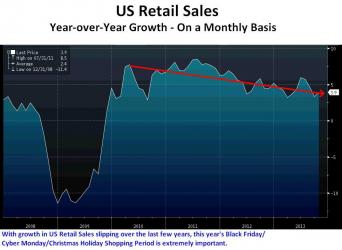
After a disappointing Black Friday, the infamous post-US Thanksgiving shopping day, the success of Cyber Monday has become even more important.
US Retail Sales have been lackluster so far this year. They have definitely been less than expected when economists were forecasting much higher economic growth that would then translate into higher consumer spending.
And, despite a slowing in the growth of US Retail Sales over the last three years (see chart above), the abundance of Federal Reserve liquidity has kept the problem mostly under the rug. This has been aided by a very strong Retail Sales lobby in the US which is quick to furnish the press with their positive spin. In fact, without looking at the details, most would conclude that the last couple of years have been fantastic.
As December unfolds, expect the spin from the Retail Sales lobby to crank into high gear. The initial reports from Cyber Monday exhibit this already with no mention that it might be very difficult to make up for the disappointing Black Friday total sales.
Just like with its declining impact on unemployment, the effect that the Federal Reserve’s Quantitative Easing on US Retail Sales may be fading as well. Not a great foundation if US stocks are to continue their torrid pace.
The opinions expressed in this report are the opinions of the author and readers should not assume they reflect the opinions or recommendations of Richardson GMP Limited or its affiliates. Assumptions, opinions and estimates constitute the author’s judgment as of the date of this material and are subject to change without notice. We do not warrant the completeness or accuracy of this material, and it should not be relied upon as such. Before acting on any recommendation, you should consider whether it is suitable for your particular circumstances and, if necessary, seek professional advice. Past performance is not indicative of future results.
Richardson GMP Limited, Member Canadian Investor Protection Fund.
Richardson is a trade-mark of James Richardson & Sons, Limited. GMP is a registered trade-mark of GMP Securities L.P. Both used under license by Richardson GMP Limited.




From Dave Lutz at Stifel, Nicolaus, here’s an ultra-quick roundup of today’s trader talk:
US Futures are starting on weaker footing this AM, mirroring overseas markets. Much of the global angst is Yen driven, which is catching a bid due to a lower than expected stimulus package being discussed. Nasdaq Futures are outperforming SPX, as AAPL pops over 1% on a upgrade from UBS. Some other “high Beta” names are mixed this AM, with TSLA up 2%, DDD up 1%, but FB losing 40bp. Over In Europe, Markets are considerably weaker in heavy volume. The DAX is off 1%, with volumes 140%+ over the 20day average, while France’s equity market is getting hit for 2%. Focus on the EU fins, which are getting hit for almost 2% (I’ll be surprised if we don’t see a bid developing as US traders man their Bloombergs).. The Nikkei managed a fresh 6year closing high, before the Stimulus details were released by Reuters, which has hit the Nikkei futures for over 1% early this AM. China managed a rebound after the IPO induced weakness today, with their smallcap index surging back after the 8% smackdown yesterday. Aussie lost 50bp, but globally resources companies continue to underperform. Focus today will be in the Autos, as November sales data is released. Bear in mind also, while searching for Liquidity, a few UK firms are hosting Charity Days today.
The 10YY is retreating slightly lower, after tasting 3M highs yesterday – but the Spread between US and German Yields has widened to 7Y highs on diverging Central Bank Policies. The DXY is under pressure this AM, losing ground to both € and Yen. This is a natural tailwind for commodities – but Gold has a “dead Cat” bounce feel, barely holding green – WTI is up small into Inventory data release tonight – but losing ground to Brent (Telling with DXY weaker). Natty Gas is getting hit for 40bp, as we enter a seasonable tough month for the commodity, and Japan’s Tepco is holding off on LNG purchases due to high prices. Aside from Vehicle sales today, we have ISM NY at 9:45, but the big driver may be the double POMO whammy —> Fed has a $750mln – $1B purchase at 11am, followed by a $3-4B purchase operation at 2pm.
More from Business Insider:
20 Years Of Tech Innovation In A Single Picture
The picture below was recently tweeted by @FascinatingPics.
It shows some of the 1993 technology that is now packed into 2013 technology.
Anytime you think the pace of innovation in the world is slowing down, just have another glance at this.

also…
50 Unfortunate Truths About Investing
(Reuters) – The yen rose against the dollar and the euro on Tuesday, rebounding from losses as falling stock markets worldwide prompted safe-haven demand for the Japanese currency.
The dollar slipped against the euro and a basket of currencies but the decline could be short-lived on a view that the Federal Reserve may begin to reduce its huge bond-buying economic stimulus earlier than some had anticipated.
After a strong U.S. ISM factory report on Monday, investors are now looking to U.S. economic growth data on Thursday and, in particular, U.S. nonfarm payrolls numbers on Friday for further signs of when the Fed may act.
The dollar fell 0.5 percent to 102.49 yen after reaching 103.37 yen in Asian trading, according to Reuters data. That was close to its 2013 high of 103.73 yen, a level dollar bulls have been targeting.
“The yen caught a reprieve from extreme selling as a solid coat of red across global bourses spurred a round of safe-haven interest,” said Joe Manimbo, senior market analyst at Western Union Business Solutions in Washington.
“Sentiment, though, remained decidedly bearish on the view that the Bank of Japan will press ahead, and maybe extend, its current pace of support to the world’s No. 3 economy.”
Trading volumes of dollar/yen were almost double the average over the past month, according to data from the Reuters dealing platform. The dollar is up 18 percent against the yen this year and rose strongly over the past month, on expectations the U.S. would soon scale back its bond-buying program while Japanese monetary policy remained loose.
The BoJ’s commitment to easy policy makes the yen the best funding currency for investing in higher-yielding assets in so-called carry trades. When riskier assets such as stocks fall, investors would buy back the yen, giving it a perceived safe- haven status.
Net yen short positions were at their highest since July 2007, according to data from the Commodity Futures Trading Commission.
“There are certainly signs that short positioning is becoming more stretched at current levels, while our short-term valuation model is signaling the yen is becoming more undervalued,” said Lee Hardman, currency economist at BTMU.
“The key is the payrolls report on Friday,” BTMU’s Hardman said. “If it’s another strong report, then it could push dollar/yen higher.”
The euro retreated from a five-year high of 140.03 yen to 139.19 yen, down 0.2 percent on the day.
Against the dollar, the euro rose 0.2 percent to $1.3573 on expectations the European Central Bank would leave interest rates unchanged this week after above-forecast inflation data last Friday.
“Status quo on ECB monetary policy should persist until the end of the year, with no negative rates in sight,” said Francesco Scotto, portfolio manager at RTFX Fund Management. “Euro/dollar is still on a bullish trend and should maintain this tone until the end of the month.”
The Australian dollar was up 0.2 percent against the U.S. dollar at $0.9124 after data showed solid net exports in July-September as well as firm retail sales in October.
Earlier, the Reserve Bank of Australia reiterated after a policy meeting that the Aussie was still uncomfortably high.
(Additional reporting by Laurence Fletcher in London; Editing by James Dalgleish)


-
I know Mike is a very solid investor and respect his opinions very much. So if he says pay attention to this or that - I will.
~ Dale G.
-
I've started managing my own investments so view Michael's site as a one-stop shop from which to get information and perspectives.
~ Dave E.
-
Michael offers easy reading, honest, common sense information that anyone can use in a practical manner.
~ der_al.
-
A sane voice in a scrambled investment world.
~ Ed R.
Inside Edge Pro Contributors

Greg Weldon

Josef Schachter

Tyler Bollhorn

Ryan Irvine

Paul Beattie

Martin Straith

Patrick Ceresna

Mark Leibovit

James Thorne

Victor Adair