
Timing & trends
Consumer confidence in the U.S. declined in January from a month earlier, indicating spending may cool following the biggest gain in three years at the end of 2013.
The Thomson Reuters/University of Michigan final index of sentiment dropped to 81.2 this month from 82.5 in December. The median estimate in a Bloomberg survey called for a decline to 81 after a preliminary January reading of 80.4.
Less optimism, partly a reflection of declining stock prices this month, may signal households will temper their spending, which climbed in the fourth quarter at fastest pacesince 2010. A report today showed incomes after taxes and adjusted for inflation dropped last month by the most since January 2013.
…..read more HERE

U.S. corn exports of 1.8 mln tonnes a marketing year high * Wheat exports most since September, topping expectations * Soybeans bounce after hitting 2-1/2 month low By Michael Hirtzer CHICAGO, Jan.. … full article

First things first: The Federal Reserve did exactly what I predicted, before it was fashionable to predict it. They agreed to lop another $10 billion off the QE bond-buying program at this week’s meeting, slashing it to $65 billion.
Policymakers also strongly implied they will continue to reduce their bond buying going forward. That step, in turn, sets the stage for actual short-term interest rate hikes. I continue to believe those will begin earlier than most market players believe, and I would start preparing for them.
But what the Fed did this week is nothing compared to what happened elsewhere in the interest rate markets.
Just imagine that you woke up one morning and the Fed had jacked interest rates up by 425 basis points overnight. That’s 4.25 percentage points — enough to raise the federal funds rate from its current 0 percent to 0.25 percent range to around 4.5 percent.
If you’re not already aware, the overnight rate serves as a benchmark for the prime rate. And the prime rate is the benchmark that many variable rate loans are tied to. So if you had a variable rate credit card at the Bankrate.com national average rate of about 11 percent, it would almost immediately surge to 15.25 percent.
Assuming you had a $10,000 balance on your credit card at 11 percent, it would take 11 years and two months to pay off, assuming a $400 monthly payment along the way. You’d pay around $2,914 in interest over that time. At a rate of 15.25 percent, it’d take you one year and three months longer to pay that balance off, and it would cost you $4,561 in interest. That’s more than $1,600 in extra interest costs.
 Your home equity line of credit? Its rate would surge from around 4.8 percent to just over 9 percent.
Any variable rate business loans you might have outstanding? Up, up, up!
With longer-term mortgages, there’s no telling exactly how much rates would go up because they don’t move on a 1-to-1 basis with overnight rates. But it’s a safe bet that they would rise at least 100 to 200 basis points.
That would drive the monthly payment on a $300,000 mortgage from around $1,490 (at a recent average rate of 4.33 percent) to a whopping $1,863. That’s more than $370 more a month … every month … for the next three decades.
Why am I bringing all this up?
Because the Turkish central bank was just forced to hike its overnight rate to 12 percent from 7.75 percent. It also had to more than double a separate overnight borrowing rate to 8 percent from 3.5 percent. So you can only imagine how the local economy there is going to react.
More importantly for a U.S.-based investor is the reason behind the move, and what it signifies for the year ahead. Turkey’s currency is the lira, and it has been falling sharply for weeks because of political turmoil and concern over the nation’s ability to finance its current account deficit.
Emerging market nations with yawning deficits need constant inflows of foreign capital to finance them. So if anything spooks foreign investors and causes them to pull back, things get real ugly, real fast. The currency plunges, the markets tank, and the central bank is often forced to implement capital controls or jack up interest rates to a level high enough to stem the outflows.
The problem is that those hikes can also drive a stake through the heart of the domestic economy. After all, if you woke up and the required monthly payment on a home mortgage had just soared by almost $400 overnight, what would you do? Chances are you’d shelve your home buying plans in a heartbeat!
Turkey is far from alone. Investors have been focusing like a laser on a “Fragile Five” bloc of nations — Turkey, Brazil, India, South Africa and Indonesia — that are in a similar bind. Their currencies and stock markets have all come under pressure amid capital concerns, and their central banks have generally been responding by raising interest rates for the past several months.
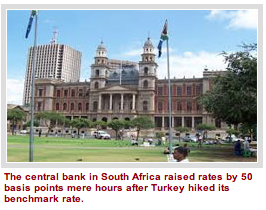
In fact, the central bank in South Africa raised rates by 50 basis points mere hours after Turkey hiked its benchmark rate. The increase pushed the rate to 5.5 percent from 5 percent, and it was the first hike going all the way back to June 2008.
What started the ball rolling? Why have emerging markets been under so much pressure?
It all goes back to the Fed. The ongoing rollback of QE — and the interest rate hikes in the U.S. and other developed nations that are likely to follow — are causing investors to rethink their emerging market exposure.
You see, one key reason so much money flowed out of the U.S., U.K. and the euro zone and in to emerging markets is because yields were artificially suppressed for so long in developed economies. Investors were forced to “chase yield” wherever they could get it, and the available yields in emerging markets were just too juicy to pass up.
Now that we’re starting to see developed world central banks lay the groundwork for draining that liquidity again, the emerging market world is facing the consequences. This is one reason I’ve been avoiding virtually all emerging market investments for a long time now, and focusing on more domestically oriented recommendations. As capital drains from emerging market investments, and makes its way back to developed markets, those kinds of names should do relatively well.
Just like with interest rates, you ultimately hit a “tipping point” with these kinds of emerging market crises. Things get bad enough, and go on for long enough, to lead to widespread selling in almost all assets, even those that have absolutely nothing to do with any of the “Fragile Five.”
I don’t think we’re at that stage yet, in large part because the domestic economy is in better shape than it has been for the past few years. But you can rest assured I’ll be watching to see if anything changes — and will do my best to let you know what all these new developments mean for your investments.
Until next time,
Mike
The investment strategy and opinions expressed in this article are those of the author’s and do not necessarily reflect those of any other editor at Weiss Research or the company as a whole.
About Money and Markets
For more information and archived issues, visit http://www.moneyandmarkets.com
Money and Markets is a free daily investment newsletter published by Weiss Research, Inc. This publication does not provide individual, customized investment or trading advice. All information is based upon data whose accuracy is deemed reliable, but not guaranteed. Performance returns cited are derived from our best estimates, but hypothetical as we do not track actual prices of customer purchases and sales. We cannot guarantee the accuracy of third party advertisements or sponsors, and these ads do not necessarily express the viewpoints of Money and Markets or its editors.

The past several years we’ve seen a lot of different buyers for mining projects globally. Corporations, investment funds, sovereign wealth funds, and international financial agencies have all gone in for project purchases.
But yesterday we got news of one of the strangest-sounding buyers I’ve come across. For mining projects being shed by precious metals developer Aquarius Platinum in South Africa.
That purchaser is the China National Arts & Crafts Corporation. Who Aquarius announced will buy the Blue Ridge platinum project for a total $37 million in cash.
An arts and crafts corporation sounds like an odd owner for the Blue Ridge project. Which includes a developed underground platinum mine, currently placed on care and maintenance due to low metals prices. Are a bunch of scrapbookers going to be out re-starting the dump trucks?
But the deal actually makes more sense after a look at who Arts & Crafts Corporation is. And suggests some interesting trends developing in the platinum business.
The buying group in fact isn’t a corporation at all. It’s a Chinese government enterprise. One whose mission is to “bring the traditional Chinese culture to the world”, according to its website.
Arts & Craft Corp thus deals in things like textiles, ceramics, fine art and jewellery. That last arena apparently being the driver for its interest in platinum mining.
In fact, the group is involved in the import and export of several jewellery-making materials. Including silver, gold, and diamonds. It also happens to be an affiliate of China Platinum Company–a firm that serves as the main import channel for platinum into China.
It would thus appear from yesterday’s deal that the company has made a strategic decision to move beyond just import of platinum. And into upstream mining development–taking direct ownership of producing centres and the associated output.
This is a very significant signal. Showing us that Chinese interest in platinum is perhaps ramping up. And that Chinese buyers may represent an expanding source of funding for platinum projects globally.
We’ll see if more deals follow from the arts and crafts folks.
Here’s to being crafty,
dforest@piercepoints.com / @piercepoints / Facebook
Ed Note: Here is the China National Arts & Crafts Corporation Website, just click HERE or on the Logo:


“It’s been so cold it’s forced the liberals to keep their hands in their own pockets.”
– Anon
“Firms that use borrowed money to lend to the smallest and riskiest companies are attracting cash at the fastest pace since before the crash.”
– Bloomberg, January 15
“U.S. state revenue isn’t rising fast enough to keep up with the cost of funding pensions, health care and public works projects.”
– Bloomberg, January 14
“Newport Beach, California, where four ranking lifeguards earned more than the town’s $109,677 median income, may partially disband its municipal ocean rescue to deal with pension costs.”
– Bloomberg, January 15
Undisciplined state and local budgeting has been riding the Wall Street bubble, which eventually depends upon the prosperity of business.
“It feels totally different to be a small-business owner in America on Main Street than on Wall Street, where they’re popping Champagne corks.”
– CNBC, January 6
Undisciplined governments have been accompanied by unreal policymakers. “Our financial system is still in a risk-averse mode.” “I don’t think that the low interest rates were an important contributor to the housing bubble.”
– John Williams, San Francisco Fed, Wall Street Journal, January 14
* * * * *
Credit Markets In looking at the last observation, one can’t help but wonder if central banking causes amnesia?
Typically a boom can run for some 12 to 18 months against rising long rates. Long treasury yields increased from July 2012 to the end of December and that counts out to 18 months. If long rates were to turn down with the economy it could show up in the next month or so.
In more normal times, the term “boom” would include a “booming” economy, but not during a lengthy post-bubble contraction.
However, for a number of obvious reasons, lower-grade bonds became a huge play. The Merrill Lynch High Yield Master went from 23% to 5%. The run from calamity to certainty has been outstanding and the yield is now trying to turn up.
Junk (JNK) has soared in price from 16.69 in 2009 to 40.97 this week.
The Daily RSI (momentum) has made a huge swing from 12 in 2009 to 83 on Friday. This compares to the best reached at 79 on May 6th.
That was just before the “Mini-Panic” that ended in late June. The Fed was heavily buying sup-prime mortgage bonds during the week that the price rolled over.
It is worth noting that at the all-important high on May 1st 2008, the RSI reached 82.
Lower-grade bonds have had a fabulous run and have reached a momentum level that last occurred in 2008 and are primed for a price decline of cyclical proportions.
The long bond future can rally further. It is not overbought and there is resistance at the 107 level.
The senior indexes (S&P) have reached momentum levels seen at the cyclical peaks in 2007 and 1937. As with this bull market, those came out of a monumental crash. Sentiment numbers are not available for 1937 but the numbers reached recently haven’t been seen since 2007.
On timing, the 1937 example ran for 249 weeks as did the 2007 example. This one is at 255 weeks and getting very stretched.
Other timing includes the probability of a January peak. Previous examples include gold in 1980, the S&P in 1973 and the Nikkei in 1990.
“Japanese firms’ massive equity financings will push up stock price. Instead of causing oversupply they will invest the newly raised funds in the stock market. The Nikkei target is 46,000 in December.”
– Sanyo Securities, January 1990
With topping action so visible, who would really want to set a target for the S&P at 4 PM on December 31st, 2014?
* * * * *
Link to BNN Headline January 24, 2014 with Howard Green and the panel of Willem Hanskamp of Heward Investment Management, Bob Hoye of Institutional Advisors and Stuart Freeman of Wells Fargo Advisors:
Part 1: http://watch.bnn.ca/headline/headline-january-2014/headline-january-24-2014/#clip1065604
Part 2: http://watch.bnn.ca/headline/headline-january-2014/headline-january-24-2014/#clip1065606
BOB HOYE, INSTITUTIONAL ADVISORS
E-MAIL bhoye.institutionaladvisors@telus.net
WEBSITE: www.institutionaladvisors.com

- The reversal to widening in May 2008 was the warning on the stock market.
- The S&P rolled over in June and crashed


-
I know Mike is a very solid investor and respect his opinions very much. So if he says pay attention to this or that - I will.
~ Dale G.
-
I've started managing my own investments so view Michael's site as a one-stop shop from which to get information and perspectives.
~ Dave E.
-
Michael offers easy reading, honest, common sense information that anyone can use in a practical manner.
~ der_al.
-
A sane voice in a scrambled investment world.
~ Ed R.
Inside Edge Pro Contributors

Greg Weldon

Josef Schachter

Tyler Bollhorn

Ryan Irvine

Paul Beattie

Martin Straith

Patrick Ceresna

Mark Leibovit

James Thorne

Victor Adair