
Timing & trends
 A lot of questions have been coming in regarding what to expect in the markets concerning war. This will be covered at the conferences in detail and it is why we set the time for these events in line with the Panic Cycles in models. We will include the comparison of how even the precious metals reacted completely differently between WWI and WWII as you can see with this chart of silver for WWI where the major Silver Crash followed and it continued to DECLINE during the inflationary boom of the Roaring ’20s. This illustrates my point about the inflation people claim the metals is a hedge against when in fact it has been a hedge against government – not inflation.
This is not a question that can be answered in a brief response. As far as the Global Market Watch forecasting yesterday was the high in Nearest Futures Gold – when it is purely a pattern recognition model – nothing else.
also from Martin:
Putin Orders Troops Back to Bases – Why? Is Yanukovych Dead?

Gold Model Calculates Gold Price Of $2400 To $2900 In 2017
In this article, contributor Gary Christenson presents the results of his intense efforts to work out a model for the gold price. This “gold model” is not meant to predict short term gold prices, nor is it intended to act as a target price for investors. The aim of the gold model is to derive a “fair value” for gold in a longer term context, based on a fundamental basis. Such a fair value should act as an objective measure to calculate the deviation with gold’s spot price.
As an example, the gold price crash of 2013 was said by mainstream media and financial pundits to bring the gold price back to “acceptable” levels as gold had been in a bubble. While it was true that the gold price was getting ahead of itself in 2011, it was nowhere near a bubble. The “gold model” from Gary Christenson confirms that the gold price was rising too fast, but it’s fair value was nowhere near the levels of its 2013 bottom.
In that respect, it is interesting to note what several famous bankers have said about the gold price. Consider the following quotes. Paul Volcker once said “Gold is my enemy.” Ben Bernanke recently said “Nodoby really understands gold prices and I don’t pretend to understand them either.” Janet Yellen her recent quote was “I don’t think anybody has a very good model of what makes gold prices go up or down.”
So here you have it, a gold model that has been 98% accurate in the past four decades, worked out by an individual who looked at the fundamentals and the big picture, in an unbiased way. Admittedly, we believe bias is the main issue for bankers.
Gold persistently rallied from 2001 to August 2011. Since then it has fallen rather hard – down nearly 40%. This begs the question: “Did the gold bull market end at the top in August 2011 as many mainstream analysts believe?” OR “Was the decline during the past 2.5 years merely a correction in the ongoing bull market?”
The answer, in my opinion, can be found in my gold pricing model that has accurately replicated AVERAGE gold prices after the noise of politics, news, high frequency trading, and day to day “management” have been purged.
I presented the specifics of my model at the Liberty Mastermind Symposium in Las Vegas on February 22, 2014. A detailed presentation would be much too long for this article so the following is a quick summary.
OBJECT:
- Create a simple model of gold prices based on a few macro-economic variables, NOT including the price of gold.
- Each variable must be intuitively sensible in its affect upon the price of gold.
- The results must be graphically similar to actual prices for gold since 1971 and be statistically significant.
VARIABLES:
- The most obvious macro-economic variable is the currency supply or some proxy for it. Since 1971 the U.S. currency supply has been increased much more rapidly than the underlying economy has grown. Hence the value (purchasing power) of each currency unit (dollars) decreased and prices, on average, have risen considerably.
- Other variables that might be applicable are the CPI, Japanese Yen, real interest rates, dollar index, 30 year T-bond yields, DOW Index, copper prices, national debt, commodity prices, and many more.
- A logical and causal relationship can be established between each of these variables and the value of gold based on either the declining value of the currency, or the changing demand for commodities and hard assets versus the demand for financial assets.
PROCESS:
- My model was created, tested, and refined to include only three variables – simplicity makes the model more credible.
- My model attempted to replicate the smoothed annual prices for gold. Smoothing filtered out most of the market noise and clarified what I refer to as an equilibrium or “fair” value for gold.
- My model made NO attempt to predict actual weekly and monthly gold market prices.
- Smoothing was accomplished by using monthly closing prices for gold since 1971, creating a centered 13 month moving average of those prices, averaging January to December monthly prices to create an annual price, and then making a 3 year moving average of those annual prices.
- Smoothing examples: Actual market prices in 1980 went as high as $850 but the smoothed gold price for 1980 was about $460. Actual market prices in December 2013 went to an approximate low of $1,183 but the smoothed gold price for 1980 was about $1,520.
MODEL RESULTS:
- The calculated Equilibrium Gold Price (EGP) had a correlation of 0.98 with the smoothed gold price from 1971 – 2013. Examine the graph of EGP and Smoothed Gold.
- The model was both simple and robust. It worked effectively, on average, during gold bull and bear markets, stock bull and bear markets, blow-off tops and crashes, volatile oil prices, Y2K and 9-11, QE, Operation Twist, ZIRP, various hot and cold wars, occasional peace, gold leasing, gold manipulations, and high frequency trading distortions in many markets.
- In August of 2011 gold was priced about 30% ABOVE the EGP.
- In December of 2013 gold was priced about 26% BELOW the EGP.
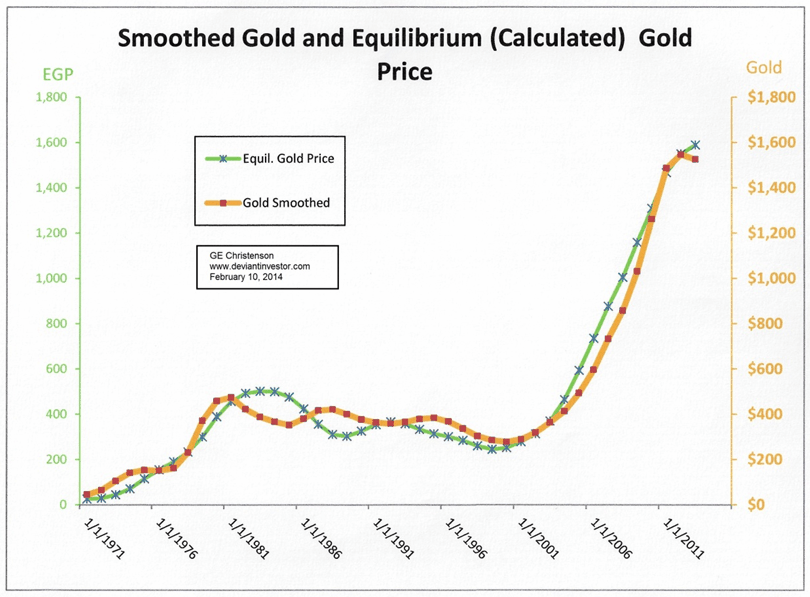
GRAPH NOTES:
- Smoothed gold prices are shown in a “gold” color.
- Calculated equilibrium gold prices (EGP) are shown in green.
- The long-term trend from 1971 – 1980 was up, from 1980 – 2001 the trend was down, and from 2001 to 2012 the trend was up. (Actual gold market high price was August 2011.)
- Nixon closed the “gold window” in 1971, removed any semblance of gold backing for the dollar, and thereby enabled the creation of significantly more dollars into circulation. The various measures of “money” supply, official national debt, Dow Index, price of gold, many commodities, and most other prices increased exponentially between 1971 and 2013.
FUTURE PRICES FOR GOLD per the EGP Model
Assume:
- Macro-economic variables continue to increase and decrease as they have for the past 42 years.
- The U.S. economy continues along its typical, but weakened, path with government expenses growing more rapidly than revenues, as they have for decades. National debt rises inevitably.
- Congress continues its multi-decade habit of borrowing and spending, talking about change, and changing little. The Fed supports the stock and bond markets and continues “liquidity injections” as it deems appropriate to benefit the 1%.
- Monetary, political, and fiscal policies will NOT be materially different from what they have been during the past 42 years.
- The U.S. will NOT be subjected to global nuclear war, Weimar hyperinflation, or an economic collapse, while we will continue to be subjected to the same Keynesian economic nonsense that has created many of our current “challenges.”
Given the above assumptions, a reasonable projection for the EGP (a “fair” price for gold) in 2017 is $2,400 – $2,900. Remembering that market prices can spike significantly above or crash below the EGP for many months, we could see a spike high above $3,500 or $4,000 in 2017. Extraordinary events such as a global war or dollar melt-down could push prices higher and sooner.
I plan to publish the details of this model, including variables, graphs, analysis, and the calculation formula in a paperback book.
Until then you may find value in these articles:
Bill Holter Jim Sinclair in Austin, Texas
Eric Sprott Do Western Central Banks Have Any Gold Left?
Gold Silver Worlds Jim Rickards: Target Gold Price
Casey Research 23 Reasons to Be Bullish on Gold
The DI Gold Investors: Take the Red Pill
Jim Sinclair www.jsmineset.com

PDAC 2014 Underscores Muted Sentiment towards Gold Stocks
The buzz phrase at PDAC 2014 could be described as “cautious optimism.” Executives, analysts and investors seem to believe a corner has been turned but failed to show any excitement or hope beyond that. Some participants estimated that attendance was down 20% from last year and much lower than 2012. I did not attend last year but definitely noticed foot traffic was significantly lower than in 2012. Interest in my presentation this year was much lower than in 2012. Mind you, these are only anecdotal measures of sentiment. However, for me they further underscore that very few seem to believe in the immediate continuation and sustainability of this recovery.
During my flight home I read Mining Weekly’s cover story (the publication given to every attendee) which further exhibits the mild, cautious optimism pervading the industry. The various assertions and comments included: “Road to recovery will be bumpy,” “Most juniors will fail,” “Control costs in an era of lower metal prices,” and “Metals prices have reached a plateau.” Also, there was a mention of strong deflationary forces and deflation, not inflation as the risk. Furthermore, industry titan Rick Rule was quoted in the story and in the Financial Post as saying juniors still need to capitulate. This is simply not the kind of talk that precedes a market decline or prolonged under-performance.
Moreover, some of these comments are divorced from a new reality. The chart below shows the CCI (commodities), CDNX and GDXJ. Commodities have broken out from a three year downtrend and advanced above the 400-day moving average for the first time in two and a half years. Canada’s Venture (CDNX) which consists of mostly commodity exploration companies declined 65% from top to bottom but is now currently trading above its 200-day moving average and at a 10-month high. It was last above that moving average in spring 2011. Meanwhile, GDXJ is holding strong after declining 82% over a more than two and a half year bear market.

The breakout in commodities and end of the downtrend suggests that inflation and not deflation will be the next concern. It also suggests a potential future tailwind for metals prices. The road to operational recovery may be bumpy but that doesn’t mean it will be for the related capital markets. The CDNX is at a 10-month high and GDXJ has rebounded 50% in two months. Meanwhile, I’m surprised by Rick Rule’s bizarre comment about capitulation considering GDXJ just endured an 82% bear market. (Major kudos to Rick for his market skepticism in 2011 and 2012). Capitulation occurred in spring 2013 and a final wave came in December 2013. Since then, most quality juniors have rebounded 100% or more.
Ironically, the time we should be most optimistic is at a market bottom. That is the best time to buy because it has the lowest risk and is when the biggest gains are made. However, the recent bear market remains fresh in the mind of the majority of market participants and company executives. They worry about making another mistake or misleading people so they hedge their views. The toughest time to buy is where we are now, a few months following a major bottom. Prices are materially higher yet sentiment has not shifted enough to displace the bad memories from the preceding bear market. Essentially, there are two reasons (instead of the usual one) not to buy.
It is incredibly difficult to buy at this juncture but, as we noted in our last editorial, the evidence favors doing so. Pullbacks, until we see much larger gains should be brief and should be used as an opportunity. ETFs such as GDX, GDXJ, and GLDX have spent the last 11 days consolidating and digesting gains. This is not rocket science. Do your due diligence and take advantage of opportunities when there. Don’t overthink it. Be long, sit tight and have an exit strategy (to limit losses) in case things play out differently. If you’d be interested in learning about the companies poised to outperform the sector, then we invite you to learn more about our service.
Good Luck!
Jordan Roy-Byrne, CMT

 Marc, given your world travel experience, how would you characterize the value of water as a natural resource and what do you think might be some of the opportunities and pitfalls in investing in that resource?
“Emerging Economies Will Submerge Soon; Devaluations & Higher Gold Demand To Follow”
Marc Faber is an international investor known for his uncanny predictions of the stock market and futures markets around the world.Dr. Doom also trades currencies and commodity futures like Gold and Oil.

Bonds and other traditional sources of interest income are still important assets for yield-seeking investors to hold. However, today’s investment environment—a combination of low interest rates, slow growth in developed economies and heightened market volatility—means that investors have to look to a variety of sources to build robust, sustainable income portfolios. Yields from dividend-paying stocks on the whole are attractive, even more so when compared to government bonds. Investing in a high-quality name with strong fundamentals can increase the likelihood that a given investor will continue to be paid dividends. As such here is a list of high quality US divident stocks that the author believes are of extremely High Quality. – Money Talks
5 All-Around Dividend Rock Stars
Not every band is of Rolling Stones caliber, and not every dividend stock is of Procter & Gamble [NYSE: PG] caliber.
In fact, there is a special group of dividend stocks that Standard & Poor’s keeps track of that it calls the “Dividend Aristocrats.” These dividend payers don’t just pay a dividend. They’re not just any old company that’s had a few dividend increases. No, these dividend maestros have — as S&P puts it — “followed a policy of increasing dividends every year for at least 25 consecutive years.”
Impressed?
You should be. Because when a company has a 25-plus year streak of paying and raising its dividend, you better believe investors are feasting on impressive compounding returns.
Meet the aristocrats
As you might expect, the Dividend Aristocrats are an elite group.
In fact, of the 500 companies in the S&P 500 index, only 54 of them currently qualify for the title. And while most of the companies on that list could make solid investments, there are some that stand out above the rest of the pack.
The five stocks below are some of the greatest businesses in existence.
They each have what we Fools like to call a “moat,” that is, a competitive advantage that allows them to consistently earn above-average returns. Their inclusion on the Dividend Aristocrat list shows their consistent dedication to returning cash to investors. And while it’s tough to find businesses of this quality at bargain-basement prices, all trade at attractive valuations.

…to read the entire Dividend Report go HERE


-
I know Mike is a very solid investor and respect his opinions very much. So if he says pay attention to this or that - I will.
~ Dale G.
-
I've started managing my own investments so view Michael's site as a one-stop shop from which to get information and perspectives.
~ Dave E.
-
Michael offers easy reading, honest, common sense information that anyone can use in a practical manner.
~ der_al.
-
A sane voice in a scrambled investment world.
~ Ed R.
Inside Edge Pro Contributors

Greg Weldon

Josef Schachter

Tyler Bollhorn

Ryan Irvine

Paul Beattie

Martin Straith

Patrick Ceresna

Mark Leibovit

James Thorne

Victor Adair