
Personal Finance
If you’re like most investors, you believe the worst of the 2008 debt crisis — and the Great Recession that followed — are over.
You believe America is now solidly on the road to economic recovery, her greatest struggles behind her.
But if you’ve been following my work, you know it’s nothing but a mirage; bought and paid for by the very people who triggered these great calamities.
The reality is, America’s fate has already been sealed; sacrificed on the altar of power and greed by those who swore an oath to defend her — with the blood of every man, woman, and child they swore to defend.
The fact is that America is on the decline, destined to go the way of the many great empires that came before us. Like Rome. Byzantium. France. Spain. And Great Britain.
No, the United States won’t disappear. But we will slip to number two, and ultimately to number three in the world, behind China and Southeast Asia.
 And the thing is, the end of America as we know it will NOT be triggered by hyperinflation … or a bond market collapse … or a stock market crash … or any single catastrophic event, as some may have you believe.
In fact, the strength in the stock market is not due to the U.S. economy. Nor is it due to money printing, corporate earnings, or any of the usual suspects.
The stock market is simply going higher and will go much higher over the longer-term because …
A. Europe is in worse shape than the United States. And …
B. The finances and policies of our government are driving investors away from the sovereign U.S. bond market and into stocks.
If you understand those two forces, you will not only be able to protect your wealth in the months and years ahead, you’ll also be able to profit, very well indeed.
Yes, I know, it makes no sense. If America is on the decline, how can stocks go higher?
Well, it’s actually simple. Most companies in America are in better financial shape than our own government. Moreover, most blue-chip stocks these days pay you income in the way of dividends or royalties and much better than you can get just about anywhere else.
And, most importantly, stocks are considered largely non-confiscatable.
On its way down, Washington will seek to nationalize part or all of your retirement assets, confiscate gold, and certainly tax you more and more.
Yet, they will never subpoena Apple for a list of its shareholders. They will never confiscate your shares in a publicly traded company or nationalize any industry.
Right now, the strength you are seeing in the stock market is largely due to an influx of the initial money coming out of the sovereign bond markets in the United States and Europe due to its troubles.
Not to mention Ukraine, which I am sure is lighting a fire under savvy Eastern European investors to also get the heck out of Europe.
The fact is that huge amounts of capital now view U.S. stocks as a safe haven, and it is rightly justified in doing so.
But again, that does not mean the U.S. economy is going to catapult higher.
It’s not. In fact, history tells us that when governments and empires start to decline, they regularly unravel with terrifying speed.
17 years for the British Empire …
11 years for the Ottomans …
8 years for France …
2 years for the Soviet Union …
In every case … the people ignored the writing on the wall, thinking it couldn’t happen to them.
In every case … the government feigned ignorance, swearing on a stack of bibles that the worst was over.
In every case … the majority failed to prepare for what was coming.
One need only look to Europe for the tragic results, where rioting, civil unrest, and depression-like conditions are now a way of life.
Jobs are being hemorrhaged. Personal income is falling. Social services are deteriorating. Home values are plunging. Crime is soaring.
A record high 28 percent of people in Greece are jobless, and Citigroup is projecting it will hit 32 percent by 2015. For those under 25, a catastrophic 61.4 percent are out of work.
In Spain, the jobless rate sits at 26 percent. For its youth, an abysmal 54.3 percent. It’s so bad, the youth in Europe are being called “the lost generation.”
Many households have no income, as all family members are out of work.
It’s virtually impossible to put into words the nightmare of poverty, hunger and homelessness jobless workers throughout Europe are feeling.
When you can’t feed your family, and you can’t find work no matter how hard you try, it can absolutely crush your soul.
All this as the European aristocracy preserves their own wealth by looting the economy, while slashing wages and social services for the working class at the same time.
It’s easy to see these as isolated events. It’s easy to bury your head in the sand and ignore, because it’s happening “somewhere else” …
It’s easy to forget if you listen to all the government-rigged economic numbers …
Millions of real people, and real families, are suffering very real consequences; quickly finding themselves living in total desperation — with little hope of having a “normal” life.
It’s even easier to think we’re immune; that it can’t happen in America.
Yet the frightening reality is that …
• 102 million working-age Americans are now unemployed — a 36 percent increase since the year 2000 …
• The average duration of unemployment has nearly doubled since January 2009 — from 19.8 weeks to 37.1 weeks …
• 40 percent of those lucky enough to have a job earn less than $20,000 a year …
• 46.5 million Americans — or 15 percent of the U.S. population — are now living in poverty, according to the U.S. Census Bureau …
• 48 million Americans are now on food stamps — the highest number since the program began in 1969 …
• Median household income has declined five years in a row …
• The rate of homeownership has declined eight years in a row.
This is the new reality.
This is why hundreds of once-great American cities are transforming into rotting, decaying hellholes.
If it hasn’t hit your hometown yet, it soon will.
The experience of European nations shows the blinding speed at which a country can deteriorate once it passes the point of no return.
The point where the delusions of the people — and the travesties of its government — can no longer mask the truth, and destiny slips in the back door.
But there is a silver lining in this grim cloud of reality; important lessons to be learned by studying the history of failing empires.
First, more and more small-business transactions go underground. More and more bartering crops up. More attempts at private digital currencies like Bitcoin. It’s going to send money into hiding, to the fullest extent possible these days.
Second, it’s going to send more and more money ? and assets ? offshore. Yes, any money you place offshore, any gold or silver bullion, needs to be reported to the IRS.
But that won’t stop money and precious metals from heading offshore.
In the minds of most investors ? and I agree ? the further away from Washington’s reach your money and many of your assets are, the better.
Third, and most importantly, it’s going to have a mind-boggling effect on nearly all financial markets.
Namely, it’s going to drive capital in a way that is constantly seeking out what I call “portability and fungibility.”
And not just into things like gold or silver, or artwork, diamonds, jewelry, numismatics, collectibles, and rare books.
Portability can also be assets that are deemed non-confiscatable, such as stocks. Own a share in Apple, for instance and as I said above, it’s unlikely Washington will subpoena Apple for a record of your shares.
There is historical precedent for all this, not just with Rome or Byzantium, but even during the Great Depression here in the United Sates.
That’s when 17 countries in Europe failed and Great Britain was quickly losing its superpower status. Yet between 1932 and 1937, the Dow Jones Industrials exploded 387 percent higher, even as the U.S. economy sunk further into a depression.
The prices of diamonds, jewelry, and art also exploded higher, as did the black market prices for gold and silver.
We are on the leading edge of a repeat of that period now. The only difference: Today it’s not just Europe that is sliding lower, the United States is losing its superpower status at the same time.
That means that the eventual explosion higher in stock prices — and commodities — will be even greater.
We’re not yet at that kind of lift-off stage, but it’s getting closer and closer with each passing day.
Best wishes,
Larry

In order to make progress on our most pressing issues, it is essential to employ practical solutions. Sincerity is no substitue for common sense – Michael Campbell
Why Is Economic Theory Important?
The Problem with Keynesianism
Surprise: You Can’t Spend More Than You Make
Argentina, South Africa, Europe, and Rand Paul
“The belief that wealth subsists not in ideas, attitudes, moral codes, and mental disciplines but in identifiable and static things that can be seized and redistributed is the materialist superstition. It stultified the works of Marx and other prophets of violence and envy. It frustrates every socialist revolutionary who imagines that by seizing the so-called means of production he can capture the crucial capital of an economy. It is the undoing of nearly every conglomerateur who believes he can safely enter new industries by buying rather than by learning them. It confounds every bureaucrat who imagines he can buy the fruits of research and development.
“The cost of capturing technology is mastery of the knowledge embodied in the underlying science. The means of entrepreneurs’ production are not land, labor, or capital but minds and hearts….
“Whatever the inequality of incomes, it is dwarfed by the inequality of contributions to human advancement. As the science fiction writer Robert Heinlein wrote, ‘Throughout history, poverty is the normal condition of man. Advances that permit this norm to be exceeded – here and there, now and then – are the work of an extremely small minority, frequently despised, often condemned, and almost always opposed by all right-thinking people. Whenever this tiny minority is kept from creating, or (as sometimes happens) is driven out of society, the people slip back into abject poverty. This is known as bad luck.’
“President Obama unconsciously confirmed Heinlein’s sardonic view of human nature in a campaign speech in Iowa: ‘We had reversed the recession, avoided depression, got the economy moving again, but over the last six months we’ve had a run of bad luck.’ All progress comes from the creative minority. Even government-financed research and development, outside the results-oriented military, is mostly wasted. Only the contributions of mind, will, and morality are enduring. The most important question for the future of America is how we treat our entrepreneurs. If our government continues to smear, harass, overtax, and oppressively regulate them, we will be dismayed by how swiftly the engines of American prosperity deteriorate. We will be amazed at how quickly American wealth flees to other countries….
“Those most acutely threatened by the abuse of American entrepreneurs are the poor. If the rich are stultified by socialism and crony capitalism, the lower economic classes will suffer the most as the horizons of opportunity close. High tax rates and oppressive regulations do not keep anyone from being rich. They prevent poor people from becoming rich. High tax rates do not redistribute incomes or wealth; they redistribute taxpayers – out of productive investment into overseas tax havens and out of offices and factories into beach resorts and municipal bonds. But if the 1 percent and the 0.1 percent are respected and allowed to risk their wealth – and new rebels are allowed to rise up and challenge them – America will continue to be the land where the last regularly become the first by serving others.”
– George Gilder, Knowledge and Power: The Information Theory of Capitalism
“The ideas of economists and political philosophers, both when they are right and when they are wrong are more powerful than is commonly understood. Indeed, the world is ruled by little else. Practical men, who believe themselves to be quite exempt from any intellectual influences, are usually slaves of some defunct economist.”
– John Maynard Keynes
“Nothing is more dangerous than a dogmatic worldview – nothing more constraining, more blinding to innovation, more destructive of openness to novelty.”
– Stephen Jay Gould
I think Lord Keynes himself would appreciate the irony that he has become the defunct economist under whose influence the academic and bureaucratic classes now toil, slaves to what has become as much a religious belief system as it is an economic theory. Men and women who display an appropriate amount of skepticism on all manner of other topics indiscriminately funnel a wide assortment of facts and data through the filter of Keynesianism without ever questioning its basic assumptions. And then some of them go on to prescribe government policies that have profound effects upon the citizens of their nations.
And when those policies create the conditions that engender the income inequality they so righteously oppose, they prescribe more of the same bad medicine. Like 18th-century physicians applying leeches to their patients, they take comfort in the fact that all right-minded and economic scientists and philosophers concur with their recommended treatments.
This week, let’s look at the problems with Keynesianism and examine its impact on income inequality.
But first, let me note that Gary Shilling has agreed to come to our Strategic Investment Conference this May 13-16 in San Diego, joining a star-studded lineup of speakers who have already committed. This is really going to be the best conference ever, and you need to figure out how to make it. Early registration pricing goes away at the end of this week. My team at Mauldin Economics has produced a short, fun introductory clip featuring some of the speakers; so enjoy the video, check out the rest of our lineup, and then sign up to join us.
This is the first year we have not had to limit our conference to accredited investors; nor are we limiting attendance from outside the United States. We have a new venue that will allow us to adequately grow the conference over time. But we will not change the format of what many people call the best investment and economic conference in the US. Hope to see you there. And now on to our letter.
Ideas have consequences, and bad ideas have bad consequences. We started a seriestwo weeks ago on income inequality, the current cause célèbre in economic and political circles. What spurred me to undertake this series was a recent paper from two economists (one from the St. Louis Federal Reserve) who are utterly remarkable in their ability to combine more bad economic ideas and research techniques into one paper than anyone else in recent memory.
Their even more remarkable conclusion is that income inequality was the cause of the Great Recession and subsequent lackluster growth. “Redistributive tax policy” is suggested approvingly. If direct redistribution is not politically possible, then other methods should be tried, the authors say. I’m sure that, given more time and data, the researchers could have used their methodology to ascribe the rise in teenage acne to income inequality as well.
So what is this notorious document? It’s “Inequality, the Great Recession, and Slow Recovery,” by Barry Z. Cynamon and Steven M. Fazzari. One could ask whether this is not just one more bad economic paper among many. If so, why should we waste our time on it?
(Let me state for the record that I am sure Messieurs Cynamon and Fazzari are wonderful husbands and fathers, their children love them, and their pets are happy when they come home. In addition, they are probably outstanding citizens who are active in all sorts of good things in their communities. Their friends and colleagues enjoy convivial gatherings with them. I’m sure that if I were to sit down to dinner with them [not likely to happen after this letter], we would have a lively debate and hugely enjoy ourselves. This is not a personal attack. I simply mean to eviscerate as best I can the rather malignant ideas that they are proffering.)
That income inequality stifles growth is not simply the idea of two economists in St. Louis. It is a widely held view that pervades almost the entire academic economics establishment. Nobel prize-winning economist Joseph Stiglitz has been pushing such an idea for some time (along with Paul Krugman, et al.); and a recent IMF paper suggests that slow growth is a direct result of income inequality, simply dismissing any so-called “right-wing” ideas that call into question the authors’ logic or methodology.
The challenge is that the subject of income inequality has now permeated the national dialogue not just in the United States but throughout the developed world. It will shape the coming political contests in the United States. How we describe income inequality and determine its proximate causes will define the boundaries of future economic and social policy. In discussing multiple problems with the Cynamon-Fazzari paper, we have the opportunity to think about how we should actually address income inequality. And hopefully we’ll steer away from simplistic answers that conveniently mesh with our political biases.
I should note that my readers have sent me an overwhelming amount of research on income inequality that I’ve been wading through for the past week. Some of it is quite discomforting, and a great deal is politically incorrect, at least some of which is almost certain to offend my gentle readers. Who knew that income inequality is not due to the greedy rich but to marriage patterns or the size of households or any number of interesting correlated factors? The research will all be thought-provoking, and we’ll will cover it in depth next week; but today let’s stay focused on the ideas of defunct economists.
Why Is Economic Theory Important?
Some readers may say, this is all well and good, but it’s just economic theory. How does that matter to our investment portfolios? The direct answer is that economic theory drives the policies of central banks and determines the price of money, and the price of money is fundamental to the prices of all our assets. What central banks do can be either helpful or harmful. Their actions can dampen volatility in the short term while intensifying pressures that distort prices, forming bubbles – which always end in significant reversals, often quite precipitously. (Note that it is not always high asset values that tumble. It is just as possible for central banks to repress the value of some assets to such low levels that they become a coiled spring.)
As we outlined at length in Code Red, central banks have a very limited set of policy tools with which to address crises. While the tools have all sorts of unlikely names, they are essentially limited to manipulating interest rates (the price of money) and flooding the market with liquidity. (Yes, I know that they can impose changes in a few secondary regulatory issues like margins, reserves, etc., but these are not their primary functions.)
The central banks of the US and England are beginning to wind down their extraordinary monetary policies. But whenever the next recession or crisis hits in the US, England, or Europe, their reaction to the problem – and subsequent monetary policy – are going to be based on Keynesian theory. The central bankers will give us more of the same, but it will be in an environment of already low rates and more than adequate liquidity. You need to understand how the theory they’re working from will express itself in the economy and affect your investment portfolio.
I should point out, however, that central banks are not the primary cause of distorted economic policy. They are reacting to the fiscal policies and political realities of their various countries. Japan’s government ran up the largest government debt-to-equity ratio in modern times; and now, as a result, the Japanese Central Bank is forced to monetize that debt.
Leverage and the distorted price of money have been at the root of almost every bubble in the postwar world. It is tempting to veer off into a soliloquy on the history of the problems leverage creates, but let’s forbear for now and deal with Keynesian thinking about income inequality.
Let’s start with a classic definition of Keynesianism from Wikipedia, so that we can all be comfortable that I’m not coloring the definition with my own bias (and, yes, I admit I have a bias). (Emphasis mine.)
Keynesian economics (or Keynesianism) is the view that in the short run, especially during recessions, economic output is strongly influenced by aggregate demand (total spending in the economy). In the Keynesian view, aggregate demand does not necessarily equal the productive capacity of the economy; instead, it is influenced by a host of factors and sometimes behaves erratically, affecting production, employment, and inflation.
The theories forming the basis of Keynesian economics were first presented by the British economist John Maynard Keynes in his book The General Theory of Employment, Interest and Money, published in 1936, during the Great Depression. Keynes contrasted his approach to the aggregate supply-focused “classical” economics that preceded his book. The interpretations of Keynes that followed are contentious, and several schools of economic thought claim his legacy.
Keynesian economists often argue that private sector decisions sometimes lead to inefficient macroeconomic outcomes which require active policy responses by the public sector, in particular, monetary policy actions by the central bank and fiscal policy actions by the government, in order to stabilize output over the business cycle. Keynesian economics advocates a mixed economy – predominantly private sector, but with a role for government intervention during recessions.
(Before I launch into a critique of Keynesianism, let me point out that I find much to admire in the thinking of John Maynard Keynes. He was a great economist and taught us a great deal. Further, and this is important, my critique is simplistic. A proper examination of the problems with Keynesianism would require a lengthy paper or a book. We are just skimming along the surface and don’t have time for a deep dive.)
Central banks around the world and much of academia have been totally captured by Keynesian thinking. In the current avant-garde world of neo-Keynesianism, consumer demand –consumption – is everything. Federal Reserve monetary policy is clearly driven by the desire to stimulate demand through lower interest rates and easy money.
And Keynesian economists (of all stripes) want fiscal policy (essentially, the budgets of governments) to increase consumer demand. If the consumer can’t do it, the reasoning goes, then the government should step in and fill the breach. This of course requires deficit spending and the borrowing of money (including from your local central bank).
Essentially, when a central bank lowers interest rates, it is trying to make it easier for banks to lend money to businesses and for consumers to borrow money to spend. Economists like to see the government commit to fiscal stimulus at the same time, as well. They point to the numerous recessions that have ended after fiscal stimulus and lower rates were applied. They see the ending of recessions as proof that Keynesian doctrine works.
There are several problems with this line of thinking. First, using leverage (borrowed money) to stimulate spending today must by definition lower consumption in the future.Debt is future consumption denied or future consumption brought forward.Keynesian economists would argue that if you bring just enough future consumption into the present to stimulate positive growth, then that present “good” is worth the future drag on consumption, as long as there is still positive growth. Leverage just evens out the ups and downs. There is a certain logic to this, of course, which is why it is such a widespread belief.
Keynes argued, however, that money borrowed to alleviate recession should be repaid when growth resumes. My reading of Keynes does not suggest that he believed in the continual fiscal stimulus encouraged by his disciples and by the cohort that are called neo-Keynesians.
Secondly, as has been well documented by Ken Rogoff and Carmen Reinhart, there comes a point at which too much leverage on both private and government debt becomes destructive. There is no exact number or way of knowing when that point will be reached. It arrives when lenders, typically in the private sector, decide that the borrowers (whether private or government) might have some difficulty in paying back the debt and therefore begin to ask for more interest to compensate them for their risks. An overleveraged economy can’t afford the increase in interest rates, and economic contraction ensues. Sometimes the contraction is severe, and sometimes it can be absorbed. When it is accompanied by the popping of an economic bubble, it is particularly disastrous and can take a decade or longer to work itself out, as the developed world is finding out now.
Every major “economic miracle” since the end of World War II has been a result of leverage. Often this leverage has been accompanied by stimulative fiscal and monetary policies. Every single “miracle” has ended in tears, with the exception of the current recent runaway expansion in China, which is now being called into question. (And this is why so many eyes in the investment world are laser-focused on China. Forget about a hard landing or a recession, a simple slowdown in China has profound effects on the rest of the world.)
I would argue (along, I think, with the “Austrian” economist Hayek and other economic schools) that recessions are not brought on by insufficient consumption but rather byinsufficient income. Fiscal and monetary policy should aim to grow incomes over the entire range of the economy, and that is accomplished by increasing production and making it easier for entrepreneurs and businesspeople to provide goods and services. When businesses increase production, they hire more workers and incomes go up.
Without income there are no tax revenues to redistribute. Without income and production, nothing of any economic significance happens. Keynes was correct when he observed that recessions are periods of reduced consumption, but that is a result and not a cause.
Entrepreneurs must be willing to create a product or offer a service in the hope that there will be sufficient demand for their work. There are no guarantees, and they risk economic peril with their ventures, whether we’re talking about the local bakery or hairdressing shop or Elon Musk trying to compete with the world’s largest automakers. If they are hampered in their efforts by government or central bank policies, then the economy stagnates.
Keynesianism is favored by politicians and academics because it offers a theory by which government actions can become the decisive factor in the economy. It offers a framework whereby governments and central banks can meddle in the economy and feel justified. It allows 12 people sitting in a board room in Washington DC to feel that they are in charge of setting the price of money (interest rates) in a free marketplace and that they know more than the entrepreneurs and businesspeople do who are actually in the market risking their own capital every day.
This is essentially the Platonic philosopher king conceit: the hubristic notion that there is a small group of wise elites that is capable of directing the economic actions of a country, no matter how educated or successful the populace has been on its own. And never mind that the world has multiple clear examples of how central controls eventually slow growth and make things worse over time. It is only when free people are allowed to set their own prices as both buyers and sellers of goods and services and, yes, even interest rates and the price of money, that valid market-clearing prices can be determined. Trying to control those prices results in one group being favored over another.
In today’s world, the favored group is almost always bankers and the wealthy class. Savers and entrepreneurs are left to eat the crumbs that fall from the plates of the well-connected crony capitalists and to live off the income from repressed interest rates. The irony of using “cheap money” to try to drive consumer demand is that retirees and savers get less money to spend, and that clearly drives down their consumption. Why is the consumption produced by ballooning debt better than the consumption produced by hard work and savings? This is trickle-down monetary policy, which ironically favors the very large banks and institutions. If you ask Keynesian central bankers if they want to be seen as helping the rich and connected, they will stand back and forcefully tell you “NO!” But that is what happens when you start down the road of financial repression. Someone benefits. So far it has not been Main Street.
And, as we will see as we examine the problems of the economic paper that launched this essay, Keynesianism has given rise to a philosophical framework that justifies the seizure of money from one group of people to give to another group of people. This is a particularly pernicious doctrine, as George Gilder noted in our opening quote:
Those most acutely threatened by the abuse of American entrepreneurs are the poor. If the rich are stultified by socialism and crony capitalism, the lower economic classes will suffer the most as the horizons of opportunity close. High tax rates and oppressive regulations do not keep anyone from being rich. They prevent poor people from becoming rich. High tax rates do not redistribute incomes or wealth; they redistribute taxpayers – out of productive investment into overseas tax havens and out of offices and factories into beach resorts and municipal bonds.
Surprise: You Can’t Spend More Than You Make
First off, let me acknowledge that not everything in the Cynamon-Fazzari paper is wrong. As they analyze the data, they make a number of correct observations. They use a great deal of sophisticated math (seriously) to prove the rather unsurprising conclusion that you can’t spend more than you make. While everyone else in the world had already pretty much assumed that was the case, economists themselves can now rest easy in the knowledge that it’s a mathematical certainty.
The authors demonstrate that there is a disparity in the growth of incomes between the top 5% and the “bottom” 95%. There is not as big a difference as their data suggests, since they don’t take into account the growing percentage of employment benefits and ignore government support programs; but that’s another story, maybe for next week. Nor do they acknowledge that the percentage of people making over $100,000 (in constant dollars) has essentially doubled in the last 30 years. So yes, there are more people who are better off than before. Far more people have somehow slipped into a very comfortable lifestyle despite the fact that those who are even wealthier are making even higher incomes.
But let’s look at some of the authors’ actual wording and conclusions. First off, this gem:
A thread of macroeconomic thinking, going back at least to Michal Kalecki, identifies a basic challenge arising from growing inequality. This approach begins with the assumption that high-income households (usually associated with profit recipients) spend a lower share of their income than others (typically wage earners). In this case, rising inequality creates a drag on demand that can lead to unemployment and even secular stagnation if demand is not generated from other sources.
Read that paragraph again. And then a third time. I acknowledge that this is a well-established strain of economic thinking, but so is Marxism. Both are wrong. The authors of this paper basically start with the proposition that because those dastardly entrepreneurs and businesspeople (whom they call “profit recipients,” as if profit were a dirty word) actually dare to save some of their money rather than spend it, they are harming the economy. How heartless and thoughtless of them. Don’t they know the economy needs their spending?
It is very difficult for me to believe that this passes as acceptable economic thought in any but socialist circles. For those of you who were forced to endure Economics 101, you may remember that Savings = Investment. In any real-world economic system, you have to have savings in order to have investment in order for the economy to grow. Further, it is blatantly flawed logic to assume that savings don’t become investments, through banks or other intermediaries. Generally, savings are actually leveraged to produce moreinvestments (and thus eventual production and consumption) than if the “profit recipients” had simply spent the money themselves.
At the heart of the Keynesian conceit we see the conclusion that consumption is better than savings. Yes, I know, I’ve written many a time about Keynes’s Paradox of Thrift: “It is a good thing for individuals to save, but if everybody saves then there is less consumption.” That seems true on the surface and makes for one of those great sound bites that Keynesians are so good at delivering, but it has an inherent flaw. It assumes that savings don’t become investments that increase productivity, which in turn leads to the production of more goods and services, which ultimately creates income, which then creates more demand.
Without savings, nothing happens. Nothing. There has to be capital of some kind from somewhere in order for economic activity to happen. In the last three years productivity has simply fallen off the charts, down by almost 60% from the average of the previous 60 years. This is a continuation of a trend that began with a decrease in savings. Productivity growth is ultimately a product of savings, and it is productivity growth that will generate an increase in income for the country as a whole. While the topic deserves an entire letter of its own, it may be enough to state here that there are consequences to the fact that savings are close to an all-time low.
A static economy does not produce an increase in either overall income or wealth. It is only an economy that is growing as a result of a healthy level of savings and investment that can produce the results that Keynesian economists want: increased incomes for everyone. (And yes, I acknowledge, as I have in previous letters, that income distribution has been increasingly uneven in recent decades; but I contend that this is the fault of government policy, not the market.)
Your typical Keynesian economist is not willing to wait a reasonable period of time for savings to become investment. Such people, and the politicians they serve, want results today. And the only way to get results today is to get people to spend today, while the process of saving and investing takes time. Neo-Keynesian economists are ultimately teenage children who want the pleasure of spending and consuming today rather than thinking about the future. And I won’t even go into the burden we are placing on future generations by borrowing money to goose our current economy and expecting them to pay that money back so that we can have our party today. We are building toward a future intergenerational war that is going to be very intense once our children learn how we have misspent their future. But that’s yet another letter. Back to our current topic.
Cynamon and Fazzari note that a rising debt-to-income ratio is accompanied by rising asset prices (home values, for instance). According to them,
This evidence shows that the financial choices of the bottom 95 percent in response to the rise in inequality that began in the early 1980s were unsustainable. Balance sheets cannot deteriorate indefinitely; the “Minsky Moment” that marked the end of rising balance sheet fragility occurred on the eve of the Great Recession. Lending was cut off to the bottom 95 percent, home price growth stalled and then declined. The crisis had begun.… This result provides empirical support for the widely held view that, other things equal, rising inequality will create a drag on consumption spending.
Really? On page 6 they state that “U.S. aggregate demand growth was not excessive before the recession,” yet they clearly understand that the spending of the “bottom” 95% was fueled by increasing debt borrowed against rising home values. Still, they decry the fact that “Lending was cut off to the bottom 95 percent, home price growth stalled and then declined.”
Actually, I think the sequence was: home price growth began to falter; it became evident that the mortgage industry was rife with corruption and fraud (from top to bottom with the complicity of the regulators and, even worse, the rating agencies); and then lending was cut off. If memory serves correctly, it was cut off to damn near everyone. There was a reason that significant assets were selling for dimes on the dollar.
Rising inequality did not create a drag on consumer spending. Too much debt and leverage created a bubble in spending that was unsustainable. It was easy-money policies, low interest rates, and regulatory failure that created the problem. The “drag on consumer spending” was the result of too much borrowing and a bubble and not the result of an inability to borrow.
How can one state with a straight face that aggregate demand growth was not excessive before the recession? In what alternative universe were the authors living? It was clearly a bubble and unsustainable. There were numerous authorities – with the exception of economists and the Federal Reserve, of course – who said so. Even someone as generally clueless as your humble analyst (at least that’s my kids’ opinion) said so least a few dozen times in the years preceding the crisis.
This letter is getting to be as long as most of you can deal with, yet there is at least as much to cover in the rest of the Cynamon-Fazzari paper as we’ve dealt with so far; so I think it is reasonable for me to declare that “It’s time to hit the send button.” Next week we’ll examine the authors’ belief that the Great Recession was the result of income inequality and tackle several other equally pernicious ideas.
Argentina, South Africa, Europe, and Rand Paul
I am back home for another 10 ten days, and then a rather aggressive travel agenda confronts me. I will go on a part business trip, part working vacation to Cafayate, Argentina, with my partners at Mauldin Economics and lots of friends. Right now the plan is to go up to Bill Bonner’s hacienda (on a mere 500,000 acres) at 10,000 feet in the Andes, and at that point I may truly be disconnected for a few days. He says he has an internet link, but last year it somehow didn’t work for anybody but him. I think that is when I realized I have an addiction problem. I’m sure there’s a 12-step program out there on the web somewhere.
Then I fly back to Dallas, hang out for eight hours, and journey on to South Africa. Don’t ask. But it makes sense, in a very odd way, to spend three consecutive nights in an airplane. The things your humble analyst has to endure to go to the ends of the earth for research purposes. The fact that I might show up at the Royal Malewene for a few days of what will then be a much-needed vacation is just a pleasant side note to the journey. After that respite I’ll began a rather serious tour of South Africa on behalf of Glacier by Sanlam, a very-full-service financial firm. I am looking forward to that trip.
Then a trip is shaping up to Amsterdam, Brussels, and Geneva prior to my own Strategic Investment Conference in San Diego. And speaking of that conference, my good friend Kyle Bass of Hayman Capital Advisors will be one of our speakers, as he was last year; but in the runup to the conference Kyle and I are going to engage in an online conversation.
Many readers will recognize Kyle from the media acclaim he garnered when his investment successes were featured in Michael Lewis’s The Big Short. In addition to being one of the most articulate and engaging speakers I know, Kyle is just an all-around nice guy. I truly treasure the times I get to spend with him. They are all too few. Seriously, if you get a chance to listen to him, you should.
If you are a qualified purchaser or a licensed investment adviser qualified to make private placement recommendations, please join me and my partners at Altegris for an exclusive webinar featuring Kyle on Monday, March 31, at 1:00 p.m. EDT / 10:00 a.m. PDT. Be sure to register here (http://www.altegris.com/mauldinreg) for this event, as it will be one of the more interesting discussions I engage in this year.
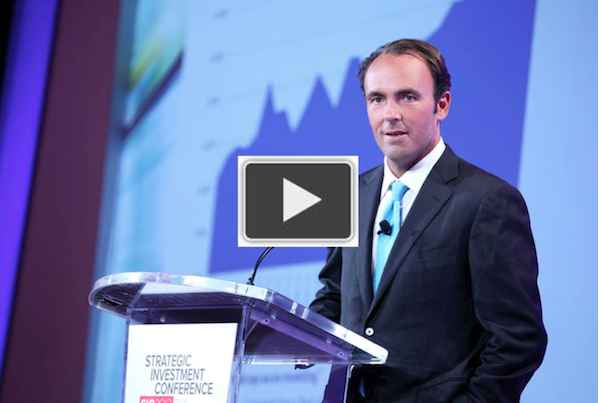
Upon qualification by my partners at Altegris, you will receive an email invitation. I apologize for limiting this discussion to qualified purchasers and investment advisors, but we must follow the rules and regulations. I look forward to having you at this exclusive event. (In this regard, I am president and a registered representative of Millennium Wave Securities, LLC, member FINRA.)
Next week I will offer you an exclusive link to an interview of Janet Yellen that was done a few years ago by my friend Jim Bruce in the process of producing his boffo documentaryMoney for Nothing. It is rather extraordinary, and I am proud to be able to make it available to my readers.
In the meantime, let me offer you a rather optimistic view of the future. A few months ago there was an enthusiastic group of young men, still in high school, who wanted to interview me about Federal Reserve policy. I kid you not. They put the interview on video, and it became part of a short documentary about the effects of Federal Reserve policies on the younger generation. They submitted the documentary to a contest sponsored by C-SPAN. There were 2,355 total submissions, and their video placed second. The outcome had nothing to do with the adeptness of your humble analyst in handling off-the-cuff remarks, but rather to these kids’ extraordinary talents, which resulted in a high-quality video and a surprisingly in-depth understanding of the topic. You can see the video here. Colleges around the country should be begging for youth like these young men to attend their schools.
Finally, I had a rather extraordinary opportunity to attend a small private dinner with Senator Rand Paul this last Tuesday. Also in attendance were old friends George Gilder and Rob Arnott, new friends Stephen Moore and David Malpass, plus a few others. It is not often I get to be the radical liberal at the table, but there I was. We were there to discuss monetary policy, but the conversation drifted widely more than a few times. The terms of the evening were simple: Chatham House rules (which means we don’t talk about what we discussed without permission), so everyone was free to throw out outlandish ideas for discussion, including ones that were maybe not ready for prime time or even mentionable in polite conversation. Basically, everyone agreed not to get offended when their pet ideas were shot down. Often in flames. (Cue sounds of falling planes and explosions!)
While everyone was polite, there were no shy participants at the table. I don’t think I’m far off in describing the conversation as pleasant, spirited, and entertainingly aggressive. I rather admired the senator, as he was willing to fully engage in the give-and-take and did not take offense (or worse, simply write people off), as some politicians do when you suggest that they’re simply wrong. Rand takes up the challenge and presses you on your thoughts. He has a very sharp intellect that has been well honed in conservative thought from the crib.
This was my first time to meet Rand (although protocol says you have to call him Senator). I couldn’t help but contrast the Senator with his father, Ron Paul, whom I have known for 30 years. They are clearly of a different generation, though the apple has not fallen far from the tree. There is a decided libertarian strain in the son. (Which, you might have gathered if you are longtime reader, is a political stance I am quite comfortable with.) But there is a very different quality and texture to Rand’s version of how that philosophy plays out in the context of organizing a country. (That is different from running a country, which he would contend is not something that politicians should do.) I note that yesterday Senator Rand ran well ahead of the second-place finisher in the rather archly conservative CPAC straw poll. In the past that has not meant very much in the broader political scheme of things, but I think Rand’s rather libertarian th inking may appeal to a broader swath of young people than some of us oldsters might think. We will see.
It was a memorable evening. I think I can speak for the group in saying that it was a learning experience for all of us. I am not sure I will get invited to participate again, but I learned a great deal more than I gave. I live for nights like that.
It truly is time to hit the send button. I almost sheepishly confess that I’m going to see the movie Mr. Peabody & Sherman in a bit. For those of us of a certain age, Rocky and Bullwinkle were fixtures in our lives, and Mr. Peabody was my favorite. Gods, I loved the Wayback Machine! I know it’s just nostalgia, but I am so susceptible at times. Have a great week and try to find a conversation of your own from which everybody walks away with more than they brought to the table.
Your looking way back and thinking way ahead analyst,
John Mauldin
subscribers@MauldinEconomics.com


 “When I look at asset prices; real estate, bonds, equities, vintage cars… I think that gold is actually one of the few assets that is relatively cheap, relatively inexpensive.”
We had a bear market that ended March 6th, 2009, at S&P 666. We are now over 1,800 — up almost three times.
We had extremely optimistic sentiment just before Christmas. We had very heavy insider selling, with high valuations, and extremely high corporate profits by historical standards.
Over the last two years, most equity markets around the world, in emerging markets, have been down or moving sideways. They’re no longer following U.S. stocks up, and in the U.S., an increasing number of shares are breaking down.
In a month’s time, the bull market will be five years old. This is the second longest bull market in the last 100 years. These are all signs of a top, so I wouldn’t buy shares here. I’m not interested.
Can the market go up another 20 percent? Perhaps.
I wasn’t interested in buying the Nasdaq in late 1999, but between January and March 2000, the NASDAQ went up another 30%. Of course, people were crying shortly thereafter when they realized their losses.
So, the markets go up and down. I think that the upside potential for most stocks is very limited now and there is considerable downside risk. Probably more downside risk than investors realize.”
….extensive article including What are the characteristics you might look for in a resource exploration or development company – full article HERE


 End of globalization- Will emerging markets come back? – (Michal Pettis)
I pointed out that in the past 200 years we had experienced a number of globalization cycles, driven largely by deep changes in monetary conditions, that followed a pattern regular enough to allow us to make some fairly confident predictions.
To put it schematically:
- Before the crisis the world had already over-invested in real estate and manufacturing capacity based on unrealistic expectations of consumption growth.
- The global crisis forced consumption growth to drop. This should have meant that if investment levels were too high before the crisis, they were even more so after the crisis.
- Instead of cutting back on investment, however, the developing world reacted to the drop in rich-country demand by significantly increasing investment, driven at least in part by worries that the consumption adjustment in Europe and the US would cause a collapse in export growth which would itself force unemployment up to dangerous levels.
Clearly this wasn’t sustainable, and not surprisingly soaring debt is now forcing this investment surge to end. http://blog.mpettis.com/2014/03/will-emerging-markets-come-back/
Global Debt Soaring Still (Bloomberg) The amount of debt globally has soared more than 40 percent to $100 trillion since the first signs of the financial crisis as governments borrowed to pull their economies out of recession and companies took advantage of record low interest rates, according to the Bank for International Settlements. http://www.bloomberg.com/news/2014-03-09/global-debt-exceeds-100-trillion-as-governments-binge-bis-says.html
The Debt/GDP debate (Economist) Can countries imperil their growth prospects by having too much debt? A new IMF paper now poses a more substantial challenge to Ms Reinhart and Mr Rogoff’s thesis. http://www.economist.com/news/finance-and-economics/21597933-new-research-suggests-debts-trajectory-affects-growth-more-its-level-breaking
George Soros is criticizing Germany’s economic policy again (The Telegraph) Mr Soros also says he believes the single currency has transformed the European Union from a voluntary association of equal states to one which is now no longer voluntary and has Germany as its leader.http://www.telegraph.co.uk/finance/10685035/George-Soros-Germany-is-self-righteous-and-hypocritical.html
Natural Gas – (Financial Times) Poland, Hungary, the Czech Republic and Slovakia have urged the US Congress to help them buy American natural gas and reduce their dependence on Russia by loosening US export limits.
In an unusually bold step, the four countries’ ambassadors to Washington sent joint letters to top lawmakers in the Senate and the House of Representatives urging them to assist in expediting exports of liquefied natural gas (LNG) to Europe.
The Ukraine crisis has revived concerns over Russia using its natural gas as a geopolitical weapon, and the ambassadors noted that their countries bought between 70 per cent and 100 per cent of their gas from the country.
Japan and Abenomics (Financial Times) Japan Inc doubled profits last year – the best performance since 2007 – but rather than selling more goods more profitably, much of these gains were simply a reflection of dollars and euros translating into more yen.
…Thus for manufacturers, still the backbone of the economy, the lower yen accounted for up to 80 per cent of their rise in net profits.
…The trouble with such foreign exchange-fuelled rises is that they are not sustainable. Indeed, with expectations of far more muted depreciation this year, the advantage could be wiped out, analysts say.
Jack Crooks
Black Swan Capital
More articles written by Jack Crooks this week:


-
I know Mike is a very solid investor and respect his opinions very much. So if he says pay attention to this or that - I will.
~ Dale G.
-
I've started managing my own investments so view Michael's site as a one-stop shop from which to get information and perspectives.
~ Dave E.
-
Michael offers easy reading, honest, common sense information that anyone can use in a practical manner.
~ der_al.
-
A sane voice in a scrambled investment world.
~ Ed R.
Inside Edge Pro Contributors

Greg Weldon

Josef Schachter

Tyler Bollhorn

Ryan Irvine

Paul Beattie

Martin Straith

Patrick Ceresna

Mark Leibovit

James Thorne

Victor Adair